Gut-Brain Psychology: Rethinking Psychology From the Microbiota–Gut–Brain Axis
Shan Liang, Xiaoli Wu, Feng Jin
Frontiers in Integrative Neuroscience · 2018 · Review
doi:10.3389/fnint.2018.00033 (opens in a new tab)
We email you when a new notice or a question about this paper appears.
Abstract
Mental disorders and neurological diseases are becoming a rapidly increasing medical burden. Although extensive studies have been conducted, the progress in developing effective therapies for these diseases has still been slow. The current dilemma reminds us that the human being is a superorganism. Only when we take the human self and its partner microbiota into consideration at the same time, can we better understand these diseases. Over the last few centuries, the partner microbiota has experienced tremendous change, much more than human genes, because of the modern transformations in diet, lifestyle, medical care, and so on, parallel to the modern epidemiological transition. Existing research indicates that gut microbiota plays an important role in this transition. According to gut-brain psychology, the gut microbiota is a crucial part of the gut-brain network, and it communicates with the brain via the microbiota-gut-brain axis. The gut microbiota almost develops synchronously with the gut-brain, brain, and mind. The gut microbiota influences various normal mental processes and mental phenomena, and is involved in the pathophysiology of numerous mental and neurological diseases. Targeting the microbiota in therapy for these diseases is a promising approach that is supported by three theories: the gut microbiota hypothesis, the "old friend" hypothesis, and the leaky gut theory. The effects of gut microbiota on the brain and behavior are fulfilled by the microbiota-gut-brain axis, which is mainly composed of the nervous pathway, endocrine pathway, and immune pathway. Undoubtedly, gut-brain psychology will bring great enhancement to psychology, neuroscience, and psychiatry. Various microbiota-improving methods including fecal microbiota transplantation, probiotics, prebiotics, a healthy diet, and healthy lifestyle have shown the capability to promote the function of the gut-brain, microbiota-gut-brain axis, and brain. It will be possible to harness the gut microbiota to improve brain and mental health and prevent and treat related diseases in the future.
Figures3
From PubMed Central, U.S. National Library of Medicine.
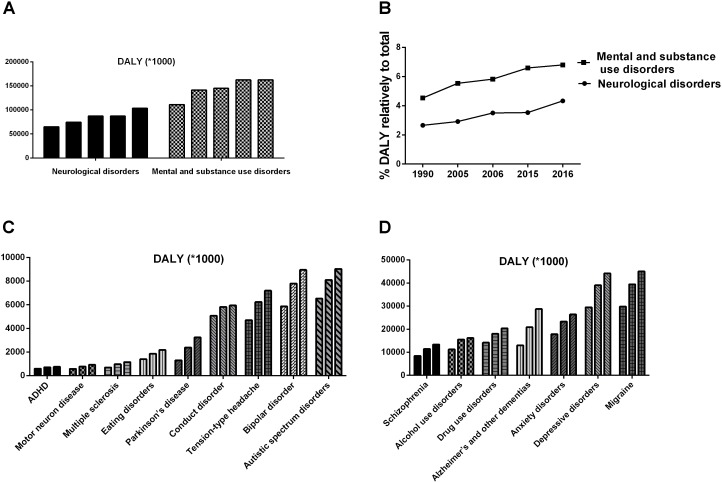
FIGURE 1
Full legend
The ever-increasing medical burden induced by mental disorders and neurological diseases (DALYs and Collaborators, 2016, 2017). (A,B) Shows the disability-adjusted life years (DALYs) induced by mental disorders and neurological diseases, respectively. (C,D) Shows the DALYs induced by different diseases in 1990, 2006, and 2016.
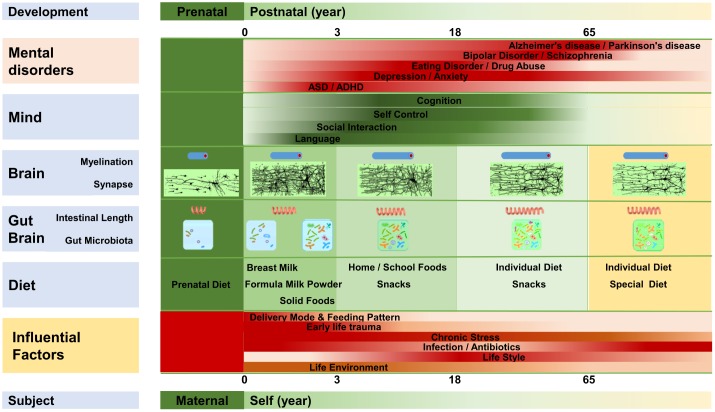
FIGURE 2
Full legend
The gut-brain, brain, and mentality develop almost synchronously throughout the lifespan. The gut-brain, brain, and mentality undergo similar developmental patterns; all three are susceptible to several factors that influence the gut microbiota. Myelination, intestinal length, and the gut microbiota develop almost synchronously. Diet plays an important role in the maturation of the gut-brain and brain, and mentality is regulated by the development of the brain and gut-brain. Microbiota disruption at different stages is likely to increase the incidence of different mental disorders.
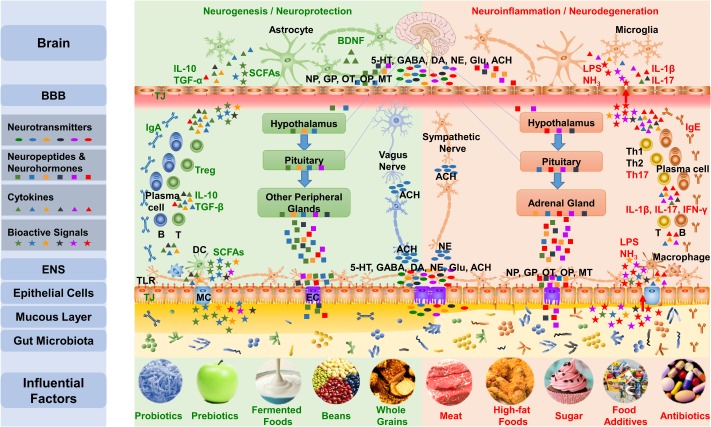
FIGURE 3
Full legend
The gut-brain communicates with the brain mainly via three pathways of the microbiota–gut–brain axis. First, the gut microbiota influences the synthesis and secretion of neurotransmitters, including 5-HT, GABA, DA, NE, Glu, and ACh. Gut signals can activate the ENS and primary afferents as well as transmit messages to the brain through the vagus nerve and the sympathetic nervous system. Second, the gut microbiota impacts the concentration and function of neuropeptides that include neuropeptides, gut peptides, OT, and opioid peptides and neurohormones, such as melatonin, communicating with the brain through the neuroendocrine pathway, including the HPA axis and hypothalamus-pituitary-other peripheral glands axis. Third, the gut microbiota regulates the function of TJs and TLRs in the gut barrier and BBB, adjusts the differentiation of lymphocytes, and impacts the brain via the immune pathway. Additionally, the bioactive products of the microbiota also influence the microbiota–gut–brain axis. The five influential factors on the left protect the microbiota and the mucous layer, leading to the production of beneficial substances, such as SCFA, by the microbiota, which results in an anti-inflammatory environment; meanwhile, the five factors on the right are likely to interrupt the normal function of the gut-brain, which can induce mucus loss and microbiota disturbance, leading to the production of harmful substances such as lipopolysaccharide and NH3 and resulting in a pro-inflammatory environment. NP, Neuropeptides; GP, Gut peptides; OP, Opioid peptides; MT, Melatonin; LPS, lipopolysaccharide; MC, M cell; EC, Enteroendocrine cell.
References372
- 1.
- 2.
Acharya C. Betrapally N. S. Gillevet P. M. Sterling R. K. Akbarali H. White M. B. (2017 ). Chronic opioid use is associated with altered gut microbiota and predicts readmissions in patients with cirrhosis. Aliment. Pharmacol. Ther. 45 319–331.
Not in our library10.1111/apt.13858 (opens in a new tab)
- 3.
Agus A. Planchais J. Sokol H. (2018 ). Gut microbiota regulation of tryptophan metabolism in health and disease. Cell Host Microbe 23 716–724.
Not in our library10.1016/j.chom.2018.05.003 (opens in a new tab)
- 4.
Ait-Belgnaoui A. Colom A. Braniste V. Ramalho L. Marrot A. Cartier C. (2014 ). Probiotic gut effect prevents the chronic psychological stress-induced brain activity abnormality in mice. Neurogastroenterol. Motil. 26 510–520.
Not in our library10.1111/nmo.12295 (opens in a new tab)
- 5.
Ait-Belgnaoui A. Durand H. Cartier C. Chaumaz G. Eutamene H. Ferrier L. (2012 ). Prevention of gut leakiness by a probiotic treatment leads to attenuated HPA response to an acute psychological stress in rats. Psychoneuroendocrinology 37 1885–1895.
Not in our library10.1016/j.psyneuen.2012.03.024 (opens in a new tab)
- 6.
Akbarali H. I. Dewey W. L. (2017 ). The gut-brain interaction in opioid tolerance. Curr. Opin. Pharmacol. 37 126–130.
Not in our library10.1016/j.coph.2017.10.012 (opens in a new tab)
- 7.
Akkasheh G. Kashani-Poor Z. Tajabadi-Ebrahimi M. Jafari P. Akbari H. Taghizadeh M. (2016 ). Clinical and metabolic response to probiotic administration in patients with major depressive disorder: a randomized, double-blind, placebo-controlled trial. Nutrition 32 315–320.
Not in our library10.1016/j.nut.2015.09.003 (opens in a new tab)
- 8.
Albert H. B. Sorensen J. S. Christensen B. S. Manniche C. (2013 ). Antibiotic treatment in patients with chronic low back pain and vertebral bone edema (Modic type 1 changes): a double-blind randomized clinical controlled trial of efficacy. Eur. Spine J. 22 697–707.
Not in our library10.1007/s00586-013-2675-y (opens in a new tab)
- 9.
Albrecht J. (2007 ). “Ammonia toxicity in the central nervous system,” in Handbook of Neurochemistry and Molecular Neurobiology, ed. Lajtha A. (New York, NY: Plenum Press), 261–276.
Not in our library
- 10.
Allen A. P. Dinan T. G. Clarke G. Cryan J. F. (2017 ). A psychology of the human brain-gut-microbiome axis. Soc. Pers. Psychol. Compass 11:e12309.
Not in our library10.1111/spc3.12309 (opens in a new tab)
- 11.
Armelagos G. J. (2009 ). “The paleolithic disease-scape, the hygiene hypothesis, and the second epidemiological transition,” in The Hygiene Hypothesis and Darwinian Medicine, ed. Rook G. A. W. (Berlin: Springer Science & Business Media), 29–43.
Not in our library
- 12.
Armelagos G. J. Brown P. J. Turner B. (2005 ). Evolutionary, historical and political economic perspectives on health and disease. Soc. Sci. Med. 61 755–765.
Not in our library10.1016/j.socscimed.2004.08.066 (opens in a new tab)
- 13.
Armstrong C. W. McGregor N. R. Lewis D. P. Butt H. L. Gooley P. R. (2017 ). The association of fecal microbiota and fecal, blood serum and urine metabolites in myalgic encephalomyelitis/chronic fatigue syndrome. Metabolomics 13:8
Not in our library10.1007/s11306-016-1145-z (opens in a new tab)
- 14.
Aroniadis O. C. Brandt L. J. (2013 ). Fecal microbiota transplantation: past, present and future. Curr. Opin. Gastroenterol. 29 79–84.
Not in our library10.1097/mog.0b013e32835a4b3e (opens in a new tab)
- 15.
Artis D. (2008 ). Epithelial-cell recognition of commensal bacteria and maintenance of immune homeostasis in the gut. Nat. Rev. Immunol. 8 411–420.
Not in our library10.1038/nri2316 (opens in a new tab)
- 16.
Backhed F. (2010 ). 99th dahlem conference on infection, inflammation and chronic inflammatory disorders: the normal gut microbiota in health and disease. Clin. Exp. Immunol. 160 80–84.
Not in our library10.1111/j.1365-2249.2010.04123.x (opens in a new tab)
- 17.
Baganz N. L. Blakely R. D. (2013 ). A dialogue between the immune system and brain, spoken in the language of serotonin. ACS Chem. Neurosci. 4 48–63.
Not in our library10.1021/cn300186b (opens in a new tab)
- 18.
Baker J. M. Al-Nakkash L. Herbst-Kralovetz M. M. (2017 ). Estrogen-gut microbiome axis: physiological and clinical implications. Maturitas 103 45–53.
Not in our library10.1016/j.maturitas.2017.06.025 (opens in a new tab)
- 19.
Bambling M. Edwards S. C. Hall S. Vitetta L. (2017 ). A combination of probiotics and magnesium orotate attenuate depression in a small SSRI resistant cohort: an intestinal anti-inflammatory response is suggested. Inflammopharmacology 25 271–274.
Not in our library10.1007/s10787-017-0311-x (opens in a new tab)
- 20.
Banerjee S. Sindberg G. Wang F. Meng J. Sharma U. Zhang L. (2016 ). Opioid-induced gut microbial disruption and bile dysregulation leads to gut barrier compromise and sustained systemic inflammation. Mucosal Immunol. 9 1418–1428.
Not in our library10.1038/mi.2016.9 (opens in a new tab)
- 21.
Barratt M. J. Lebrilla C. Shapiro H. Y. Gordon J. I. (2017 ). The gut microbiota, food science, and human nutrition: a timely marriage. Cell Host Microbe 22 134–141.
Not in our library10.1016/j.chom.2017.07.006 (opens in a new tab)
- 22.
Becker K. (2007 ). Autism, asthma, inflammation, and the hygiene hypothesis. Med. Hypotheses 69 731–740.
Not in our library10.1016/j.mehy.2007.02.019 (opens in a new tab)
- 23.
Bekkering P. Jafri I. van Overveld F. J. Rijkers G. T. (2013 ). The intricate association between gut microbiota and development of type 1, type 2 and type 3 diabetes. Expert Rev. Clin. Immunol. 9 1031–1041.
Not in our library10.1586/1744666x.2013.848793 (opens in a new tab)
- 24.
Bercik P. Collins S. M. (2014 ). The effects of inflammation, infection and antibiotics on the microbiota-gut-brain axis. Adv. Exp. Med. Biol. 817 279–289.
Not in our library10.1007/978-1-4939-0897-4_13 (opens in a new tab)
- 25.
Bercik P. Denou E. Collins J. Jackson W. Lu J. Jury J. (2011a ). The intestinal microbiota affect central levels of brain-derived neurotropic factor and behavior in mice. Gastroenterology 141 599–609.
Not in our library10.1053/j.gastro.2011.04.052 (opens in a new tab)
- 26.
Bercik P. Park A. J. Sinclair D. Khoshdel A. Lu J. Huang X. (2011b ). The anxiolytic effect of Bifidobacterium longum NCC3001 involves vagal pathways for gut-brain communication. Neurogastroenterol. Motil. 23 1132–1139.
Not in our library10.1111/j.1365-2982.2011.01796.x (opens in a new tab)
- 27.
Bercik P. Verdu E. F. Foster J. A. Macri J. Potter M. Huang X. X. (2010 ). Chronic gastrointestinal inflammation induces anxiety-like behavior and alters central nervous system biochemistry in mice. Gastroenterology 139 2102.e1–2112.e1.
Not in our library10.1053/j.gastro.2010.06.063 (opens in a new tab)
- 28.
Bereswill S. Pyndt Jørgensen B. Hansen J. T. Krych L. Larsen C. Klein A. B. (2014 ). A possible link between food and mood: dietary impact on gut microbiota and behavior in BALB/c mice. PLoS One 9:e103398.
Not in our library10.1371/journal.pone.0103398 (opens in a new tab)
- 29.
Berthoud H. R. (2008 ). Vagal and hormonal gut-brain communication: from satiation to satisfaction. Neurogastroenterol. Motil. 20(Suppl. 1), 64–72.
Not in our library10.1111/j.1365-2982.2008.01104.x (opens in a new tab)
- 30.
Bested A. C. Logan A. C. Selhub E. M. (2013a ). Intestinal microbiota, probiotics and mental health: from metchnikoff to modern advances: part I - autointoxication revisited. Gut Pathog. 5:5.
Not in our library10.1186/1757-4749-5-5 (opens in a new tab)
- 31.
Bested A. C. Logan A. C. Selhub E. M. (2013b ). Intestinal microbiota, probiotics and mental health: from metchnikoff to modern advances: part III - convergence toward clinical trials. Gut Pathog. 5:4.
Not in our library10.1186/1757-4749-5-4 (opens in a new tab)
- 32.
Bharwani A. Mian M. F. Foster J. A. Surette M. G. Bienenstock J. Forsythe P. (2016 ). Structural & functional consequences of chronic psychosocial stress on the microbiome & host. Psychoneuroendocrinology 63 2010–2025.
Not in our library10.1016/j.psyneuen.2015.10.001 (opens in a new tab)
- 33.
- 34.
Bien-Ly N. Watts R. J. (2014 ). The blood-brain barrier’s gut check. Sci. Transl. Med. 6:263fs246.
Not in our library10.1126/scitranslmed.aaa2543 (opens in a new tab)
- 35.
Blaser M. J. (2016 ). Antibiotic use and its consequences for the normal microbiome. Science 352 544–545.
Not in our library10.1126/science.aad9358 (opens in a new tab)
- 36.
Bloomfield S. (2013 ). The hygiene hypothesis: identifying microbial friends and protecting against microbial enemies. Perspect. Public Health 133 301–303.
Not in our library10.1177/1757913913506642 (opens in a new tab)
- 37.
Bodnar R. J. (2016 ). Endogenous opiates and behavior: 2014. Peptides 75 18–70.
Not in our library10.1016/j.peptides.2015.10.009 (opens in a new tab)
- 38.
Bodnar R. J. (2017 ). Endogenous opiates and behavior: 2015. Peptides 88 126–188.
Not in our library10.1016/j.peptides.2016.12.004 (opens in a new tab)
- 39.
Bokulich N. A. Chung J. Battaglia T. Henderson N. Jay M. Li H. (2016 ). Antibiotics, birth mode, and diet shape microbiome maturation during early life. Sci. Transl. Med. 8:343ra382.
Not in our library10.1126/scitranslmed.aad7121 (opens in a new tab)
- 40.
Cited by papers we hold14
Reads
Read by people on this page
None yet.
Checked or read by AI through naulon
None yet.
A person counts once a day per paper. We keep no cookie and no address: a reader is a hash that changes every day. Any month under five reads shows no number.
Are you an author?
Is this your paper?
Claim it to add your note and be paid when agents cite it. Free.