Gut-Brain Psychology: Rethinking Psychology From the Microbiota–Gut–Brain Axis
Shan Liang, Xiaoli Wu, Feng Jin
Frontiers in Integrative Neuroscience · 2018 · Review
doi:10.3389/fnint.2018.00033 (opens in a new tab)
We email you when a new notice or a question about this paper appears.
Abstract
Mental disorders and neurological diseases are becoming a rapidly increasing medical burden. Although extensive studies have been conducted, the progress in developing effective therapies for these diseases has still been slow. The current dilemma reminds us that the human being is a superorganism. Only when we take the human self and its partner microbiota into consideration at the same time, can we better understand these diseases. Over the last few centuries, the partner microbiota has experienced tremendous change, much more than human genes, because of the modern transformations in diet, lifestyle, medical care, and so on, parallel to the modern epidemiological transition. Existing research indicates that gut microbiota plays an important role in this transition. According to gut-brain psychology, the gut microbiota is a crucial part of the gut-brain network, and it communicates with the brain via the microbiota-gut-brain axis. The gut microbiota almost develops synchronously with the gut-brain, brain, and mind. The gut microbiota influences various normal mental processes and mental phenomena, and is involved in the pathophysiology of numerous mental and neurological diseases. Targeting the microbiota in therapy for these diseases is a promising approach that is supported by three theories: the gut microbiota hypothesis, the "old friend" hypothesis, and the leaky gut theory. The effects of gut microbiota on the brain and behavior are fulfilled by the microbiota-gut-brain axis, which is mainly composed of the nervous pathway, endocrine pathway, and immune pathway. Undoubtedly, gut-brain psychology will bring great enhancement to psychology, neuroscience, and psychiatry. Various microbiota-improving methods including fecal microbiota transplantation, probiotics, prebiotics, a healthy diet, and healthy lifestyle have shown the capability to promote the function of the gut-brain, microbiota-gut-brain axis, and brain. It will be possible to harness the gut microbiota to improve brain and mental health and prevent and treat related diseases in the future.
Figures3
From PubMed Central, U.S. National Library of Medicine.
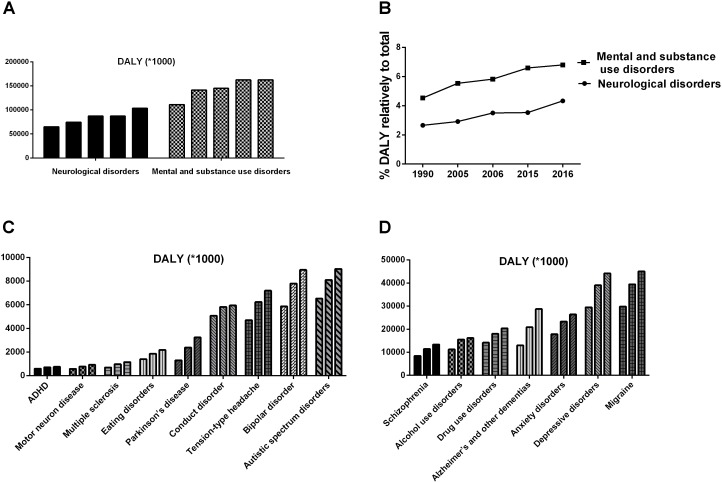
FIGURE 1
Full legend
The ever-increasing medical burden induced by mental disorders and neurological diseases (DALYs and Collaborators, 2016, 2017). (A,B) Shows the disability-adjusted life years (DALYs) induced by mental disorders and neurological diseases, respectively. (C,D) Shows the DALYs induced by different diseases in 1990, 2006, and 2016.
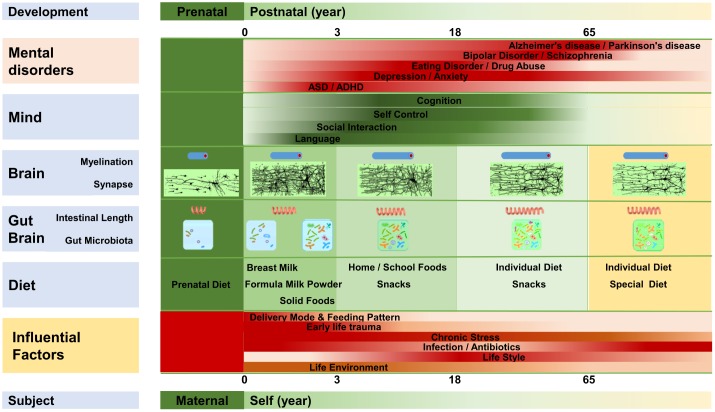
FIGURE 2
Full legend
The gut-brain, brain, and mentality develop almost synchronously throughout the lifespan. The gut-brain, brain, and mentality undergo similar developmental patterns; all three are susceptible to several factors that influence the gut microbiota. Myelination, intestinal length, and the gut microbiota develop almost synchronously. Diet plays an important role in the maturation of the gut-brain and brain, and mentality is regulated by the development of the brain and gut-brain. Microbiota disruption at different stages is likely to increase the incidence of different mental disorders.
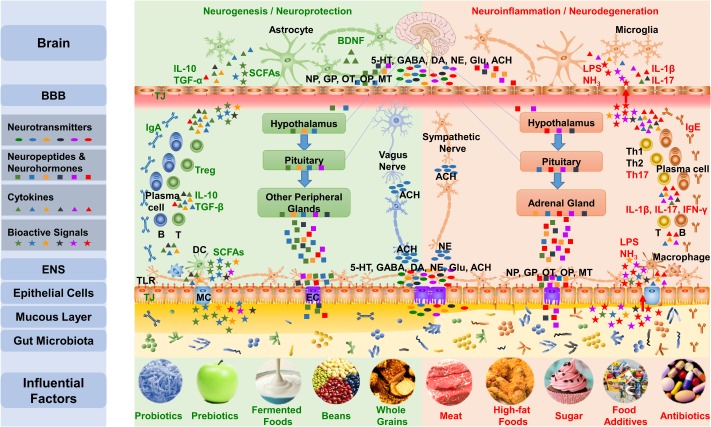
FIGURE 3
Full legend
The gut-brain communicates with the brain mainly via three pathways of the microbiota–gut–brain axis. First, the gut microbiota influences the synthesis and secretion of neurotransmitters, including 5-HT, GABA, DA, NE, Glu, and ACh. Gut signals can activate the ENS and primary afferents as well as transmit messages to the brain through the vagus nerve and the sympathetic nervous system. Second, the gut microbiota impacts the concentration and function of neuropeptides that include neuropeptides, gut peptides, OT, and opioid peptides and neurohormones, such as melatonin, communicating with the brain through the neuroendocrine pathway, including the HPA axis and hypothalamus-pituitary-other peripheral glands axis. Third, the gut microbiota regulates the function of TJs and TLRs in the gut barrier and BBB, adjusts the differentiation of lymphocytes, and impacts the brain via the immune pathway. Additionally, the bioactive products of the microbiota also influence the microbiota–gut–brain axis. The five influential factors on the left protect the microbiota and the mucous layer, leading to the production of beneficial substances, such as SCFA, by the microbiota, which results in an anti-inflammatory environment; meanwhile, the five factors on the right are likely to interrupt the normal function of the gut-brain, which can induce mucus loss and microbiota disturbance, leading to the production of harmful substances such as lipopolysaccharide and NH3 and resulting in a pro-inflammatory environment. NP, Neuropeptides; GP, Gut peptides; OP, Opioid peptides; MT, Melatonin; LPS, lipopolysaccharide; MC, M cell; EC, Enteroendocrine cell.
References372
- 1.
- 2.
Acharya C. Betrapally N. S. Gillevet P. M. Sterling R. K. Akbarali H. White M. B. (2017 ). Chronic opioid use is associated with altered gut microbiota and predicts readmissions in patients with cirrhosis. Aliment. Pharmacol. Ther. 45 319–331.
Not in our library10.1111/apt.13858 (opens in a new tab)
- 3.
Agus A. Planchais J. Sokol H. (2018 ). Gut microbiota regulation of tryptophan metabolism in health and disease. Cell Host Microbe 23 716–724.
Not in our library10.1016/j.chom.2018.05.003 (opens in a new tab)
- 4.
Ait-Belgnaoui A. Colom A. Braniste V. Ramalho L. Marrot A. Cartier C. (2014 ). Probiotic gut effect prevents the chronic psychological stress-induced brain activity abnormality in mice. Neurogastroenterol. Motil. 26 510–520.
Not in our library10.1111/nmo.12295 (opens in a new tab)
- 5.
Ait-Belgnaoui A. Durand H. Cartier C. Chaumaz G. Eutamene H. Ferrier L. (2012 ). Prevention of gut leakiness by a probiotic treatment leads to attenuated HPA response to an acute psychological stress in rats. Psychoneuroendocrinology 37 1885–1895.
Not in our library10.1016/j.psyneuen.2012.03.024 (opens in a new tab)
- 6.
Akbarali H. I. Dewey W. L. (2017 ). The gut-brain interaction in opioid tolerance. Curr. Opin. Pharmacol. 37 126–130.
Not in our library10.1016/j.coph.2017.10.012 (opens in a new tab)
- 7.
Akkasheh G. Kashani-Poor Z. Tajabadi-Ebrahimi M. Jafari P. Akbari H. Taghizadeh M. (2016 ). Clinical and metabolic response to probiotic administration in patients with major depressive disorder: a randomized, double-blind, placebo-controlled trial. Nutrition 32 315–320.
Not in our library10.1016/j.nut.2015.09.003 (opens in a new tab)
- 8.
Albert H. B. Sorensen J. S. Christensen B. S. Manniche C. (2013 ). Antibiotic treatment in patients with chronic low back pain and vertebral bone edema (Modic type 1 changes): a double-blind randomized clinical controlled trial of efficacy. Eur. Spine J. 22 697–707.
Not in our library10.1007/s00586-013-2675-y (opens in a new tab)
- 9.
Albrecht J. (2007 ). “Ammonia toxicity in the central nervous system,” in Handbook of Neurochemistry and Molecular Neurobiology, ed. Lajtha A. (New York, NY: Plenum Press), 261–276.
Not in our library
- 10.
Allen A. P. Dinan T. G. Clarke G. Cryan J. F. (2017 ). A psychology of the human brain-gut-microbiome axis. Soc. Pers. Psychol. Compass 11:e12309.
Not in our library10.1111/spc3.12309 (opens in a new tab)
- 11.
Armelagos G. J. (2009 ). “The paleolithic disease-scape, the hygiene hypothesis, and the second epidemiological transition,” in The Hygiene Hypothesis and Darwinian Medicine, ed. Rook G. A. W. (Berlin: Springer Science & Business Media), 29–43.
Not in our library
- 12.
Armelagos G. J. Brown P. J. Turner B. (2005 ). Evolutionary, historical and political economic perspectives on health and disease. Soc. Sci. Med. 61 755–765.
Not in our library10.1016/j.socscimed.2004.08.066 (opens in a new tab)
- 13.
Armstrong C. W. McGregor N. R. Lewis D. P. Butt H. L. Gooley P. R. (2017 ). The association of fecal microbiota and fecal, blood serum and urine metabolites in myalgic encephalomyelitis/chronic fatigue syndrome. Metabolomics 13:8
Not in our library10.1007/s11306-016-1145-z (opens in a new tab)
- 14.
Aroniadis O. C. Brandt L. J. (2013 ). Fecal microbiota transplantation: past, present and future. Curr. Opin. Gastroenterol. 29 79–84.
Not in our library10.1097/mog.0b013e32835a4b3e (opens in a new tab)
- 15.
Artis D. (2008 ). Epithelial-cell recognition of commensal bacteria and maintenance of immune homeostasis in the gut. Nat. Rev. Immunol. 8 411–420.
Not in our library10.1038/nri2316 (opens in a new tab)
- 16.
Backhed F. (2010 ). 99th dahlem conference on infection, inflammation and chronic inflammatory disorders: the normal gut microbiota in health and disease. Clin. Exp. Immunol. 160 80–84.
Not in our library10.1111/j.1365-2249.2010.04123.x (opens in a new tab)
- 17.
Baganz N. L. Blakely R. D. (2013 ). A dialogue between the immune system and brain, spoken in the language of serotonin. ACS Chem. Neurosci. 4 48–63.
Not in our library10.1021/cn300186b (opens in a new tab)
- 18.
Baker J. M. Al-Nakkash L. Herbst-Kralovetz M. M. (2017 ). Estrogen-gut microbiome axis: physiological and clinical implications. Maturitas 103 45–53.
Not in our library10.1016/j.maturitas.2017.06.025 (opens in a new tab)
- 19.
Bambling M. Edwards S. C. Hall S. Vitetta L. (2017 ). A combination of probiotics and magnesium orotate attenuate depression in a small SSRI resistant cohort: an intestinal anti-inflammatory response is suggested. Inflammopharmacology 25 271–274.
Not in our library10.1007/s10787-017-0311-x (opens in a new tab)
- 20.
Banerjee S. Sindberg G. Wang F. Meng J. Sharma U. Zhang L. (2016 ). Opioid-induced gut microbial disruption and bile dysregulation leads to gut barrier compromise and sustained systemic inflammation. Mucosal Immunol. 9 1418–1428.
Not in our library10.1038/mi.2016.9 (opens in a new tab)
- 21.
Barratt M. J. Lebrilla C. Shapiro H. Y. Gordon J. I. (2017 ). The gut microbiota, food science, and human nutrition: a timely marriage. Cell Host Microbe 22 134–141.
Not in our library10.1016/j.chom.2017.07.006 (opens in a new tab)
- 22.
Becker K. (2007 ). Autism, asthma, inflammation, and the hygiene hypothesis. Med. Hypotheses 69 731–740.
Not in our library10.1016/j.mehy.2007.02.019 (opens in a new tab)
- 23.
Bekkering P. Jafri I. van Overveld F. J. Rijkers G. T. (2013 ). The intricate association between gut microbiota and development of type 1, type 2 and type 3 diabetes. Expert Rev. Clin. Immunol. 9 1031–1041.
Not in our library10.1586/1744666x.2013.848793 (opens in a new tab)
- 24.
Bercik P. Collins S. M. (2014 ). The effects of inflammation, infection and antibiotics on the microbiota-gut-brain axis. Adv. Exp. Med. Biol. 817 279–289.
Not in our library10.1007/978-1-4939-0897-4_13 (opens in a new tab)
- 25.
Bercik P. Denou E. Collins J. Jackson W. Lu J. Jury J. (2011a ). The intestinal microbiota affect central levels of brain-derived neurotropic factor and behavior in mice. Gastroenterology 141 599–609.
Not in our library10.1053/j.gastro.2011.04.052 (opens in a new tab)
- 26.
Bercik P. Park A. J. Sinclair D. Khoshdel A. Lu J. Huang X. (2011b ). The anxiolytic effect of Bifidobacterium longum NCC3001 involves vagal pathways for gut-brain communication. Neurogastroenterol. Motil. 23 1132–1139.
Not in our library10.1111/j.1365-2982.2011.01796.x (opens in a new tab)
- 27.
Bercik P. Verdu E. F. Foster J. A. Macri J. Potter M. Huang X. X. (2010 ). Chronic gastrointestinal inflammation induces anxiety-like behavior and alters central nervous system biochemistry in mice. Gastroenterology 139 2102.e1–2112.e1.
Not in our library10.1053/j.gastro.2010.06.063 (opens in a new tab)
- 28.
Bereswill S. Pyndt Jørgensen B. Hansen J. T. Krych L. Larsen C. Klein A. B. (2014 ). A possible link between food and mood: dietary impact on gut microbiota and behavior in BALB/c mice. PLoS One 9:e103398.
Not in our library10.1371/journal.pone.0103398 (opens in a new tab)
- 29.
Berthoud H. R. (2008 ). Vagal and hormonal gut-brain communication: from satiation to satisfaction. Neurogastroenterol. Motil. 20(Suppl. 1), 64–72.
Not in our library10.1111/j.1365-2982.2008.01104.x (opens in a new tab)
- 30.
Bested A. C. Logan A. C. Selhub E. M. (2013a ). Intestinal microbiota, probiotics and mental health: from metchnikoff to modern advances: part I - autointoxication revisited. Gut Pathog. 5:5.
Not in our library10.1186/1757-4749-5-5 (opens in a new tab)
- 31.
Bested A. C. Logan A. C. Selhub E. M. (2013b ). Intestinal microbiota, probiotics and mental health: from metchnikoff to modern advances: part III - convergence toward clinical trials. Gut Pathog. 5:4.
Not in our library10.1186/1757-4749-5-4 (opens in a new tab)
- 32.
Bharwani A. Mian M. F. Foster J. A. Surette M. G. Bienenstock J. Forsythe P. (2016 ). Structural & functional consequences of chronic psychosocial stress on the microbiome & host. Psychoneuroendocrinology 63 2010–2025.
Not in our library10.1016/j.psyneuen.2015.10.001 (opens in a new tab)
- 33.
- 34.
Bien-Ly N. Watts R. J. (2014 ). The blood-brain barrier’s gut check. Sci. Transl. Med. 6:263fs246.
Not in our library10.1126/scitranslmed.aaa2543 (opens in a new tab)
- 35.
Blaser M. J. (2016 ). Antibiotic use and its consequences for the normal microbiome. Science 352 544–545.
Not in our library10.1126/science.aad9358 (opens in a new tab)
- 36.
Bloomfield S. (2013 ). The hygiene hypothesis: identifying microbial friends and protecting against microbial enemies. Perspect. Public Health 133 301–303.
Not in our library10.1177/1757913913506642 (opens in a new tab)
- 37.
Bodnar R. J. (2016 ). Endogenous opiates and behavior: 2014. Peptides 75 18–70.
Not in our library10.1016/j.peptides.2015.10.009 (opens in a new tab)
- 38.
Bodnar R. J. (2017 ). Endogenous opiates and behavior: 2015. Peptides 88 126–188.
Not in our library10.1016/j.peptides.2016.12.004 (opens in a new tab)
- 39.
Bokulich N. A. Chung J. Battaglia T. Henderson N. Jay M. Li H. (2016 ). Antibiotics, birth mode, and diet shape microbiome maturation during early life. Sci. Transl. Med. 8:343ra382.
Not in our library10.1126/scitranslmed.aad7121 (opens in a new tab)
- 40.
- 41.
Borre Y. E. O’Keeffe G. W. Clarke G. Stanton C. Dinan T. G. Cryan J. F. (2014 ). Microbiota and neurodevelopmental windows: implications for brain disorders. Trends Mol. Med. 20 509–518.
Not in our library10.1016/j.molmed.2014.05.002 (opens in a new tab)
- 42.
Bourassa M. W. Alim I. Bultman S. J. Ratan R. R. (2016 ). Butyrate, neuroepigenetics and the gut microbiome: can a high fiber diet improve brain health? Neurosci. Lett. 625 56–63.
Not in our library10.1016/j.neulet.2016.02.009 (opens in a new tab)
- 43.
Braniste V. Al-Asmakh M. Kowal C. Anuar F. Abbaspour A. Toth M. (2014 ). The gut microbiota influences blood-brain barrier permeability in mice. Sci. Transl. Med. 6:263ra158.
Not in our library10.1126/scitranslmed.3009759 (opens in a new tab)
- 44.
Bravo J. A. Forsythe P. Chew M. V. Escaravage E. Savignac H. M. Dinan T. G. (2011 ). Ingestion of Lactobacillus strain regulates emotional behavior and central GABA receptor expression in a mouse via the vagus nerve. Proc. Natl. Acad. Sci. U.S.A. 108 16050–16055.
Not in our library10.1073/pnas.1102999108 (opens in a new tab)
- 45.
Bruce-Keller A. J. Salbaum J. M. Berthoud H. R. (2018 ). Harnessing gut microbes for mental health: getting from here to there. Biol. Psychiatry 83 214–223.
Not in our library10.1016/j.biopsych.2017.08.014 (opens in a new tab)
- 46.
Buffington S. A. Di Prisco G. V. Auchtung T. A. Ajami N. J. Petrosino J. F. Costa-Mattioli M. (2016 ). Microbial reconstitution reverses maternal diet-induced social and synaptic deficits in offspring. Cell 165 1762–1775.
Not in our library10.1016/j.cell.2016.06.001 (opens in a new tab)
- 47.
Burcelin R. M. Serino M. Chabo C. Garidou L. Pomie C. Courtney M. (2013 ). Metagenome and metabolism the tissue microbiota hypothesis. Diabetes Obes. Metab. 15 61–70.
Not in our library10.1111/dom.12157 (opens in a new tab)
- 48.
Burokas A. Arboleya S. Moloney R. D. Peterson V. L. Murphy K. Clarke G. (2017 ). Targeting the microbiota-gut-brain axis: prebiotics have anxiolytic and antidepressant-like effects and reverse the impact of chronic stress in mice. Biol. Psychiatry 82 472–487.
Not in our library10.1016/j.biopsych.2016.12.031 (opens in a new tab)
- 49.
Cabral A. (2013 ). Function of the microbiota. Best Pract. Res. Clin. Gastroenterol. 27 5–16.
Not in our library10.1016/j.bpg.2013.03.006 (opens in a new tab)
- 50.
Cammarota G. Ianiro G. Bibbo S. Gasbarrini A. (2014 ). Gut microbiota modulation: probiotics, antibiotics or fecal microbiota transplantation? Intern. Emerg. Med. 9 365–373.
Not in our library10.1007/s11739-014-1069-4 (opens in a new tab)
- 51.
Carlson A. L. Xia K. Azcarate-Peril M. A. Goldman B. D. Ahn M. Styner M. A. (2018 ). Infant gut microbiome associated with cognitive development. Biol. Psychiatry 83 148–159.
Not in our library10.1016/j.biopsych.2017.06.021 (opens in a new tab)
- 52.
- 53.
Castillo-Ruiz A. Mosley M. George A. J. Mussaji L. F. Fullerton E. F. Ruszkowski E. M. (2018 ). The microbiota influences cell death and microglial colonization in the perinatal mouse brain. Brain Behav. Immun. 67 218–229.
Not in our library10.1016/j.bbi.2017.08.027 (opens in a new tab)
- 54.
Cerdo T. Ruiz A. Suarez A. Campoy C. (2017 ). Probiotic, prebiotic, and brain development. Nutrients 9:E1247.
Not in our library10.3390/nu9111247 (opens in a new tab)
- 55.
Chassaing B. Koren O. Goodrich J. K. Poole A. C. Srinivasan S. Ley R. E. (2015 ). Dietary emulsifiers impact the mouse gut microbiota promoting colitis and metabolic syndrome. Nature 519 92–96.
Not in our library10.1038/nature14232 (opens in a new tab)
- 56.
Chassaing B. Van de Wiele T. De Bodt J. Marzorati M. Gewirtz A. T. (2017 ). Dietary emulsifiers directly alter human microbiota composition and gene expression ex vivo potentiating intestinal inflammation. Gut 66 1414–1427.
Not in our library10.1136/gutjnl-2016-313099 (opens in a new tab)
- 57.
Chen J. J. Zeng B. H. Li W. W. Zhou C. J. Fan S. H. Cheng K. (2017 ). Effects of gut microbiota on the microRNA and mRNA expression in the hippocampus of mice. Behav. Brain Res. 322(Pt A), 34–41.
Not in our library10.1016/j.bbr.2017.01.021 (opens in a new tab)
- 58.
Christian L. M. Galley J. D. Hade E. M. Schoppe-Sullivan S. Dush C. K. Bailey M. T. (2015 ). Gut microbiome composition is associated with temperament during early childhood. Brain Behav. Immun. 45 118–127.
Not in our library10.1016/j.bbi.2014.10.018 (opens in a new tab)
- 59.
Claesson M. J. Cusack S. O’Sullivan O. Greene-Diniz R. de Weerd H. (2011 ). Composition, variability, and temporal stability of the intestinal microbiota of the elderly. Proc. Natl. Acad. Sci. U.S.A. 108 4586–4591.
Not in our library10.1073/pnas.1000097107 (opens in a new tab)
- 60.
Clarke S. F. Murphy E. F. O’Sullivan O. Lucey A. J. Humphreys M. Hogan A. (2014 ). Exercise and associated dietary extremes impact on gut microbial diversity. Gut 63 1913–1920.
Not in our library10.1136/gutjnl-2013-306541 (opens in a new tab)
- 61.
Clemente J. C. Ursell Luke K. Parfrey Laura W. Knight R. (2012 ). The impact of the gut microbiota on human health: an integrative view. Cell 148 1258–1270.
Not in our library10.1016/j.cell.2012.01.035 (opens in a new tab)
- 62.
Collins S. M. Kassam Z. Bercik P. (2013 ). The adoptive transfer of behavioral phenotype via the intestinal microbiota: experimental evidence and clinical implications. Curr. Opin. Microbiol. 16 240–245.
Not in our library10.1016/j.mib.2013.06.004 (opens in a new tab)
- 63.
Collins S. M. Surette M. Bercik P. (2012 ). The interplay between the intestinal microbiota and the brain. Nat. Rev. Microbiol. 10 735–742.
Not in our library10.1038/nrmicro2876 (opens in a new tab)
- 64.
Cooper D. N. Kable M. E. Marco M. L. De Leon A. Rust B. Baker J. E. (2017 ). The effects of moderate whole grain consumption on fasting glucose and lipids, gastrointestinal symptoms, and microbiota. Nutrients 9:E173.
Not in our library10.3390/nu9020173 (opens in a new tab)
- 65.
Cowan C. S. M. Hoban A. E. Ventura-Silva A. P. Dinan T. G. Clarke G. Cryan J. F. (2017 ). Gutsy moves: the amygdala as a critical node in microbiota to brain signaling. Bioessays 40:1700172.
Not in our library10.1002/bies.201700172 (opens in a new tab)
- 66.
Cox L. M. Weiner H. L. (2018 ). Microbiota signaling pathways that influence neurologic disease. Neurotherapeutics 15 135–145.
Not in our library10.1007/s13311-017-0598-8 (opens in a new tab)
- 67.
Crumeyrolle-Arias M. Jaglin M. Bruneau A. Vancassel S. Cardona A. Dauge V. (2014 ). Absence of the gut microbiota enhances anxiety-like behavior and neuroendocrine response to acute stress in rats. Psychoneuroendocrinology 42 207–217.
Not in our library10.1016/j.psyneuen.2014.01.014 (opens in a new tab)
- 68.
Cryan J. F. Dinan T. G. (2012 ). Mind-altering microorganisms: the impact of the gut microbiota on brain and behaviour. Nat. Rev. Neurosci. 13 701–712.
Not in our library10.1038/nrn3346 (opens in a new tab)
- 69.
Cryan J. F. O’Mahony S. M. (2011 ). The microbiome-gut-brain axis: from bowel to behavior. Neurogastroenterol. Motil. 23 187–192.
Not in our library10.1111/j.1365-2982.2010.01664.x (opens in a new tab)
- 70.
Cussotto S. Sandhu K. V. Dinan T. G. Cryan J. F. (2018 ). The neuroendocrinology of the microbiota-gut-brain axis: a behavioural perspective. Front. Neuroendocrinol. [Epub ahead of print].
Not in our library10.1016/j.yfrne.2018.04.002 (opens in a new tab)
- 71.
Dai Y. J. Wang H. Y. Wang X. J. Kaye A. D. Sun Y. H. (2017 ). Potential beneficial effects of probiotics on human migraine headache: a literature review. Pain Physician 20 E251–E255.
Not in our library
- 72.
Daien C. I. Pinget G. V. Tan J. K. Macia L. (2017 ). Detrimental impact of microbiota-accessible carbohydrate-deprived diet on gut and immune homeostasis: an overview. Front. Immunol. 8:548.
Not in our library10.3389/fimmu.2017.00548 (opens in a new tab)
- 73.
- 74.
- 75.
Daulatzai M. A. (2014 ). Chronic functional bowel syndrome enhances gut-brain axis dysfunction, neuroinflammation, cognitive impairment, and vulnerability to dementia. Neurochem. Res. 39 624–644.
Not in our library10.1007/s11064-014-1266-6 (opens in a new tab)
- 76.
Davey K. J. Cotter P. D. O’Sullivan O. Crispie F. Dinan T. G. Cryan J. F. (2013 ). Antipsychotics and the gut microbiome: olanzapine-induced metabolic dysfunction is attenuated by antibiotic administration in the rat. Transl. Psychiatry 3:e309.
Not in our library10.1038/tp.2013.83 (opens in a new tab)
- 77.
David L. A. Maurice C. F. Carmody R. N. Gootenberg D. B. Button J. E. Wolfe B. E. (2014 ). Diet rapidly and reproducibly alters the human gut microbiome. Nature 505 559–563.
Not in our library10.1038/nature12820 (opens in a new tab)
- 78.
- 79.
de Kort S. Keszthelyi D. Masclee A. A. (2011 ). Leaky gut and diabetes mellitus: what is the link? Obes. Rev. 12 449–458.
Not in our library10.1111/j.1467-789x.2010.00845.x (opens in a new tab)
- 80.
De Palma G. Collins S. M. Bercik P. Verdu E. F. (2014 ). The microbiota-gut-brain axis in gastrointestinal disorders: stressed bugs, stressed brain or both? J. Physiol. 592(Pt 14), 2989–2997.
Not in our library10.1113/jphysiol.2014.273995 (opens in a new tab)
- 81.
Derrien M. Veiga P. (2017 ). Rethinking diet to aid human-microbe symbiosis. Trends Microbiol. 25 100–112.
Not in our library10.1016/j.tim.2016.09.011 (opens in a new tab)
- 82.Corrected
Microbiota is essential for social development in the mouse · 2013
- 83.
Desbonnet L. Clarke G. Traplin A. O’Sullivan O. Crispie F. Moloney R. D. (2015 ). Gut microbiota depletion from early adolescence in mice: Implications for brain and behaviour. Brain Behav. Immun. 48 165–173.
Not in our library10.1016/j.bbi.2015.04.004 (opens in a new tab)
- 84.
Desbonnet L. Garrett L. Clarke G. Bienenstock J. Dinan T. G. (2008 ). The probiotic Bifidobacteria infantis: an assessment of potential antidepressant properties in the rat. J. Psychiatr. Res. 43 164–174.
Not in our library10.1016/j.jpsychires.2008.03.009 (opens in a new tab)
- 85.
Desbonnet L. Garrett L. Clarke G. Kiely B. Cryan J. F. Dinan T. G. (2010 ). Effects of the probiotic Bifidobacterium infantis in the maternal separation model of depression. Neuroscience 170 1179–1188.
Not in our library10.1016/j.neuroscience.2010.08.005 (opens in a new tab)
- 86.
- 87.
Diaz Heijtz R. (2016 ). Fetal, neonatal, and infant microbiome: perturbations and subsequent effects on brain development and behavior. Semin. Fetal. Neonatal. Med. 21 410–417.
Not in our library10.1016/j.siny.2016.04.012 (opens in a new tab)
- 88.
Diaz Heijtz R. Wang S. Anuar F. Qian Y. Bjorkholm B. Samuelsson A. (2011 ). Normal gut microbiota modulates brain development and behavior. Proc. Natl. Acad. Sci. U.S.A. 108 3047–3052.
Not in our library10.1073/pnas.1010529108 (opens in a new tab)
- 89.
Dickerson F. Severance E. Yolken R. (2017 ). The microbiome, immunity, and schizophrenia and bipolar disorder. Brain Behav. Immun. 62 46–52.
Not in our library10.1016/j.bbi.2016.12.010 (opens in a new tab)
- 90.
Dinan T. G. Cryan J. F. (2012 ). Regulation of the stress response by the gut microbiota: implications for psychoneuroendocrinology. Psychoneuroendocrinology 37 1369–1378.
Not in our library10.1016/j.psyneuen.2012.03.007 (opens in a new tab)
- 91.
Dinan T. G. Cryan J. F. (2017 ). Gut instincts: microbiota as a key regulator of brain development, ageing and neurodegeneration. J. Physiol. 595 489–503.
Not in our library10.1113/jp273106 (opens in a new tab)
- 92.
Dinan T. G. Cryan J. F. Stanton C. (2018 ). Gut microbes and brain development have black box connectivity. Biol. Psychiatry 83 97–99.
Not in our library10.1016/j.biopsych.2017.11.005 (opens in a new tab)
- 93.
Dinan T. G. Stanton C. Cryan J. F. (2013 ). Psychobiotics: a novel class of psychotropic. Biol. Psychiatry 74 720–726.
Not in our library10.1016/j.biopsych.2013.05.001 (opens in a new tab)
- 94.
- 95.
Doenyas C. (2018 ). Gut microbiota, inflammation, and probiotics on neural development in autism spectrum disorder. Neuroscience 374 271–286.
Not in our library10.1016/j.neuroscience.2018.01.060 (opens in a new tab)
- 96.
Dolle L. Tran H. Q. Etienne-Mesmin L. Chassaing B. (2016 ). Policing of gut microbiota by the adaptive immune system. BMC Med. 14:27.
Not in our library10.1186/s12916-016-0573-y (opens in a new tab)
- 97.
Duan Y. Wu X. Liang S. Jin F. (2015 ). Elevated blood ammonia level is a potential biological risk factor of behavioral disorders in prisoners. Behav. Neurol. 2015:797862.
Not in our library10.1155/2015/797862 (opens in a new tab)
- 98.
Duncan S. H. Belenguer A. Holtrop G. Johnstone A. M. Flint H. J. Lobley G. E. (2007 ). Reduced dietary intake of carbohydrates by obese subjects results in decreased concentrations of butyrate and butyrate-producing bacteria in feces. Appl. Environ. Microbiol. 73 1073–1078.
Not in our library10.1128/aem.02340-06 (opens in a new tab)
- 99.
Egert M. Simmering R. Riedel C. U. (2017 ). The association of the skin microbiota with health, immunity, and disease. Clin. Pharmacol. Ther. [Epub ahead of print].
Not in our library10.1002/cpt.698 (opens in a new tab)
- 100.
Elliott D. E. Weinstock J. V. (2009 ). “Inflammatory bowel disease and the hygiene hypothesis: an argument for the role of helminths,” in The Hygiene Hypothesis and Darwinian Medicine, ed. Rook G. A. W. (Berlin: Springer Science & Business Media), 149–178.
Not in our library
- 101.
Eloe-Fadrosh E. A. Rasko D. A. (2013 ). The human microbiome: from symbiosis to pathogenesis. Annu. Rev. Med. 64 145–163.
Not in our library10.1146/annurev-med-010312-133513 (opens in a new tab)
- 102.
- 103.
Erny D. Hrabe de Angelis A. L. Jaitin D. Wieghofer P. Staszewski O. David E. (2015 ). Host microbiota constantly control maturation and function of microglia in the CNS. Nat. Neurosci. 18 965–977.
Not in our library10.1038/nn.4030 (opens in a new tab)
- 104.
Eutamene H. Bueno L. (2007 ). Role of probiotics in correcting abnormalities of colonic flora induced by stress. Gut 56 1495–1497.
Not in our library10.1136/gut.2007.124040 (opens in a new tab)
- 105.
Evans S. Chang Y.-W. Burant C. McInnis M. (2017 ). The effect of dietary omega-6 fatty acids on inflammatory profiles differs in bipolar subjects with potential mediation by the microbiomic complement. Biol. Psychiatry 81:S15
Not in our library10.1016/j.biopsych.2017.02.046 (opens in a new tab)
- 106.
Evans S. J. Bassis C. M. Hein R. Assari S. Flowers S. A. Kelly M. B. (2017 ). The gut microbiome composition associates with bipolar disorder and illness severity. J. Psychiatr. Res. 87 23–29.
Not in our library10.1016/j.jpsychires.2016.12.007 (opens in a new tab)
- 107.
Evrensel A. Ceylan M. E. (2016 ). Fecal microbiota transplantation and its usage in neuropsychiatric disorders. Clin. Psychopharmacol. Neurosci. 14 231–237.
Not in our library10.9758/cpn.2016.14.3.231 (opens in a new tab)
- 108.
Faith J. J. Guruge J. L. Charbonneau M. Subramanian S. Seedorf H. Goodman A. L. (2013 ). The long-term stability of the human gut microbiota. Science 341:1237439.
Not in our library10.1126/science.1237439 (opens in a new tab)
- 109.
Fang S. Evans R. M. (2013 ). Microbiology: wealth management in the gut. Nature 500 538–539.
Not in our library10.1038/500538a (opens in a new tab)
- 110.
Fasano A. (2012 ). Leaky gut and autoimmune diseases. Clin. Rev. Allergy Immunol. 42 71–78.
Not in our library10.1007/s12016-011-8291-x (opens in a new tab)
- 111.
Ferreira C. Veldhoen M. (2012 ). Host and microbes date exclusively. Cell 149 1428–1430.
Not in our library10.1016/j.cell.2012.06.005 (opens in a new tab)
- 112.
Fineberg S. K. Ross D. A. (2017 ). Oxytocin and the Social Brain. Biol. Psychiatry 81 e19–e21.
Not in our library10.1016/j.biopsych.2016.11.004 (opens in a new tab)
- 113.
Fink M. P. (1990 ). Leaky gut hypothesis - a historical-perspective. Crit. Care Med. 18 579–580.
Not in our library10.1097/00003246-199005000-00024 (opens in a new tab)
- 114.
Fond G. Boukouaci W. Chevalier G. Regnault A. Eberl G. Hamdani N. (2015 ). The “psychomicrobiotic”: targeting microbiota in major psychiatric disorders: a systematic review. Pathol. Biol. 63 35–42.
Not in our library10.1016/j.patbio.2014.10.003 (opens in a new tab)
- 115.
Forsythe P. Bienenstock J. Kunze W. A. (2014 ). Vagal pathways for microbiome-brain-gut axis communication. Adv. Exp. Med. Biol. 817 115–133.
Not in our library10.1007/978-1-4939-0897-4_5 (opens in a new tab)
- 116.
Forsythe P. Kunze W. A. (2012 ). “Voices from within gut microbes and the CNS,” in Cellular and Molecular Life Sciences, ed. Eichmann K. (Berlin: Springer Science and Business Media), 1–15.
Not in our library10.1007/s00018-012-1028-z (opens in a new tab)
- 117.
Forsythe P. Sudo N. Dinan T. Taylor V. H. Bienenstock J. (2010 ). Mood and gut feelings. Brain Behav. Immun. 24 9–16.
Not in our library10.1016/j.bbi.2009.05.058 (opens in a new tab)
- 118.
Foster J. A. Lyte M. Meyer E. Cryan J. F. (2016 ). Gut microbiota and brain function: an evolving field in neuroscience. Int. J. Neuropsychopharmacol. 19:pyv114.
Not in our library10.1093/ijnp/pyv114 (opens in a new tab)
- 119.
Fraune S. Bosch T. C. (2010 ). Why bacteria matter in animal development and evolution. Bioessays 32 571–580.
Not in our library10.1002/bies.200900192 (opens in a new tab)
- 120.
Freestone P. P. E. Sandrini S. M. Haigh R. D. Lyte M. (2008 ). Microbial endocrinology: how stress influences susceptibility to infection. Trends Microbiol. 16 55–64.
Not in our library10.1016/j.tim.2007.11.005 (opens in a new tab)
- 121.
- 122.
Frohlich E. E. Farzi A. Mayerhofer R. Reichmann F. Jacan A. Wagner B. (2016 ). Cognitive impairment by antibiotic-induced gut dysbiosis: analysis of gut microbiota-brain communication. Brain Behav. Immun. 56 140–155.
Not in our library10.1016/j.bbi.2016.02.020 (opens in a new tab)
- 123.
Galland L. (2014 ). The gut microbiome and the brain. J. Med. Food 17 1261–1272.
Not in our library10.1089/jmf.2014.7000 (opens in a new tab)
- 124.
Garcia Bueno B. Caso J. R. Madrigal J. L. Leza J. C. (2016 ). Innate immune receptor toll-like receptor 4 signalling in neuropsychiatric diseases. Neurosci. Biobehav. Rev. 64 134–147.
Not in our library10.1016/j.neubiorev.2016.02.013 (opens in a new tab)
- 125.
Garcia-Pena C. Alvarez-Cisneros T. Quiroz-Baez R. Friedland R. P. (2017 ). Microbiota and aging. a review and commentary. Arch. Med. Res. 48 681–689.
Not in our library10.1016/j.arcmed.2017.11.005 (opens in a new tab)
- 126.
Gareau M. G. (2016 ). Cognitive function and the microbiome. Int. Rev. Neurobiol. 131 227–246.
Not in our library10.1016/bs.irn.2016.08.001 (opens in a new tab)
- 127.
Gareau M. G. Jury J. MacQueen G. Sherman P. M. Perdue M. H. (2007 ). Probiotic treatment of rat pups normalises corticosterone release and ameliorates colonic dysfunction induced by maternal separation. Gut 56 1522–1528.
Not in our library10.1136/gut.2006.117176 (opens in a new tab)
- 128.
Gawronska A. Dziechciarz P. Horvath A. Szajewska H. (2007 ). A randomized double-blind placebo-controlled trial of Lactobacillus GG for abdominal pain disorders in children. Aliment. Pharmacol. Ther. 25 177–184.
Not in our library10.1111/j.1365-2036.2006.03175.x (opens in a new tab)
- 129.
Gazzaniga F. S. Kasper D. L. (2016 ). Veggies and intact grains a day keep the pathogens away. Cell 167 1161–1162.
Not in our library10.1016/j.cell.2016.10.047 (opens in a new tab)
- 130.
- 131.
Gensollen T. Iyer S. S. Kasper D. L. Blumberg R. S. (2016 ). How colonization by microbiota in early life shapes the immune system. Science 352 539–544.
Not in our library10.1126/science.aad9378 (opens in a new tab)
- 132.
Geuking M. B. Koller Y. Rupp S. McCoy K. D. (2014 ). The interplay between the gut microbiota and the immune system. Gut Microbes 5 411–418.
Not in our library10.4161/gmic.29330 (opens in a new tab)
- 133.
Gholizadeh P. Eslami H. Yousefi M. Asgharzadeh M. Aghazadeh M. Kafil H. S. (2016 ). Role of oral microbiome on oral cancers, a review. Biomed. Pharmacother. 84 552–558.
Not in our library10.1016/j.biopha.2016.09.082 (opens in a new tab)
- 134.
Gibson G. R. Hutkins R. Sanders M. E. Prescott S. L. Reimer R. A. Salminen S. J. (2017 ). Expert consensus document: the International Scientific Association for Probiotics and Prebiotics (ISAPP) consensus statement on the definition and scope of prebiotics. Nat. Rev. Gastroenterol. Hepatol. 14 491–502.
Not in our library10.1038/nrgastro.2017.75 (opens in a new tab)
- 135.
Girolamo F. Coppola C. Ribatti D. (2017 ). Immunoregulatory effect of mast cells influenced by microbes in neurodegenerative diseases. Brain Behav. Immun. 65 68–89.
Not in our library10.1016/j.bbi.2017.06.017 (opens in a new tab)
- 136.
Glenny E. M. Bulik-Sullivan E. C. Tang Q. Bulik C. M. Carroll I. M. (2017 ). Eating disorders and the intestinal microbiota: mechanisms of energy homeostasis and behavioral influence. Curr. Psychiatry Rep. 19:51.
Not in our library10.1007/s11920-017-0797-3 (opens in a new tab)
- 137.
Gomez A. (2017 ). Loss of gut microbiome diversity in industrialized societies: alternative views (comment on Doi 10.1002/bies.201600145). Bioessays 39:1700005.
Not in our library10.1002/bies.201700005 (opens in a new tab)
- 138.
Gong L. Cao W. Chi H. Wang J. Zhang H. Liu J. (2018 ). Whole cereal grains and potential health effects: involvement of the gut microbiota. Food Res. Int. 103 84–102.
Not in our library10.1016/j.foodres.2017.10.025 (opens in a new tab)
- 139.
Grenham S. Clarke G. Cryan J. F. Dinan T. G. (2011 ). Brain-gut-microbe communication in health and disease. Front. Physiol. 2:94.
Not in our library10.3389/fphys.2011.00094 (opens in a new tab)
- 140.
Group N. P. (2008 ). Who are we. Nature 453:563.
Not in our library10.1038/453563a (opens in a new tab)
- 141.
Gur T. L. Worly B. L. Bailey M. T. (2015 ). Stress and the commensal microbiota: importance in parturition and infant neurodevelopment. Front. Psychiatry 6:5.
Not in our library10.3389/fpsyt.2015.00005 (opens in a new tab)
- 142.
Gutierrez-Diaz I. Fernandez-Navarro T. Sanchez B. Margolles A. Gonzalez S. (2016 ). Mediterranean diet and faecal microbiota: a transversal study. Food Funct. 7 2347–2356.
Not in our library10.1039/c6fo00105j (opens in a new tab)
- 143.
- 144.
Hamdani N. Boukouaci W. Hallouche M. R. Charron D. Krishnamoorthy R. Leboyer M. (2015 ). Resolution of a manic episode treated with activated charcoal: evidence for a brain-gut axis in bipolar disorder. Aust. N. Z. J. Psychiatry 49 1221–1223.
Not in our library10.1177/0004867415595873 (opens in a new tab)
- 145.
Hamer H. M. Preter V. D. Preter V. D. Verbeke K. (2012 ). Functional analysis of colonic bacterial metabolism: relevant to health? Am. J. Physiol. Gastrointest. Liver Physiol. 302 G1–G9.
Not in our library10.1152/ajpgi.00048.2011.-with (opens in a new tab)
- 146.
Hansson J. Bosco N. Favre L. Raymond F. Oliveira M. Metairon S. (2011 ). Influence of gut microbiota on mouse B2 B cell ontogeny and function. Mol. Immunol. 48 1091–1101.
Not in our library10.1016/j.molimm.2011.02.002 (opens in a new tab)
- 147.
- 148.
He Z. Cui B. T. Zhang T. Li P. Long C. Y. Ji G. Z. (2017 ). Fecal microbiota transplantation cured epilepsy in a case with Crohn’s disease: the first report. World J. Gastroenterol. 23 3565–3568.
Not in our library10.3748/wjg.v23.i19.3565 (opens in a new tab)
- 149.
Hearing M. Graziane N. Dong Y. Thomas M. J. (2018 ). Opioid and psychostimulant plasticity: targeting overlap in nucleus accumbens glutamate signaling. Trends Pharmacol. Sci. 39 276–294.
Not in our library10.1016/j.tips.2017.12.004 (opens in a new tab)
- 150.
Hoban A. E. Stilling R. M. Moloney G. Shanahan F. Dinan T. G. Clarke G. (2017 ). The microbiome regulates amygdala-dependent fear recall. Mol. Psychiatry 23 1134–1144.
Not in our library10.1038/mp.2017.100 (opens in a new tab)
- 151.
- 152.
- 153.
Holzer P. (2016 ). Neuropeptides, microbiota, and behavior. Int. Rev. Neurobiol. 131 67–89.
Not in our library10.1016/bs.irn.2016.08.005 (opens in a new tab)
- 154.
Holzer P. Farzi A. (2014 ). Neuropeptides and the microbiota-gut-brain axis. Adv. Exp. Med. Biol. 817 195–219.
Not in our library10.1007/978-1-4939-0897-4_9 (opens in a new tab)
- 155.
Holzer P. Reichmann F. Farzi A. (2012 ). Neuropeptide Y, peptide YY and pancreatic polypeptide in the gut-brain axis. Neuropeptides 46 261–274.
Not in our library10.1016/j.npep.2012.08.005 (opens in a new tab)
- 156.
Honda K. Littman D. R. (2016 ). The microbiota in adaptive immune homeostasis and disease. Nature 535 75–84.
Not in our library10.1038/nature18848 (opens in a new tab)
- 157.
Hu X. Wang T. Jin F. (2016 ). Alzheimer’s disease and gut microbiota. Sci. China Life Sci. 59 1006–1023.
Not in our library10.1007/s11427-016-5083-9 (opens in a new tab)
- 158.
Hu X. Wang T. Liang S. Li W. Wu X. Jin F. (2015 ). Antibiotic-induced imbalances in gut microbiota aggravates cholesterol accumulation and liver injuries in rats fed a high-cholesterol diet. Appl. Microbiol. Biotechnol. 99 9111–9122.
Not in our library10.1007/s00253-015-6753-4 (opens in a new tab)
- 159.
Hu X. Wang T. Luo J. Liang S. Li W. Wu X. (2014 ). Age-dependent effect of high cholesterol diets on anxiety-like behavior in elevated plus maze test in rats. Behav. Brain Funct. 10:30.
Not in our library10.1186/1744-9081-10-30 (opens in a new tab)
- 160.
Human Microbiome Project Consortium. (2012 ). Structure, function and diversity of the healthy human microbiome. Nature 486 207–214.
Not in our library10.1038/nature11234 (opens in a new tab)
- 161.
Humphries C. (2017 ). Microbiome: detecting diversity. Nature 550 S12–S14.
Not in our library10.1038/550s12a (opens in a new tab)
- 162.
Nutritional Psychiatry: Where to Next? · 2017
Not checked - 163.
Jiang H. Ling Z. Zhang Y. Mao H. Ma Z. Yin Y. (2015 ). Altered fecal microbiota composition in patients with major depressive disorder. Brain Behav. Immun. 48 186–194.
Not in our library10.1016/j.bbi.2015.03.016 (opens in a new tab)
- 164.
Jiang Z. Zhao M. Zhang H. Li Y. Liu M. Feng F. (2017 ). Antimicrobial emulsifier - glycerol monolaurate induces metabolic syndrome, gut microbiota dysbiosis and systemic low-grade inflammation in low-fat diet fed mice. Mol. Nutr. Food Res. 62:1700547.
Not in our library10.1002/mnfr.201700547 (opens in a new tab)
- 165.
Jin Y. Wu S. Zeng Z. Fu Z. (2017 ). Effects of environmental pollutants on gut microbiota. Environ. Pollut. 222 1–9.
Not in our library10.1016/j.envpol.2016.11.045 (opens in a new tab)
- 166.
Joshipura K. J. Munoz-Torres F. J. Morou-Bermudez E. Patel R. P. (2017 ). Over-the-counter mouthwash use and risk of pre-diabetes/diabetes. Nitric Oxide 71 14–20.
Not in our library10.1016/j.niox.2017.09.004 (opens in a new tab)
- 167.
- 168.
Kantak P. A. Bobrow D. N. Nyby J. G. (2014 ). Obsessive-compulsive-like behaviors in house mice are attenuated by a probiotic (Lactobacillus rhamnosus GG). Behav. Pharmacol. 25 71–79.
Not in our library10.1097/fbp.0000000000000013 (opens in a new tab)
- 169.
Kaur I. P. Kuhad A. Garg A. Chopra K. (2009 ). Probiotics: delineation of prophylactic and therapeutic benefits. J. Med. Food 12 219–235.
Not in our library10.1089/jmf.2007.0544 (opens in a new tab)
- 170.
Keightley P. C. Koloski N. A. Talley N. J. (2015 ). Pathways in gut-brain communication: evidence for distinct gut-to-brain and brain-to-gut syndromes. Aust. N. Z. J. Psychiatry 49 207–214.
Not in our library10.1177/0004867415569801 (opens in a new tab)
- 171.
Kelly J. R. Borre Y. O’ Brien C Patterson E. El Aidy S Deane J. (2016 ). Transferring the blues: depression-associated gut microbiota induces neurobehavioural changes in the rat. J. Psychiatr. Res. 82 109–118.
Not in our library10.1016/j.jpsychires.2016.07.019 (opens in a new tab)
- 172.
- 173.
- 174.
Kennedy P. J. Cryan J. F. Dinan T. G. Clarke G. (2017 ). Kynurenine pathway metabolism and the microbiota-gut-brain axis. Neuropharmacology 112(Pt B), 399–412.
Not in our library10.1016/j.neuropharm.2016.07.002 (opens in a new tab)
- 175.
- 176.
Kibe R. Kurihara S. Sakai Y. Suzuki H. Ooga T. Sawaki E. (2014 ). Upregulation of colonic luminal polyamines produced by intestinal microbiota delays senescence in mice. Sci. Rep. 4:4548.
Not in our library10.1038/srep04548 (opens in a new tab)
- 177.
Kim H. N. Yun Y. Ryu S. Chang Y. Kwon M. J. Cho J. (2017 ). Correlation between gut microbiota and personality in adults: a cross-sectional study. Brain Behav. Immun. 69 374–385.
Not in our library10.1016/j.bbi.2017.12.012 (opens in a new tab)
- 178.
Kim S. Kim H. Yim Y. S. Ha S. Atarashi K. Tan T. G. (2017 ). Maternal gut bacteria promote neurodevelopmental abnormalities in mouse offspring. Nature 549 528–532.
Not in our library10.1038/nature23910 (opens in a new tab)
- 179.
Kim Y. A. Keogh J. B. Clifton P. M. (2017 ). Probiotics, prebiotics, synbiotics and insulin sensitivity. Nutr. Res. Rev. 31 1–17.
Not in our library10.1017/s095442241700018x (opens in a new tab)
- 180.
Kim M. Qie Y. Park J. Kim C. H. (2016 ). Gut microbial metabolites fuel host antibody responses. Cell Host Microbe 20 202–214.
Not in our library10.1016/j.chom.2016.07.001 (opens in a new tab)
- 181.
- 182.
Knoop K. A. Gustafsson J. K. McDonald K. G. Kulkarni D. H. Coughlin P. E. McCrate S. (2017 ). Microbial antigen encounter during a preweaning interval is critical for tolerance to gut bacteria. Sci. Immunol. 2:eaao1314.
Not in our library10.1126/sciimmunol.aao1314 (opens in a new tab)
- 183.
Koh A. De Vadder F. Kovatcheva-Datchary P. Backhed F. (2016 ). From dietary fiber to host physiology: short-chain fatty acids as key bacterial metabolites. Cell 165 1332–1345.
Not in our library10.1016/j.cell.2016.05.041 (opens in a new tab)
- 184.
Kong F. Zhao J. Han S. Zeng B. Yang J. Si X. (2014 ). Characterization of the gut microbiota in the red panda (Ailurus fulgens). PLoS One 9:e87885.
Not in our library10.1371/journal.pone.0087885 (opens in a new tab)
- 185.
Kramer A. Bekeschus S. Broker B. M. Schleibinger H. Razavi B. Assadian O. (2013 ). Maintaining health by balancing microbial exposure and prevention of infection: the hygiene hypothesis versus the hypothesis of early immune challenge. J. Hosp. Infect. 83 S29–S34.
Not in our library10.1016/s0195-6701(13)60007-9 (opens in a new tab)
- 186.
Kundu P. Blacher E. Elinav E. Pettersson S. (2017 ). Our gut microbiome: the evolving inner self. Cell 171 1481–1493.
Not in our library10.1016/j.cell.2017.11.024 (opens in a new tab)
- 187.
Lach G. Schellekens H. Dinan T. G. Cryan J. F. (2017 ). Anxiety, depression, and the microbiome: a role for gut peptides. Neurotherapeutics 15 36–59.
Not in our library10.1007/s13311-017-0585-0 (opens in a new tab)
- 188.
- 189.
Nutritional Aspects of Depression · 2015
Not checked - 190.
Lazaro C. P. Ponde M. P. Rodrigues L. E. (2016 ). Opioid peptides and gastrointestinal symptoms in autism spectrum disorders. Rev. Bras. Psiquiatr. 38 243–246.
Not in our library10.1590/1516-4446-2015-1777 (opens in a new tab)
- 191.
Le Floc’h N. Otten W. Merlot E. (2011 ). Tryptophan metabolism, from nutrition to potential therapeutic applications. Amino Acids 41 1195–1205.
Not in our library10.1007/s00726-010-0752-7 (opens in a new tab)
- 192.
Leclercq S. Cani P. D. Neyrinck A. M. Starkel P. Jamar F. Mikolajczak M. (2012 ). Role of intestinal permeability and inflammation in the biological and behavioral control of alcohol-dependent subjects. Brain Behav. Immun. 26 911–918.
Not in our library10.1016/j.bbi.2012.04.001 (opens in a new tab)
- 193.
Leclercq S. Forsythe P. Bienenstock J. (2016 ). Posttraumatic stress disorder: does the gut microbiome hold the key? Can. J. Psychiatry 61 204–213.
Not in our library10.1177/0706743716635535 (opens in a new tab)
- 194.
Ledford H. (2014 ). Medical research: if depression were cancer. Nature 515 182–184.
Not in our library10.1038/515182a (opens in a new tab)
- 195.
Lee Y. K. Mazmanian S. K. (2010 ). Has the microbiota played a critical role in the evolution of the adaptive immune system? Science 330 1768–1773.
Not in our library10.1126/science.1195568 (opens in a new tab)
- 196.
Lee Y. K. Menezes J. S. Umesaki Y. Mazmanian S. K. (2011 ). Proinflammatory T-cell responses to gut microbiota promote experimental autoimmune encephalomyelitis. Proc. Natl. Acad. Sci. U.S.A. 108(Suppl. 1), 4615–4622.
Not in our library10.1073/pnas.1000082107 (opens in a new tab)
- 197.
Lerner A. Neidhofer S. Matthias T. (2017 ). The gut microbiome feelings of the brain: a perspective for non-microbiologists. Microorganisms 5:E66.
Not in our library10.3390/microorganisms5040066 (opens in a new tab)
- 198.
Leulier F. MacNeil L. T. Lee W. J. Rawls J. F. Cani P. D. Schwarzer M. (2017 ). Integrative physiology: at the crossroads of nutrition, microbiota, animal physiology, and human health. Cell Metab. 25 522–534.
Not in our library10.1016/j.cmet.2017.02.001 (opens in a new tab)
- 199.
Levy M. Kolodziejczyk A. A. Thaiss C. A. Elinav E. (2017 ). Dysbiosis and the immune system. Nat. Rev. Immunol. 17 219–232.
Not in our library10.1038/nri.2017.7 (opens in a new tab)
- 200.
Li J. Hou Q. Zhang J. Xu H. Sun Z. Menghe B. (2017 ). Carbohydrate staple food modulates gut microbiota of mongolians in China. Front. Microbiol. 8:484.
Not in our library10.3389/fmicb.2017.00484 (opens in a new tab)
- 201.
Li W. Wu X. Hu X. Wang T. Liang S. Duan Y. (2017 ). Structural changes of gut microbiota in Parkinson’s disease and its correlation with clinical features. Sci. China Life Sci. 60 1223–1233.
Not in our library10.1007/s11427-016-9001-4 (opens in a new tab)
- 202.
Liang S. Wang T. Hu X. Li W. Jin F. Wang L. (2012 ). Microorganism and behavior and psychiatric disorders (Article in Chinese). Adv. Psychol. Sci. 20 75–97.
Not in our library10.3724/sp.j.1042.2012.00075 (opens in a new tab)
- 203.
Liang S. Wang T. Hu X. Luo J. Li W. Wu X. (2015 ). Administration of Lactobacillus helveticus NS8 improves behavioral, cognitive, and biochemical aberrations caused by chronic restraint stress. Neuroscience 310 561–577.
Not in our library10.1016/j.neuroscience.2015.09.033 (opens in a new tab)
- 204.
Liang S. Wu X. Hu X. Niu Y. Jin F. (2018a ). The development and tendency of depression researches: viewed from the microbiota-gut-brain axis (Article in Chinese). Chin. Sci. Bull. 63 2010–2025.
Not in our library10.1360/n972017-01182 (opens in a new tab)
- 205.
- 206.
Liddle R. A. (2018 ). Parkinson’s disease from the gut. Brain Res. 1693(Pt B), 201–206.
Not in our library10.1016/j.brainres.2018.01.010 (opens in a new tab)
- 207.
Lim E. S. Wang D. Holtz L. R. (2016 ). The bacterial microbiome and virome milestones of infant development. Trends Microbiol. 24 801–810.
Not in our library10.1016/j.tim.2016.06.001 (opens in a new tab)
- 208.
Limon J. J. Skalski J. H. Underhill D. M. (2017 ). Commensal fungi in health and disease. Cell Host Microbe 22 156–165.
Not in our library10.1016/j.chom.2017.07.002 (opens in a new tab)
- 209.
Liu X. Cao S. Zhang X. (2015 ). Modulation of gut microbiota-brain axis by probiotics. J. Agric. Food Chem. 63 7885–7895.
Not in our library10.1021/acs.jafc.5b02404 (opens in a new tab)
- 210.
Luczynski P. McVey Neufeld K. A. Oriach C. S. Clarke G. Dinan T. G. Cryan J. F. (2016 ). Growing up in a bubble: using germ-free animals to assess the influence of the gut microbiota on brain and behavior. Int. J. Neuropsychopharmacol. 19:pyw020.
Not in our library10.1093/ijnp/pyw020 (opens in a new tab)
- 211.
- 212.
Luo J. Wang T. Liang S. Hu X. Li W. Jin F. (2014 ). Ingestion of Lactobacillus strain reduces anxiety and improves cognitive function in the hyperammonemia rat. Sci. China Life Sci. 57 327–335.
Not in our library10.1007/s11427-014-4615-4 (opens in a new tab)
- 213.
Lurie I. Yang Y. X. Haynes K. Mamtani R. Boursi B. (2015 ). Antibiotic exposure and the risk for depression, anxiety, or psychosis: a nested case-control study. J. Clin. Psychiatry 76 1522–1528.
Not in our library10.4088/jcp.15m09961 (opens in a new tab)
- 214.
Lyte M. (2010 ). The microbial organ in the gut as a driver of homeostasis and disease. Med. Hypotheses 74 634–638.
Not in our library10.1016/j.mehy.2009.10.025 (opens in a new tab)
- 215.
- 216.
Lyte M. (2014a ). Microbial endocrinology and the microbiota-gut-brain axis. Adv. Exp. Med. Biol. 817 3–24.
Not in our library10.1007/978-1-4939-0897-4_1 (opens in a new tab)
- 217.
Lyte M. (2014b ). Microbial endocrinology: host-microbiota neuroendocrine interactions influencing brain and behavior. Gut Microbes 5 381–389.
Not in our library10.4161/gmic.28682 (opens in a new tab)
- 218.
Lyte M. Li W. Opitz N. Gaykema R. P. Goehler L. E. (2006 ). Induction of anxiety-like behavior in mice during the initial stages of infection with the agent of murine colonic hyperplasia Citrobacter rodentium. Physiol. Behav. 89 350–357.
Not in our library10.1016/j.physbeh.2006.06.019 (opens in a new tab)
- 219.
Magnusson K. R. Hauck L. Jeffrey B. M. Elias V. Humphrey A. Nath R. (2015 ). Relationships between diet-related changes in the gut microbiome and cognitive flexibility. Neuroscience 300 128–140.
Not in our library10.1016/j.neuroscience.2015.05.016 (opens in a new tab)
- 220.
Man W. H. de Steenhuijsen Piters W. A. Bogaert D. (2017 ). The microbiota of the respiratory tract: gatekeeper to respiratory health. Nat. Rev. Microbiol. 15 259–270.
Not in our library10.1038/nrmicro.2017.14 (opens in a new tab)
- 221.
Mancabelli L. Milani C. Lugli G. A. Turroni F. Ferrario C. van Sinderen D. (2017 ). Meta-analysis of the human gut microbiome from urbanized and pre-agricultural populations. Environ. Microbiol. 19 1379–1390.
Not in our library10.1111/1462-2920.13692 (opens in a new tab)
- 222.
- 223.
Mancuso C. Santangelo R. (2017 ). Alzheimer’s disease and gut microbiota modifications: the long way between preclinical studies and clinical evidence. Pharmacol. Res. 129 329–336.
Not in our library10.1016/j.phrs.2017.12.009 (opens in a new tab)
- 224.
Manderino L. Carroll I. Azcarate-Peril M. A. Rochette A. Heinberg L. Peat C. (2017 ). Preliminary evidence for an association between the composition of the gut microbiome and cognitive function in neurologically healthy older adults. J. Int. Neuropsychol. Soc. 23 700–705.
Not in our library10.1017/s1355617717000492 (opens in a new tab)
- 225.
- 226.
Maqsood R. Stone T. W. (2016 ). The gut-brain axis, BDNF, NMDA and CNS disorders. Neurochem. Res. 41 2819–2835.
Not in our library10.1007/s11064-016-2039-1 (opens in a new tab)
- 227.
Maranduba C. M. De Castro S. B. de Souza G. T. Rossato C. da Guia F. C. Valente M. A. (2015 ). Intestinal microbiota as modulators of the immune system and neuroimmune system: impact on the host health and homeostasis. J. Immunol. Res. 2015:931574.
Not in our library10.1155/2015/931574 (opens in a new tab)
- 228.
Margolis K. G. Stevanovic K. Li Z. Yang Q. M. Oravecz T. Zambrowicz B. (2014 ). Pharmacological reduction of mucosal but not neuronal serotonin opposes inflammation in mouse intestine. Gut 63 928–937.
Not in our library10.1136/gutjnl-2013-304901 (opens in a new tab)
- 229.
Marizzoni M. Provasi S. Cattaneo A. Frisoni G. B. (2017 ). Microbiota and neurodegenerative diseases. Curr. Opin. Neurol. 30 630–638.
Not in our library10.1097/wco.0000000000000496 (opens in a new tab)
- 230.
Markle J. G. M. Frank D. N. Mortin-Toth S. Robertson C. E. Feazel L. M. Rolle-Kampczyk U. (2013 ). Sex differences in the gut microbiome drive hormone-dependent regulation of autoimmunity. Science 339 1084–1088.
Not in our library10.1126/science.1233521 (opens in a new tab)
- 231.
Marques T. M. Cryan J. F. Shanahan F. Fitzgerald G. F. Ross R. P. Dinan T. G. (2014 ). Gut microbiota modulation and implications for host health: dietary strategies to influence the gut-brain axis. Innov. Food Sci. Emerg. Technol. 22 239–247.
Not in our library10.1016/j.ifset.2013.10.016 (opens in a new tab)
- 232.
Matcovitch-Natan O. Winter D. R. Giladi A. Vargas Aguilar S. Spinrad A. Sarrazin S. (2016 ). Microglia development follows a stepwise program to regulate brain homeostasis. Science 353:aad8670.
Not in our library10.1126/science.aad8670 (opens in a new tab)
- 233.
Mayer E. A. Knight R. Mazmanian S. K. Cryan J. F. Tillisch K. (2014a ). Gut microbes and the brain: paradigm shift in neuroscience. J. Neurosci. 34 15490–15496.
Not in our library10.1523/jneurosci.3299-14.2014 (opens in a new tab)
- 234.
Mayer E. A. Padua D. Tillisch K. (2014b ). Altered brain-gut axis in autism: comorbidity or causative mechanisms? Bioessays 36 933–939.
Not in our library10.1002/bies.201400075 (opens in a new tab)
- 235.
Mayer E. A. Tillisch K. Gupta A. (2015 ). Gut/brain axis and the microbiota. J. Clin. Invest. 125 926–938.
Not in our library10.1172/jci76304 (opens in a new tab)
- 236.
- 237.
McCoy K. D. Ronchi F. Geuking M. B. (2017 ). Host-microbiota interactions and adaptive immunity. Immunol. Rev. 279 63–69.
Not in our library10.1111/imr.12575 (opens in a new tab)
- 238.
McCusker R. H. Kelley K. W. (2013 ). Immune-neural connections: how the immune system’s response to infectious agents influences behavior. J. Exp. Biol. 216(Pt 1), 84–98.
Not in our library10.1242/jeb.073411 (opens in a new tab)
- 239.
McFall-Ngai M. Hadfield M. G. Bosch T. C. G. Carey H. V. Domazet-Loso T. (2013 ). Animals in a bacterial world, a new imperative for the life sciences. Proc. Natl. Acad. Sci. U.S.A. 110 3229–3236.
Not in our library10.1073/pnas.1218525110/-/dcsupplemental (opens in a new tab)
- 240.
McKean J. Naug H. Nikbakht E. Amiet B. Colson N. (2017 ). Probiotics and subclinical psychological symptoms in healthy participants: a systematic review and meta-analysis. J. Altern. Complement. Med. 23 249–258.
Not in our library10.1089/acm.2016.0023 (opens in a new tab)
- 241.
McKenzie C. Tan J. Macia L. Mackay C. R. (2017 ). The nutrition-gut microbiome-physiology axis and allergic diseases. Immunol. Rev. 278 277–295.
Not in our library10.1111/imr.12556 (opens in a new tab)
- 242.
Meng J. Banerjee S. Li D. Sindberg G. M. Wang F. Ma J. (2015 ). Opioid exacerbation of gram-positive sepsis, induced by gut microbial modulation, is rescued by IL-17A neutralization. Sci. Rep. 5:10918.
Not in our library10.1038/srep10918 (opens in a new tab)
- 243.
Mi G. L. Zhao L. Qiao D. D. Kang W. Q. Tang M. Q. Xu J. K. (2015 ). Effectiveness of Lactobacillus reuteri in infantile colic and colicky induced maternal depression: a prospective single blind randomized trial. Antonie Van Leeuwenhoek 107 1547–1553.
Not in our library10.1007/s10482-015-0448-9 (opens in a new tab)
- 244.
Mika A. Day H. E. Martinez A. Rumian N. L. Greenwood B. N. Chichlowski M. (2017 ). Early life diets with prebiotics and bioactive milk fractions attenuate the impact of stress on learned helplessness behaviours and alter gene expression within neural circuits important for stress resistance. Eur. J. Neurosci. 45 342–357.
Not in our library10.1111/ejn.13444 (opens in a new tab)
- 245.
- 246.
Moloney R. D. Desbonnet L. Clarke G. Dinan T. G. Cryan J. F. (2014 ). The microbiome: stress, health and disease. Mamm. Genome 25 49–74.
Not in our library10.1007/s00335-013-9488-5 (opens in a new tab)
- 247.
- 248.
- 249.
- 250.
Neish A. S. Pacifici R. Mulle J. G. Kraft C. S. Stephens D. S. (2017 ). The microbiome: current and future view of an ancient paradigm. Future Microbiol. 12 831–834.
Not in our library10.2217/fmb-2017-2083 (opens in a new tab)
- 251.
Nemani K. Hosseini Ghomi R. McCormick B. Fan X. (2015 ). Schizophrenia and the gut-brain axis. Prog. Neuro Psychopharmacol. Biol. Psychiatry 56 155–160.
Not in our library10.1016/j.pnpbp.2014.08.018 (opens in a new tab)
- 252.
Neufeld K. M. Kang N. Bienenstock J. Foster J. A. (2011 ). Reduced anxiety-like behavior and central neurochemical change in germ-free mice. Neurogastroenterol. Motil. 23 255–264.
Not in our library10.1111/j.1365-2982.2010.01620.x (opens in a new tab)
- 253.
Neuman H. Debelius J. W. Knight R. Koren O. (2015 ). Microbial endocrinology: the interplay between the microbiota and the endocrine system. FEMS Microbiol. Rev. 39 509–521.
Not in our library10.1093/femsre/fuu010 (opens in a new tab)
- 254.
Nicholson J. K. Holmes E. Kinross J. Burcelin R. Gibson G. Jia W. (2012 ). Host-gut microbiota metabolic interactions. Science 336 1262–1267.
Not in our library10.1126/science.1223813 (opens in a new tab)
- 255.
Nishida A. H. Ochman H. (2017 ). Rates of gut microbiome divergence in mammals. Mol. Ecol. 27 1884–1897.
Not in our library10.1111/mec.14473 (opens in a new tab)
- 256.
Noh H. Jeon J. Seo H. (2014 ). Systemic injection of LPS induces region-specific neuroinflammation and mitochondrial dysfunction in normal mouse brain. Neurochem. Int. 69 35–40.
Not in our library10.1016/j.neuint.2014.02.008 (opens in a new tab)
- 257.
Ochoa-Reparaz J. Kasper L. H. (2018 ). The microbiome and neurologic disease: past and future of a 2-way interaction. Neurotherapeutics 15 1–4.
Not in our library10.1007/s13311-018-0604-9 (opens in a new tab)
- 258.
Ochoa-Reparaz J. Mielcarz D. W. Ditrio L. E. Burroughs A. R. Foureau D. M. Haque-Begum S. (2009 ). Role of gut commensal microflora in the development of experimental autoimmune encephalomyelitis. J. Immunol. 183 6041–6050.
Not in our library10.4049/jimmunol.0900747 (opens in a new tab)
- 259.
Ogbonnaya E. S. Clarke G. Shanahan F. Dinan T. G. Cryan J. F. O’Leary O. F. (2015 ). Adult hippocampal neurogenesis is regulated by the microbiome. Biol. Psychiatry 78 e7–e9.
Not in our library10.1016/j.biopsych.2014.12.023 (opens in a new tab)
- 260.
Ohland C. L. Kish L. Bell H. Thiesen A. Hotte N. Pankiv E. (2013 ). Effects of Lactobacillus helveticus on murine behavior are dependent on diet and genotype and correlate with alterations in the gut microbiome. Psychoneuroendocrinology 38 1738–1747.
Not in our library10.1016/j.psyneuen.2013.02.008 (opens in a new tab)
- 261.
Ohsawa K. Uchida N. Ohki K. Nakamura Y. Yokogoshi H. (2015 ). Lactobacillus helveticus-fermented milk improves learning and memory in mice. Nutr. Neurosci. 18 232–240.
Not in our library10.1179/1476830514y.0000000122 (opens in a new tab)
- 262.
O’Mahony S. M. Clarke G. Borre Y. E. Dinan T. G. Cryan J. F. (2014 ). Serotonin, tryptophan metabolism and the brain-gut-microbiome axis. Behav. Brain Res. 277 32–48.
Not in our library10.1016/j.bbr.2014.07.027 (opens in a new tab)
- 263.
O’Mahony S. M. Clarke G. Dinan T. G. Cryan J. F. (2017 ). Early-life adversity and brain development: is the microbiome a missing piece of the puzzle? Neuroscience 342 37–54.
Not in our library10.1016/j.neuroscience.2015.09.068 (opens in a new tab)
- 264.
O’Mahony S. M. Hyland N. P. Dinan T. G. Cryan J. F. (2011 ). Maternal separation as a model of brain-gut axis dysfunction. Psychopharmacology 214 71–88.
Not in our library10.1007/s00213-010-2010-9 (opens in a new tab)
- 265.
O’Mahony S. M. Marchesi J. R. Scully P. Codling C. Ceolho A. M. Quigley E. M. M. (2009 ). Early life stress alters behavior, immunity, and microbiota in rats: implications for irritable bowel syndrome and psychiatric illnesses. Biol. Psychiatry 65 263–267.
Not in our library10.1016/j.biopsych.2008.06.026 (opens in a new tab)
- 266.
Owen L. Corfe B. (2017 ). The role of diet and nutrition on mental health and wellbeing. Proc. Nutr. Soc. 76 425–426.
Not in our library10.1017/s0029665117001057 (opens in a new tab)
- 267.
Parashar A. Udayabanu M. (2016 ). Gut microbiota regulates key modulators of social behavior. Eur. Neuropsychopharmacol. 26 78–91.
Not in our library10.1016/j.euroneuro.2015.11.002 (opens in a new tab)
- 268.
Partty A. Kalliomaki M. Wacklin P. Salminen S. Isolauri E. (2015 ). A possible link between early probiotic intervention and the risk of neuropsychiatric disorders later in childhood: a randomized trial. Pediatr. Res. 77 823–828.
Not in our library10.1038/pr.2015.51 (opens in a new tab)
- 269.
Paschos G. K. FitzGerald G. A. (2017 ). Circadian clocks and metabolism: implications for microbiome and aging. Trends Genet. 33 760–769.
Not in our library10.1016/j.tig.2017.07.010 (opens in a new tab)
- 270.
Paulose J. K. Cassone V. M. (2016 ). The melatonin-sensitive circadian clock of the enteric bacterium Enterobacter aerogenes. Gut Microbes 7 424–427.
Not in our library10.1080/19490976.2016.1208892 (opens in a new tab)
- 271.
- 272.
Penders J. Thijs C. Vink C. Stelma F. F. Snijders B. Kummeling I. (2006 ). Factors influencing the composition of the intestinal microbiota in early infancy. Pediatrics 118 511–521.
Not in our library10.1542/peds.2005-2824 (opens in a new tab)
- 273.
Petrof E. O. Claud E. C. Gloor G. B. Allen-Vercoe E. (2013 ). Microbial ecosystems therapeutics: a new paradigm in medicine? Benef. Microbes 4 53–65.
Not in our library10.3920/bm2012.0039 (opens in a new tab)
- 274.
Pimentel M. Mathur R. Chang C. (2013 ). Gas and the microbiome. Curr. Gastroenterol. Rep. 15:356.
Not in our library10.1007/s11894-013-0356-y (opens in a new tab)
- 275.
Pirbaglou M. Katz J. de Souza R. J. Stearns J. C. Motamed M. Ritvo P. (2016 ). Probiotic supplementation can positively affect anxiety and depressive symptoms: a systematic review of randomized controlled trials. Nutr. Res. 36 889–898.
Not in our library10.1016/j.nutres.2016.06.009 (opens in a new tab)
- 276.
- 277.
Prinz M. Tay T. L. Wolf Y. Jung S. (2014 ). Microglia: unique and common features with other tissue macrophages. Acta Neuropathol. 128 319–331.
Not in our library10.1007/s00401-014-1267-1 (opens in a new tab)
- 278.
Quigley E. M. M. (2017 ). Microbiota-brain-gut axis and neurodegenerative diseases. Curr. Neurol. Neurosci. Rep. 17:94.
Not in our library10.1007/s11910-017-0802-6 (opens in a new tab)
- 279.
- 280.
- 281.
Raybould H. E. (2010 ). Gut chemosensing: interactions between gut endocrine cells and visceral afferents. Auton. Neurosci. 153 41–46.
Not in our library10.1016/j.autneu.2009.07.007 (opens in a new tab)
- 282.
Rea K. Dinan T. G. Cryan J. F. (2016 ). The microbiome: a key regulator of stress and neuroinflammation. Neurobiol. Stress 4 23–33.
Not in our library10.1016/j.ynstr.2016.03.001 (opens in a new tab)
- 283.
Rehfeld J. F. (2014 ). Gastrointestinal hormones and their targets. Adv. Exp. Med. Biol. 817 157–175.
Not in our library10.1007/978-1-4939-0897-4_7 (opens in a new tab)
- 284.
Rhee S. H. Pothoulakis C. Mayer E. A. (2009 ). Principles and clinical implications of the brain-gut-enteric microbiota axis. Nat. Rev. Gastroenterol. Hepatol. 6 306–314.
Not in our library10.1038/nrgastro.2009.35 (opens in a new tab)
- 285.
Ridaura V. Belkaid Y. (2015 ). Gut microbiota: the link to your second brain. Cell 161 193–194.
Not in our library10.1016/j.cell.2015.03.033 (opens in a new tab)
- 286.
Rieder R. Wisniewski P. J. Alderman B. L. Campbell S. C. (2017 ). Microbes and mental health: a review. Brain Behav. Immun. 66 9–17.
Not in our library10.1016/j.bbi.2017.01.016 (opens in a new tab)
- 287.
Robertson R. C. Seira Oriach C. Murphy K. Moloney G. M. Cryan J. F. Dinan T. G. (2017 ). Omega-3 polyunsaturated fatty acids critically regulate behaviour and gut microbiota development in adolescence and adulthood. Brain Behav. Immun. 59 21–37.
Not in our library10.1016/j.bbi.2016.07.145 (opens in a new tab)
- 288.
Roca-Saavedra P. Mendez-Vilabrille V. Miranda J. M. Nebot C. Cardelle-Cobas A. Franco C. M. (2017 ). Food additives, contaminants and other minor components: effects on human gut microbiota—a review. J. Physiol. Biochem. 74 69–83.
Not in our library10.1007/s13105-017-0564-2 (opens in a new tab)
- 289.
Rodrigues-Amorim D. Rivera-Baltanas T. Regueiro B. Spuch C. de Las Heras M. E. Vazquez-Noguerol Mendez R. (2018 ). The role of the gut microbiota in schizophrenia: current and future perspectives. World J. Biol. Psychiatry [Epub ahead of print].
Not in our library10.1080/15622975.2018.1433878 (opens in a new tab)
- 290.
Rook G. A. W. (2009 ). “Introduction: the changing microbial environment, Darwinian medicine and the hygiene hypothesis,” in The Hygiene Hypothesis and Darwinian Medicine, ed. Rook G. A. W. (Berlin: Springer Science & Business Media), 1–27.
Not in our library
- 291.
Rook G. A. W. (2013 ). Regulation of the immune system by biodiversity from the natural environment: an ecosystem service essential to health. Proc. Natl. Acad. Sci. U.S.A. 110 18360–18367.
Not in our library10.1073/pnas.1313731110 (opens in a new tab)
- 292.
Rook G. A. W. Backhed F. Levin B. R. McFall-Ngai M. J. McLean A. R. (2017 ). Evolution, human-microbe interactions, and life history plasticity. Lancet 390 521–530.
Not in our library10.1016/s0140-6736(17)30566-4 (opens in a new tab)
- 293.
Rook G. A. W. Lowry C. A. (2008 ). The hygiene hypothesis and psychiatric disorders. Trends Immunol. 29 150–158.
Not in our library10.1016/j.it.2008.01.002 (opens in a new tab)
- 294.
Rook G. A. W. Lowry C. A. Raison C. L. (2011 ). Lymphocytes in neuroprotection, cognition and emotion: is intolerance really the answer? Brain Behav. Immun. 25 591–601.
Not in our library10.1016/j.bbi.2010.12.005 (opens in a new tab)
- 295.
Rosas-Villegas A. Sanchez-Tapia M. Avila-Nava A. Ramirez V. Tovar A. R. Torres N. (2017 ). Differential effect of sucrose and fructose in combination with a high fat diet on intestinal microbiota and kidney oxidative stress. Nutrients 9:E393.
Not in our library10.3390/nu9040393 (opens in a new tab)
- 296.
Rothhammer V. Borucki D. M. Tjon E. C. Takenaka M. C. Chao C. C. Ardura-Fabregat A. (2018 ). Microglial control of astrocytes in response to microbial metabolites. Nature 557 724–728.
Not in our library10.1038/s41586-018-0119-x (opens in a new tab)
- 297.
Rudzki L. Szulc A. (2018 ). “Immune Gate” of psychopathology-the role of gut derived immune activation in major psychiatric disorders. Front. Psychiatry 9:205.
Not in our library10.3389/fpsyt.2018.00205 (opens in a new tab)
- 298.
Sampson T. R. Debelius J. W. Thron T. Janssen S. Shastri G. G. Ilhan Z. E. (2016 ). Gut microbiota regulate motor deficits and neuroinflammation in a model of parkinson’s disease. Cell 167 1469.e12–1480.e12.
Not in our library10.1016/j.cell.2016.11.018 (opens in a new tab)
- 299.
Sampson T. R. Mazmanian S. K. (2015 ). Control of brain development, function, and behavior by the microbiome. Cell Host Microbe 17 565–576.
Not in our library10.1016/j.chom.2015.04.011 (opens in a new tab)
- 300.
Sanchez B. Delgado S. Blanco-Miguez A. Lourenco A. Gueimonde M. Margolles A. (2017 ). Probiotics, gut microbiota, and their influence on host health and disease. Mol. Nutr. Food Res. 61:1600240.
Not in our library10.1002/mnfr.201600240 (opens in a new tab)
- 301.
Sandhu K. V. Sherwin E. Schellekens H. Stanton C. Dinan T. G. Cryan J. F. (2017 ). Feeding the microbiota-gut-brain axis: diet, microbiome, and neuropsychiatry. Transl. Res. 179 223–244.
Not in our library10.1016/j.trsl.2016.10.002 (opens in a new tab)
- 302.
Sandoval-Motta S. Aldana M. Martinez-Romero E. Frank A. (2017 ). The human microbiome and the missing heritability problem. Front. Genet. 8:80.
Not in our library10.3389/fgene.2017.00080 (opens in a new tab)
- 303.
Sarris J. Logan A. C. Akbaraly T. N. Amminger G. P. Balanza-Martinez V. Freeman M. P. (2015 ). Nutritional medicine as mainstream in psychiatry. Lancet Psychiatry 2 271–274.
Not in our library10.1016/s2215-0366(14)00051-0 (opens in a new tab)
- 304.
Schnorr S. L. Bachner H. A. (2016 ). Integrative therapies in anxiety treatment with special emphasis on the gut microbiome. Yale J. Biol. Med. 89 397–422.
Not in our library
- 305.
Shanahan F. (2009 ). “Linking lifestyle with microbiota and risk of chronic inflammatory disorders,” in The Hygiene Hypothesis and Darwinian Medicine, ed. Rook G. A. W. (Berlin: Springer Science & Business Media), 93–102.
Not in our library10.1007/978-3-7643-8903-1_5 (opens in a new tab)
- 306.
Shanahan F. van Sinderen D. O’Toole P. W. Stanton C. (2017 ). Feeding the microbiota: transducer of nutrient signals for the host. Gut 66 1709–1717.
Not in our library10.1136/gutjnl-2017-313872 (opens in a new tab)
- 307.
Sharon G. Sampson T. R. Geschwind D. H. Mazmanian S. K. (2016 ). The central nervous system and the gut microbiome. Cell 167 915–932.
Not in our library10.1016/j.cell.2016.10.027 (opens in a new tab)
- 308.
Shen Y. Xu J. Li Z. Huang Y. Yuan Y. Wang J. (2018 ). Analysis of gut microbiota diversity and auxiliary diagnosis as a biomarker in patients with schizophrenia: a cross-sectional study. Schizophr. Res. [Epub ahead of print].
Not in our library10.1016/j.schres.2018.01.002 (opens in a new tab)
- 309.
- 310.
Skosnik P. D. Cortes-Briones J. A. (2016 ). Targeting the ecology within: the role of the gut-brain axis and human microbiota in drug addiction. Med. Hypotheses 93 77–80.
Not in our library10.1016/j.mehy.2016.05.021 (opens in a new tab)
- 311.
Skypala I. J. (2017 ). When nutrition and allergy collide: the rise of anaphylaxis to plant foods. Curr. Opin. Allergy Clin. Immunol. 17 338–343.
Not in our library10.1097/aci.0000000000000387 (opens in a new tab)
- 312.
Slyepchenko A. Maes M. Jacka F. N. Köhler C. A. Barichello T. McIntyre R. S. (2017 ). Gut microbiota, bacterial translocation, and interactions with diet: pathophysiological links between major depressive disorder and non-communicable medical comorbidities. Psychother. Psychosom. 86 31–46.
Not in our library10.1159/000448957 (opens in a new tab)
- 313.
Slykerman R. F. Thompson J. Waldie K. E. Murphy R. Wall C. Mitchell E. A. (2017 ). Antibiotics in the first year of life and subsequent neurocognitive outcomes. Acta Paediatr. 106 87–94.
Not in our library10.1111/apa.13613 (opens in a new tab)
- 314.
Smith K. Torres C. D. (2014 ). Mental health: a world of depression. Nature 515:181.
Not in our library10.1038/515180a (opens in a new tab)
- 315.
Smith P. A. (2015 ). The tantalizing links between gut microbes and the brain. Nature 526 312–314.
Not in our library10.1038/526312a (opens in a new tab)
- 316.
Smythies L. E. Smythies J. R. (2014 ). Microbiota, the immune system, black moods and the brain-melancholia updated. Front. Hum. Neurosci. 8:720.
Not in our library10.3389/fnhum.2014.00720 (opens in a new tab)
- 317.
Sonnenburg E. D. Samuel A. Smits Mikhail Tikhonov Steven K. Higginbottom Ned S. Wingreen Sonnenburg J. L. (2016 ). Diet-induced extinctions in the gut microbiota compound over generations. Nature 529 212–215.
Not in our library10.1038/nature16504 (opens in a new tab)
- 318.
- 319.
Steenbergen L. Sellaro R. van Hemert S. Bosch J. A. Colzato L. S. (2015 ). A randomized controlled trial to test the effect of multispecies probiotics on cognitive reactivity to sad mood. Brain Behav. Immun. 48 258–264.
Not in our library10.1016/j.bbi.2015.04.003 (opens in a new tab)
- 320.
Strachan D. P. (1989 ). Hay fever, hygiene, and household size. Br. Med. J. 299 1259–1260.
Not in our library10.1136/bmj.299.6710.1259 (opens in a new tab)
- 321.
- 322.
Stumpf R. M. Wilson B. A. Rivera A. Yildirim S. Yeoman C. J. Polk J. D. (2013 ). The primate vaginal microbiome: comparative context and implications for human health and disease. Am. J. Phys. Anthropol. 152(Suppl. 57), 119–134.
Not in our library10.1002/ajpa.22395 (opens in a new tab)
- 323.
Sudo N. (2006 ). Stress and gut microbiota: does postnatal microbial colonization programs the hypothalamic-pituitary-adrenal system for stress response? Int. Congr. Ser. 1287 350–354.
Not in our library10.1016/j.ics.2005.12.019 (opens in a new tab)
- 324.
Sudo N. (2014 ). Microbiome, HPA axis and production of endocrine hormones in the gut. Adv. Exp. Med. Biol. 817 177–194.
Not in our library10.1007/978-1-4939-0897-4_8 (opens in a new tab)
- 325.
Sudo N. Chida Y. Kubo C. (2005 ). Postnatal microbial colonization programs the hypothalamic-pituitary-adrenal system for stress response in mice. J. Psychosom. Res. 58 S60–S60.
Not in our library10.1113/jphysiol.2004.063388 (opens in a new tab)
- 326.
Suez J. Korem T. Zeevi D. Zilberman-Schapira G. Thaiss C. A. Maza O. (2014 ). Artificial sweeteners induce glucose intolerance by altering the gut microbiota. Nature 514 181–186.
Not in our library10.1038/nature13793 (opens in a new tab)
- 327.
Taylor W. R. Takemiya K. (2017 ). hypertension opens the flood gates to the gut microbiota. Circ. Res. 120 249–251.
Not in our library10.1161/circresaha.116.310339 (opens in a new tab)
- 328.
Terenius L. (2000 ). From opiate pharmacology to opioid peptide physiology. Ups. J. Med. Sci. 105 1–15.
Not in our library10.1517/03009734000000043 (opens in a new tab)
- 329.
Thaiss C. A. Levy M. Suez J. Elinav E. (2014 ). The interplay between the innate immune system and the microbiota. Curr. Opin. Immunol. 26 41–48.
Not in our library10.1016/j.coi.2013.10.016 (opens in a new tab)
- 330.
Thaiss C. A. Nobs S. P. Elinav E. (2017 ). NFIL-trating the host circadian rhythm-microbes fine-tune the epithelial clock. Cell Metab. 26 699–700.
Not in our library10.1016/j.cmet.2017.10.014 (opens in a new tab)
- 331.
- 332.
Tlaskalova-Hogenova H. Tuckova L. Mestecky J. Kolinska J. Rossmann P. Stepankova R. (2005 ). Interaction of mucosal microbiota with the innate immune system. Scand. J. Immunol. 62(Suppl. 1), 106–113.
Not in our library10.1111/j.1365-3083.2005.01618.x (opens in a new tab)
- 333.
- 334.
Tordesillas L. Berin M. C. Sampson H. A. (2017 ). Immunology of food allergy. Immunity 47 32–50.
Not in our library10.1016/j.immuni.2017.07.004 (opens in a new tab)
- 335.
Turna J. Grosman Kaplan K. Anglin R. Van Ameringen M. (2016 ). “What’s bugging the gut in Ocd?” a review of the gut microbiome in obsessive-compulsive disorder. Depress Anxiety 33 171–178.
Not in our library10.1002/da.22454 (opens in a new tab)
- 336.
Two A. M. Nakatsuji T. Kotol P. F. Arvanitidou E. Du-Thumm L. Hata T. R. (2016 ). The cutaneous microbiome and aspects of skin antimicrobial defense system resist acute treatment with topical skin cleansers. J. Invest. Dermatol. 136 1950–1954.
Not in our library10.1016/j.jid.2016.06.612 (opens in a new tab)
- 337.
Ulvestad E. (2009 ). Cooperation and conflict in host-microbe relations. APMIS 117 311–322.
Not in our library10.1111/j.1600-0463.2009.02457.x (opens in a new tab)
- 338.
van de Wouw M. Schellekens H. Dinan T. G. Cryan J. F. (2017 ). Microbiota-gut-brain axis: modulator of host metabolism and appetite. J. Nutr. 147 727–745.
Not in our library10.3945/jn.116.240481 (opens in a new tab)
- 339.
van den Hoogen W. J. Laman J. D. t Hart B. A. (2017 ). Modulation of multiple sclerosis and its animal model experimental autoimmune encephalomyelitis by food and gut microbiota. Front. Immunol. 8:1081.
Not in our library10.3389/fimmu.2017.01081 (opens in a new tab)
- 340.
Velmurugan G. Ramprasath T. Gilles M. Swaminathan K. Ramasamy S. (2017 ). Gut microbiota, endocrine-disrupting chemicals, and the diabetes epidemic. Trends Endocrinol. Metab. 28 612–625.
Not in our library10.1016/j.tem.2017.05.001 (opens in a new tab)
- 341.
Vogtmann E. Flores R. Yu G. Freedman N. D. Shi J. Gail M. H. (2015 ). Association between tobacco use and the upper gastrointestinal microbiome among Chinese men. Cancer Causes Control 26 581–588.
Not in our library10.1007/s10552-015-0535-2 (opens in a new tab)
- 342.
von Mutius E. (2017 ). The shape of the microbiome in early life. Nat. Med. 23 274–275.
Not in our library10.1038/nm.4299 (opens in a new tab)
- 343.
- 344.
Vuong H. E. Yano J. M. Fung T. C. Hsiao E. Y. (2017 ). The microbiome and host behavior. Ann. Rev. Neurosci. 40 21–49.
Not in our library10.1146/annurev-neuro-072116-031347 (opens in a new tab)
- 345.
- 346.
Wall R. Cryan J. F. Ross R. P. Fitzgerald G. F. Dinan T. G. Stanton C. (2014 ). Bacterial neuroactive compounds produced by psychobiotics. Adv. Exp. Med. Biol. 817 221–239.
Not in our library10.1007/978-1-4939-0897-4_10 (opens in a new tab)
- 347.
Wall R. Marques T. M. O’Sullivan O. Ross R. P. Shanahan F. Quigley E. M. M. (2012 ). Contrasting effects of bifidobacterium breve NCIMB 702258 and Bifidobacterium breve DPC 6330 on the composition of murine brain fatty acids and gut microbiota. Am. J. Clin. Nutr. 95 1278–1287.
Not in our library10.3945/ajcn.111.026435 (opens in a new tab)
- 348.
Wallace B. D. Redinbo M. R. (2013 ). The human microbiome is a source of therapeutic drug targets. Curr. Opin. Chem. Biol. 17 379–384.
Not in our library10.1016/j.cbpa.2013.04.011 (opens in a new tab)
- 349.
- 350.
- 351.
Wang F. Roy S. (2017 ). Gut homeostasis, microbial dysbiosis, and opioids. Toxicol. Pathol. 45 150–156.
Not in our library10.1177/0192623316679898 (opens in a new tab)
- 352.
Wang L. Christophersen C. T. Sorich M. J. Gerber J. P. Angley M. T. Conlon M. A. (2012 ). Elevated fecal short chain fatty acid and ammonia concentrations in children with autism spectrum disorder. Dig. Dis. Sci 57 2096–2102.
Not in our library10.1007/s10620-012-2167-7 (opens in a new tab)
- 353.
Wang T. Hu X. Liang S. Li W. Wu X. Wang L. (2015 ). Lactobacillus fermentum NS9 restores the antibiotic induced physiological and psychological abnormalities in rats. Benef. Microbes 6 707–717.
Not in our library10.3920/bm2014.0177 (opens in a new tab)
- 354.
Westfall S. Lomis N. Kahouli I. Dia S. Y. Singh S. P. Prakash S. (2017 ). Microbiome, probiotics and neurodegenerative diseases: deciphering the gut brain axis. Cell. Mol. Life Sci. 74 3769–3787.
Not in our library10.1007/s00018-017-2550-9 (opens in a new tab)
- 355.
Williamson P. S. (2017 ). A brief overview and comparison of global fiber regulations. Cereal Foods World 62 95–97.
Not in our library10.1094/cfw-62-3-0095 (opens in a new tab)
- 356.
Wood J. D. (2007 ). Neuropathophysiology of functional gastrointestinal disorders. World J. Gastroenterol. 13 1313–1332.
Not in our library10.3748/wjg.v13.i9.1313 (opens in a new tab)
- 357.
Worthington J. J. Reimann F. Gribble F. M. (2018 ). Enteroendocrine cells-sensory sentinels of the intestinal environment and orchestrators of mucosal immunity. Mucosal Immunol. 11 3–20.
Not in our library10.1038/mi.2017.73 (opens in a new tab)
- 358.
Wu G. D. Chen J. Hoffmann C. Bittinger K. Chen Y. Y. Keilbaugh S. A. (2011 ). Linking long-term dietary patterns with gut microbial enterotypes. Science 334 105–108.
Not in our library10.1126/science.1208344 (opens in a new tab)
- 359.
Wu J. Zhang Y. Yang H. Rao Y. Miao J. Lu X. (2016 ). Intestinal microbiota as an alternative therapeutic target for epilepsy. Can. J. Infect. Dis. Med. Microbiol. 2016:9032809.
Not in our library10.1155/2016/9032809 (opens in a new tab)
- 360.
Yang C. Gao J. Zhang J. Luo A. L. (2017 ). Enterochromaffin cells in the gut: a distant regulator of brain function? Gut 67 1557–1558.
Not in our library10.1136/gutjnl-2017-315406 (opens in a new tab)
- 361.
Yang T. Zubcevic J. (2017 ). Gut-brain axis in regulation of blood pressure. Front. Physiol. 8:845
Not in our library10.3389/fphys.2017.00845 (opens in a new tab)
- 362.
Yang Y. Tian J. Yang B. (2018 ). Targeting gut microbiome: a novel and potential therapy for autism. Life Sci. 194 111–119.
Not in our library10.1016/j.lfs.2017.12.027 (opens in a new tab)
- 363.
Yano J. M. Yu K. Donaldson G. P. Shastri G. G. Ann P. Ma L. (2015 ). Indigenous bacteria from the gut microbiota regulate host serotonin biosynthesis. Cell 161 264–276.
Not in our library10.1016/j.cell.2015.02.047 (opens in a new tab)
- 364.
Yatsunenko T. Rey F. E. Manary M. J. Trehan I. Dominguez-Bello M. G. Contreras M. (2012 ). Human gut microbiome viewed across age and geography. Nature 486 222–227.
Not in our library10.1038/nature11053 (opens in a new tab)
- 365.
Yolken R. Dickerson F. (2017 ). The role of the microbiome in bipolar disorder-a new model. Biol. Psychiatry 81 S313–S314.
Not in our library10.1016/j.biopsych.2017.02.839 (opens in a new tab)
- 366.
Young V. B. (2017 ). The role of the microbiome in human health and disease: an introduction for clinicians. BMJ 356:j831.
Not in our library10.1136/bmj.j831 (opens in a new tab)
- 367.
Zarrinpar A. Chaix A. Yooseph S. Panda S. (2014 ). Diet and feeding pattern affect the diurnal dynamics of the gut microbiome. Cell Metab. 20 1006–1017.
Not in our library10.1016/j.cmet.2014.11.008 (opens in a new tab)
- 368.
Zepf F. D. Stewart R. M. Hood S. Guillemin G. J. (2016 ). Great expectations: nutritional medicine as a mainstream in clinical psychiatry and weighing opportunities against risks. Med. Hypotheses 88 68–69.
Not in our library10.1016/j.mehy.2016.01.004 (opens in a new tab)
- 369.
- 370.
Zhao H. Shi Y. Luo X. Peng L. Yang Y. Zou L. (2017 ). The effect of fecal microbiota transplantation on a child with tourette syndrome. Case Rep. Med. 2017:6165239.
Not in our library10.1155/2017/6165239 (opens in a new tab)
- 371.
Zhao L. Zhang C. (2017 ). Microbiome: keeping rhythm with your gut. Nat. Microbiol. 2:16273.
Not in our library10.1038/nmicrobiol.2016.273 (opens in a new tab)
- 372.
Zheng P. Zeng B. Zhou C. Liu M. Fang Z. Xu X. (2016 ). Gut microbiome remodeling induces depressive-like behaviors through a pathway mediated by the host’s metabolism. Mol. Psychiatry 21 786–796.
Not in our library10.1038/mp.2016.44 (opens in a new tab)
Cited by papers we hold14
Reads
Read by people on this page
None yet.
Checked or read by AI through naulon
None yet.
A person counts once a day per paper. We keep no cookie and no address: a reader is a hash that changes every day. Any month under five reads shows no number.
Are you an author?
Is this your paper?
Claim it to add your note and be paid when agents cite it. Free.