The transcriptional regulator BZR1 mediates trade-off between plant innate immunity and growth
Rosa Lozano-Durán, Alberto P Macho, Freddy Boutrot and 3 more
eLife · 2013 · CC BY
doi:10.7554/elife.00983 (opens in a new tab)
We email you when a new notice or a question about this paper appears.
Abstract
The molecular mechanisms underlying the trade-off between plant innate immunity and steroid-mediated growth are controversial. Here, we report that activation of the transcription factor BZR1 is required and sufficient for suppression of immune signaling by brassinosteroids (BR). BZR1 induces the expression of several WRKY transcription factors that negatively control early immune responses. In addition, BZR1 associates with WRKY40 to mediate the antagonism between BR and immune signaling. We reveal that BZR1-mediated inhibition of immunity is particularly relevant when plant fast growth is required, such as during etiolation. Thus, BZR1 acts as an important regulator mediating the trade-off between growth and immunity upon integration of environmental cues.
Full text
From PubMed Central, U.S. National Library of Medicine, as current on Oct 20, 2026. Paragraph numbers are ours, so an answer can point at one.
Introduction
The trade-off between plant growth and immunity needs to be finely regulated to ensure proper allocation of resources in an efficient and timely manner upon effective integration of environmental cues. A key aspect of plant immunity is the perception of pathogen-associated molecular patterns (PAMPs) by surface-localized pattern-recognition receptors (PRRs), leading to PAMP-triggered immunity (PTI). PRRs of the leucine-rich repeat receptor kinases (LRR-RKs) class rely on the regulatory LRR-RK BAK1 (BRASSINOSTEROID INSENSITIVE 1-ASSOCIATED KINASE 1) for signaling; that is the case of FLS2 (FLAGELLIN SENSITIVE 2) and EFR (EF-TU RECEPTOR), which perceive bacterial flagellin (or the active peptide flg22) and EF-Tu (or the active peptide elf18) respectively. BAK1 also interacts with the LRR-RK BRI1 (BRASSINOSTEROID INSENSITIVE 1), the main receptor for the growth-promoting steroid hormones brassinosteroids (BR), and is a positive regulator of BR-mediated growth. Hence, a crosstalk between the BR- and PAMP-triggered signaling pathways resulting from competition for BAK1 was hypothesized. While a unidirectional antagonism between BR and PTI signaling has been recently described in Arabidopsis, the exact underlying mechanisms are still controversial. Activation of the BR signaling pathway via either transgenic overexpression of BRI1 or the BR biosynthetic gene DWF4 or expression of the activated BRI1 allele BRI1sud suppresses PTI outputs. One such output, the PAMP-triggered callose deposition, could be restored by over-expression of BAK1-HA, suggesting that BAK1 is a limiting factor. However, exogenous BR treatment of wild-type plants does not affect the FLS2-BAK1 complex formation upon FLS2 activation, while it results in decreased PTI responses.
Results and discussion
In order to clarify the role of BAK1 in the BR-PTI crosstalk, we investigated FLS2-BAK1 complex formation in the transgenic Arabidopsis lines overexpressing BRI1 or DWF4 or expressing BRI1sud. Upon treatment with flg22, FLS2 associated normally with BAK1 in these transgenic plants, and neither FLS2 nor BAK1 accumulation was altered (Figure 1—figure supplement 1A). Moreover, these plants displayed a weaker reactive oxygen species (ROS) burst in response to chitin (Figure 1—figure supplement 1B), whose signaling pathway is BAK1-independent. This result is consistent with the previous finding that exogenous BR treatment can also inhibit the chitin-induced ROS burst. BAK1-HA is not fully functional in BR signaling and exerts a dominant-negative effect on the endogenous BAK1 (Figure 1—figure supplement 1C), which may explain that introduction of the BAK1-HA transgene can override the suppression of immunity triggered by overexpression of BRI1; BAK1-HA does not exert such a dominant negative effect, however, on PTI signaling (Figure 1—figure supplement 1D). Taken together, these results indicate that the BR-mediated suppression of PTI is triggered independently of a competition between BRI1 and PRRs for BAK1.
We sought to determine at which level of the BR signaling pathway the antagonism initiates. After BR perception by BRI1 and activation of the BRI1-BAK1 complex, the BR signal transduction cascade includes inactivation of BIN2 (BR INSENSITIVE 2) and BIN2-like kinases, a family of GSK3-like kinases acting as negative regulators of the pathway. This leads to dephosphorylation of BZR1 (BRASSINAZOLE RESISTANT 1) and BES1/BZR2 (BRI1-EMS-SUPPRESSOR 1/BRASSINAZOLE RESISTANT 2), two bHLH transcription factors acting as major regulators of BR-induced transcriptional changes, which then become active. Treatment with the chemicals LiCl and bikinin, which inhibit GSK3-like kinases, resulted in impaired flg22-triggered ROS burst (Figure 1A,B), as observed upon genetic or ligand-induced activation of the BR pathway. Furthermore, a triple mutant in BIN2 and the two closest related GSK3-like kinases, BIL1 (BIN2-LIKE 1) and BIL2 (triple GSK3 mutant; ), shows a similar impairment in response to either flg22 or chitin (Figure 1C). Interestingly, in spite of regulating MAPKs involved in stomata development, neither BR treatment nor loss of function of BIN2 affect flg22-triggered MAPK activation (Figure 1—figure supplement 2), contrary to what has been recently suggested. These results indicate that the BR-PTI crosstalk occurs downstream of BIN2.
Transgenic expression of two different constitutively active versions of BZR1, BZR1Δ and BZR1S173A, results in impaired flg22- or chitin-triggered ROS burst (Figure 1D, Figure 1—figure supplement 3A). Consistent with previous results (; Figure 1—figure supplements 1A and 2), plants expressing BZR1Δ or BZR1S173A display normal FLS2-BAK1 complex formation and MAPK activation upon flg22 treatment (Figure 2A,B, Figure 2—figure supplement 1A,B), but are impaired in PAMP-triggered marker gene expression, seedling growth inhibition (SGI) (Figure 2C–E) and induced resistance to P. syringae pv. tomato (Pto) DC3000 (Figure 2F, Figure 2—figure supplement 1C), and are more susceptible to the non-host strain Pseudomonas syringae pv. cilantro (Pci) 0788-9 (Figure 2G). Notably, transgenic expression of a constitutively active form of BES1, BES1S171A, does not impact the flg22-triggered ROS burst (Figure 1—figure supplement 3B). We then tested if activation of BZR1 is sufficient to inhibit PTI signaling. Induction of BR signaling by bikinin treatment still represses elf18-induced ROS burst in the BRI1 mutant bri1-5 (we used elf18 in this experiment because bri1-5 is in the Ws-2 background, which is a natural fls2 mutant) (Figure 1—figure supplement 3C). bri1-5/BZR1Δ plants still exhibited reduced PAMP-triggered ROS burst (Figure 1E), and treatment with the BR biosynthetic inhibitor brassinazole (BRZ) did not affect the BZR1Δ effect (Figure 1—figure supplement 3D). Interestingly, BRZ treatment of wild-type Col-0 plants results in increased ROS production (Figure 1—figure supplement 3D), which is consistent with the fact that BR inhibits PTI responses and suggests that endogenous concentrations of the hormone exert this effect. These results demonstrate that activation of BZR1 affects PTI signaling independently of BR perception or synthesis.
To understand how BZR1 mediates the BR-PTI crosstalk, we performed meta-analysis of microarray and ChIP-chip data containing BR-regulated and BZR1 or BES1 target genes. Functional enrichment of BR-regulated genes unveiled a statistically significant over-representation of defense-related GO terms of the Biological Process ontology (Table 1), indicating that BR signaling regulates the expression of defense-related genes. Independent analysis of BR-regulated BZR1 or BES1 targets confirmed BZR1 as the main transcription factor involved in the regulation of defense gene expression (Table 1). Two out of four over-represented GO terms of the Molecular Function ontology among the BR-regulated BZR1 targets are transcription factor and transcription repressor activity (Table 2). Interestingly, several defense-related GO terms are also over-represented in the subset of BR-regulated BZR1-targeted transcription factors (Table 3), pointing at a BZR1-mediated secondary transcriptional wave of defense-related genes.
To identify BZR1-regulated transcription factors with a prominent role in defense, we performed promoter enrichment analysis on the subset of defense-related BR-regulated genes, and found the W-box motif as the only significantly over-represented motif (Table 4). The W-box motif is the binding site for the WRKY family of transcription factors, and several members of this family are BR-regulated BZR1-targets (Table 5). We hypothesized that WRKYs that are BR-induced and BZR1 targets may be involved in PTI signaling. Notably, wrky11, wrky15, wrky18 and wrky70 mutants displayed enhanced PAMP-triggered ROS (Figure 3A), suggesting that these transcription factors act as negative regulators of early PTI signaling. This is in accordance with their role as negative regulators of immunity (Figure 3—figure supplement 1A; ). Therefore, the BZR1-mediated inhibition of PTI might be partially explained by the up-regulation of genes encoding WRKY transcription factors that negatively control the expression of genes involved in early PTI signaling.
One of the WRKY genes targeted by BZR1 is WRKY40. Interestingly, all described targets of WRKY40 are also targets of BZR1 (Table 6). The over-representation of the W-box motif among BZR1 targets (Table 7) suggests that BZR1 may interact with WRKY transcription factors (such as WRKY40) to cooperatively regulate transcription. WRKY40 has been described as a negative regulator of defense against biotrophic pathogens and insects. In agreement with this, we found that a null wrky40 mutant is more resistant to Pto DC3000 (Figure 3—figure supplement 1B). Strikingly, wrky40 plants are partially impaired in the BR-mediated suppression of PAMP-triggered ROS (Figure 3B), suggesting that WRKY40 may act coordinately with BZR1 to suppress immunity. Indeed, we found that BZR1 associates with WRKY40, but not WRKY6, in co-immunoprecipitation experiments when transiently co-expressed in Nicotiana benthamiana leaves (Figure 3C) or Arabidopsis protoplasts (Figure 3D). Collectively, these results indicate that BZR1 and WRKY40 form a protein complex that may participate in the transcriptional inhibition of PTI signaling.
BZR1, together with DELLAs and PIF4, is part of a core transcription module that integrates hormonal (gibberellin [GA] and BR) and environmental (light) signals. In the dark, BZR1 is activated by endogenous BR and GA to promote growth, partially through the synergistic interaction with PIF4. Because etiolation requires rapid growth, we hypothesized that plants may prioritize growth over immunity in dark conditions. In fact, we found that PAMP-triggered SGI was partially impaired in dark-grown seedlings (Figure 4A–D). This impairment was abolished in the BR-insensitive mutants bri1-301 and bin2-1 (Figure 4A, Figure 4—figure supplement 2A), indicating that BR signaling is responsible for the dark-induced suppression of this PTI response. Activation of BZR1 in the BZR1Δ line mimicked the dark-induced suppression of SGI in both light and dark (Figure 4B). However, activation of BES1 in the BES1S171A line did not impact SGI (Figure 4—figure supplement 3A). Consistent with the previous results, exogenous BR treatment suppressed SGI in both light and dark (Figure 4C, Figure 4—figure supplement 2B,C). While treatment with GA alone did not have a dramatic effect on SGI, co-treatment with BL and GA resulted in an enhancement of the BR-mediated suppression of SGI (Figure 4C, Figure 4—figure supplement 2B), indicating an additive effect of these two hormones when applied together. Moreover, treatment with the GA synthesis inhibitors paclobutrazol (PAC) or uniconazole (Uni) abolished the effect of BL on SGI (Figure 4—figure supplement 1A,B and Figure 4—figure supplement 2B,C), and this effect was reduced in the GA biosynthetic mutant ga1-3 (Figure 4—figure supplement 1C). Taken together, these results demonstrate that BR suppress at least one PTI output, SGI, in the dark in a GA-dependent manner, most likely through activation of BZR1. Notably, although the wrky40 mutant undergoes etiolation normally (Figure 4—figure supplement 2D), it shows a diminished suppression of SGI in the dark (Figure 4D, Figure 4—figure supplement 2D), supporting the idea that WRKY40 is required for the BZR1-mediated inhibition of PTI.
Previously, a unidirectional negative crosstalk between the growth-promoting hormone BR and PTI had been described. In this work, we show that activation of one of two major BR-activated transcription factors, BZR1, is sufficient to suppress PTI, measured as PAMP-triggered ROS production, PAMP-triggered gene expression, SGI or induced resistance (Figures 1 and 2, Figure 1—figure supplement 3, Figure 2—figure supplement 1). Of note, another PTI output, MAPK activation, is not affected by activation of the BR pathway (Figure 2B, Figure 1—figure supplement 2, Figure 2—figure supplement 1B). BR treatment results in BZR1-dependent changes in the expression of defense-related genes, among which several members of the WRKY family of transcription factors can be found. Because the promoters of BR-regulated defense-related genes are enriched in the W-box motif (Table 4), BZR1-targeted WRKY transcription factors could be responsible for a secondary wave of transcription, ultimately leading to the suppression of PTI. In agreement with this idea, a subset of WRKYs induced by BR (WRKY11, WRKY15 and WRKY18) (Figure 3A) act as negative regulators of PAMP-triggered ROS, potentially by controlling the steady-state expression of genes encoding components required for this response. The over-representation of the W-box motif among the BZR1 targets (Table 7) raises the possibility that, additionally, WRKY transcription factors could also act together with BZR1 to cooperatively regulate gene expression. We found that WRKY40 associates with BZR1 directly or indirectly in planta (Figure 3C,D); in the absence of WRKY40, the BR-mediated suppression of PAMP-triggered ROS burst is partially impaired (Figure 3B). Therefore, WRKYs may play a dual role in the BZR1-mediated suppression of defense, as both co- and secondary regulators of defense gene expression. Given that the loss of BR-mediated suppression of PAMP-triggered ROS burst in the wrky40 mutant is only partial, BZR1 may interact with other members of the WRKY family, such as WRKY18 or WRKY60, to repress immunity.
Furthermore, we recently described that the bHLH transcription factor HBI1, which is a BRZ1 target, negatively regulates PTI (Malinovsky et al., under revision). All together, these results illustrate that BZR1 controls the expression of transcription factors (e.g. WRKY11, WRKY15, WRKY18 and HBI1), which themselves might control the expression of PTI components (see model in Figure 4E) whose identities remain to be identified.
Plants need to finely regulate allocation of resources upon integration of environmental cues, both biotic and abiotic, in order to rapidly and readily adapt to changing conditions and ensure survival in a cost-efficient manner. Dark conditions impose an energetic limitation due to lack of photo-assimilates; in this situation, the restoration of normal photosynthesis by reaching light is an essential requirement to guarantee perpetuation, and as such must be given priority. We hypothesize that when plants face conditions that require rapid growth, such as when germinating in soil or when under a canopy, limited resources are invested in this developmental process at the expense of immunity in what must be a quantitative choice. Indeed, we show that etiolated seedlings do not arrest their growth in response to PAMPs as light-grown seedlings do, as measured by total fresh weight (Figure 4A–D). In addition, BR signaling, acting cooperatively with GA signaling, is required for the dark-induced suppression of this PTI response (Figure 4C, Figure 4—figure supplement 1), and activation of BZR1 is sufficient to exert this effect regardless of light conditions (Figure 4B). Although seedlings were used in these experiments due to technical reasons, BR also regulate growth at later developmental stages, so this phenomenon may be more general. Based on these findings, we propose a model in which BZR1 regulates the expression of defense genes, assisted by WRKY40 (and potentially other WRKYs), ultimately resulting in a quantitative suppression of immunity (Figure 4E). Because the activation status of BZR1 depends on BR, GA and light signaling, BZR1 would act as a molecular integrator of these inputs to effectively regulate the trade-off between growth and immunity.
Plant materials and growth conditions
Col-0 plants were used as control. The transgenic lines BZR1Δ, bri1-5/BZR1Δ and BES1S171A, BZR1S173A and BZR1-CFP, 35S:BRI1-cit, BRI1p:BRI1sud-cit, 35S:DWF4 and BAK1-HA are published. The mutant lines Triple GSK3 mutant, bri1-5, bri1-301, bin2-1, wrky11, wrky18, wrky53 and wrky70 wrky27, wrky40 and ga1-3 are published. wrky15 mutant was identified in the ZIGIA population; wrky48 and wrky57 are from the SALK collection.
Arabidopsis plants and seedlings were grown as described in.
Chemicals
Flg22 and elf18 peptides were purchased from Peptron, and chitin oligosaccharide from Yaizu Suisankagaku. epiBL was purchased from Xiamen Topusing Chemical. LiCl, bikinin, brassinazole and GA were purchased from Sigma (St Louis, MO, USA). Paclobutrazol was purchased from Duchefa (Haarlem, NL). Uniconazole was purchased from Sigma.
ROS assays
The measurement of ROS generation was performed as described in. Leaf discs from five-week-old Arabidopsis plants were used in each experiment, as indicated in the figure legends. Total photon counts were measured over 40 min by using a high-resolution photon counting system (HRPCS218) (Photek, St Leonards on Sea, UK) coupled to an aspherical wide lens (Sigma Imaging, Welwyn Garden City, UK).
Protein extraction and IP experiments
Protein extraction and immunoprecipitation of Arabidopsis was performed as described in. Arabidopsis mesophyll protoplasts were prepared from 4 to 5-week-old plants, transfected with the indicated constructs and incubated for 16 hr prior to BL treatment. Protein extraction of N. benthamiana was performed as described in; immunoprecipitations were performed using the μMACS GFP Isolation Kit (Miltenyi Biotec, Church Lane Bisley, UK), following the manufacturer’s instructions. In N. benthamiana, BZR1-GFP was expressed from the pUb-cYFP-Dest vector; WRKY40-HA and WRKY6-HA were expressed from the pAM-PAT vector (AY436765; GeneBank). In protoplasts, WRKY40-HA was expressed from the pGWB414 vector; the construct to express BZR1-GFP has been described elsewhere. In both cases, samples were treated with 1 μM epiBL solution for 1 hr prior to protein extraction.
MAP kinase activation assays
MAP kinase activation assays were performed as described in. Phospho-p44/42 MAPK (Erk1/2; Thr202/Tyr204) rabbit monoclonal antibodies (Cell Signaling Technologies, Hitchin, UK) were used according to the manufacturer’s protocol.
RNA isolation and qPCR assays
RNA isolation was performed from ten-day-old seedling following the protocol described in. First-strand cDNA synthesis was performed with the SuperScript III RNA transcriptase (Invitrogen, Paisley, UK) and oligo(dT) primer, according to the manufacturer’s instructions. For qPCR reactions, the reaction mixture consisted of cDNA first-strand template, primers (5 nmol each) and SYBR Green JumpStart Taq ReadyMix (Sigma). qPCR was performed in a BioRad CFX96 real-time system. UBQ10 was used as the internal control; expression in mock-treated Col-0 seedlings was used as the calibrator, with the expression level set to one. Relative expression was determined using the comparative Ct method (2-ΔΔCt). Each data point is the mean value of three experimental replicate determinations. Primers for At2g17740 are described in; for NHL10 are described in; for LOX2 are described in; for UBQ10 (U-box) are described in.
Seedling growth inhibition assay
Seedling growth inhibition assays were performed as described in. In brief, four-day-old Arabidopsis seedlings were grown in liquid Murashige–Skoog medium containing 1% sucrose supplemented with flg22 and the appropriate chemicals. Seedlings were weighed between 6 and 10 days after treatment.
Bacterial infections
Induced resistance assays were performed as described previously. In brief, water or a 1 μM flg22 solution were infiltrated with a needleless syringe into leaves of four-week-old Arabidopsis plants 24 hr prior to bacterial inoculation (Pto DC3000, 105 cfu/ml). Bacterial growth was determined 2 days after inoculation by plating serial dilutions of leaf extracts.
Spray inoculation of P. syringae pv. cilantro (Pci) 0788-9 was performed as described in. In brief, bacteria were grown in an overnight culture in LB medium, cells were harvested by centrifugation, and pellets were re-suspended to OD600 = 0.02 in 10 mM MgCl2 with 0.04% Silwet L-77. Bacterial suspensions were sprayed onto leaf surfaces and plants were kept uncovered. Bacterial growth was determined 3 days after inoculation by plating serial dilutions of leaf extracts.
Meta-analysis
Functional enrichment analyses of the Biological Process ontology were performed using VirtualPlant. Functional enrichment analysis of the Molecular Function ontology was performed using the Classification SuperViewer tool of the Bio-Array Resource for Arabidopsis Functional Genomics, BAR. Promoter analyses were performed using Athena.
Figures12
From PubMed Central, U.S. National Library of Medicine.
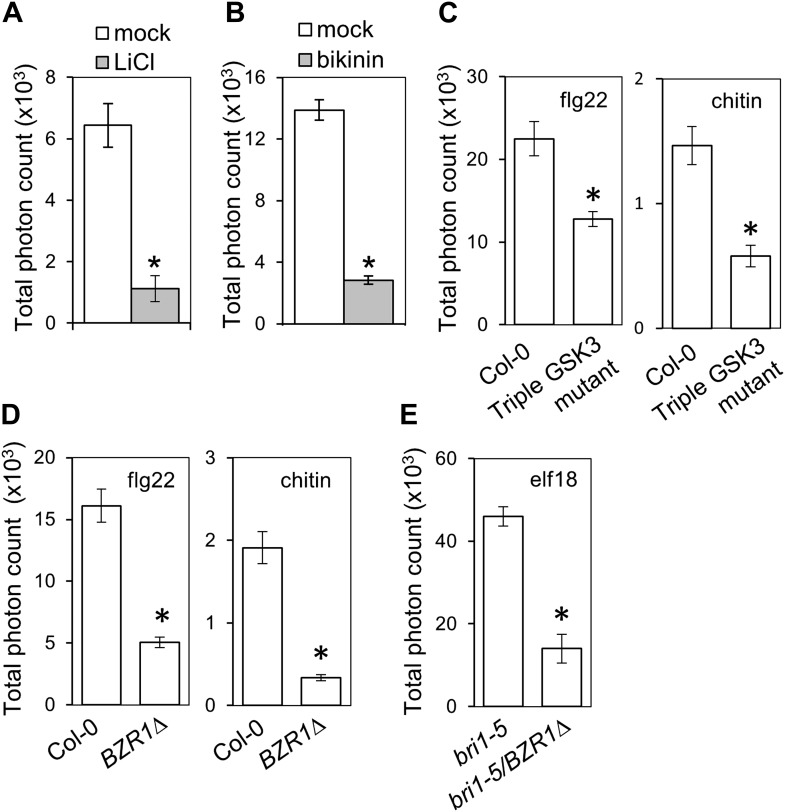
Figure 1.
Full legend
Activation of BZR1 is sufficient to inhibit the PAMP-triggered ROS burst. (A) and (B) Flg22-triggered ROS burst after LiCl (A) or bikinin (B) treatment. Leaf discs were pre-treated with a 10 mM LiCl solution for 5 hr or with a 50 μM bikinin solution for 16 hr. (C) Flg22- or chitin-triggered ROS burst in Col-0 and the triple GSK3 mutant plants. (D) Flg22- or chitin-induced ROS burst in Col-0 and BZR1Δ plants. (E) Elf18-triggered ROS burst in bri1-5 and bri1-5/BZR1Δ plants. In all cases, bars represent SE of n = 28 rosette leaf discs. Asterisks indicate a statistically significant difference compared to the corresponding control (mock treatment [A and B], Col-0 [C and D] or bri1-5 [E]), according to a Student’s t-test (p<0.05). Leaf discs of four- to five-week-old Arabidopsis plants were used in these assays. Flg22 and elf18 were used at a concentration of 50 nM; chitin was used at a concentration of 1 mg/ml. Total photon counts were integrated between minutes two and 40 after PAMP treatment. All experiments were repeated at least three times with similar results. DOI: http://dx.doi.org/10.7554/eLife.00983.003
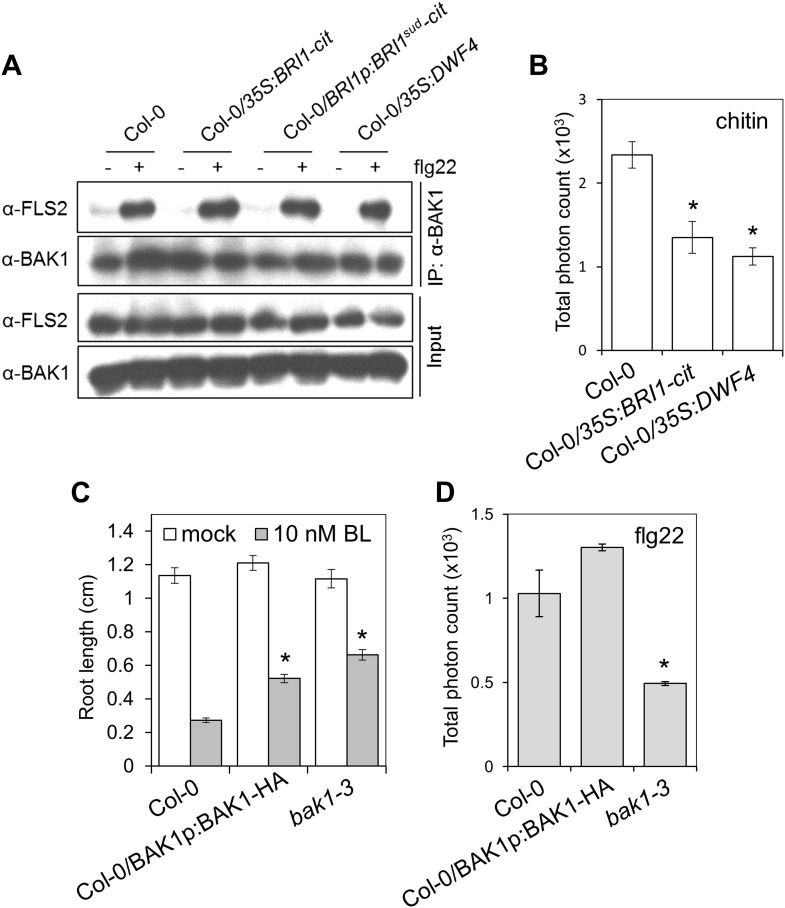
Figure 1—figure supplement 1.
Full legend
The BR-mediated suppression of PTI can be triggered independently of a competition for BAK1. (A) Co-IP of BAK1 and FLS2 in Col-0, 35S:BRI1-cit, 35S:BRI1sud-cit and 35S:DWF4 seedlings treated with 1 μM flg22 for 10 min. Coimmunoprecipitated proteins were analyzed by using anti-FLS2 or anti-BAK1 antibodies. (B) Chitin-triggered ROS burst in Col-0, 35S:BRI1-cit and 35S:DWF4 plants. Chitin was used at a concentration of 1 mg/ml. Total photon counts were integrated between minutes two and 40 after PAMP treatment. Bars represent SE of n = 28 rosette leaf discs. (C) Root length of seven-day-old Col-0, BAK1p:BAK1-HA (in Col-0 WT background) or bak1-3 seedlings grown on medium supplemented or not with 10 nM BL. Bars represent SE of 12 ≤ n ≤ 17. Asterisks indicate a statistically significant difference between treatments according to a Student's t-test (p<0.05). (D) Flg22-triggered ROS burst in Col-0, BAK1p:BAK1-HA (in Col-0 WT background) or bak1-3 plants. Leaf discs of four- to five-week-old Arabidopsis plants were used in these assays. Flg22 was used at a concentration of 50 nM. Total photon counts were integrated between minutes two and 40 after PAMP treatment. Bars represent SE of n = 28 rosette leaf discs. All experiments were repeated at least twice with similar results. DOI: http://dx.doi.org/10.7554/eLife.00983.004
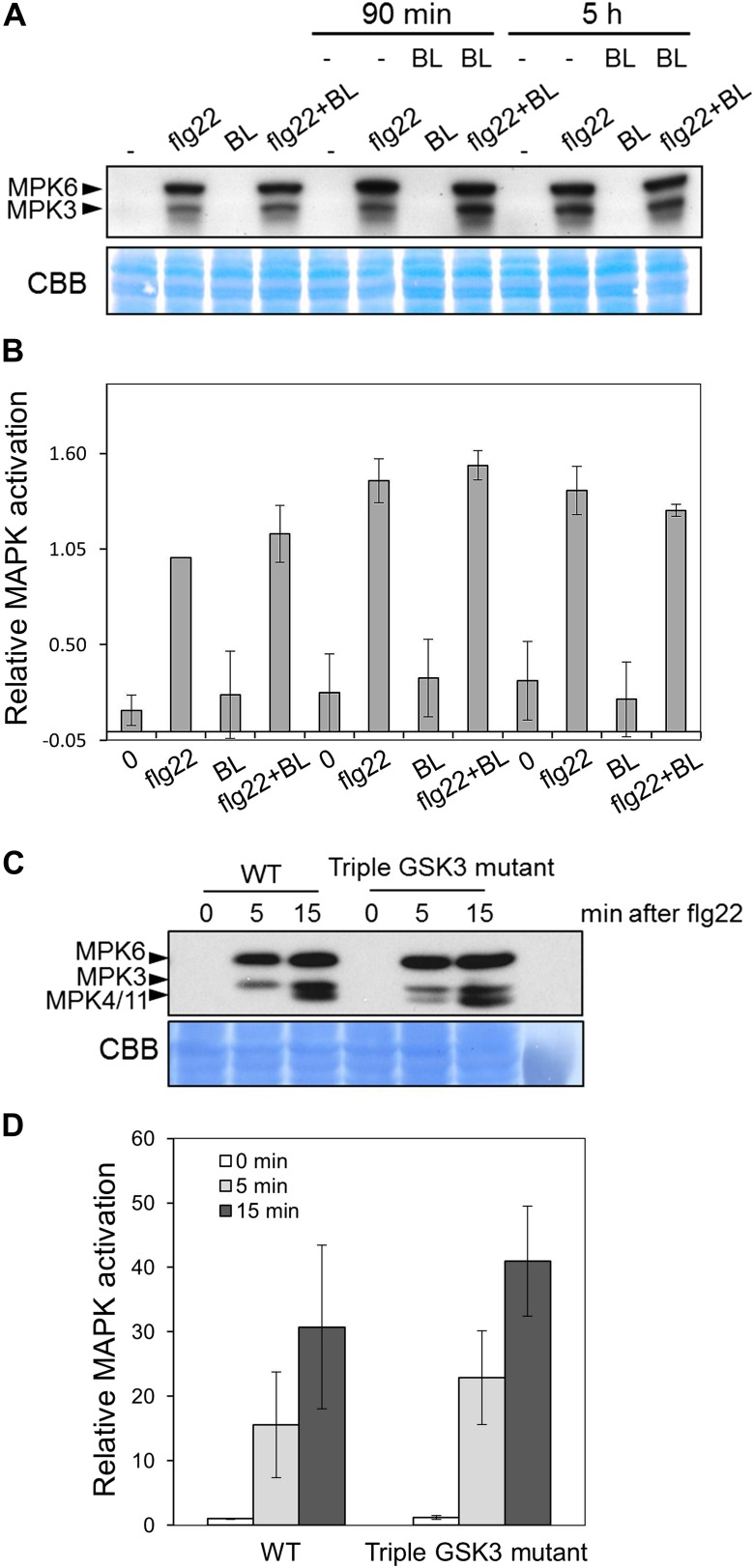
Figure 1—figure supplement 2.
Full legend
PAMP-triggered MAPK activation is not impaired upon activation of BR signaling. (A) MAPK activation in Col-0 seedlings upon treatment with 1 μM flg22 (F) and/or epiBL (B) for 10 min (with or without a 90-min or 5-hr BL pre-treatment). (B) Quantification of total MAPK activation in the experiment shown in (A), measured as pixel intensity using ImageJ. Results are the average of two independent blots, corresponding to two independent biological replicated. (C) MAPK activation in Col-0 and Triple GSK3 mutant seedlings upon treatment with 1 μM flg22. (D) Quantification of total MAPK activation in the experiment shown in (C), measured as pixel intensity using ImageJ. Results are the average of two independent blots, corresponding to two independent biological replicated. Proteins were separated in a 10% acrylamide gel and transferred to PVDF membranes. Membranes were blotted with phospho-p44/42 MAPK (Erk1/2; Thr202/Tyr204) rabbit monoclonal antibodies. Bars represent SD. DOI: http://dx.doi.org/10.7554/eLife.00983.005
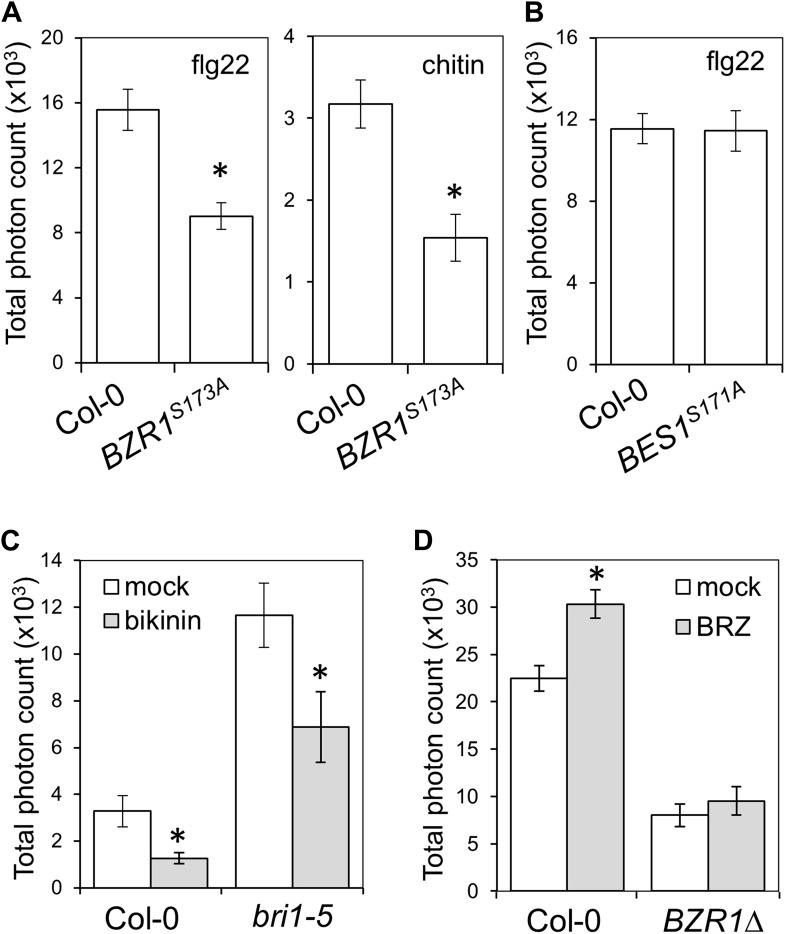
Figure 1—figure supplement 3.
Full legend
Activation of BZR1, but not BES1, is sufficient to inhibit the PAMP-triggered ROS burst. (A) Flg22- or chitin-triggered ROS burst in BZR1S173A plants. (B) Flg22-triggered ROS burst in BES1S171A plants. (C) Flg22-triggered ROS burst in mock- or bikinin-treated Col-0 or bri1-5 plants. Leaf discs were pre-treated with a 50 μM bikinin solution for 16 hr. (D) Flg22-triggered ROS burst in mock- or BRZ-treated Col-0 or BZR1Δ plants. Leaf discs were pre-treated with a 2.5 μM BRZ solution for 16 hr. In all cases, bars represent SE of 21 ≤ n ≤ 28. Asterisks indicate a statistically significant difference compared to Col-0 (A and B) or mock-treatment (C and D) according to a Student's t-test (p<0.05). Flg22 was used at a concentration of 50 nM; chitin was used at a concentration of 1 mg/ml. Total photon counts were integrated between minutes two and 40 after PAMP treatment. DOI: http://dx.doi.org/10.7554/eLife.00983.006
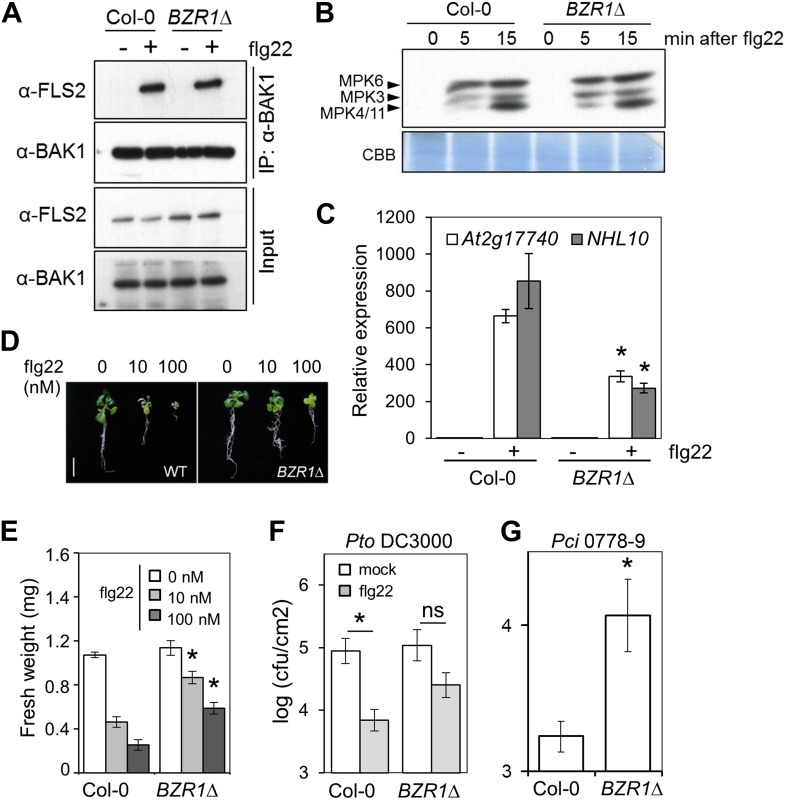
Figure 2.
Full legend
Activation of BZR1 results in the suppression of specific PTI outputs. (A) Co-immunoprecipitation (Co-IP) of BAK1 and FLS2 in Col-0 and BZR1Δ seedlings after 10 min mock (−) or 1 μM flg22 (+) treatment. Proteins were separated in a 10% acrylamide gel and transferred to PVDF membranes. Membranes were blotted with anti-FLS2 or anti-BAK1 antibodies. (B) MAPK activation in Col-0 and BZR1Δ seedlings upon 1 μM flg22 treatment. Proteins were separated in a 10% acrylamide gel and transferred to PVDF membranes. Membranes were blotted with phospho-p44/42 MAPK (Erk1/2; Thr202/Tyr204) rabbit monoclonal antibodies. CBB: Coomassie brilliant blue. (C) Marker gene (At2g17700 and NHL10) expression in Col-0 and BZR1Δ seedlings after 1 hr mock (−) or 1 μM flg22 (+) treatment, as determined by qPCR. Bars represent SE of n = 3. (D) and (E) Seedling growth inhibition of 10-day-old Col-0 or BZR1Δ seedlings induced by increasing concentrations of flg22, as indicated. Scale bar (D), 1 cm. Bars (E) represent SE of 8 ≤ n ≤ 16. (F) Flg22-induced resistance to P. syringae pv. tomato DC3000 in Col-0 and BZR1Δ plants. Plants were pre-treated with 1 μM flg22 or water 24 hr prior to bacterial infiltration. Bars represent SE of n = 4. This experiment was repeated seven times with similar results. (G) Susceptibility of Col-0 and BZR1Δ plants to P. syringae pv. cilantro 0788-9. Bars represent SE of n = 4. Asterisks indicate a statistically significant difference compared to Col-0 according to a Student’s t-test (p<0.05); ns = not significant. All experiments were repeated at least twice with similar results unless otherwise stated. DOI: http://dx.doi.org/10.7554/eLife.00983.007
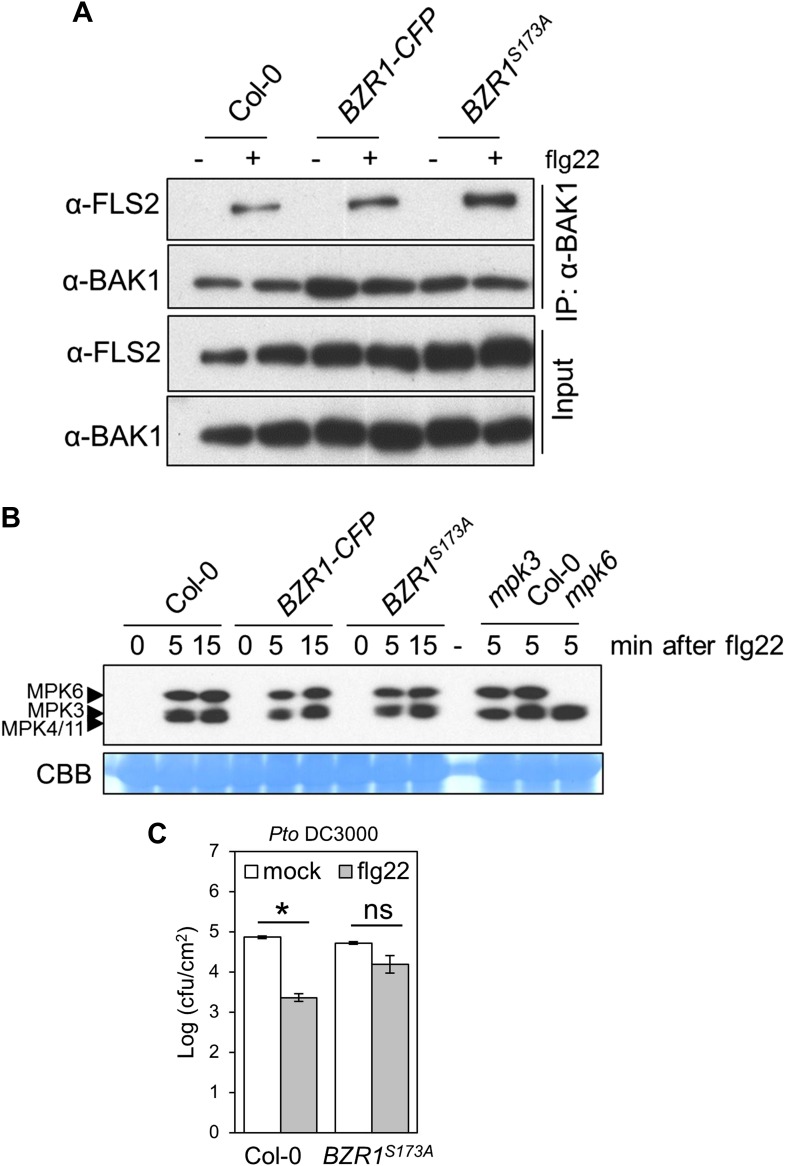
Figure 2—figure supplement 1.
Full legend
Expression of the constitutively active BZR1S173A results in the suppression of specific PTI outputs. (A) Co-IP of BAK1 and FLS2 in Col-0 and BZR1S173A seedlings treated with 1 μM flg22 for 10 min. Co-immunoprecipitated proteins were analyzed by using anti-FLS2 or anti-BAK1 antibodies. (B) MAPK activation in Col-0 and BZR1S173A seedlings upon treatment with 1 μM flg22. Membranes were blotted with phospho-p44/42 MAPK (Erk1/2; Thr202/Tyr204) rabbit monoclonal antibodies. (C) Flg22-induced resistance to Pto DC3000 in BZR1S173A plants. Plants were pre-treated with 1 μM flg22 or water 24 hr prior to bacterial inoculation. Bars represent SE of n = 4. Asterisks indicate a statistically significant difference compared to mock-treated plants according to a Student's t-test (p<0.05); ns = not significant. All experiments were repeated at least twice with similar results. DOI: http://dx.doi.org/10.7554/eLife.00983.008
Show all 12 figures
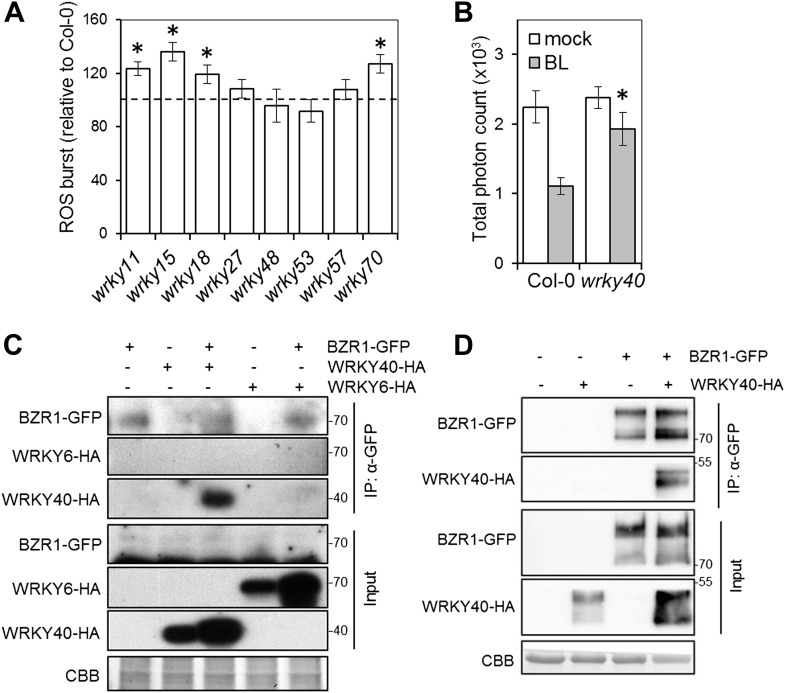
Figure 3.
Full legend
WRKY transcription factors play a dual role on the BR-mediated regulation of PTI signaling. (A) Flg22-triggered ROS burst in mutants in each BR-induced BZR1-targeted WRKY. Leaf discs of four- to five-week-old Arabidopsis plants were used in these assays. Flg22 was used at a concentration of 50 nM. Total photon counts were integrated between minutes two and 40 after PAMP treatment. Bars represent SE of n = 28. Asterisks indicate a statistically significant difference compared to Col-0 according to a Student’s t-test (p<0.05). (B) Flg22-triggered ROS burst in epiBL (BL)- or mock- pre-treated wrky40 mutant or wild-type plants. Leaf discs of four- to five-week-old plants were pre-treated with a 1 μM BL solution or mock solution for 8 hr. Flg22 was used at a concentration of 50 nM. Total photon counts were integrated between minutes two and 40 after PAMP treatment. Bars represent SE of n = 21. Asterisks indicate a statistically significant difference compared to Col-0 according to a Student’s t-test (p<0.05). (C) Co-IP of BZR1-GFP transiently expressed in N. benthamiana, alone or together with WRKY40-HA or WRKY6-HA. BZR1-GFP was immunoprecipitated with an anti-GFP antibody. Immuniprecipitated or total proteins were separated in a 10% acrylamide gel and transferred to PVDF membranes. Membranes were blotted with anti-HA or anti-GFP antibodies. CBB: Coomassie brilliant blue. (D) Co-IP of BZR1-GFP transiently expressed in Arabidopsis protoplasts, alone or together with WRKY40-HA. BZR1-GFP was immunoprecipitated with an anti-GFP antibody. Immuniprecipitated or total proteins were separated in a 10% acrylamide gel and transferred to PVDF membranes. Membranes were blotted with anti-HA or anti-GFP antibodies. CBB: Coomassie brilliant blue. All experiments were repeated at least twice with similar results. DOI: http://dx.doi.org/10.7554/eLife.00983.014
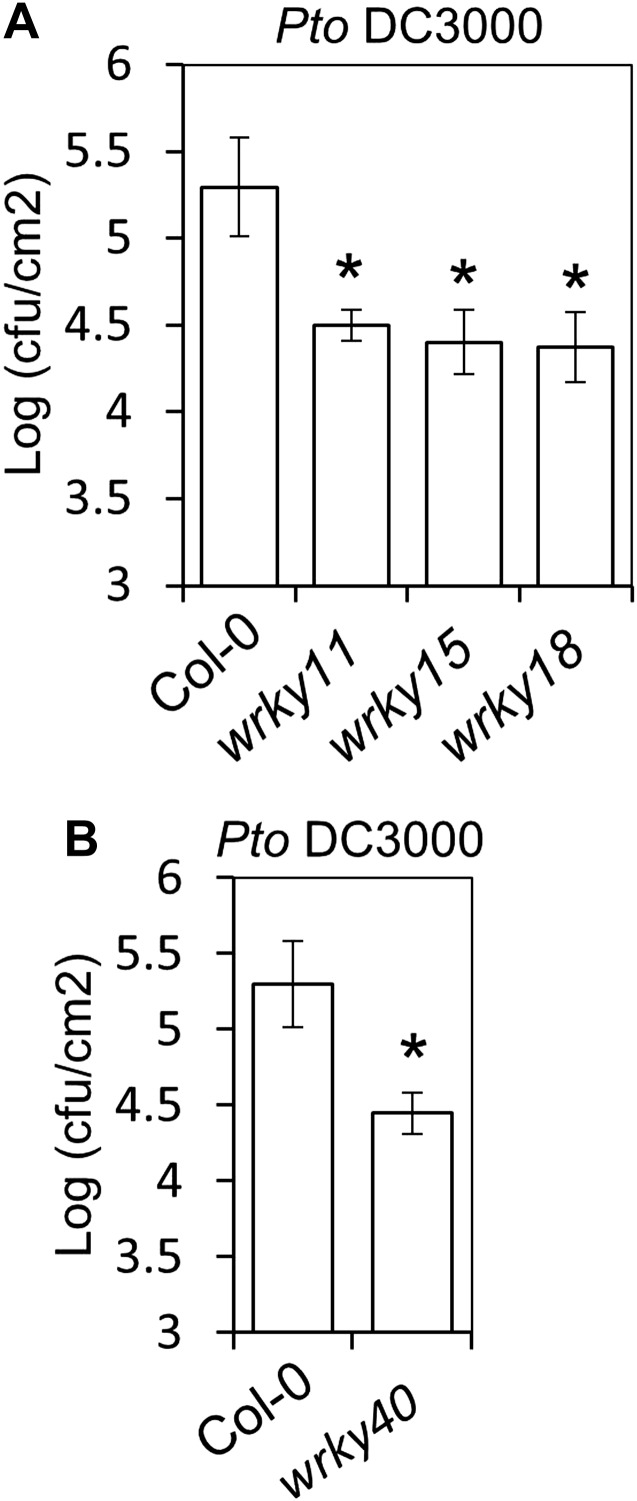
Figure 3—figure supplement 1.
Full legend
Mutants in WRKY11, WRKY15, WRKY18 and WRKY40 are more resistant to Pto DC3000. (A) and (B) Pto DC3000 infections in Col-0, wrky11, wrky15, and wrky18 (A) and in Col-0 and wrky40 (B) plants. Bars represent SE of n = 4. Asterisks indicate a statistically significant difference compared to Col-0 plants according to a Student's t-test (p<0.05); ns = not significant. All experiments were repeated at least three times with similar results. DOI: http://dx.doi.org/10.7554/eLife.00983.015
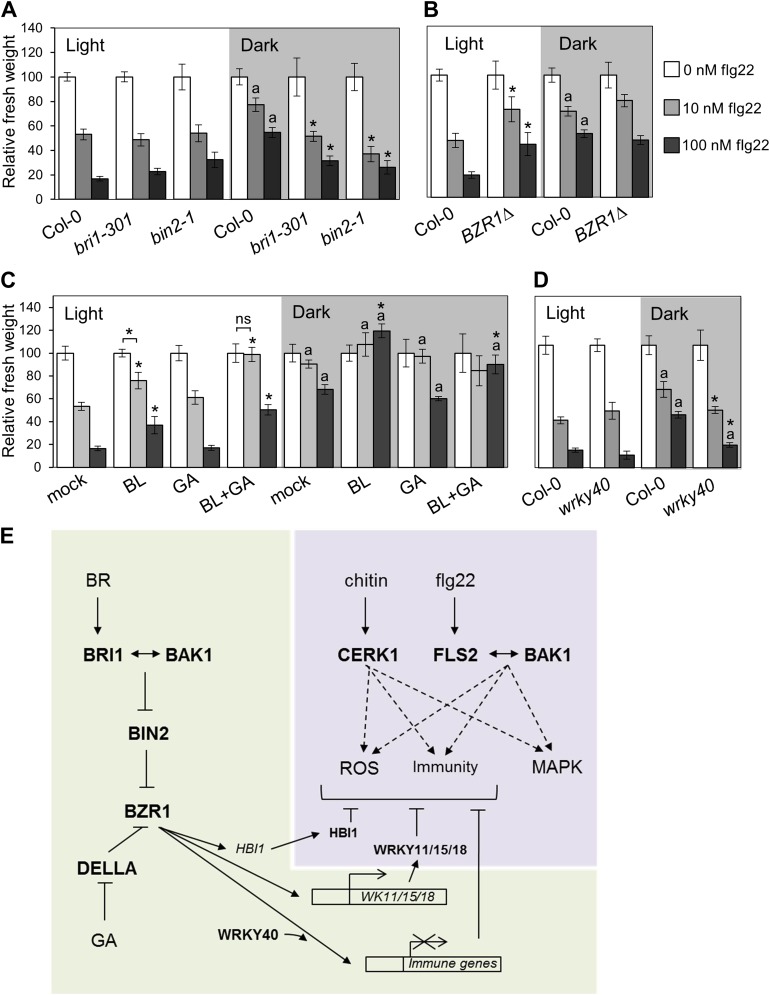
Figure 4.
Full legend
Activation of BR signaling and BZR1 prioritizes growth over immunity in the dark. (A) and (B) Relative seedling growth inhibition of 10-day-old (A) Col-0, bri1-301 and bin2-1 or (B) Col-0 and BZR1Δ seedlings induced by increasing concentrations of flg22 in either light or dark. (C) Relative seedling growth inhibition of 10-day-old Col-0 seedlings grown on medium supplemented or not with BL (1 μM), GA (1 μM), BL+GA (1 μM + 1 μM) or mock solution in light or dark. (D) Relative seedling growth inhibition of Col-0 or wrky40 seedlings induced by increasing concentrations of flg22 in either light or dark. Bars represent SE of n = 16 (A, B and D) or n = 8 (C) Asterisks indicate a statistically significant difference compared to Col-0 in the same condition (light or dark and same concentration of flg22), according to a Student’s t-test (p<0.05); ‘a’ indicates a statistically significant difference compared to the same genotype/treatment and concentration of flg22 in light, according to a Student’s t-test (p<0.05). All experiments were repeated at least three times with similar results. Values are relative to Col-0 (A, B and D) or mock-treated seedlings (C) (set to 100). Absolute values of these experiments are shown in Figure 4—figure supplement 3. (E) Schematic model depicting the BZR1-mediated inhibition of PTI. Upon BR- and DELLA-dependent activation, BZR1 induces the expression of negative regulators of PTI, such as WRKY11, WRKY15, WRKY18, or HBI1. In addition, BZR1 also inhibits the expression of immune genes, acting cooperatively with WRKY40 and possibly other WRKYs. Ultimately, the BZR1-mediated changes in transcription would lead to the suppression of PTI signaling. The PTI signaling pathway is shadowed in violet; the BR signaling pathway is shadowed in green. DOI: http://dx.doi.org/10.7554/eLife.00983.018
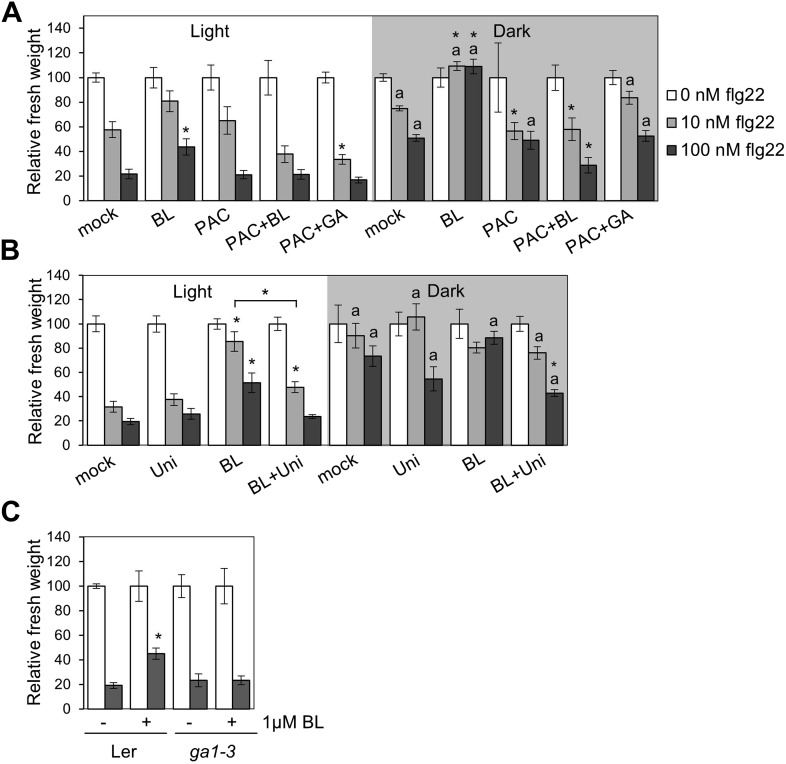
Figure 4—figure supplement 1.
Full legend
The BR-mediated suppression of seedling growth inhibition in the dark requires GA synthesis. Seedling growth inhibition of 10-day-old Col-0 seedlings grown on medium supplemented or not with (A) BL (1 μM), paclobutrazol (PAC; 1 μM), BL+PAC (1 μM + 1 μM) and PAC+GA (1 μM + 1 μM), or (B) uniconazole (Uni; 100 μM), BL (1 μM) and Uni+BL (100 μM + 1 μM) induced by increasing concentrations of flg22 in light or dark. (C) Seedling growth inhibition of 10-day-old Ler and ga1-3 seedlings grown on medium supplemented or not with BL (1 μM). Bars represent SE of n = 8. Asterisks indicate a statistically significant difference compared to Col-0 in the same condition (light or dark and same concentration of flg22), according to a Student's t-test (p<0.05); ‘a’ indicates a statistically significant difference compared to the same genotype/treatment and concentration of flg22 in light, according to a Student's t-test (p<0.05). Values are relative to mock-treated seedlings (set to 100). All experiments were repeated at least twice with similar results. DOI: http://dx.doi.org/10.7554/eLife.00983.019
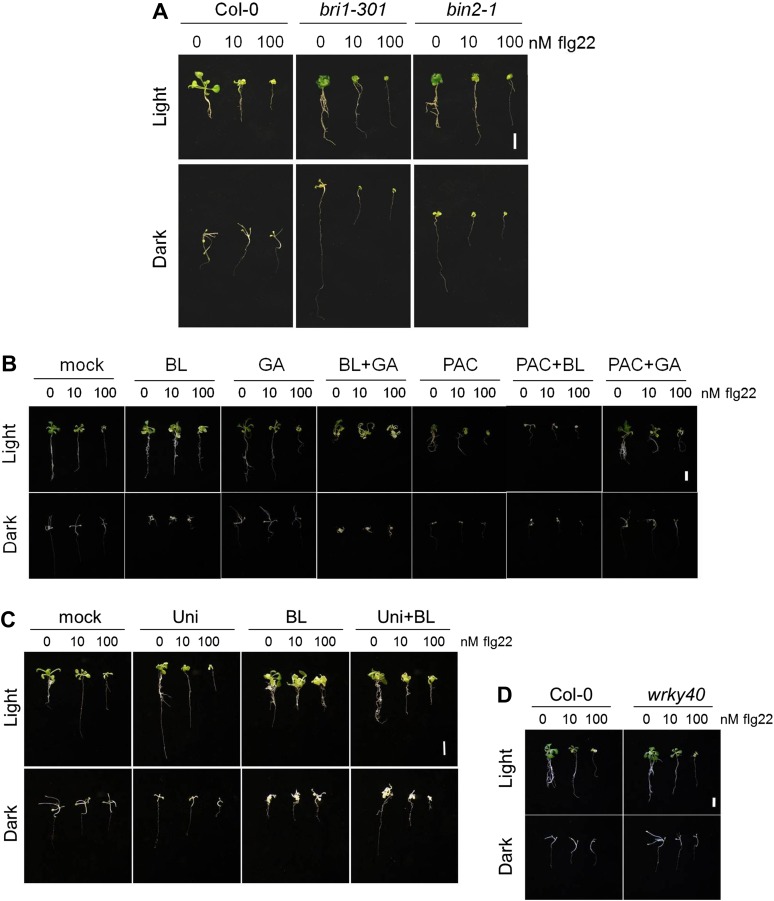
Figure 4—figure supplement 2.
Full legend
Phenotype of the light- or dark-grown seedlings used in the seedling growth inhibition assays (Figure 4 and Figure 4—figure supplement 1). Representative seedlings of the seedling growth inhibition experiments depicted in: (A) Figure 4A; (B) Figure 4—figure supplement 1A; (C) Figure 4–figure supplement 1B; (D) Figure 4D. Scale bar, 1 cm. DOI: http://dx.doi.org/10.7554/eLife.00983.020
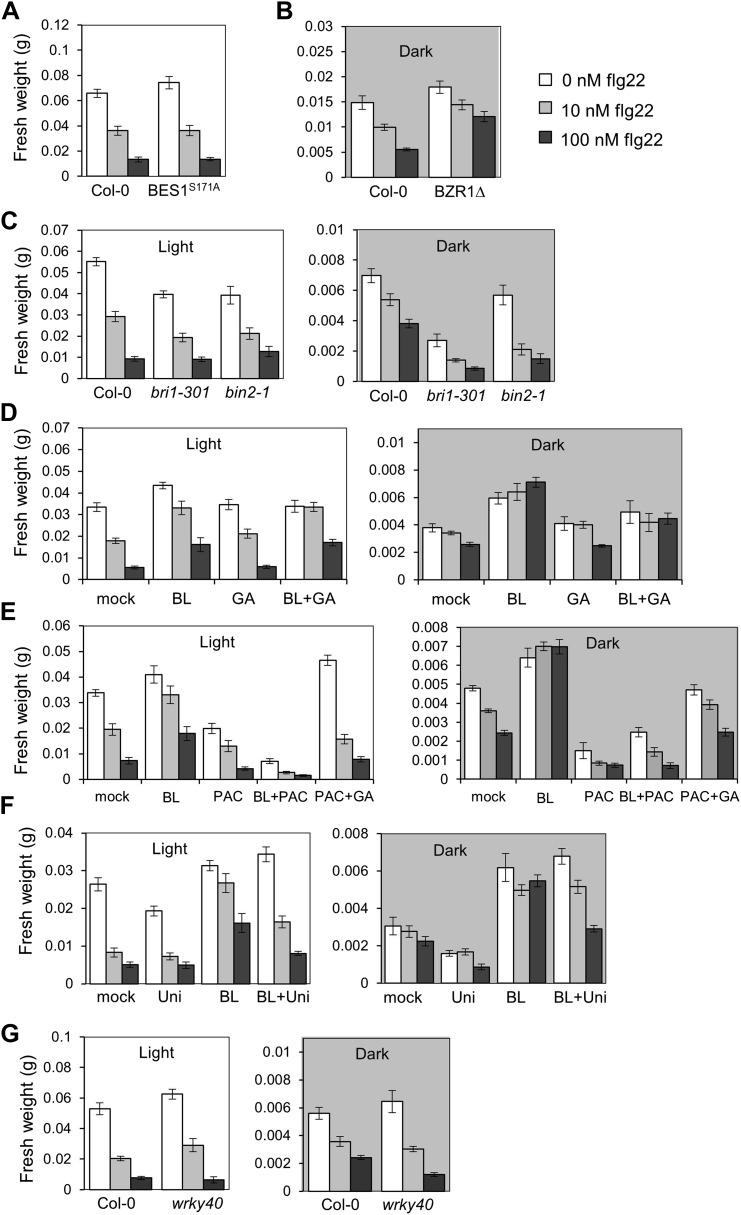
Figure 4—figure supplement 3.
Full legend
Absolute fresh weight values of seedling growth inhibition assays. (A) Seedling growth inhibition of 10-day-old Col-0 or BES1S171A seedlings induced by increasing concentrations of flg22. (B) Absolute fresh weight values of the seedling growth inhibition assay depicted in Figure 4B, dark. (C) Absolute fresh weight values of the seedling growth inhibition assay depicted in Figure 4A. (D) Absolute fresh weight values of the seedling growth inhibition assay depicted in Figure 4C. (E) Absolute fresh weight values of the seedling growth inhibition assay depicted in Figure 4—figure supplement 1A. (F) Absolute fresh weight values of the seedling growth inhibition assay depicted in Figure 4—figure supplement 1B. (G) Absolute fresh weight values of the seedling growth inhibition assay depicted in Figure 4D. Error bars represent SE as indicated in Figure 4, Figure 4—figure supplement 1. DOI: http://dx.doi.org/10.7554/eLife.00983.021
References55
- 1.
Albrecht C Boutrot F Segonzac C Schwessinger B Gimenez-Ibanez S Chinchilla D Rathjen JP de Vries SC Zipfel C 2012 Brassinosteroids inhibit pathogen-associated molecular pattern-triggered immune signaling independent of the receptor kinase BAK1. Proceedings of the National Academy of Sciences of the United States of America109:303–308.
Not in our library10.1073/pnas.1109921108 (opens in a new tab)
- 2.
Alonso JM Stepanova AN Leisse TJ Kim CJ Chen H Shinn P Stevenson DK Zimmerman J Barajas P Cheuk R Gadrinab C Heller C Jeske A Koesema E Meyers CC Parker H Prednis L Ansari Y Choy N Deen H Geralt M Hazari N Hom E Karnes M Mulholland C Ndubaku R Schmidt I Guzman P Aguilar-Henonin L Schmid M Weigel D Carter DE Marchand T Risseeuw E Brogden D Zeko A Crosby WL Berry CC Ecker JR 2003 Genome-wide insertional mutagenesis of Arabidopsis thaliana. Science301:653–657.
Not in our library10.1126/science.1086391 (opens in a new tab)
- 3.
Bai MY Fan M Oh E Wang ZY 2012a A triple helix-loop-helix/basic helix-loop-helix cascade controls cell elongation downstream of multiple hormonal and environmental signaling pathways in Arabidopsis. Plant Cell24:4917–4929.
Not in our library10.1105/tpc.112.105163 (opens in a new tab)
- 4.
Bai MY Shang JX Oh E Fan M Bai Y Zentella R Sun TP Wang ZY 2012b Brassinosteroid, gibberellin and phytochrome impinge on a common transcription module in Arabidopsis. Nature Cell Biology14:810–817.
Not in our library10.1038/ncb2546 (opens in a new tab)
- 5.
Belkhadir Y Jaillais Y Epple P Balsemao-Pires E Dangl JL Chory J 2012 Brassinosteroids modulate the efficiency of plant immune responses to microbe-associated molecular patterns. Proceedings of the National Academy of Sciences of the United States of America109:297–302.
Not in our library10.1073/pnas.1112840108 (opens in a new tab)
- 6.
Boudsocq M Willmann MR McCormack M Lee H Shan L He P Bush J Cheng SH Sheen J 2010 Differential innate immune signalling via Ca(2+) sensor protein kinases. Nature464:418–422.
Not in our library10.1038/nature08794 (opens in a new tab)
- 7.
- 8.
Casal JJ 2013 Photoreceptor signaling networks in plant responses to shade. Annual Review of Plant Biology64:403–427.
Not in our library10.1146/annurev-arplant-050312-120221 (opens in a new tab)
- 9.
Choudhary SP Yu JQ Yamaguchi-Shinozaki K Shinozaki K Tran LS 2012 Benefits of brassinosteroid crosstalk. Trends in Plant Science17:594–605.
Not in our library10.1016/j.tplants.2012.05.012 (opens in a new tab)
- 10.
De Rybel B Audenaert D Vert G Rozhon W Mayerhofer J Peelman F Coutuer S Denayer T Jansen L Nguyen L Vanhoutte I Beemster GT Vleminckx K Jonak C Chory J Inzé D Russinova E Beeckman T 2009 Chemical inhibition of a subset of Arabidopsis thaliana GSK3-like kinases activates brassinosteroid signaling. Chemical Biology16:594–604.
Not in our library10.1016/j.chembiol.2009.04.008 (opens in a new tab)
- 11.
Dodds PN Rathjen JP 2010 Plant immunity: towards an integrated view of plant-pathogen interactions. Nature Reviews Genetics11:539–548.
Not in our library10.1038/nrg2812 (opens in a new tab)
- 12.
Gallego-Bartolome J Minguet EG Grau-Enguix F Abbas M Locascio A Thomas SG Alabadi D Blazquez MA 2012 Molecular mechanism for the interaction between gibberellin and brassinosteroid signaling pathways in Arabidopsis. Proceedings of the National Academy of Sciences of the United States of America109:13446–13451.
Not in our library10.1073/pnas.1119992109 (opens in a new tab)
- 13.
Gampala SS Kim TW He JX Tang W Deng Z Bai MY Guan S Lalonde S Sun Y Gendron JM Chen H Shibagaki N Ferl RJ Ehrhardt D Chong K Burlingame AL Wang ZY 2007 An essential role for 14-3-3 proteins in brassinosteroid signal transduction in Arabidopsis. Developmental Cell13:177–189.
Not in our library10.1016/j.devcel.2007.06.009 (opens in a new tab)
- 14.
Grefen C Donald N Hashimoto K Kudla J Schumacher K Blatt MR 2010 A ubiquitin-10 promoter-based vector set for fluorescent protein tagging facilitates temporal stability and native protein distribution in transient and stable expression studies. Plant Journal64:355–365.
Not in our library10.1111/j.1365-313x.2010.04322.x (opens in a new tab)
- 15.
Jaillais Y Vert G 2012 Brassinosteroids, gibberellins and light-mediated signalling are the three-way controls of plant sprouting. Nature Cell Biology14:788–790.
Not in our library10.1038/ncb2551 (opens in a new tab)
- 16.
Journot-Catalino N Somssich IE Roby D Kroj T 2006 The transcription factors WRKY11 and WRKY17 act as negative regulators of basal resistance in Arabidopsis thaliana. Plant Cell18:3289–3302.
Not in our library10.1105/tpc.106.044149 (opens in a new tab)
- 17.
Katari MS Nowicki SD Aceituno FF Nero D Kelfer J Thompson LP Cabello JM Davidson RS Goldberg AP Shasha DE Coruzzi GM Gutiérrez RA 2010 VirtualPlant: a software platform to support systems biology research. Plant Physiology152:500–515.
Not in our library10.1104/pp.109.147025 (opens in a new tab)
- 18.
Khan M Rozhon W Bigeard J Pflieger D Husar S Pitzschke A Teige M Jonak C Hirt H Poppenberger B 2013 Brassinosteroid-regulated GSK3/Shaggy-like kinases phosphorylate mitogen-activated protein (MAP) kinase kinases, which control stomata development in Arabidopsis thaliana. The Journal of Biological Chemistry288:7519–7527.
Not in our library10.1074/jbc.m112.384453 (opens in a new tab)
- 19.
Kim TW Michniewicz M Bergmann DC Wang ZY 2012 Brassinosteroid regulates stomatal development by GSK3-mediated inhibition of a MAPK pathway. Nature482:419–422.
Not in our library10.1038/nature10794 (opens in a new tab)
- 20.
Kim TW Wang ZY 2010 Brassinosteroid signal transduction from receptor kinases to transcription factors. Annual Review of Plant Biology61:681–704.
Not in our library10.1146/annurev.arplant.043008.092057 (opens in a new tab)
- 21.
- 22.
Li QF Wang C Jiang L Li S Sun SS He JX 2012 An interaction between BZR1 and DELLAs mediates direct signaling crosstalk between brassinosteroids and gibberellins in Arabidopsis. Science Signaling5:ra72.
Not in our library10.1126/scisignal.2002908 (opens in a new tab)
- 23.
Monaghan J Zipfel C 2012 Plant pattern recognition receptor complexes at the plasma membrane. Current Opinion in Plant Biology15:349–357.
Not in our library10.1016/j.pbi.2012.05.006 (opens in a new tab)
- 24.
Mukhtar MS Deslandes L Auriac MC Marco Y Somssich IE 2008 The Arabidopsis transcription factor WRKY27 influences wilt disease symptom development caused by Ralstonia solanacearum. Plant Journal56:935–947.
Not in our library10.1111/j.1365-313x.2008.03651.x (opens in a new tab)
- 25.
Nakagawa T Suzuki T Murata S Nakamura S Hino T Maeo K Tabata R Kawai T Tanaka K Niwa Y Watanabe Y Nakamura K Kimura T Ishiguro S 2007 Improved Gateway binary vectors: high-performance vectors for creation of fusion constructs in transgenic analysis of plants. Bioscience Biotechnology and Biochemistry71:2095–2100.
Not in our library10.1271/bbb.70216 (opens in a new tab)
- 26.
Navarro L Bari R Achard P Lison P Nemri A Harberd NP Jones JD 2008 DELLAs control plant immune responses by modulating the balance of jasmonic acid and salicylic acid signaling. Current Biology18:650–655.
Not in our library10.1016/j.cub.2008.03.060 (opens in a new tab)
- 27.
Nekrasov V Li J Batoux M Roux M Chu ZH Lacombe S Rougon A Bittel P Kiss-Papp M Chinchilla D van Esse HP Jorda L Schwessinger B Nicaise V Thomma BP Molina A Jones JD Zipfel C 2009 Control of the pattern-recognition receptor EFR by an ER protein complex in plant immunity. The EMBO Journal28:3428–3438.
Not in our library10.1038/emboj.2009.262 (opens in a new tab)
- 28.
Noguchi T Fujioka S Choe S Takatsuto S Yoshida S Yuan H Feldmann KA Tax FE 1999 Brassinosteroid-insensitive dwarf mutants of Arabidopsis accumulate brassinosteroids. Plant Physiology121:743–752.
Not in our library10.1104/pp.121.3.743 (opens in a new tab)
- 29.
O’Connor TR Dyreson C Wyrick JJ 2005 Athena: a resource for rapid visualization and systematic analysis of Arabidopsis promoter sequences. Bioinformatics21:4411–4413.
Not in our library10.1093/bioinformatics/bti714 (opens in a new tab)
- 30.
Oh E Zhu JY Wang ZY 2012 Interaction between BZR1 and PIF4 integrates brassinosteroid and environmental responses. Nature Cell Biology14:802–809.
Not in our library10.1038/ncb2545 (opens in a new tab)
- 31.
- 32.
Pandey SP Roccaro M Schon M Logemann E Somssich IE 2010 Transcriptional reprogramming regulated by WRKY18 and WRKY40 facilitates powdery mildew infection of Arabidopsis. Plant Journal64:912–923.
Not in our library10.1111/j.1365-313x.2010.04387.x (opens in a new tab)
- 33.
Peng P Yan Z Zhu Y Li J 2008 Regulation of the Arabidopsis GSK3-like kinase BRASSINOSTEROID-INSENSITIVE 2 through proteasome-mediated protein degradation. Molecular Plant1:338–346.
Not in our library10.1093/mp/ssn001 (opens in a new tab)
- 34.
Pieterse CM Van der Does D Zamioudis C Leon-Reyes A Van Wees SC 2012 Hormonal modulation of plant immunity. Annu Review of Cell and Developmental Biology28:489–521.
Not in our library10.1146/annurev-cellbio-092910-154055 (opens in a new tab)
- 35.
Ranf S Eschen-Lippold L Pecher P Lee J Scheel D 2011 Interplay between calcium signalling and early signalling elements during defense responses to microbe- or damage-associated molecular patterns. Plant Journal68:100–113.
Not in our library10.1111/j.1365-313x.2011.04671.x (opens in a new tab)
- 36.
Rushton PJ Somssich IE Ringler P Shen QJ 2010 WRKY transcription factors. Trends in Plant Science15:247–258.
Not in our library10.1016/j.tplants.2010.02.006 (opens in a new tab)
- 37.
Ryu H Kim K Cho H Park J Choe S Hwang I 2007 Nucleocytoplasmic shuttling of BZR1 mediated by phosphorylation is essential in Arabidopsis brassinosteroid signaling. Plant Cell19:2749–2762.
Not in our library10.1105/tpc.107.053728 (opens in a new tab)
- 38.
Schon M Toller A Diezel C Roth C Westphal L Wiermer M Somssich IE 2013 Analyses of wrky18 wrky40 plants reveal critical roles of SA/EDS1 signaling and indole-glucosinolate biosynthesis for Golovinomyces orontii resistance and a loss-of resistance towards Pseudomonas syringae pv. tomato AvrRPS4. Molecular Plant-Microbe Interactions26:758–767.
Not in our library10.1094/mpmi-11-12-0265-r (opens in a new tab)
- 39.
Schweizer F Bodenhausen N Lassueur S Masclaux FG Reymond P 2013 Differential contribution of transcription factors to Arabidopsis thaliana defense against Spodoptera littoralis. Frontiers of Plant Science4:13.
Not in our library10.3389/fpls.2013.00013 (opens in a new tab)
- 40.
- 41.
Shan L He P Li J Heese A Peck SC Nurnberger T Martin GB Sheen J 2008 Bacterial effectors target the common signaling partner BAK1 to disrupt multiple MAMP receptor-signaling complexes and impede plant immunity. Cell Host & Microbe4:17–27.
Not in our library10.1016/j.chom.2008.05.017 (opens in a new tab)
- 42.
Sun Y Fan XY Cao DM Tang W He K Zhu JY He JX Bai MY Zhu S Oh E Patil S Kim TW Ji H Wong WH Rhee SY Wang ZY 2010 Integration of brassinosteroid signal transduction with the transcription network for plant growth regulation in Arabidopsis. Developmental Cell19:765–777.
Not in our library10.1016/j.devcel.2010.10.010 (opens in a new tab)
- 43.
Toufighi K Brady SM Austin R Ly E Provart NJ 2005 The botany array resource: e-Northerns, expression angling, and promoter analyses. Plant Journal43:153–163.
Not in our library10.1111/j.1365-313x.2005.02437.x (opens in a new tab)
- 44.
Vert G Chory J 2006 Downstream nuclear events in brassinosteroid signalling. Nature441:96–100.
Not in our library10.1038/nature04681 (opens in a new tab)
- 45.
- 46.
Wang ZY Nakano T Gendron J He J Chen M Vafeados D Yang Y Fujioka S Yoshida S Asami T Chory J 2002 Nuclear-localized BZR1 mediates brassinosteroid-induced growth and feedback suppression of brassinosteroid biosynthesis. Developmental Cell2:505–513.
Not in our library10.1016/s1534-5807(02)00153-3 (opens in a new tab)
- 47.
Wisman E Cardon GH Fransz P Saedler H 1998a The behaviour of the autonomous maize transposable element En/Spm in Arabidopsis thaliana allows efficient mutagenesis. Plant Molecular Biology37:989–999.
Not in our library10.1023/a:1006082009151 (opens in a new tab)
- 48.
- 49.
Xu W Huang J Li B Li J Wang Y 2008 Is kinase activity essential for biological functions of BRI1?Cell research18:472–478.
Not in our library10.1038/cr.2008.36 (opens in a new tab)
- 50.
Xu X Chen C Fan B Chen Z 2006 Physical and functional interactions between pathogen-induced Arabidopsis WRKY18, WRKY40, and WRKY60 transcription factors. Plant Cell18:1310–1326.
Not in our library10.1105/tpc.105.037523 (opens in a new tab)
- 51.
Yan Z Zhao J Peng P Chihara RK Li J 2009 BIN2 functions redundantly with other Arabidopsis GSK3-like kinases to regulate brassinosteroid signaling. Plant Physiology150:710–721.
Not in our library10.1104/pp.109.138099 (opens in a new tab)
- 52.
Yin Y Wang ZY Mora-Garcia S Li J Yoshida S Asami T Chory J 2002 BES1 accumulates in the nucleus in response to brassinosteroids to regulate gene expression and promote stem elongation. Cell109:181–191.
Not in our library10.1016/s0092-8674(02)00721-3 (opens in a new tab)
- 53.
Yu X Li L Zola J Aluru M Ye H Foudree A Guo H Anderson S Aluru S Liu P Rodermel S Yin Y 2011 A brassinosteroid transcriptional network revealed by genome-wide identification of BESI target genes in Arabidopsis thaliana. Plant Journal65:634–646.
Not in our library10.1111/j.1365-313x.2010.04449.x (opens in a new tab)
- 54.
Zhu JY Sae-Seaw J Wang ZY 2013 Brassinosteroid signalling. Development140:1615–1620.
Not in our library10.1242/dev.060590 (opens in a new tab)
- 55.
Zipfel C Robatzek S Navarro L Oakeley EJ Jones JD Felix G Boller T 2004 Bacterial disease resistance in Arabidopsis through flagellin perception. Nature428:764–767.
Not in our library10.1038/nature02485 (opens in a new tab)
Cited by papers we hold4
Reads
Read by people on this page
None yet.
Checked or read by AI through naulon
None yet.
A person counts once a day per paper. We keep no cookie and no address: a reader is a hash that changes every day. Any month under five reads shows no number.
Are you an author?
Is this your paper?
Claim it to add your note and be paid when agents cite it. Free.