A Submarine Journey: The Pyrrole-Imidazole Alkaloids
Barbara Forte, Beatrice Malgesini, Claudia Piutti and 3 more
Marine Drugs · 2009 · Review · CC BY
doi:10.3390/md7040705 (opens in a new tab)
We email you when a new notice or a question about this paper appears.
Abstract
In his most celebrated tale “The Picture of Dorian Gray”, Oscar Wilde stated that “those who go beneath the surface do so at their peril”. This sentence could be a prophetical warning for the practitioner who voluntarily challenges himself with trying to synthesize marine sponge-deriving pyrrole-imidazole alkaloids. This now nearly triple-digit membered community has been growing exponentially in the last 20 years, both in terms of new representatives and topological complexity – from simple, achiral oroidin to the breathtaking 12-ring stylissadines A and B, each possessing 16 stereocenters. While the biosynthesis and the role in the sponge economy of most of these alkaloids still lies in the realm of speculations, significant biological activities for some of them have clearly emerged. This review will account for the progress in achieving the total synthesis of the more biologically enticing members of this class of natural products.
Abstract licence: CC BY
Full text
From PubMed Central, U.S. National Library of Medicine, as current on Oct 26, 2026. Paragraph numbers are ours, so an answer can point at one.
Introduction
Sometime in 2003, our Company decided to set up a new project based upon the chance of fishing out new potent and selective kinase inhibitors from the natural products armoury. Particularly, the task was to play with the marine-origin metabolite hymenialdisine (see Subsection 3.1), a natural-born pan-kinase inhibitor. The goal of that project would have been to first synthesize this pyrrole-imidazole alkaloid and then to bias its biological activity through chemical manipulations. A non-biomimetic, simple disconnection allowed us to cut off the double bond connecting the northern glycocyamidine ring with the southern pyrroloazepinone, thus envisioning aldisine as the suitable key intermediate. However, as soon as we were able to routinely produce multigram batches of this intermediate, an outstanding paper from Wan et al. (see Subsection 3.1) was published, in which a number of hymenialdisine derivatives, even larger than in our rosiest hopes, was synthesized. Despite this setback, we pursued anyway the opportunity to successfully complete the hymenialdisine synthesis. From then on, the temptation of challenging other pyrrole-imidazole alkaloids was hard to resist, as much as it was hard to resist the enjoyment of the stimulating literature dealing with those natural products, published during the last five years in exponentially growing numbers.
The idea of a review recounting the efforts and achievements in the total synthesis of pyrrole-imidazole alkaloids was actually born from the perusal of these papers. However, as a number of reviews dealing with this topic are already available, we decided to cover the literature from 2005 to mid-2009 by focusing only on those alkaloids possessing a clear pharmacological value. A brief discussion on the biogenesis and the ecological role of these natural products will be the hors-d’œuvre.
Pyrrole-Imidazole Alkaloids Sources and Biogenesis
The pyrrole-imidazole alkaloids (PIAs) family comprises hundreds of secondary metabolites originating from marine sponges exclusively. Those natural products, whose architectural complexity goes from simple, achiral, monomeric oroidin (1, Figure 1) to the breath-taking 16-stereocenter-containing tetrameric stylissadine A and B (2 and 3, Figure 1), have been mainly isolated from various species of Agelasidae, Axinellidae, Dyctionellidae and Hymeniacidonidae families of sponges. The systematic recurrence of PIAs in these families of sponges allowed to speculate their taxon-specificity and then to consider these secondary metabolites as chemical markers for phylogenetically related sponges. The localization of those alkaloids in sponge cells has recently been investigated.
There are numerous speculations in the literature on the biogenesis of PIAs. As the simple oroidin (1, Figure 1) is mostly considered to be the biogenetic precursor of any other alkaloid pertaining to this family, those hypotheses can be grouped according to their pre- or post- oroidin focus. Pre-oroidin speculations are based on the fundamental aminoacids involved in the production of oroidin in living organisms (Figure 2). Thus, proline and/or ornithine may provide the backbone to build up the pyrrole-2-carboxylic acid moiety, while histidine may contribute to the 2-aminoimidazole portion. Low incorporation of these three aminoacids in the biosynthesis of the oroidin cyclized derivative stevensine has been experimentally observed by Kerr et al. by feeding cell cultures of the marine sponge Axinella corrugata (previously Teichaxinella morchella) with the corresponding 14C-labeled aminoacids. Alternatively, ornithine as well as lysine may be the source of the the five contiguous carbon atoms present in the aminopropenylimidazole portion of oroidin. A more recent and intriguing hypothesis emerged upon the isolation of verpacamides A-D (e.g. verpacamide C, 4, Figure 2) from the marine sponge Axinella vaceleti.
These cyclo(l-Arg-l-Pro) dipeptides differ only by their oxidative state, thus resembling intermediates along a given biogenetic pathway. The authors, by capitalizing on the discovery of an unprecedented conversion of proline into 2-aminoimidazolone, speculate that verpacamides may represent the biogenetic precursors of dispacamide A (5, Figure 2), a postulated forerunner of oroidin.
Post-oroidin hypotheses, on the other hand, can be sub-classified according to the alkaloids and their respective biosynthesis. Thus, along with a number of biochemical considerations on single natural products, frequently formulated while disclosing their isolation, more general speculations that try to link as many PIAs as possible have emerged. The seminal paper in this respect was published in 2001 by Al Mourabit and Potier (A/P). The ability of a given enzyme, through proton exchange reactions, to govern the tautomeric equilibria (and consequently the corresponding nucleophilic/electrophilic behaviour) of the aminopropenylimidazole portion of oroidin, was hypothesized to be the key point for the formation of both polycyclic monomers and cyclized dimers. The common intermediate (6, Figure 2) arising from oroidin that the authors invoked for the formation of the palau’amines, the styloguanidines and the axinellamines groups of alkaloids (see Section 5), was subsequently elaborated by Köck, Baran et al. (K/B) from both a stereochemical and an oxidative state point of view, in light of the recently revised structure of palau’amine (see Section 5). The symmetry that this revision finally brought to the cyclized dimeric members of the PIAs family, allowed the so-called “pre-axinellamines” intermediate (7, Figure 2) not only to more precisely connect the aforementioned groups of natural compounds, but also to include the konbu’acidins and the subsequently isolated massadines and stylissadines in this network. According to the same hypothesis, the “pre-axinellamines” 7 may be derived, in turn, from oroidin (1), sceptrin (8, Figure 2) or from ageliferin (9, Figure 2). Interestingly, the amide hydrolysis that Köck, Baran et al. invoked in order to cleave redundant bromopyrrole moieties in the styloguanidine and palau'amine biosynthetic hypothesis (see Section 5), is in agreement with the supposition that the 4,5-dibromopyrrole-2-carboxylic acid derives from oroidin hydrolysis, and is not one of its precursors.
If, on the one hand, nothing is known about either the enzymes or the corresponding genes by which sponges perform the aforementioned biogenetic transformations, on the other hand, haloperoxidase-mediated introduction of halogen(s) onto those marine alkaloids are easy to be inferred. Those enzymes, whose cofactors are represented by heme iron or vanadium, employ hydrogen peroxide to generate a metal-bound hypohalite ion, that is the electrophilic halogen source responsible for the halogenation of electron-rich substrates like the pyrrole nucleus in PIAs. Other, recently discovered, haloperoxidases (e.g., PrnA) use flavin adenine dinucleotide as a metal-free cofactor to halogenate nucleophilic substrates.
The absolute configuration of many of the more complex members of the PIAs family is still not known. Despite the fact that tentative assignment through CD spectroscopy (for a recent example, see Nishimura et al.) for some of the simpler representatives has proven to be correct, only total synthesis can tell us which enantiomer is the natural one.
Pyrrole-Imidazole Alkaloids Ecological Role
PIAs’ ecological role started to be investigated in the late ‘90s, when it was realized that sponges’ structural defences alone (spongin fibers and glass spicules) were ineffective feeding deterrents towards predatory reef fishes. The first report in this respect dates back to 1996, when an ecoassay-guided isolation, performed on the extracts of sponges of the genus Agelas, allowed the identification of 4,5-dibromopyrrole-2-carboxylic acid and oroidin (1) as the major components responsible for the observed chemical feeding deterrence. Later on, stevensine, present in high concentration in the sponge Axinella corrugata (previously Teichaxinella morchella), was also demonstrated to possess antifeedant properties. A structure-activity antifeedant relationship was subsequently established for oroidin-like molecules. From these studies, the imidazole moiety, while not being active per se, looks like an enhancer of the deterrent activity exerted by the pyrrole counterpart. Other PIAs were recognized to chemically defend sponges from predators. Acquarium and field feeding assays unveiled sceptrin (8) as the major metabolite of Agelas conifera able to deter fish feeding at natural concentrations, and it allowed ranking of a number of PIAs according to their antifeedant activities. This work, furthermore, highlighted the experimental observation that a higher number of bromine atoms present in the metabolite correlates with a higher feeding deterrent potency. The ecological role of PIAs has been tentatively explained by a general interaction of those metabolites with the cellular calcium homeostasis. From all those information, indicating that PIAs play a defensive role in sponges’ economy, still something is missing in our understanding. Combinations of PIAs did not provide any evidence of synergic activity. Concentrations of some PIAs in the sponges are so low to have negligible deterrent effects. Thus, the spontaneous question remains unanswered: “Why do sponges synthesize such a large number of alkaloids?”
Moreover, the isolation of both (+)-dibromophakellin (from Pseudoaxynissa cantharella) and (−)-dibromophakellin (from Phakellia flabellate) as well as (+)-dibromoisophakellin (from Pseudoaxynissa cantharella) and (−)-dibromoisophakellin (from Acanthella carteri) further complicates the scenario. As evolutionary pressure should select which enantiomer is better to perform a given function, do these enantiomeric alkaloids have a different ecological role in the biology of the sponge?
Pyrrole-Imidazole Alkaloids Classification
The 2-amino-4(5)-vinylimidazole portion of PIAs can vary with regard to its oxidative as well as hydration state, while the pyrrole-carboxamide moiety structural variations reside exclusively in the absence or the presence of bromine atom(s) in 2- and/or 3- position(s) of the pyrrole nucleus. The most commonly accepted PIA classification is based upon both the number of “oroidin units” and the presence of extra-rings involving either the imidazole or the pyrrole portion of the alkaloids. Accordingly, five classes of PIAs will be encountered in the following sections: Acyclic monomersCyclic monomersAcyclic dimersCyclic dimersCyclic tetramers
Acyclic monomers
Cyclic monomers
Acyclic dimers
Cyclic dimers
Cyclic tetramers
Alkaloids whose structures hardly fit any of the aforementioned classification criteria have been included in a sixth additional class.
Oroidin
Oroidin (1) was isolated in 1971 from the marine sponge Agelas oroides. It is the simplest among bromopyrrole-imidazole alkaloids and it has a linear structure characterized by a bromopyrrole carboxamide and an amino-imidazole moiety linked through a propenyl chain. Oroidin is the most abundant PIA and, as already mentioned (Subsection 1.1), it might be considered a biogenetic precursor of the other alkaloids.
Efforts towards the synthesis of oroidin followed two main strategies employing either an already assembled imidazole ring or an open chain precursor of imidazole. In 2006, two total syntheses of oroidin were published, and both works have been recently reviewed.
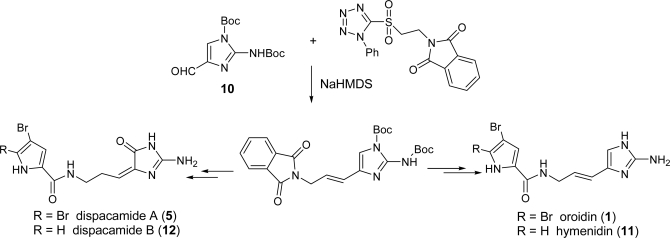
Ando et al. described a method involving a versatile intermediate 10, arising from 2-aminoimidazol-4-carbaldehyde, that allowed the synthesis not only of oroidin (1) and hymenidin (11), but also dispacamide A (5) and dispacamide B (12). The general approach of the synthesis is reported in Scheme 1, while in Subsection 2.2 a full detailed version is described for the dispacamides.
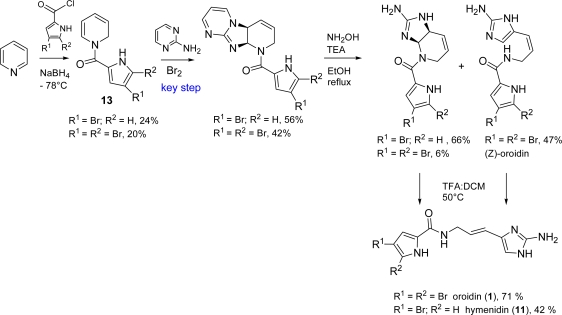
Al Mourabit et al., inspired by the natural product dibromoagelaspongine, performed a one-pot bromine-mediated oxidative addition of 2-aminopyrimidine, as a masked guanidine, on N-acyl-1,2-dihydropyridine 13. The synthesis proved to be short and exquisite, with only little mass loss and good final yields (Scheme 2).
The function of oroidin (1) as chemical defense for sponges of the genus Agelas against predation by the reef fish Thalassomia bifasciatum has already been mentioned (see subsection 1.2). Besides, 1 inhibits larval metamorphosis of the barnacle Balanus amphitrite (ED50 = 15 μg/mL). Oroidin was also reported to possess antibiofilm activity against the marine α-proteobacteria R. salexigens and the medically relevant γ-proteobacterium Pseudomonas aeruginosa (PA; IC50 = 190 μM on PA01; IC50 = 166 μM on PA14). With the aim of finding new chemical entities able to inhibit the formation of bacterial biofilms, the simple and linear oroidin was proposed as a lead compound for SAR studies. Melander’s group synthesized several libraries of analogues based upon the oroidin template and the 2-aminoimidazole moiety (Figure 3).
Reverse amides, N-pyrrole substitutions, amide isosters and linker modifications are only few examples of a huge and successful synthetic work that led to the discovery of small molecules able to inhibit and disperse biofilms across order, class and phylum.
Dispacamide A
In dispacamide A (5), isolated in 1996 by Fattorusso et al. from the sponge Agelas dispar, the oroidin 2-aminoimidazole moiety is oxidized to an alkylidene glycocyamidine. Dispacamide A is a potent, non competitive, antihistaminic agent, showing activity in the micromolar range on the guinea pig ileum (pD2 5.52 ± 0.11, where pD2 is the negative logarithm of the molar concentrations of the antagonists which induced a 50% decrease in the maximal response to the agonist). It also shows fish feeding deterrence (10 mM).
Length and functionalization of the central linear chain are crucial parameters for the antihistaminic activity, whereas the presence of a bromine atom at position 2 of the pyrrole ring is not relevant. From a biogenetic point of view, dispacamide A is assumed to be the direct precursor of pyrroloazepinone hymenialdisine (see Subsection 3.1).
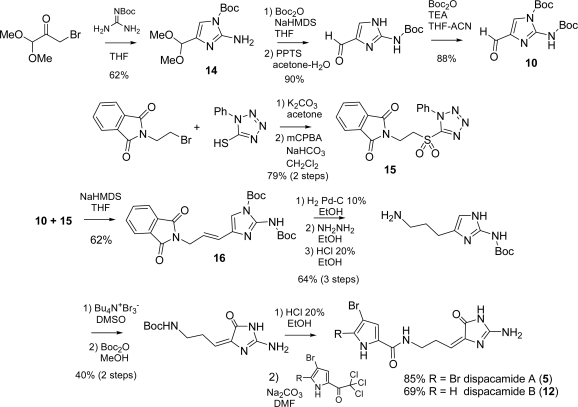
Several total syntheses of dispacamide A have hitherto been reported and reviewed, in particular by Lindel et al.. More recently, Ando et al. published a novel approach, which is described in Scheme 3 and was already mentioned in the oroidin subsection (see Scheme 1). In Ando’s strategy, the pyrrole part of the congeners for natural 2-aminoimidazole alkaloids was introduced at a later stage of the synthesis.
3-Bromo-1,1-dimethoxypropan-2-one and tert-butoxy-carbonylguanidine produced the functionalized aminoimidazole ring 14 in acceptable yield, which was then manipulated to furnish the suitably protected key intermediate 1,2-bis-tert-butoxycarbonylaminoimidazol-4-carbaldehyde (10).
The two building blocks 10 and 15 were then coupled via Julia olefination thus providing E olefin 16 in good yield and good selectivity. From 16, the syntheses of oroidin (1) and hymenidin (11) were achieved (steps not shown), while hydrogenating the double bond paved the way for the preparation of dispacamides A (5) and B (12). The imidazole nucleus was oxidized with tetra-n-butylammonium tribromide and the primary amino group needed to be selectively Boc-protected for ease of purification. Final amidation with trichloroacetyl-pyrroles led to the desired dispacamides and could be used (in principle) to readily prepare derivatives with structural motifs differing from those involved in the natural products.
Hymenialdisine
(Z)-Hymenialdisine [(Z)-HMD; 17, Figure 4] is the only PIA potently active as kinase inhibitor. As it showed nanomolar kinase inhibitory activity against a wide panel of kinases, it is potentially useful not only for the treatment of cancer, but also for illnesses such as Alzheimer’s disease and type 2 diabetes.
Nguyen and Tepe recently published a review offering an exhaustive overview on several aspects of these molecules. (Z)-HMD (17) was originally isolated from marine sponges of the genera Hymeniacidon, Acanthella, Axinella, and Pseudoaxinyssa, while (Z)-2-debromohymenialdisine (DBH) (19) came from the sponge Phakellia.
(Z)-Hymenialdisines differ only by the presence of a bromine atom in the pyrrole α-position; these compounds share a fused bicyclic pyrrole[2,3-c]azepin-8-one linked through a double bond with a glycocyamidine ring. A few groups contributed to characterize HMD and DBH with spectral and X-ray studies.
Both the (E) and (Z) isomers have been isolated; they interconvert in a pH- and concentration-dependent manner and (Z)-HMD (17) is the most abundant one, due to its higher thermodynamical stability.
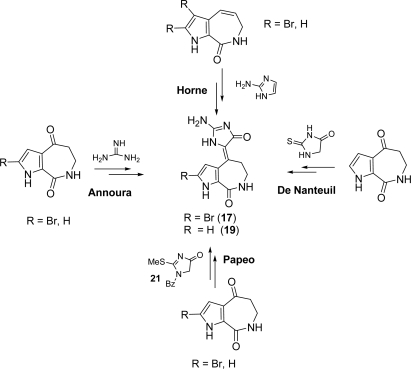
Synthetic approaches towards (Z)-HMD (17) and (Z)-DBH (19) have been reported (Scheme 4). 1-Benzoyl-2-methylsulfanyl-1,5-dihydroimidazol-4-one (21) employed in Papeo’s approach was also useful in the first total synthesis of (Z)-axinohydantoin (see Subsection 3.2).
Initially (Z)-HMD (17) was found to be slightly cytotoxic in PV4 cells (32.5% at 100 μg/ml). Meijer et al. extensively studied 17 from a structural and biological point of view. (Z)-HMD was found to be a competitive inhibitor of ATP (Ki = 50 nM) and it proved to be a potent inhibitor of kinases like Cyclin-Dependent Kinases, Glycogen Synthase-3β and Casein Kinase 1 (Table 1).
The structure of a CDK2-HMD complex was determined at 2.1 Å resolution, indicating the binding of 17 in the ATP binding pocket. The N1 atom of the pyrrole ring, the carbonyl oxygen and the amide nitrogen of the azepine ring form three hydrogen bonds with Glu81 and Leu83 of the CDK2 backbone. The pyrroloazepine bicyclic core is held in a shallow hydrophobic pocket by several van der Waals contacts with side chain atoms (31 of total 45). The bromine is partially exposed to the solvent and also packed against a few main-chain residues. In addition, the free NH2 group is involved in direct hydrogen bond formation with Asp145, while the glycocyamidine ring system makes other Van der Waals interactions together with two water-mediated hydrogen bonds with the main chain.
In spite of this high in vitro activity, 17 did not show significant inhibition in cells: only 40% of growth inhibition was reached at 100 μM in adenocarcinoma cells. This behaviour might be ascribed to the low permeability of the molecule.
However, being potent pan-kinase inhibitors, HMD and analogues represent a potential for the treatment of neurodegenerative disorders, inflammatory pathologies, diabetes and cancer. Different series of HMD analogues were synthesized in order to establish a SAR. In those derivatives, the main features that allow (Z)-HMD to bind in the kinase ATP binding site were left unchanged, while attempts have been performed in order to improve selectivity and permeability.
Axinohydantoins
(E)-Axinohydantoin (23) and (E)-debromoaxinohydantoin (25) were isolated from the sponges Axinella sp. and Monanchora, respectively (genera Hymeniacidon) (Figure 5). (Z)-Axinohydantoin (22) and (Z)-debromoaxinohydantoin (24) were subsequently isolated from the sponge Stylotella aurantium. Those latter secondary metabolites were also found in Hymeniacidon species (Figure 5).
Axinohydantoins are structurally related to HMD, but, in the former, the glycocyamidine ring is replaced by a hydantoin ring. While 22 displayed interesting micromolar inhibitory activity against a number of kinases (PKC, IC50 = 9 μM; GSK-3β, IC50 = 3 μM; CDK1/cyclin B, IC50 = 4 μM; CK1, IC50 = 4.5 μM; CDC5/p25, IC50 = 7 μM), 24 inhibits, always in the micromolar range, only protein kinase C (IC50 = 22 μM). In addition, a slight activity was found on murine P388 lymphocytic leukemia for (E)-axinohydantoin (23) (ED50 of 18 μg/mL).
The first total syntheses of 24 and 25 were reported by Horne et al.. Recently our group accomplished the first synthesis of (Z)- and (E)-axinohydantoins (22) and (23), along with a second generation synthesis of 24 and 25. To this purpose, the chemistry already optimized for HMD synthesis was successfully employed.
Aldisine (26) and 2-bromoaldisine (27), available in multigram scale, were coupled with the versatile intermediate 1-benzoyl-2-methylsulfanyl-1,5-dihydroimidazol-4-one (21) to afford intermediates 28 and 29, which were readily converted to the corresponding hydantoins 30 and 31 (Scheme 5).
Intermediates 28 and 29 are also potentially suitable for preparing new analogues via nucleophilic displacement of the methylthio group. The cleavage of the benzoyl protecting group and the slow double bond endo/exo isomerization sequentially occurred in the presence of NH2NH2·H2O, thus delivering debromoaxinohydantoins (82% overall yield, 24/25 ratio: 90/10) and axinohydantoins (67% overall yield, 22/23 ratio: 80/20), respectively (Scheme 6).
Dibromophakellstatin
(−)-Dibromophakellstatin 32 is a tetracyclic monomeric pyrrole-imidazole alkaloid, isolated from the Indian Ocean sponge Phakellia mauritiana in 1997 by Pettit et al., that showed interesting cell growth inhibitory activity against a minipanel of human cancer cell lines. Since then, several total syntheses of the racemic natural product have been reported and reviewed. The approaches by Lindel, Feldman, Austin and Chen for the construction of the tetracyclic core of rac-dibromophakellstatin are summarized in Scheme 7.
The first total synthesis of (−)-dibromophakellstatin 32 was accomplished by the Lindel group, who exploited the enantioselective version of their three-component imidazolinone annulation on a tricyclic enamide with TsONHCOOEt (Scheme 8). Hydroxyproline was chosen as source of stereogenic information and used for the synthesis of chiral enamide 33, where the TBS-protected hydroxy group, positioned in the preferred axial conformation, efficiently controlled the stereochemistry of the annulation, thus affording intermediate 34 as single diastereoisomer. The endgame to the natural product was put through by the reductive removal of hydroxy group after its conversion into alkylbromide 35 and treatment with SmI2 that, simultaneously, reduced the C-Br bond and deprotected imidazolone nitrogens to 36. Final bromination with NBS afforded (−)-dibromophakellstatin 32.
In late 2007, a careful investigation of the antitumor activity of dibromophakellstatin both as racemic mixture and as single enantiomers has been reported by Lindel. Rac-dibromophakellstatin was tested on a panel of 36 human tumor cell lines and proved to be active on ovarian (IC50 = 0.60 μM), glioblastoma (0.93 μM), non-small cell lung (0.96 μM) and uterus (1.21 μM) cancer cell lines. When inhibitory activity against these cell lines was tested for single enantiomers, only (−)-32 showed antitumor effects.
Agelastatins
Four closely related compounds belong to this class of tetracyclic PIAs. Agelastatin A (37) and its brominated congener agelastatin B (38) were isolated in 1993 from the marine sponge Agelas dendromorpha by Pietra and co-workers. They were fully characterized by using a combination of molecular modelling, NMR and exciton splitting. Few years later two new metabolites, namely agelastatin C (39) and agelastatin D (40) were isolated from the extracts of the sponge Cymbastela sp. by Molinski and co-workers (Figure 6).
These natural products display a densely functionalized tetracyclic core with four contiguous stereocenters, which is an enticing and synthetically challenging structural motif. Agelastatin A (37) is reported to exhibit significant biological activity. After its recognition as cytotoxic agent towards KB cells at concentration below 1 μg/mL, Pietra and Pettit research groups showed a powerful activity of 37 against a wide range of cancer cell lines such as human KB nasopharyngeal cancer cells, L1210 murine tumor cell line, RT112/84 bladder carcinoma cells, SK-MEL-5 melanoma cells, HCT-116 colon carcinoma cells, and MDA-MB-435s breast cancer cells. Comparative studies showed that agelastatin A inhibited tumor cell growth from 1.5 to 16 times more potently than cisplatin, particularly, against human bladder, skin, colon, and breast carcinomas.
Very recently, agelastatin A (37) was demonstrated to be very effective in down-regulating the expression of β-catenin and in up-regulating Tcf-4, an inhibitor of osteopontin (OPN) at the cellular level. These two effects result in repression of OPN and inhibition of OPN-mediated malignant cell invasion, adhesion, and colony formation in vitro. Longley also highlighted that agelastatin A’s ability in inhibiting β-catenin, which also controls transcription from the multidrug resistance 1 gene, could be helpful in reducing drug resistance issues, possibly both as single agent as well as in combination therapy. Together with its cytotoxic activity, agelastatin A was also envisioned as inhibitor of glycogen synthase kinase-3 β (GSK-3β), an enzyme responsible for the neurofibrillary tangles typically found in Alzheimer’s disease, and as a mimetic of insulin.
The impressive biological activity, together with its scarce availability, prompted many synthetic chemists to engage in the total synthesis of 37. To date, fourteen total syntheses have been achieved, each presenting different strategies to assemble the tetracyclic core of agelastatin A.
In analogy to the previously published papers, the most recently reported syntheses of 37 show very different and elegant retrosynthetic analyses which represent a clear example of the creativity in the “art of total synthesis”. The key structures involved in the achievement of agelastatin A synthesis are represented in Figure 7.
Trost and Dong applied a metal-catalyzed asymmetric allylic alkylation (AAA) to the synthesis of 37 by using pyrroles and N-alkoxyamides (hydroxamic esters) as nucleophiles. Key intermediate 43 was obtained using an AAA between bisallylic carbonate 41 and the bifunctional nucleophile 42. The challenging task, aimed at chemoselectively differentiating the two nucleophilic nitrogens in 42, successfully allowed a tandem cyclization to obtain pyrrolopiperazinone 44 (Scheme 9).
The Kresze reaction was used to carry out an allylic amination on 44. Subsequent treatment of 45 with methyl isocyanate gave urea 46 (Scheme 10). Hydroboration followed by NaBO3-mediated peroxidation gave alcohol 47 which, after Dess-Martin periodinane (DMP) oxidation and protective group removal, afforded (−)-37.
Ichikawa and co-workers achieved the total synthesis of (−)-37 by using a strategy involving a [3.3] sigmatropic rearrangement of an allyl cyanate as the key step. The synthesis started with an elegant transformation of L-arabitol 48 to obtain allyl carbamate 49. Subsequent dehydration afforded allyl cyanate 50, which rearranged to 51 with a chirality transfer of the stereogenic center via a concerted six-membered transition state (Scheme 11).
Further manipulations gave compound 52, which was in turn subjected to ring-closing metathesis using first generation Grubb’s catalyst thus securing cyclopentene 53. Introduction of the carbamate functionality followed by its dehydration delivered a substrate prone to a subsequent [3.3] sigmatropic rearrangement which, after isocyanate trapping, gave the vicinal diamine 54 (Scheme 12). The total synthesis of (−)-37 was then completed in eight steps.
Yoshimitsu, Ino and Tanaka reported the total synthesis of 37 starting from enantiomerically pure aminoalcohol 55 which was converted in the pivotal azidoformate 56 in five steps (Scheme 13). Vicinal dinitrogen functionalities were introduced through thermal aziridination of the π-bond followed by ring opening, thus obtaining azide 57. Lactamization proceeded smoothly after azide reduction and nitrile hydrolysis affording carbamate 58, which was opened using methylamine. The resulting alcohol was carefully oxidized using TPAP, and the derived ketone was trapped in situ by the vicinal urea nitrogen. This extremely concise synthesis was completed via pyrrole bromination (Scheme 13).
One year later the same research group proposed a second-generation approach affording a streamlined process to obtain agelastatin A (37). This synthesis is based on an iron halide-triggered radical aminohalogenation. Intermediate 59 was considered the most suitable substrate because of its restricted mobility, which might improve the stereochemical outcome of the reaction during the halogen transfer step. After extensive investigations, the authors reported that the best results were achieved by performing the reaction in ethanol with FeBr2 as radical initiator in the presence of bromide salts, such as LiBr or Bu4NBr. Azidoformate 59 was thus treated under the abovementioned conditions delivering bromide 60 in satisfactory yield, which was in turn reacted with NaH in DMF affording lactam 58. Agelastatin A (37) was finally obtained in further three steps as outlined below (Scheme 14).
Intramolecular olefin aziridination was used in 2009 by Wehn and Du Bois to forge agelastatin A. In their synthesis, sulfamate 61, easily prepared starting from commercially available materials, was subjected to aziridination in the presence of dimeric RuII catalyst in order to obtain 62, which was then regioselectively opened to give oxathiazepane 63. Interestingly, the catalyst was reported to be very effective, allowing very low loading (0.06 mol%) and high turnover number (>1500) thus enabling an easy and inexpensive scale-up. Key polyamine intermediate 64 was secured from 63 by treatment with ethylpyrocarbonate and then with NaSePh (Scheme 15).
After construction of the central core, agelastatin A was obtained in seven steps. Racemic 37 was recently prepared by Dickson and Wardrop using a synthetic route in which a trichloroacetamide group plays the simultaneous role of a protecting group, a pendant nucleophile assisting the cyclofunctionalization and the latent urea required for the imidazolinone ring construction. The key compound all cis-substituted cyclopentene 68 has been obtained starting from the imidate 65, which after heating in xylenes, gave, through Overman rearrangement, trichloroacetamide 66. Compound 67 was obtained upon treatment with N-bromoacetamide followed by DBU-mediated debromination. Exposure of dihydrooxazole 67 to p-toluenesulfonic acid gave key compound 68 (Scheme 16).
Advanced intermediate 69 was easily obtained from 68 by converting the hydroxy group into the corresponding phthalimide under Mitsunobu conditions followed by installation of the urea moiety through displacement of the trichloroacetamide group. Tricycle 70 was forged by hydrazine-mediated phthalimide removal, coupling with 2-pyrrole carboxylic acid, acetate ester methanolysis, oxidation and base-mediated intramolecular cyclization. This synthesis was completed by removing the benzyl group with simultaneous imidazolidinone ring formation. Regioselective pyrrole bromination afforded (±)-37 (Scheme 17).
Chida and co-workers envisioned diaminocyclopentene 74 as key intermediate for their agelastatin A synthesis. In order to obtain 74, bis-trichloroimidate 71, prepared in seven steps from commercially available d-tartaric acid, was subjected to a sequential Overman rearrangement. Allylic sulfide 72 thus obtained was oxidized to sulfoxide and, in the presence of P(OMe)3, underwent the Mislow-Evans rearrangement to diolefin 73. Grubbs’ catalyst provided smooth access to 74, which was finally converted into oxazoline 75 (Scheme 18).
Removal of the trichloroacetyl group in 75 with DIBAL, condensation of the resulting amine with 2-bromopyrrol-5-yl carboxylic acid, followed by hydrolysis of oxazoline and THP protection of the secondary alcohol afforded 76. In order to carry out the aza-Michael addition to construct the piperazinone ring, intermediate 76 was converted into protected N-methylurea 77 by treatment with 2,4-dimethoxybenzylmethyl amine (MeNHDMB). Removal of THP and oxidation of the secondary alcohol gave α,β-unsaturated ketone 78 which, in turn, underwent the final aza-Michael addition. Targeted (−)-37 was isolated in satisfactorily yield after oxidative cleavage of DMB group (Scheme 19).
Nagelamide D
Nagelamide D (79) has a connection between C-10 and C-15′ of its oroidin monomer units and was isolated as a racemate by Kobayashi’s group in 2003 from Okinawan marine sponges of the genus Agelas. Some antibacterial activity was reported against Micrococcus luteus (MIC, 4.17 μg/mL), Bacillus subtilis (MIC, 33.3 μg/mL) and Escherichia coli (MIC, 33.3 μg/mL). Nagelamide D (79) was synthesized by Lovely group in 2009 according to the retrosynthetic pathway depicted in Scheme 20. The envisioned strategy foresees a cross-coupling reaction between imidazolyl fragment A and vinyl fragment B, both accessible from a common precursor, the protected diiodoimidazole 80.
The two actual fragments 81 and 82 were coupled according to the Baldwin procedure for fluoride-mediated Stille reaction, providing bis-vinylimidazole 83 in good yield after treatment with TBAF to complete the partial desilylation. The next step was a catalytic hydrogenation to saturate both double bonds (Scheme 21).
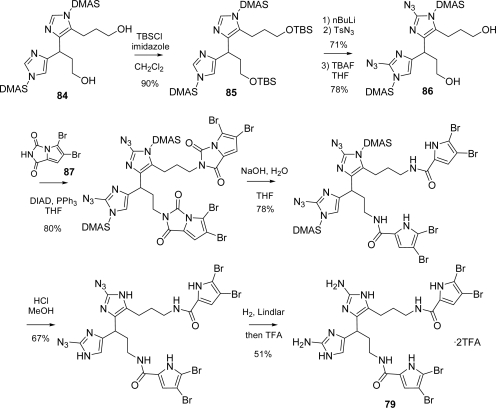
Diol 84 was then protected as bis tbutyl-dimethylsilylether 85 and then transformed into the bis azide 86, before desilylation of the hydroxy groups with TBAF (Scheme 22). At this point, the two bromopyrrole moieties were introduced by means of a double Mitsunobu reaction with dibromopyrrolohydantoin derivative 87, which completed the formation of the nagelamide D full skeleton. The pyrrolohydantoin rings were then hydrolyzed, followed by imidazole deprotection with methanolic HCl. Azides were finally reduced over Lindlar catalyst affording nagelamide D (79), which was isolated as its TFA salt.
The authors reported that 1H-NMR of synthetic nagelamide D did not match that of the naturally occurring material; moreover, they were unable to get original NMR data from Kobayashi in order to unravel this inconsistency. Lovely also mentioned an unpublished biomimetic total synthesis of nagelamide D by Horne et al., whose spectroscopic data perfectly matched the ones from Lovely group. The question whether the assigned structure or Kobayashi’s NMR data are in error remains open (on the subject see also Usami).
Sceptrin
Sceptrin (8) (Figure 8) was isolated in 1981 by Faulkner and Clardy from Agelas sceptrum. It is a dimeric pyrrole imidazole alkaloid formally made up by two hymenidin (11) subunits. The biogenetic hypothesis derives sceptrin from hymenidin (11) via an enzyme-mediated [2+2]-cycloaddition.
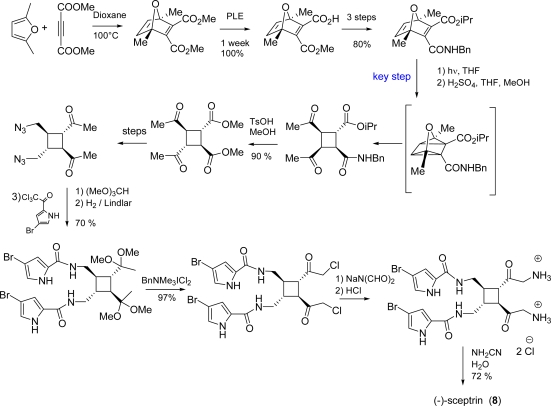
After some unfruitful attempts to synthesize sceptrin from urocanic acid derivatives, Baran and Birman independently reported the synthesis of racemic sceptrin in 2004; two years later, the first enantioselective synthesis of (−)-sceptrin was published (Scheme 23). Main hallmarks of this approach are: minimal use of protecting groups (benzylamide proved to be crucial for a complete transfer of chirality);application of an oxaquadricyclane rearrangement/fragmentation in natural product synthesis to diastereoselectively access the cyclobutane core of sceptrin;application of a new chemo- and regioselective halogenation method;formation of 2-aminoimidazole in mild conditions (these moieties were voluntarily introduced at a later stage of the synthesis because the earlier introduction of this step resulted in compounds intractability).
minimal use of protecting groups (benzylamide proved to be crucial for a complete transfer of chirality);
application of an oxaquadricyclane rearrangement/fragmentation in natural product synthesis to diastereoselectively access the cyclobutane core of sceptrin;
application of a new chemo- and regioselective halogenation method;
formation of 2-aminoimidazole in mild conditions (these moieties were voluntarily introduced at a later stage of the synthesis because the earlier introduction of this step resulted in compounds intractability).
Sceptrin has useful biological properties, like antibacterial and antiviral, antihistaminic and antimuscarinic activity; besides, it is a natural inhibitor of somatostatin. Recently, Rodriguez and his group, through bidirectional affinity experiments, identified sceptrin as being able to bind to MreB, a cell wall regulator, and thus a validated antibiotic target. When sceptrin interacts with MreB, cell wall disruption was observed.
Ageliferin
Ageliferins (9, 88 and 89, Figure 9) are dimeric pyrrole-imidazole alkaloids that have been isolated from the sponge Agelas conifera. This family of natural products showed antimicrobial and antiviral activity as well as actomyosin ATPase activation. Ageliferins, like the majority of alkaloids originated by sponges of the genus Agelas, are feeding deterrents.
The chemical defence that sponges adopt against predatory reef fishes has been investigated and measured, revealing that ageliferins, together with their close relatives sceptrins, are responsible for deterrence in the sponge Agelas conifera. Biogenetically, ageliferin (9) was hypothesized to derive from hymenidin (11) via an enzyme-mediated [4+2]-cycloaddition that infers chirality to achiral precursors, as well as an enzyme-catalyzed [2+2]-cycloaddition generates sceptrin (8) (Figure 10).
Since its isolation and identification, several synthetic efforts aiming at the synthesis of 9 were based on this biogenetic hypothesis. In 2004 Baran and co-workers speculated about the extracts composition of Agelas conifera (Figure 11), in which sceptrin was dramatically more abundant than ageliferins. If the two families of alkaloids derived from the same linear precursor via two different cycloaddition pathways, ageliferins should be thermodynamically more abundant than sceptrins in the extract.
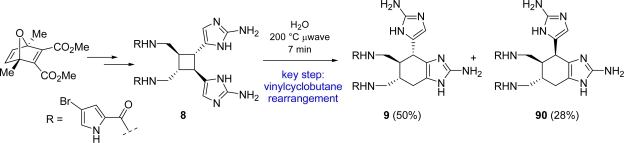
An alternative biogenetic pathway was then postulated involving a formal-sigmatropic rearrangement of sceptrin followed by a double bond isomerisation (Figure 10). According to this hypothesis, the vinylcyclobutane of rac-sceptrin was efficiently converted into the cyclohexene core of rac-ageliferin under microwave irradiation and some speculations on the reaction mechanism have been reported. Two years later, Baran and co-workers published the accomplishment of the total synthesis of (−)-sceptrin (8), whose subsequent microwave-mediated vinylcyclobutane rearrangement yielded the naturally occurring (−)-ageliferin (9) (40% yield along with unreacted sceptrin). The scale-up of the reaction and the prolonged heating resulted in the formation of epi-ageliferin, later christened nagelamide E (90), which was synthesized for the first time (Scheme 24).
Among the mechanistic speculations originally reported, the hypothesis of a 6-endo-trig recombination and olefin isomerization of the diradical intermediate deriving from the radical scission of the cyclobutane ring, showed to be more consistent with the observed partial stereochemical erosion.
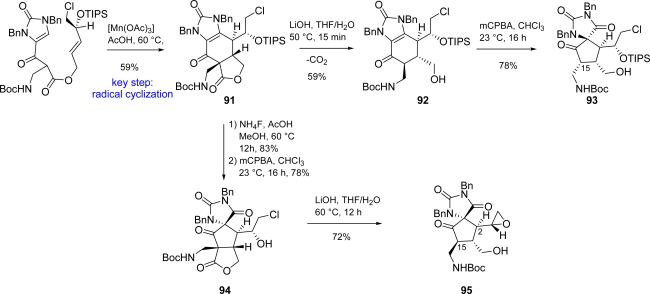
A different approach to the core skeleton of ageliferin, as well as other oroidin cyclic dimers, has been reported by Chen et al. in 2006, who exploited a regiocontrolled MnIII-mediated oxidative heterobicyclization of a β-ketoester for the construction of tricycle 91. The reaction proceeded through a 5-exo/6-endo radical cyclization pathway (Scheme 25).
Hydrolysis of 91 revealed ageliferin core 92, which was oxidatively rearranged to massadine skeleton 93 despite epimerization at C15. Lactone 91 can be oxidized after removal of the TIPS protective group, generating the spiro-derivative 94 with opposite facial selectivity. Subsequent hydrolysis afforded intermediate 95, which bears the palau’amine spiro-skeleton, but opposite relative configurations at C2 and C15.
In mid-2009 an alternative approach has been described by Lovely, who exploited a thermal intramolecular Diels-Alder (IMDA) on enyne 96 for the construction of the intermediate 97, which could be converted to ageliferins core 98 or, in turn, rearranged under oxidative conditions in the presence of Davis’ oxaziridine (99) to the palau'amine nucleus 100 (Scheme 26).
Palau’amine
The hexacyclic bisguanidine palau'amine (101) was isolated in 1993 by Scheuer and co-workers from the sponge Stylotella agminata. It showed cytotoxicity against some tumor cell lines as well as antibiotic and antifungal activity. The relative configuration initially assigned (101a) to the structure implies a cis junction of the azabicylo[3.3.0]octane moiety and a cis relationship between the chlorine atom and the aminomethyl chain (Figure 12).
Later, while reporting the isolation and structure elucidation of tetrabromostyloguanidine (102) (also named carteramine A), Matsunaga and Köck raised the question for a revision of the assigned structure of palau'amine, according to NMR data and computational experiments on related compounds. Finally, in 2007 Quinn et al. reported the correct structure of palau'amine (101b), entailing an inversion of configuration at C12, C17 and C20 (Figure 12) resulting in a thermodynamically less obvious trans-fused azabicylo[3.3.0]octane moiety and with the chlorine atom being trans to the vicinal aminomethyl chain.
In 1998 Scheuer proposed palau'amine as biogenetically arising from a Diels-Alder reaction between 11,12-dehydrophakellin (103) and 3-amino-1-(2-aminoimidazolyl)prop-1-ene, followed by a chloroperoxidase-catalyzed chlorination that initiates a 1,2-shift/ring contraction and water addition (Scheme 27).
The revision of the structure of 101 exerted a profound influence on the biogenetic hypothesis concerning dimeric PIAs (see Subsection 1.1 and Figure 13).
Since its isolation, efforts towards the total synthesis of palau'amine have been increasing. Recently Baran et al. have reported the total synthesis of axinellamines and massadines. These achievements may represent the prelude for the completion of their own strategy toward palau'amine.
Lovely exploited an intramolecular Diels-Alder approach (IMDA) for the construction of the intermediate 97 (see Scheme 26) that, after stereoselective double bond reduction, was subjected to an oxidative rearrangement thus securing the spiro-fused system of palau'amine (100). To this purpose Davis' reagent (99) delivered better results than its ancestor dimethyldioxirane.
Chen reported a regiocontrolled MnIII-mediated oxidative heterobicyclization of a β-ketoester yielding the spiro intermediate 95 after suitable modifications (Scheme 25).
Romo succeeded in the synthesis of the trans-fused azabicyclo[3.3.0]octane core of palau'amine by exploiting a biomimetic chlorination and a concomitant 1,2 shift/ring contraction of 104 for the construction of cis-fused intermediate 105.
Subsequent selective deprotection, followed by simultaneous ring cleavage/epimerization with sodium methoxide afforded the anti-substituted cyclopentyl ester 106. Further manipulations yielded trans-azabicyclo[3.3.0]octane 107 (Scheme 28).
The tricyclic prolinol derivative 107 was envisioned to be a suitable substrate for the application of the oxidative annulation strategy that recently provided the first enantioselective synthesis of (+)-phakellin from prolinol by Romo’s group. This approach would lead to the targeted palau'amine (101).
Overman’s approach foresees thiosemicarbazide annulation on a densely functionalized 4,5-dihydropyrrole-2-carboxylate 108 as the key step for the assembly of a triazatriquinane 109, precursor of the cis-fused tetracyclic skeleton of epi-palau'amine. Evolution of intermediate 109 by means of a SmI2-mediated N-N bond reduction yielded 110.
The following insertion of a spiro glycocyamidine ring, a subsequent TBAF-promoted cyclization for the assembly of the ketopiperazine moiety and further manipulations, resulted in the synthesis of hexacyclic congeners 111 and 112 of epi-palau’amine, bearing a cis configuration at the azabicyclo[3.3.0]octane core (Scheme 29).
Harran exploited a different approach to palau'amine following his biogenetic proposal which was based upon a spirocycloisomerization of tethered alkylidene glycocyamidines. For this purpose, tetrahydropyridazine (113) has been acylated with acyl chloride 114 and subsequently elaborated to intermediate 115, from which target monomer 116 was derived by mild thermolysis in the presence of HgCl2.
Treatment of 116 with (i-PrCp)2TiCl2 prior to KHMDS, followed by exposure to FeCl2(DMF)3FeCl4, generated 117 as mixture of meso and C2 isomers. Hydrosilylation of 117, performed on the C2 isomer, and reduction mediated by proazaphosphatrane 118 yielded the partially debrominated bis-alkylidene derivative 119 that underwent spirocyclization in the presence of t-BuOCl affording the spirocyclic core of palau'amine 120 (Scheme 30).
Axinellamines
Like palau’amine (101), axinellamines (121–124), massadines (125, 126) and stylissadines (2, 3) (Figure 13) are PIAs with a high degree of complexity and for this reason they are appealing targets for total synthesis.
Axinellamines (121–124) were first isolated from Axinella sp.. Their architecture is characterized by important stereogenicity (8 contiguous stereocenters) and a fully decorated cyclopentane ring. Moreover, axinellamines B-D (122–124) display antibacterial activity against Helicobacter pylori, a bacterium implicated in pepticular and gastric cancer (minimum inhibitory concentration (MIC) for bactericidal action against H. pylori at 1000 μM). Several papers have been published reporting synthetic efforts toward the synthesis of axinellamines and some of them have already been reviewed.
The key intermediate in the synthesis of axinellamines is the elaborated cyclopentane ring A (Figure 14), also common to palau’amine, massadine, styloguanidine (127, Figure 13) and stylissadines. The first enantioselective synthesis toward an analogue of A, which exploited the desymmetrization of 128, was reported by Carreira et al. in 2000.
Many approaches to this intermediate were envisioned and they can be classified into four main categories (Figure 14): a) linear, b) ring contraction,, c) ring expansion (this approach still awaits experimental realization) d) abiotic.
The first total synthesis of axinellamine A (121) and B (122) was completed by Baran et al. in 2008 starting from 129 and using an extremely straightforward approach. Key step was an oxidation (by means of AgII complex 132, Scheme 32), on polyfunctionalized intermediate 131. Both regioselectivity and overoxidation control of this reaction proved to be very impressive. Synthesis of key intermediate 131 required 17 steps with an overall yield of 1.3% (Scheme 31).
Starting from advanced intermediate 131, the synthesis of 121 and 122, as racemic mixture, was then completed in 6 steps and an overall yield of approximately 0.3% (Scheme 32).
Massadines
Starting from 130, Baran et al. synthesized also massadine (125) and massadine chloride (126), a precursor of the daunting stylissadines (Figure 13).
Massadine was first isolated in 2003 from the marine sponge Stylissa aff. Massa. Like the axinellamines, it is a dimeric pyrrole-imidazole alkaloid. Its peculiarity is due to the presence of a hydroxy group at C14 that renders this compound unique among the dimeric PIAs (Figure 13). Massadine (125) is biologically active as inhibitor of geranylgeranyltransferase type 1 from Candida albicans with IC50 of 3.9 μM. A postulated biosynthetic precursor of 125 is massadine chloride (126), first isolated from Stylissa caribica. Massadine chloride possesses a chlorine atom at C14, as in axinellamines (121–124) (C13), palau’amine (101) (C17) and tetrabromostyloguanidine (102) (C17) (Figure 13).
Syntheses of these alkaloids proved soon to be challenging due to the presence of many functional groups leading to several failed approaches. Finally, 125 and 126, together with their unnatural C3,C7 epimers succumbed to total synthesis as reported in Scheme 33.
The key step of the synthesis was again the silver(II)-mediated oxidation reaction already reported in the synthesis of axinellamines (see Scheme 32). An optimization of the reaction conditions was necessary for massadines synthesis and led to the finding that TFA accelerates the oxidation, thus providing a general method to chemoselectively oxidize unprotected guanidines. Also the axinellamines synthesis overall yield was improved, obtaining 133 and 134 (Scheme 32), in shorter reaction times and at room temperature. The subsequent treatment of 135 with cyanamide required controlled pH conditions giving 136 along with its hydroxy analogue 137 (Scheme 33). The same reaction sequence was performed on both 136 and 137 leading to massadine chloride (126) and massadine (125) respectively, although each one associated with the corresponding C3,C7-epimer. Both 126 and 3,7-epi-(126) can be converted to their hydroxy analogues, 125 and 3,7-epi-(125), in warm water, probably involving a nucleophilic substitution mechanism with retention of configuration via a massadine aziridine species.
Stylissadines
Stylissadines (2 and 3, Figure 1 and 13) are tetrameric members of PIAs. Structurally, they are ether-linked dimers of massadine and thus the largest and the most complex structures within the oroidin family of alkaloids discovered so far. Stylissadine A (2) is the formal condensation product of two molecules of massadine (125) and it has a C2 symmetry. Stylissadine B (3), on the contrary, does not have a C2 symmetry because the C-2’ stereocenter is inverted. Both have biological activity (2: IC50 = 0.7 μM; 3: IC50 = 1.8 μM) as antagonists of the P2X7 receptor involved in inflammatory diseases, but their high molecular weight and structural complexity render them hard to develop as drugs. Efforts to convert massadine chloride into stylissadines are underway in Baran’s group.
Ageladine A
In 2003, Fusetani et al. isolated the fluorescent alkaloid ageladine A (138) from the sponge Agelas Nakamurai by a bioassay-guided extraction. Ageladine A is reported to inhibit several matrix metalloproteinases (MMPs-1, -2, -8, -9, -12 and -13). As it has been demonstrated that 138 does not chelate zinc ion like all known MMP-inhibitors do, the natural product probably operates with a completely different mechanism of action. Ageladine A showed also antiangiogenic effects. Moreover it is the first isolated PIA containing a 2-aminoimidazolopyridine moiety.
In the same paper, Fusetani also hypothesized a possible biogenesis of ageladine A: amino acids proline and histidine evolve to dibromopyrrole carboxyaldehyde and histamine, respectively. They subsequently generate intermediate imine 139, which undergoes oxidative intramolecular cyclization to afford 138 (Figure 15).
Since its isolation, quite a few total syntheses have been reported and recently reviewed. As shown in Figure 16, the first generation Weinreb approach toward 138 settled a 6π-1-azatriene electrocyclization as the key step, while a biomimetic synthesis was reported one year later by the same group exploiting a 6π-2-azatriene electrocyclization. In the meantime Karuso et al. published an elegant, two-step, biomimetic synthesis of ageladine A starting from 2-aminohistamine and 4,5-dibromo-2-formylpyrrole and moving through a Pictet-Spengler-type condensation.
An evaluation of the MMP-12 inhibition efficiency of ageladine A and its analogues has been reported by Ando and co-workers, confirming that the two bromine atoms and the NH groups are essential for the biological activity. Moreover very recently it has been demonstrated that 138 is a reliable and stable fluorescent pH sensor. Because of its permeability it can be used for detection of intracellular pH changes.
Conclusions
Pyrrole-imidazole alkaloids (PIAs), a quite enlarged family of metabolites exclusively found in marine sponges, fascinate the scientific community for several reasons. Although the isolation of the first representatives of this family dates back to the ‘70s, new relatives continue to be unveiled, thus requiring a parallel fine-tuning in the speculations around their biogenesis and their ecological role in the sponges. Moreover, the quest to support hypotheses with experimental data, by increasing our knowledge in sponges’ biochemistry, proved to be encumbered by the difficulties in artificial sponge cell culturing. Challenges are also plentiful from a synthetic point of view. Architectural complexity, unusually high nitrogen content (N/C ≅ 1:2), structural revisions, unknown absolute stereochemistry are just some of the dreadful aspects one has to take into account while planning a total synthesis of these alkaloids. Those synthetic efforts however should not be considered just as simple intellectual divertissements: some PIAs are gifted with promising biological activities, and larger availability of these compounds is key in developing more accurate pharmacological profiles.
Figures49
From PubMed Central, U.S. National Library of Medicine. Licence: CC BY.
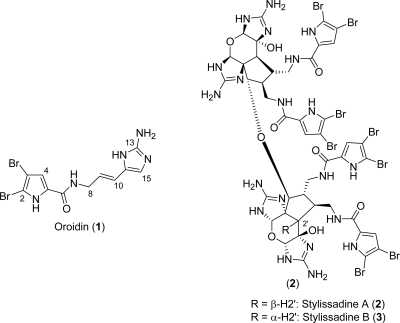
Figure 1.
Full legend
PIAs complexity extremes.
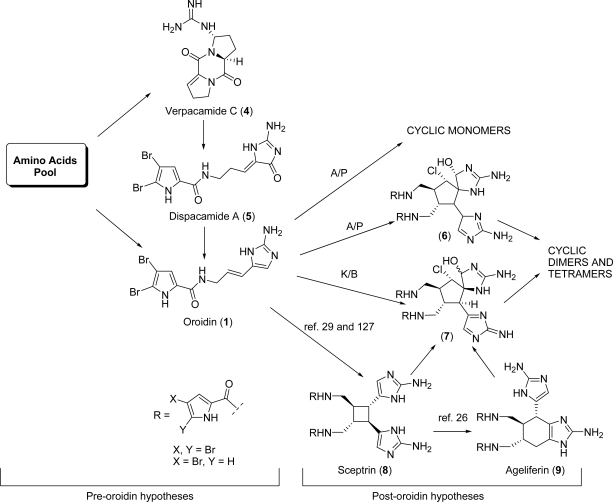
Figure 2.
Full legend
PIAs biogenetic speculations.
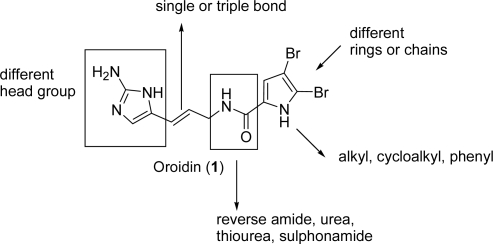
Figure 3.
Full legend
Examples of oroidin modification towards antibiofilm inhibitors.
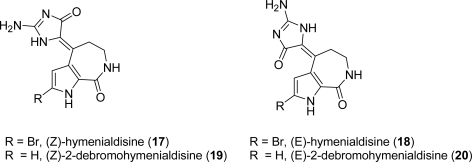
Figure 4.
Full legend
Structures of HMD and DBH.
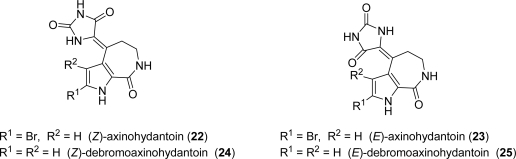
Figure 5.
Full legend
Axinohydantoins.
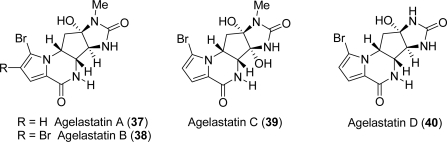
Figure 6.
Full legend
Agelastatins.
Show all 49 figures
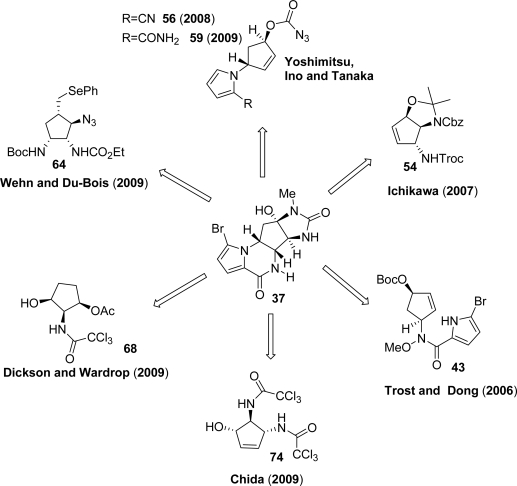
Figure 7.
Full legend
Different synthetic routes to achieve agelastatin A total synthesis.
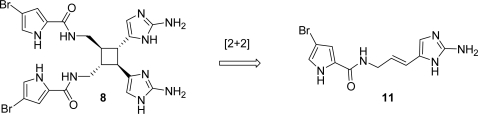
Figure 8.
Full legend
Proposal for the biogenetic origin of sceptrin (8).
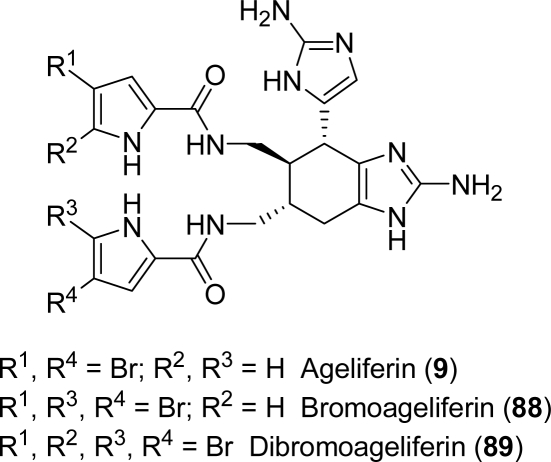
Figure 9.
Full legend
Ageliferins.
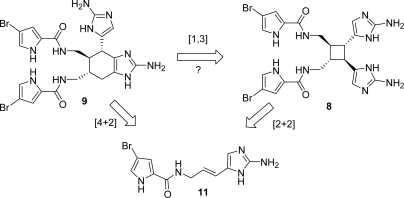
Figure 10.
Full legend
Proposal for biogenetic origin for ageliferin (9).
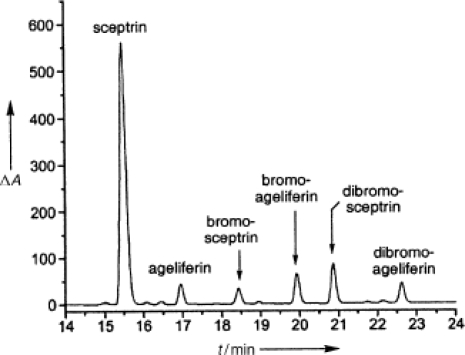
Figure 11.
Full legend
Extracts composition of Agelas conifera. Reproduced with permission from Verlag Z. Naturforsch. [145].
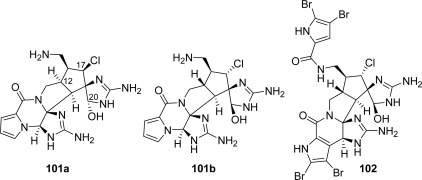
Figure 12.
Full legend
Previously assigned (101a) and revised (101b) structure of palau’amine.
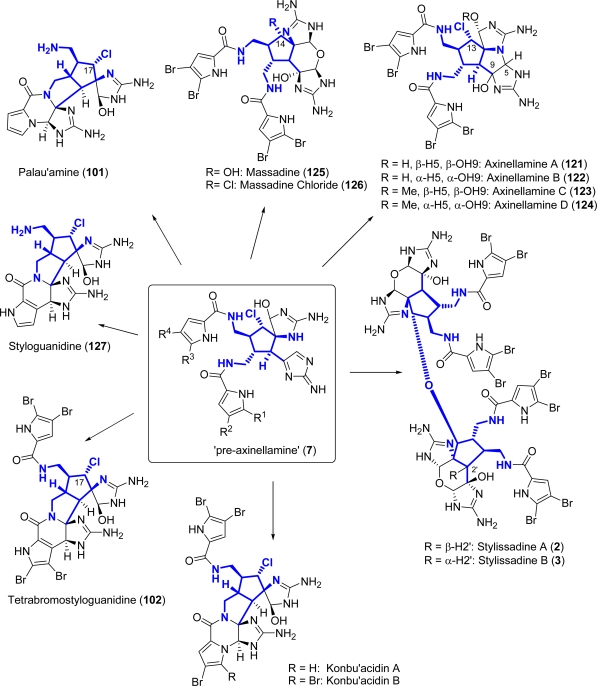
Figure 13.
Full legend
Structurally related PIAs cyclic dimers.
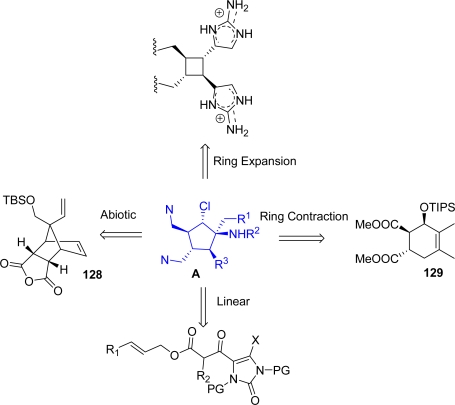
Figure 14.
Full legend
Different approaches toward intermediate A.
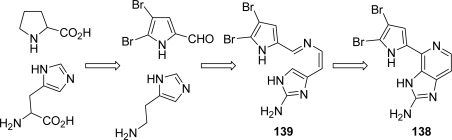
Figure 15.
Full legend
Proposed biogenesis for ageladine A (138).
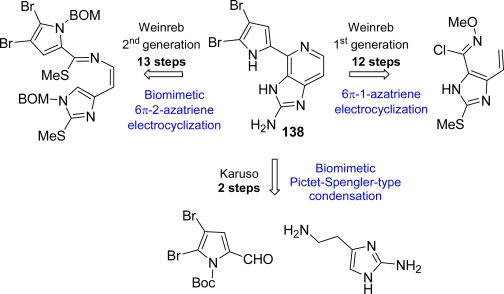
Figure 16.
Full legend
Approaches to ageladine A (138).
Scheme 1.
Full legend
Approach to oroidin and related compounds via intermediate 10.
Scheme 2.
Full legend
The Al Mourabit synthesis of oroidin.
Scheme 3.
Full legend
Ando’s synthesis of dispacamide A.
Scheme 4.
Full legend
Synthetic approaches to (Z)-HMD (17) and (Z)-DBH (19).
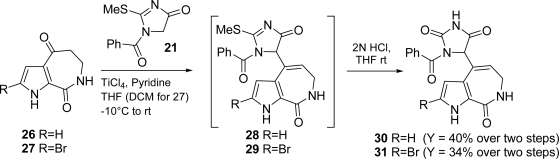
Scheme 5.
Full legend
Northern ring installation.
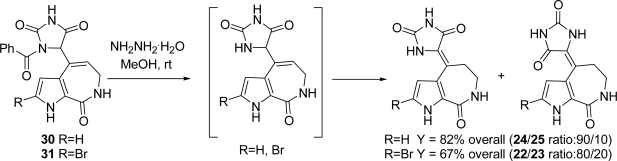
Scheme 6.
Full legend
Benzoyl removal and double bond isomerization.
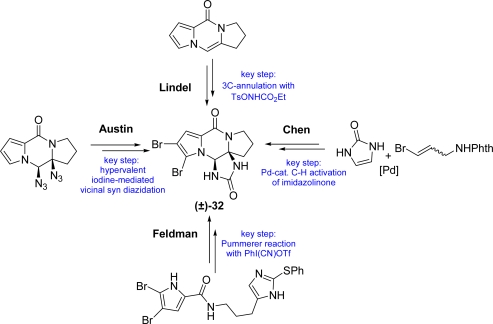
Scheme 7.
Full legend
Racemic approaches to (±)-dibromophakellstatin 32.
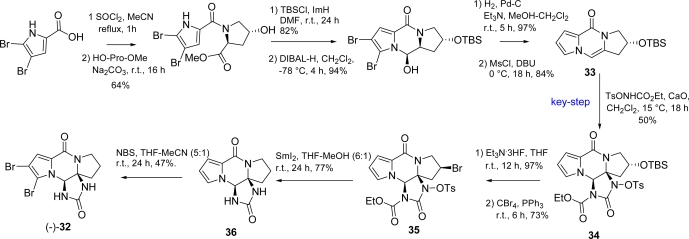
Scheme 8.
Full legend
Enantioselective synthesis of (−)-32.

Scheme 9.
Full legend
Tandem Pd-AAA reported by Trost and Dong.
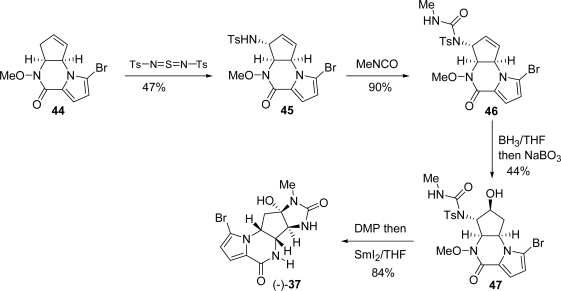
Scheme 10.
Full legend
Completion of the Trost (−)-agelastatin A synthesis.

Scheme 11.
Full legend
Allyl cyanate [3.3] sigmatropic rearrangment involving a [1,3] chirality transfer.
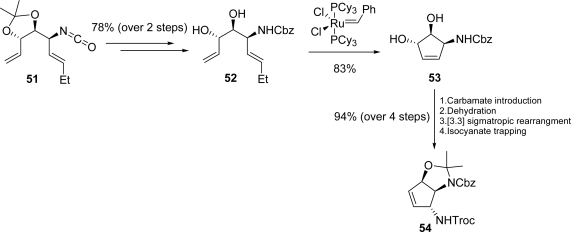
Scheme 12.
Full legend
Access to key vicinal diamine 54.
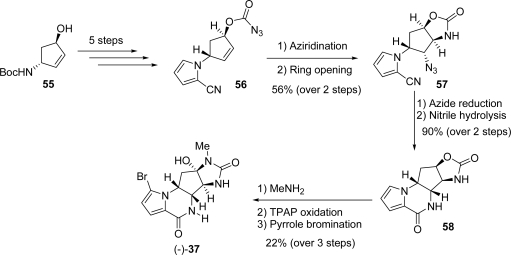
Scheme 13.
Full legend
Aziridination reaction used in agelastatin A synthesis.

Scheme 14.
Full legend
Yoshimitsu and Tanaka’s second-generation approach to (−)-37.

Scheme 15.
Full legend
Synthesis of selenide key intermediate 64.

Scheme 16.
Full legend
Synthesis of all cis-substituted cyclopentene 68.
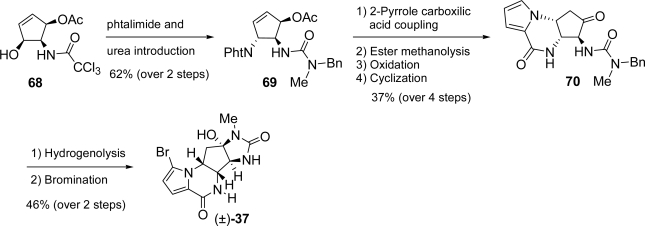
Scheme 17.
Full legend
Completion of (±)-37 synthesis according to Dickson and Wardrop.
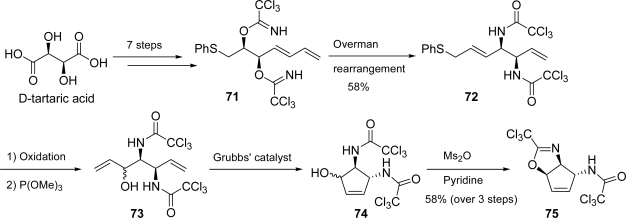
Scheme 18.
Full legend
Synthesis of key compound 75.
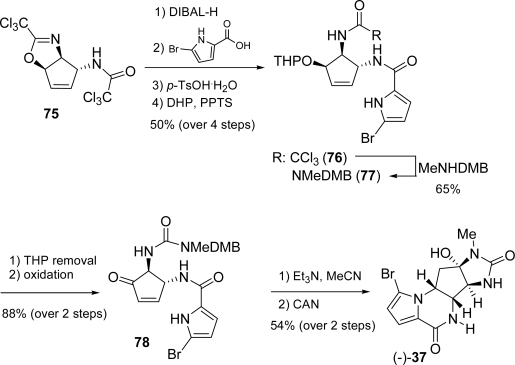
Scheme 19.
Full legend
Chida and co-workers completion of (−)-37 total synthesis.
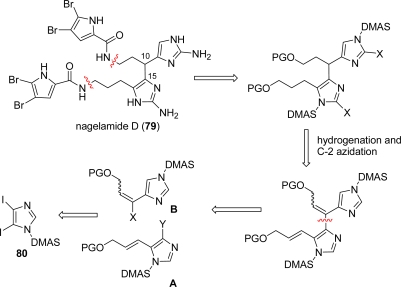
Scheme 20.
Full legend
Retrosynthetic approach to Nagelamide D (79).
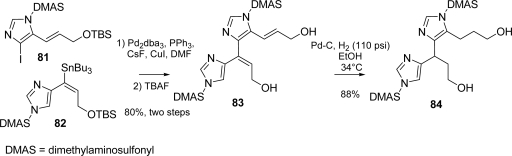
Scheme 21.
Full legend
Nagelamide D: Fragment Assembly and Reduction.
Scheme 22.
Full legend
Completion of the synthesis of nagelamide D (79).
Scheme 23.
Full legend
Baran’s total synthesis of (−)-sceptrin (8). PLE = pig liver esterase, DMT-MM = 4-(4,6-dimethoxy[1,3,5]triazin-2-yl)-4-methylmorpholinium chloride.
Scheme 24.
Full legend
Enantioselective synthesis of (−)-ageliferin (9) and (−)-nagelamide E (90).
Scheme 25.
Full legend
Chen approach to oroidin cyclic dimers core.
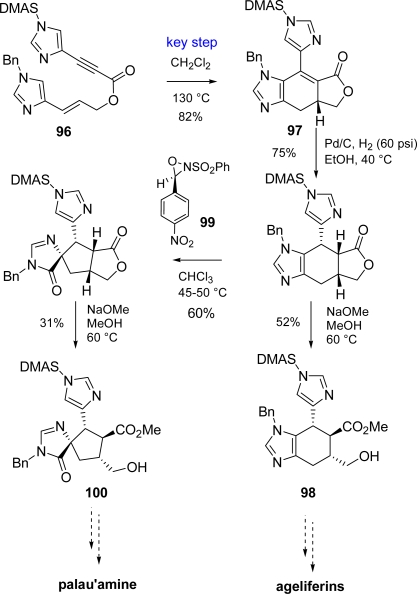
Scheme 26.
Full legend
IMDA approach to ageliferins and palau’amine cores.
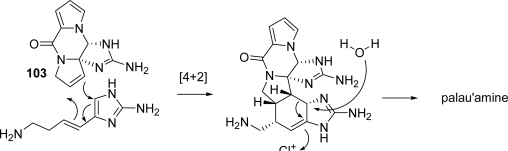
Scheme 27.
Full legend
Scheuer's proposal for biogenesis of palau'amine.
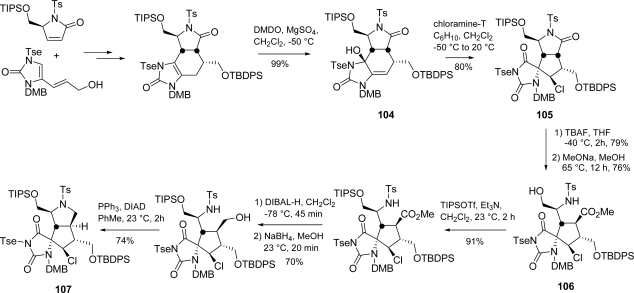
Scheme 28.
Full legend
Romo’s approach to palau’amine core 107.
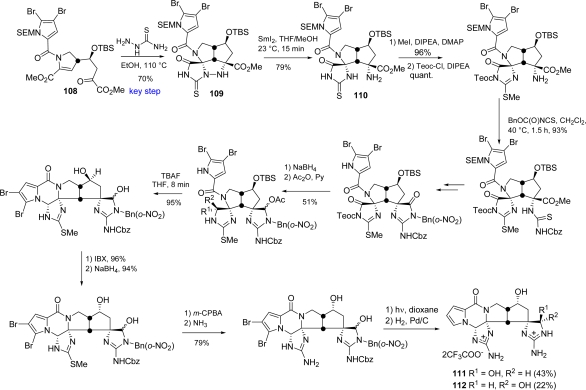
Scheme 29.
Full legend
Overman’s synthesis of congeners 111 and 112 of epi-palau’amine.
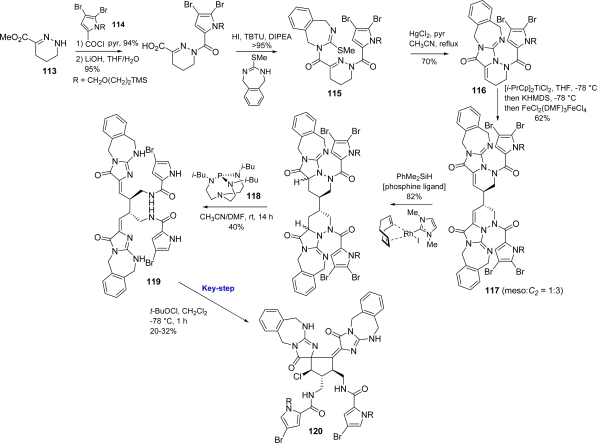
Scheme 30.
Full legend
Harran's approach to palau'amine spirocyclic core 120.
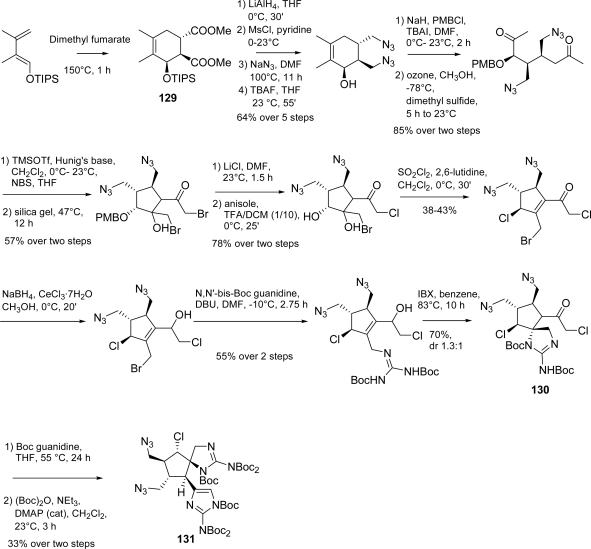
Scheme 31.
Full legend
Baran synthesis of key intermediate 131.
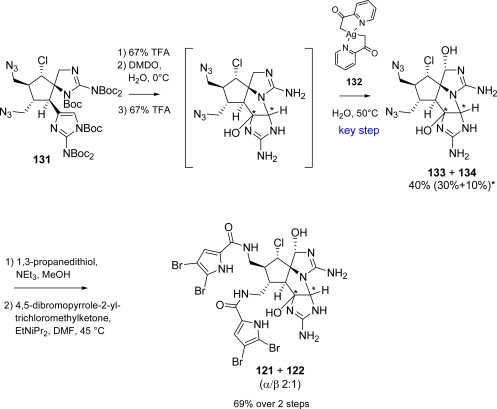
Scheme 32.
Full legend
Completion of the axinellamine A (121) and B (122) total synthesis. * 77% (H, OH=β) and 48% (H, OH= α) after optimization: 132, H2O, TFA 10% (v:v), r.t155
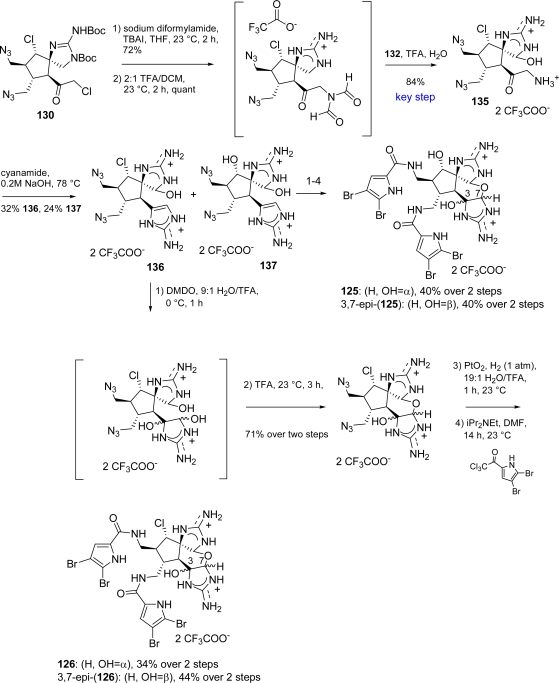
Scheme 33.
Full legend
Synthesis of 125 and 126.
References184
- 1.
Wan Y Hur W Cho CY Liu Y Adrian FJ Lozach O Bach S Mayer T Fabbro D Meijer L Gray NS Synthesis and target identification of hymenialdisine analogsChem Biol2004 11247259
Not in our library10.1016/j.chembiol.2004.01.015 (opens in a new tab)
- 2.
Hoffmann H Lindel T Synthesis of the pyrrole-imidazole alkaloidsSynthesis2003 17531783
Not in our library
- 3.
Jacquot DEN Lindel T Challenge palau'amine: Current standingsCurr Org Chem2005 915511565
Not in our library
- 4.
Jin Z Muscarine, imidazole, oxazole, and thiazole alkaloidsNat Prod Rep2005 22196229
Not in our library10.1039/b316104h (opens in a new tab)
- 5.
Jin Z Imidazole, oxazole and thiazole alkaloidsNat Prod Rep2006 23464496
Not in our library10.1039/b502166a (opens in a new tab)
- 6.
Nakao Y Fusetani N Enzyme inhibitors from marine invertebratesJ Nat Prod2007 70689710
Not in our library10.1021/np060600x (opens in a new tab)
- 7.
Weinreb SM Some recent advances in the synthesis of polycyclic imidazole-containing marine natural productsNat Prod Rep2007 24931948
Not in our library10.1039/b700206h (opens in a new tab)
- 8.
Morris JC Phillips AJ Marine natural products: Synthetic aspectsNat Prod Rep2009 26245265
Not in our library10.1039/b805111a (opens in a new tab)
- 9.
Fattorusso E Taglialatela-Scafati O Modern Alkaloids1st edWyley VCH Verlag GmbH & Co KgaAWeinheim, Germany2008
Not in our library
- 10.
Jin Z Muscarine, imidazole, oxazole and thiazole alkaloidsNat Prod Rep2009 26382445
Not in our library10.1039/b718045b (opens in a new tab)
- 11.
Kitagawa I Kobayashi M Kitanaka K Kido M Kyogoku Y Marine natural products. XII. On the chemical constituents of the Okinawan marine sponge Hymeniacidon aldisChem Pharm Bull1983 3123212328
Not in our library
- 12.
Braekman JC Daloze D Stoller C Van Soest RWM Chemotaxonomy of Agelas (Porifera: Demospongiae)Biochem Syst Ecol1992 20417431
Not in our library
- 13.
Richelle-Maurer E De Kluijver MJ Feio S Gaudencio S Gaspar H Gomez R Tavares R Van De Vyver G van Soest RWM Localization and ecological significance of oroidin and sceptrin in the Caribbean sponge Agelas coniferaBiochem Syst Ecol2003 3110731091
Not in our library
- 14.
Andrade P Willoughby R Pomponi SA Kerr RG Biosynthetic studies of the alkaloid, stevensine, in a cell culture of the marine sponge Teichaxinella morchellaTetrahedron Lett1999 4047754778
Not in our library
- 15.
Assmann M Lichte E Van Soest RWM Köck M New bromopyrrole alkaloid from the marine sponge Agelas wiedenmeyeriOrg Lett1999 1455457
Not in our library
- 16.
Vergne C Boury-Esnault N Perez T Martin M-T Adeline M-T Dau ETH Al Mourabit A Verpacamides A-D, a sequence of C11N5 diketopiperazines relating cyclo(Pro-Pro) to cyclo(Pro-Arg), from the marine sponge Axinella vaceleti: Possible biogenetic precursors of pyrrole-2-aminoimidazole alkaloidsOrg Lett2006 824212424
Not in our library10.1021/ol0608092 (opens in a new tab)
- 17.
Travert N Al Mourabit A A likely biogenetic gateway linking 2-aminoimidazolinone metabolites of sponges to proline: Spontaneous oxidative conversion of the pyrrole-proline-guanidine pseudo-peptide to dispacamide AJ Am Chem Soc2004 1261025210253
Not in our library10.1021/ja047574e (opens in a new tab)
- 18.
Foley LH Büchi G Biomimetic synthesis of dibromophakellinJ Am Chem Soc1982 10417761777
Not in our library
- 19.
Fedoreev SA Il'In SG Utkina NK Maksimov OB Reshetnyak MV Antipin MY Struchkov YT The structure of dibromoagelaspongin - A novel bromine-containing guanidine derivative from the marine sponge Agelas spTetrahedron1989 4534873492
Not in our library
- 20.
D'Ambrosio M Guerriero A Debitus C Ribes O Pusset J Leroy S Pietra F Agelastatin A, a new skeleton cytotoxic alkaloid of the oroidin family. Isolation from the axinellid sponge Agelas dendromorpha of the Coral seaJ. Chem. Soc., Chem. Commun1993 13051306
Not in our library
- 21.
Tsukamoto S Kato H Hirota H Fusetani N Mauritiamine, a new antifouling oroidin dimer from the marine sponge Agelas mauritianaJ Nat Prod1996 59501503
Not in our library
- 22.
Kinnel RB Gehrken H-P Swali R Skoropowski G Scheuer PJ Palau'amine and its congeners: A family of bioactive bisguanidines from the marine spongeStylotella aurantium J Org Chem1998 6332813286
Not in our library
- 23.
Garrido-Hernandez H Nakadai M Vimolratana M Li Q Doundoulakis T Harran PG Spirocycloisomerization of tethered alkylidene glycocyamidines: Synthesis of a base template common to the palau'amine family of alkaloidsAngew. Chem., Int. Ed2005 44765769
Not in our library10.1002/anie.200462069 (opens in a new tab)
- 24.
Faulkner DJ Andersen RJ Natural products chemistry of the marine environmentSea1974 5679714
Not in our library
- 25.
Sharma G Magdoff-Fairchild B Natural products of marine sponges. 7. The constitution of weakly basic guanidine compounds, dibromophakellin and monobromophakellinJ Org Chem1977 4241184124
Not in our library
- 26.
Baran PS O'Malley DP Zografos AL Natural product synthesis: Sceptrin as a potential biosynthetic precursor to complex pyrrole-imidazole alkaloids: The total synthesis of ageliferinAngew. Chem., Int. Ed2004 4326742677
Not in our library10.1002/anie.200453937 (opens in a new tab)
- 27.
Wang S Dilley AS Poullennec KG Romo D Planned and unplanned halogenations in route to selected oroidin alkaloidsTetrahedron2006 6271557161
Not in our library
- 28.
Grube A Immel S Baran PS Köck M Massadine chloride: A biosynthetic precursor of massadine and stylissadineAngew. Chem., Int. Ed2007 4667216724
Not in our library10.1002/anie.200701935 (opens in a new tab)
- 29.
Al Mourabit A Potier P Sponge's molecular diversity through the ambivalent reactivity of 2-aminoimidazole: A universal chemical pathway to the oroidin-based pyrrole-imidazole alkaloids and their palau'amine congenersEur J Org Chem2001 237243
Not in our library
- 30.
Köck M Grube A Seiple IB Baran PS The pursuit of palau'amineAngew. Chem., Int. Ed2007 4665866594
Not in our library10.1002/anie.200701798 (opens in a new tab)
- 31.
Van Pee K-H Microbial biosynthesis of halometabolitesArch Microbiol2001 175250258
Not in our library10.1007/s002030100263 (opens in a new tab)
- 32.
Butler A Carter-Franklin JN The role of vanadium bromoperoxidase in the biosynthesis of halogenated marine natural productsNat Prod Rep2004 21180188
Not in our library10.1039/b302337k (opens in a new tab)
- 33.
Dong C Flecks S Unversucht S Haupt C van Pee K-H Naismith JH Tryptophan 7-halogenase (PrnA) structure suggests a mechanism for regioselective chlorinationScience2005 30922162219
Not in our library10.1126/science.1116510 (opens in a new tab)
- 34.
Nishimura S Matsunaga S Shibazaki M Suzuki K Furihata K Van Soest RWM Fusetani N Massadine, a novel geranylgeranyltransferase type I inhibitor from the marine sponge Stylissa affmassa. Org. Lett2003 522552257
Not in our library10.1021/ol034564u (opens in a new tab)
- 35.
Jacquot DEN Mayer P Lindel T Chiroptical analysis of marine sponge alkaloids sharing the pyrrolopyrazinone coreChem Eur J2004 1011411148
Not in our library10.1002/chem.200305392 (opens in a new tab)
- 36.
Fattorusso E Taglialatela-Scafati O Two novel pyrrole-imidazole alkaloids from the Mediterranean spongeAgelas oroides Tetrahedron Lett2000 4199179922
Not in our library
- 37.
D'Ambrosio M Guerriero A Ripamonti M Debitus C Waikedre J Pietra F The active centers of agelastatin A, a strongly cytotoxic alkaloid of the Coral Sea axinellid sponge Agelas dendromorpha, as determined by comparative bioassays with semisynthetic derivativesHelv Chim Acta1996 79727735
Not in our library
- 38.
Chanas B Pawlik JR Lindel T Fenical W Chemical defense of the Caribbean sponge Agelas clathrodes (Schmidt)J Exp Mar Biol Ecol1997 208185196
Not in our library
- 39.
Wilson DM Puyana M Fenical W Pawlik JR Chemical defense of the Caribbean reef sponge Axinella corrugata against predatory fishesJ Chem Ecol1999 2528112823
Not in our library
- 40.
Lindel T Hoffmann H Hochgurtel M Pawlik JR Structure-activity relationship of inhibition of fish feeding by sponge-derived and synthetic pyrrole-imidazole alkaloidsJ Chem Ecol2000 2614771496
Not in our library
- 41.
Assmann M Van Soest RWM Köck M New antifeedant bromopyrrole alkaloid from the Caribbean sponge Stylissa caribicaJ Nat Prod2001 6413451347
Not in our library10.1021/np000482s (opens in a new tab)
- 42.
Assmann M Lichte E Pawlik JR Köck M Chemical defenses of the Caribbean sponges Agelas wiedenmayeri and Agelas coniferaMar Ecol Prog Ser2000 207255262
Not in our library
- 43.
Bickmeyer U Drechsler C Köck M Assmann M Brominated pyrrole alkaloids from marine Agelas sponges reduce depolarization-induced cellular calcium elevationToxicon2004 444551
Not in our library10.1016/j.toxicon.2004.04.001 (opens in a new tab)
- 44.
Bickmeyer U Bromoageliferin and dibromoageliferin, secondary metabolites from the marine sponge Agelas conifera, inhibit voltage-operated, but not store-operated calcium entry in PC12 cellsToxicon2005 45627632
Not in our library10.1016/j.toxicon.2005.01.006 (opens in a new tab)
- 45.
De Nanteuil G Ahond A Guilhem J Poupat C Tran Huu Dau E Potier P Pusset M Pusset J Laboute P Marine invertebrates from the New Caledonian lagoon. V. Isolation and identification of metabolites of a new species of sponge Pseudaxinyssa cantharellaTetrahedron1985 4160196033
Not in our library
- 46.
Fedoreev SA Utkina NK Il'In SG Reshetnyak MV Maksimov OB The structure of dibromoisophakellin from the marine spongeAcanthella carteri Tetrahedron Lett1986 2731773180
Not in our library
- 47.
Forenza S Minale L Riccio R Fattorusso E New bromopyrrole derivatives from the sponge Agelas oroidesJ Chem Soc D1971 11291130
Not in our library
- 48.
De Nanteuil G Ahond A Poupat C Thoison O Potier P Synthesis of oroidineBull Soc Chim Fr1986 813816
Not in our library
- 49.
Daninos-Zeghal S Al Mourabit A Ahond A Poupat C Potier P Synthesis of marine 2-aminoimidazole metabolites: Hymenidin, oroidin, and keramadineTetrahedron1997 5376057614
Not in our library
- 50.
Berree F Girard-Le Bleis P Carboni B Synthesis of the marine sponge alkaloid oroidin and its analogues via Suzuki cross-coupling reactionsTetrahedron Lett2002 4349354938
Not in our library
- 51.
Olofson A Yakushijin K Horne DA Synthesis of C11N5 marine alkaloids oroidin, clathrodin, and dispacamides. Preparation and transformation of 2-amino-4,5-dialkoxy-4,5-dihydroimidazoline from 2-aminoimidazolesJ Org Chem1998 6312481253
Not in our library
- 52.
Little TL Webber SE A simple and practical synthesis of 2-aminoimidazolesJ Org Chem1994 5972997305
Not in our library
- 53.
Ando N Terashima S A novel synthesis of the 2-aminoimidazol-4-carbaldehyde derivatives, versatile synthetic intermediates for 2-aminoimidazole alkaloidsSynlett2006 28362840
Not in our library
- 54.
Schroif-Gregoire C Travert N Zaparucha A Al Mourabit A Direct access to marine pyrrole-2-aminoimidazoles, oroidin, and derivatives, via new acyl-1,2-dihydropyridine intermediatesOrg Lett2006 829612964
Not in our library10.1021/ol0608451 (opens in a new tab)
- 55.
Yamada A Kitamura H Yamaguchi K Fukuzawa S Kamijima C Yazawa K Kuramoto M Wang G-Y-S Fujitani Y Uemura D Development of chemical substances regulating biofilm formationBull Chem Soc Jpn1997 7030613069
Not in our library
- 56.
Richards JJ Huigens RW III Ballard TE Basso A Cavanagh J Melander C Inhibition and dispersion of proteobacterial biofilmsChem Commun2008 16981700
Not in our library10.1039/b719802g (opens in a new tab)
- 57.
Donlan RM Costerton JW Biofilms: Survival mechanisms of clinically relevant microorganismsClin Microbiol Rev2002 15167193
Not in our library10.1128/cmr.15.2.167-193.2002 (opens in a new tab)
- 58.
Musk DJ Jr Hergenrother PJ Chemical countermeasures for the control of bacterial biofilms: Effective compounds and promising targetsCurr Med Chem2006 1321632177
Not in our library10.2174/092986706777935212 (opens in a new tab)
- 59.
Huigens RW III Richards JJ Parise G Ballard TE Zeng W Deora R Melander C Inhibition of Pseudomonas aeruginosa biofilm formation with bromoageliferin analoguesJ Am Chem Soc2007 12969666967
Not in our library10.1021/ja069017t (opens in a new tab)
- 60.
Richards JJ Ballard TE Melander C Inhibition and dispersion of Pseudomonas aeruginosa biofilms with reverse amide 2-aminoimidazole oroidin analogsOrg Biomol Chem2008 613561363
Not in our library10.1039/b719082d (opens in a new tab)
- 61.
Ballard TE Richards JJ Wolfe AL Melander C Synthesis and antibiofilm activity of a second-generation reverse-amide oroidin library: A structure-activity relationship studyChem Eur J2008 141074510761
Not in our library10.1002/chem.200801419 (opens in a new tab)
- 62.
Richards JJ Reed CS Melander C Effects of N-pyrrole substitution on the anti-biofilm activities of oroidin derivatives against Acinetobacter baumanniiBioorg Med Chem Lett2008 1843254327
Not in our library10.1016/j.bmcl.2008.06.089 (opens in a new tab)
- 63.
Richards JJ Reyes S Stowe SD Tucker AT Ballard TE Mathies LD Cavanagh J Melander C Amide isosteres of oroidin: Assessment of antibiofilm activity and C. elegans toxicityJ Med Chem2009 5245824585
Not in our library10.1021/jm900378s (opens in a new tab)
- 64.
Richards JJ Ballard TE Huigens RW III Melander C Synthesis and screening of an oroidin library against Pseudomonas aeruginosa biofilmsChemBioChem2008 912671279
Not in our library10.1002/cbic.200700774 (opens in a new tab)
- 65.
Cafieri F Fattorusso E Mangoni A Taglialatela-Scafati O Dispacamides, anti-histamine alkaloids from Caribbean Agelas spongesTetrahedron Lett1996 3735873590
Not in our library
- 66.
Lindel T Hoffmann H Synthesis of dispacamide from the marine sponge Agelas disparTetrahedron Lett1997 3889358938
Not in our library
- 67.
Fresneda PM Molina P Sanz MA A convergent approach to midpacamide and dispacamide pyrrole-imidazole marine alkaloidsTetrahedron Lett2001 42851854
Not in our library
- 68.
Meijer L Thunnissen AMWH White AW Garnier M Nikolic M Tsai LH Walter J Cleverley KE Salinas PC Wu YZ Biernat J Mandelkow EM Kim SH Pettit GR Inhibition of cyclin-dependent kinases, GSK-3β and CK1 by hymenialdisine, a marine sponge constituentChem Biol2000 75163
Not in our library10.1016/s1074-5521(00)00063-6 (opens in a new tab)
- 69.
Nguyen TNT Tepe JJ Preparation of hymenialdisine, analogues and their evaluation as kinase inhibitorsCurr Med Chem2009 1631223143
Not in our library10.2174/092986709788803015 (opens in a new tab)
- 70.
Sharma GM Buyer JS Pomerantz MW Characterization of a yellow compound isolated from the marine sponge Phakellia flabellataJ Chem Soc, Chem Commun1980 435436
Not in our library
- 71.
Cimino G De Rosa S De Stefano S Mazzarella L Puliti R Sodano G Isolation and X-ray crystal structure of a novel bromo compound from two marine spongesTetrahedron Lett1982 23767768
Not in our library
- 72.
Mattia CA Mazzarella L Puliti R 4-(2-Amino-4-oxo-2-imidazolin-5-ylidene)-2-bromo-4,5,6,7-tetrahydropyrrolo[2,3-c]azepin-8-one methanol solvate: A new bromo compound from the sponge Acanthella AurantiacaActa Crystallogr, Sect B1982 B3825132515
Not in our library
- 73.
Williams DH Faulkner DJ Isomers and tautomers of hymenialdisine and debromohymenialdisineNat Prod Lett1996 95764
Not in our library
- 74.
Annoura H Tatsuoka T Total syntheses of hymenialdisine and debromohymenialdisine: Stereospecific construction of the 2-amino-4-oxo-2-imidazolin-5(Z)-disubstituted ylidene ring systemTetrahedron Lett1995 36413416
Not in our library
- 75.
Xu Y-Z Yakushijin K Horne DA Synthesis of C11N5 marine sponge alkaloids: (±)-Hymenin, stevensine, hymenialdisine, and debromohymenialdisineJ Org Chem1997 62456464
Not in our library10.1021/jo9619746 (opens in a new tab)
- 76.
Sosa ACB Yakushijin K Horne DA A practical synthesis of (Z)-debromohymenialdisineJ Org Chem2000 65610611
Not in our library10.1021/jo991277o (opens in a new tab)
- 77.
Portevin B Golsteyn RM Pierre A De Nanteuil G An expeditious multigram preparation of the marine protein kinase inhibitor debromohymenialdisineTetrahedron Lett2003 4492639265
Not in our library
- 78.
Papeo G Posteri H Borghi D Varasi M A new glycocyamidine ring precursor: Syntheses of (Z)-hymenialdisine, (Z)-2-debromohymenialdisine, and (±)-endo-2-debromohymenialdisineOrg Lett2005 756415644
Not in our library10.1021/ol052266m (opens in a new tab)
- 79.
Endo M Nakagawa M Hamamoto Y Ishihama M Pharmacologically active substances from southern pacific marine invertebratesPure Appl Chem1986 58387394
Not in our library
- 80.
He Q Chen W Qin Y Synthesis of 2-substituted endo-hymenialdisine derivativesTetrahedron Lett2007 4818991901
Not in our library
- 81.
Chacun-Lefevre L Joseph B Merour J-Y Synthesis and reactivity of azepino[3,4-b]indol-5-yl trifluoromethanesulfonateTetrahedron2000 5644914499
Not in our library
- 82.
Kaiser HM Zenz I Lo WF Spannenberg A Schroeder K Jiao H Goerdes D Beller M Tse MK Preparation of novel unsymmetrical bisindoles under solvent-free conditions: Synthesis, crystal structures, and mechanistic aspectsJ Org Chem2007 7288478858
Not in our library10.1021/jo7016026 (opens in a new tab)
- 83.
Mangu N Kaiser HM Kar A Spannenberg A Beller M Tse MK Synthesis of novel hymenialdisine analogues using solvent-free and silica gel-promoted ring opening of epoxidesTetrahedron2008 6471717177
Not in our library
- 84.
Parmentier J-G Portevin B Golsteyn RM Pierre A Hickman J Gloanec P De Nanteuil G Synthesis and CHK1 inhibitory potency of hymenialdisine analoguesBioorg Med Chem Lett2009 19841844
Not in our library10.1016/j.bmcl.2008.12.001 (opens in a new tab)
- 85.
Pettit GR Herald CL Leet JE Gupta R Schaufelberger DE Bates RB Clewlow PJ Doubek DL Manfredi KP Rützler K Schmidt JM Tackett LP Ward FB Bruck M Camou F Antineoplastic agents. 168. Isolation and structure of axinohydantoinCan J Chem1990 6816211624
Not in our library
- 86.
Groszek G Kantoci D Pettit GR The isolation and structure elucidation of debromoaxinohydantoinLiebigs Ann1995 715716
Not in our library
- 87.
Patil AD Freyer AJ Killmer L Hofmann G Johnson RK (Z)-Axinohydantoin and debromo-(Z)-axinohydantoin from the sponge Stylotella aurantium. Inhibitors of protein kinase CNat Prod Lett1997 9201207
Not in our library
- 88.
Inaba K Sato H Tsuda M Kobayashi JI Spongiacidins A-D, new bromopyrrole alkaloids from Hymeniacidon spongeJ Nat Prod1998 61693695
Not in our library10.1021/np970565h (opens in a new tab)
- 89.
Sosa ACB Yakushijin K Horne DA Synthesis of axinohydantoinsJ Org Chem2002 6744984500
Not in our library10.1021/jo020063v (opens in a new tab)
- 90.
Tutino F Posteri H Borghi D Quartieri F Mongelli N Papeo G Stereoselective synthesis of (Z)-axino- and (Z)-debromoaxinohydantoinTetrahedron2009 6523722376
Not in our library
- 91.
Boyd MR Pettit GR McNulty J Herald DL Doubek DL Chapuis J-C Schmidt JM Tackett LP Antineoplastic agents. 362. Isolation and X-ray crystal structure of dibromophakellstatin from the Indian Ocean spongePhakellia mauritiana J Nat Prod1997 60180183
Not in our library10.1021/np9606106 (opens in a new tab)
- 92.
Jacquot DEN Zoellinger M Lindel T Total synthesis of the marine natural product rac-dibromophakellstatinAngew. Chem., Int. Ed2005 4422952298
Not in our library10.1002/anie.200462252 (opens in a new tab)
- 93.
Zoellinger M Mayer P Lindel T Total synthesis of the cytostatic marine natural product dibromophakellstatin via three-component imidazolidinone anellationJ Org Chem2006 7194319439
Not in our library10.1021/jo061813u (opens in a new tab)
- 94.
Feldman KS Skoumbourdis AP Extending Pummerer reaction chemistry. Synthesis of (±)-dibromophakellstatin by oxidative cyclization of an imidazole derivativeOrg Lett2005 7929931
Not in our library10.1021/ol0500113 (opens in a new tab)
- 95.
Feldman KS Skoumbourdis AP Fodor MD Extending Pummerer reaction chemistry. Synthesis studies in the phakellin alkaloid areaJ Org Chem2007 7280768086
Not in our library10.1021/jo701487j (opens in a new tab)
- 96.
Chung R Yu E Incarvito CD Austin DJ Hypervalent iodine-mediated vicinal syn diazidation: Application to the total synthesis of (±)-dibromophakellstatinOrg Lett2004 638813884
Not in our library10.1021/ol0490532 (opens in a new tab)
- 97.
Lu J Tan X Chen C Palladium-catalyzed direct functionalization of imidazolinone: Synthesis of dibromophakellstatinJ Am Chem Soc2007 12977687769
Not in our library10.1021/ja072844p (opens in a new tab)
- 98.
Zoellinger M Mayer P Lindel T Enantioselective total synthesis of (−)-dibromophakellstatinSynlett2007 27562758
Not in our library
- 99.
Zoellinger M Kelter G Fiebig H-H Lindel T Antitumor activity of the marine natural product dibromophakellstatin in vitroBioorg. Med. Chem. Lett2007 17346349
Not in our library10.1016/j.bmcl.2006.10.046 (opens in a new tab)
- 100.
D'Ambrosio M Guerriero A Chiasera G Pietra F Conformational preferences and absolute configuration of agelastatin A, a cytotoxic alkaloid of the axinellid sponge Agelas dendromorpha from the Coral Sea, via combined molecular modeling, NMR, and exciton splitting for diamide and hydroxyamide derivativesHelv Chim Acta1994 7718951902
Not in our library
- 101.
Hong TW Jimenez DR Molinski TF Agelastatins C and D, new pentacyclic bromopyrroles from the sponge Cymbastela sp., and potent arthropod toxicity of (−)-agelastatin AJ Nat Prod1998 61158161
Not in our library10.1021/np9703813 (opens in a new tab)
- 102.
Pettit GR Ducki S Herald DL Doubek DL Schmidt JM Chapuis J-C Antineoplastic agents. 470. Absolute configuration of the marine sponge bromopyrrole agelastatin AOncol Res2005 151120
Not in our library10.3727/096504005775082075 (opens in a new tab)
- 103.
Hale KJ Domostoj MM El-Tanani M Campbell FC Mason CK Strategies and Tactics in Organic SynthesisHarmata M Academic PressLondon, UK2005
Not in our library
- 104.
Mason CK Mcfarlane S Johnston PG Crowe P Erwin PJ Domostoj MM Campbell FC Manaviazar S Hale KJ El-Tanani M Agelastatin A: A novel inhibitor of osteopontin-mediated adhesion, invasion, and colony formationMol Cancer Ther2008 7548558
Not in our library10.1158/1535-7163.mct-07-2251 (opens in a new tab)
- 105.
Longley DB Johnston PG Molecular mechanisms of drug resistanceJ Pathol2005 205275292
Not in our library10.1002/path.1706 (opens in a new tab)
- 106.
Hale KJ Domostoj MM Tocher DA Irving E Scheinmann F Enantiospecific formal total synthesis of the tumor and GSK-3β inhibiting alkaloid, (−)-agelastatin AOrg Lett2003 529272930
Not in our library10.1021/ol035036l (opens in a new tab)
- 107.
Stien D Anderson GT Chase CE Koh Y-H Weinreb SM Total synthesis of the antitumor marine sponge alkaloid agelastatin AJ Am Chem Soc1999 12195749579
Not in our library
- 108.
Feldman KS Saunders JC Alkynyliodonium salts in organic synthesis. Application to the total synthesis of (−)-agelastatin A and (−)-agelastatin BJ Am Chem Soc2002 12490609061
Not in our library10.1021/ja027121e (opens in a new tab)
- 109.
Feldman KS Saunders JC Wrobleski ML Alkynyliodonium salts in organic synthesis. Development of a unified strategy for the syntheses of (−)-agelastatin A and (−)-agelastatin BJ Org Chem2002 6770967109
Not in our library10.1021/jo026287v (opens in a new tab)
- 110.
Domostoj MM Irving E Scheinmann F Hale KJ New total synthesis of the marine antitumor alkaloid (−)-agelastatin AOrg Lett2004 626152618
Not in our library10.1021/ol0490476 (opens in a new tab)
- 111.
Davis FA Deng J Asymmetric total synthesis of (−)-agelastatin A using sulfinimine (N-sulfinyl imine) derived methodologiesOrg Lett2005 7621623
Not in our library10.1021/ol047634l (opens in a new tab)
- 112.
Nicolaou KC Vourloumis D Winssinger N Baran PS The art and science of total synthesis at the dawn of the twenty-first centuryAngew. Chem., Int. Ed2000 3944122
Not in our library
- 113.
Trost BM Crawley ML Asymmetric transition-metal-catalyzed allylic alkylations: Applications in total synthesisChem Rev2003 10329212943
Not in our library10.1021/cr020027w (opens in a new tab)
- 114.
Trost BM Dong G New class of nucleophiles for palladium-catalyzed asymmetric allylic alkylation. Total synthesis of agelastatin AJ Am Chem Soc2006 12860546055
Not in our library10.1021/ja061105q (opens in a new tab)
- 115.
Trost BM Dong G A stereodivergent strategy to both product enantiomers from the same enantiomer of a stereoinducing catalyst: Agelastatin AChem Eur J2009 1569106919
Not in our library10.1002/chem.200900794 (opens in a new tab)
- 116.
Ichikawa Y Yamaoka T Nakano K Kotsuki H Synthesis of (−)-agelastatin A by [3.3] sigmatropic rearrangement of allyl cyanateOrg Lett2007 929892992
Not in our library10.1021/ol0709735 (opens in a new tab)
- 117.
Yoshimitsu T Ino T Tanaka T Total synthesis of (−)-agelastatin AOrg Lett2008 1054575460
Not in our library10.1021/ol802225g (opens in a new tab)
- 118.
Yoshimitsu T Ino T Futamura N Kamon T Tanaka T Total synthesis of the β-catenin inhibitor, (−)-agelastatin A: A second-generation approach based on radical aminobrominationOrg Lett2009 1134023405
Not in our library10.1021/ol9012684 (opens in a new tab)
- 119.
Wehn PM Du Bois J A stereoselective synthesis of the bromopyrrole natural product (−)-agelastatin AAngew. Chem., Int. Ed2009 4838023805
Not in our library10.1002/anie.200806292 (opens in a new tab)
- 120.
Dickson DP Wardrop DJ Total synthesis of (±)-agelastatin A, a potent inhibitor of osteopontin-mediated neoplastic transformationsOrg Lett2009 1113411344
Not in our library10.1021/ol900133v (opens in a new tab)
- 121.
Hama N Matsuda T Sato T Chida N Total synthesis of (−)-agelastatin A: The application of a sequential sigmatropic rearrangementOrg Lett2009 1126872690
Not in our library10.1021/ol900799e (opens in a new tab)
- 122.
Endo T Tsuda M Okada T Mitsuhashi S Shima H Kikuchi K Mikami Y Fromont J Kobayashi JI Nagelamides A-H, new dimeric bromopyrrole alkaloids from marine sponge Agelas speciesJ Nat Prod2004 6712621267
Not in our library10.1021/np034077n (opens in a new tab)
- 123.
Bhandari MR Sivappa R Lovely CJ Total synthesis of the putative structure of nagelamide DOrg Lett2009 1115351538
Not in our library10.1021/ol9001762 (opens in a new tab)
- 124.
Lovely CJ Du H Sivappa R Bhandari MR He Y Dias HVR Preparation and Diels-Alder chemistry of 4-vinylimidazolesJ Org Chem2007 7237413749
Not in our library10.1021/jo0626008 (opens in a new tab)
- 125.
Mee SPH Lee V Baldwin JE Significant enhancement of the Stille reaction with a new combination of reagents-copper(I) iodide with cesium fluorideChem Eur J2005 1132943308
Not in our library10.1002/chem.200401162 (opens in a new tab)
- 126.
Usami Y Recent synthetic studies leading to structural revisions of marine natural productsMar Drugs2009 7314330
Not in our library10.3390/md7030314 (opens in a new tab)
- 127.
Walker RP Faulkner DJ Van Engen D Clardy J Sceptrin, an antimicrobial agent from the sponge Agelas sceptrumJ Am Chem Soc1981 10367726773
Not in our library
- 128.
D'Auria M Racioppi R Photochemical dimerization of esters of urocanic acidJ Photochem Photobiol1998 112145148
Not in our library
- 129.
Baran PS Zografos AL O'Malley DP Short total synthesis of (±)-sceptrinJ Am Chem Soc2004 12637263727
Not in our library10.1021/ja049648s (opens in a new tab)
- 130.
Birman VB Jiang X-T Synthesis of sceptrin alkaloidsOrg Lett2004 623692371
Not in our library10.1021/ol049283g (opens in a new tab)
- 131.
Baran PS Li K O'Malley DP Mitsos C Short, enantioselective total synthesis of sceptrin and ageliferin by programmed oxaquadricyclane fragmentationAngew. Chem., Int. Ed2006 45249252
Not in our library10.1002/anie.200503374 (opens in a new tab)
- 132.
O'Malley DP Li K Maue M Zografos AL Baran PS Total synthesis of dimeric pyrrole-imidazole alkaloids: Sceptrin, ageliferin, nagelamide E, oxysceptrin, nakamuric acid, and the axinellamine carbon skeletonJ Am Chem Soc2007 12947624775
Not in our library10.1021/ja069035a (opens in a new tab)
- 133.
Nelsen SF Calabrese JC Nucleophilic cleavage of quadricyclene-2,3-dicarboxylate derivatives by iodideJ Am Chem Soc1973 9583858389
Not in our library
- 134.
Kajigaeshi S Kakinami T Moriwaki M Fujisaki S Maeno K Okamoto T Halogenation using quaternary ammonium polyhalides. Part X. α-Chlorination of aromatic acetyl derivatives with benzyltrimethylammonium dichloroiodateSynthesis1988 545546
Not in our library
- 135.
Lancini GC Lazzari E Arioli V Bellani P Synthesis and relationship between structure and activity of 2-nitroimidazole derivativesJ Med Chem1969 12775780
Not in our library10.1021/jm00305a012 (opens in a new tab)
- 136.
Keifer PA Schwartz RE Koker MES Hughes RG Jr Rittschof D Rinehart KL Bioactive bromopyrrole metabolites from the Caribbean sponge Agelas coniferaJ Org Chem1991 5629652975
Not in our library
- 137.
Cafieri F Carnuccio R Fattorusso E Taglialatela-Scafati O Vallefuoco T Anti-histaminic activity of bromopyrrole alkaloids isolated from Caribbean Agelas spongesBioorg Med Chem Lett1997 722832288
Not in our library
- 138.
Shen X Perry TL Dunbar CD Kelly-Borges M Hamann MT Debromosceptrin, an alkaloid from the Caribbean sponge Agelas coniferaJ Nat Prod1998 6113021303
Not in our library10.1021/np980129a (opens in a new tab)
- 139.
Rosa R Silva W Escalona De Motta G Rodriguez AD Morales JJ Ortiz M Antimuscarinic activity of a family of C11N5 compounds isolated from Agelas spongesExperientia1992 48885887
Not in our library10.1007/bf02118426 (opens in a new tab)
- 140.
Vassas A Bourdy G Paillard JJ Lavayre J Pais M Quirion JC Debitus C Naturally occurring somatostatin and vasoactive intestinal peptide inhibitors. Isolation of alkaloids from two marine spongesPlanta Med1996 622830
Not in our library10.1055/s-2006-957790 (opens in a new tab)
- 141.
Rodriguez AD Lear MJ La Clair JJ Identification of the binding of sceptrin to MreB via a bidirectional affinity protocolJ Am Chem Soc2008 13072567258
Not in our library10.1021/ja7114019 (opens in a new tab)
- 142.
Gitai Z Dye NA Reisenauer A Wachi M Shapiro L MreB actin-mediated segregation of a specific region of a bacterial chromosomeCell2005 120329341
Not in our library10.1016/j.cell.2005.01.007 (opens in a new tab)
- 143.
Rinehart KL Biologically active marine natural productsPure Appl Chem1989 61525528
Not in our library
- 144.
Kobayashi J Tsuda M Murayama T Nakamura H Ohizumi Y Ishibashi M Iwamura M Ohta T Nozoe S Ageliferins, potent actomyosin ATPase activators from the Okinawan marine sponge Agelas spTetrahedron1990 4655795586
Not in our library
- 145.
Assmann M Köck M Bromosceptrin, an alkaloid from the marine sponge Agelas coniferaZ Naturforsch, C J Biosci2002 57157160
Not in our library10.1515/znc-2002-1-226 (opens in a new tab)
- 146.
Northrop BH O'Malley DP Zografos AL Baran PS Houk KN Mechanism of the vinylcyclobutane rearrangement of sceptrin to ageliferin and nagelamide EAngew. Chem., Int. Ed2006 4541264130
Not in our library10.1002/anie.200600514 (opens in a new tab)
- 147.
Tan X Chen C Regiocontrol in MnIII-mediated oxidative heterobicyclizations: Access to the core skeletons of oroidin dimersAngew. Chem., Int. Ed2006 4543454348
Not in our library10.1002/anie.200601208 (opens in a new tab)
- 148.
Sivappa R Mukherjee S Dias HVR Lovely CJ Studies toward the total synthesis of the oroidin dimersOrg Biomol Chem2009 732153218
Not in our library10.1039/b909482b (opens in a new tab)
- 149.
Kinnel RB Gehrken HP Scheuer PJ Palau'amine: A cytotoxic and immunosuppressive hexacyclic bisguanidine antibiotic from the sponge Stylotella agminataJ Am Chem Soc1993 11533763377
Not in our library
- 150.
Kobayashi H Kitamura K Nagai K Nakao Y Fusetani N Van Soest RWM Matsunaga S Carteramine A, an inhibitor of neutrophil chemotaxis, from the marine sponge Stylissa carteriTetrahedron Lett2007 4821272129
Not in our library
- 151.
Grube A Köck M Structural assignment of tetrabromostyloguanidine: Does the relative configuration of the palau'amines need revision?Angew Chem, Int Ed2007 4623202324
Not in our library10.1002/anie.200604076 (opens in a new tab)
- 152.
Buchanan MS Carroll AR Quinn RJ Revised structure of palau'amineTetrahedron Lett2007 4845734574
Not in our library
- 153.
O'Malley DP Yamaguchi J Young IS Seiple IB Baran PS Total synthesis of (±)-axinellamines A and BAngew. Chem., Int. Ed2008 4735813583
Not in our library10.1002/anie.200801138 (opens in a new tab)
- 154.
Su S Seiple IB Young IS Baran PS Total syntheses of (±)-massadine and massadine chlorideJ Am Chem Soc2008 1301649016491
Not in our library10.1021/ja8074852 (opens in a new tab)
- 155.
Lovely CJ Du H He Y Dias HVR Oxidative rearrangement of imidazoles with dimethyldioxiraneOrg Lett2004 6735738
Not in our library10.1021/ol036403w (opens in a new tab)
- 156.
Dilley AS Romo D Enantioselective strategy to the spirocyclic core of palau'amine and related bisguanidine marine alkaloidsOrg Lett2001 315351538
Not in our library10.1021/ol015864j (opens in a new tab)
- 157.
Dransfield PJ Dilley AS Wang S Romo D A unified synthetic strategy toward oroidin-derived alkaloids premised on a biosynthetic proposalTetrahedron2006 6252235247
Not in our library
- 158.
Zancanella MA Romo D Facile synthesis of the trans-fused azabicyclo[3.3.0]octane core of the palau'amines and the tricyclic core of the axinellamines from a common intermediateOrg Lett2008 1036853688
Not in our library10.1021/ol801289b (opens in a new tab)
- 159.
Wang S Romo D Enantioselective synthesis of (+)-monobromophakellin and (+)-phakellin: A concise phakellin annulation strategy applicable to palau'amineAngew. Chem., Int. Ed2008 4712841286
Not in our library10.1002/anie.200703998 (opens in a new tab)
- 160.
Katz JD Overman LE Studies towards the total synthesis of palau'amine. Formation of 4,5-dihydropyrrole-2-carboxylate intermediates by alkene-enamide ring-closing metathesisTetrahedron2004 6095599568
Not in our library
- 161.
Lanman BA Overman LE Paulini R White NS On the structure of palau'amine: Evidence for the revised relative configuration from chemical synthesisJ Am Chem Soc2007 1291289612900
Not in our library10.1021/ja074939x (opens in a new tab)
- 162.
Li Q Hurley P Ding H Roberts AG Akella R Harran PG Exploring symmetry-based logic for a synthesis of palau'amineJ Org Chem2009 7459095919
Not in our library10.1021/jo900755r (opens in a new tab)
- 163.
Urban S Leone PDA Carroll AR Fechner GA Smith J Hooper JNA Quinn RJ Axinellamines A-D, novel imidazo-azolo-imidazole alkaloids from the Australian marine sponge Axinella spJ Org Chem1999 64731735
Not in our library10.1021/jo981034g (opens in a new tab)
- 164.
Arndt H-D Riedrich M Synthesis of marine alkaloids from the oroidin familyAngew. Chem., Int. Ed2008 4747854788
Not in our library10.1002/anie.200801793 (opens in a new tab)
- 165.
Starr JT Koch G Carreira EM Enantioselective synthesis of the cyclopentyl core of the axinellaminesJ Am Chem Soc2000 12287938794
Not in our library
- 166.
Dransfield PJ Wang S Dilley A Romo D Highly regioselective Diels-Alder reactions toward oroidin alkaloids: Use of a tosylvinyl moiety as a nitrogen masking group with adjustable electronicsOrg Lett2005 716791682
Not in our library10.1021/ol0473602 (opens in a new tab)
- 167.
Kato T Shizuri Y Izumida H Yokoyama A Endo M Styloguanidines, new chitinase inhibitors from the marine sponge Stylotella aurantiumTetrahedron Lett1995 3621332136
Not in our library
- 168.
Poullennec KG Romo D Enantioselective total synthesis of (+)-dibromophakellstatinJ Am Chem Soc2003 12563446345
Not in our library10.1021/ja034575i (opens in a new tab)
- 169.
Du H He Y Rasapalli S Lovely CJ New methods of imidazole functionalization - from imidazole to marine alkaloidsSynlett2006 965992
Not in our library
- 170.
Sivappa R Hernandez NM He Y Lovely CJ Studies toward the total synthesis of axinellamine and massadineOrg Lett2007 938613864
Not in our library10.1021/ol0711568 (opens in a new tab)
- 171.
Yamaguchi J Seiple IB Young IS O'Malley DP Maue M Baran PS Synthesis of 1,9-dideoxy-pre-axinellamineAngew. Chem., Int. Ed2008 4735783580
Not in our library10.1002/anie.200705913 (opens in a new tab)
- 172.
Belanger G Hong F-T Overman LE Rogers BN Tellew JE Trenkle WC Stereocontrolled synthesis of triazacyclopenta[cd]pentalenes by intramolecular 1,3-dipolar cycloaddition reactions of azomethine iminesJ Org Chem2002 6778807883
Not in our library10.1021/jo026282y (opens in a new tab)
- 173.
Lanman BA Overman LE Evaluation of strategies for the synthesis of the guanidine hemiaminal portion of palau'amineHeterocycles2006 70557570
Not in our library10.3987/com-06-s(w)16 (opens in a new tab)
- 174.
König SG Miller SM Leonard KA Loewe RS Chen BC Austin DJ A Transient N-O-linked Pauson-Khand strategy for the synthesis of the deschloro carbocyclic core of the palau'amines and styloguanidinesOrg Lett2003 522032206
Not in our library10.1021/ol0344063 (opens in a new tab)
- 175.
Grube A Köck M Stylissadines A and B: The first tetrameric pyrrole-imidazole alkaloidsOrg Lett2006 846754678
Not in our library10.1021/ol061317s (opens in a new tab)
- 176.
Buchanan MS Carroll AR Addepalli R Avery VM Hooper JNA Quinn RJ Natural products, stylissadines A and B, specific antagonists of the P2X7 receptor, an important inflammatory targetJ Org Chem2007 7223092317
Not in our library10.1021/jo062007q (opens in a new tab)
- 177.
Fujita M Nakao Y Matsunaga S Seiki M Itoh Y Yamashita J Van Soest RWM Fusetani N Ageladine A: An antiangiogenic matrix metalloproteinase inhibitor from the marine spongeAgelas nakamurai J Am Chem Soc2003 1251570015701
Not in our library10.1021/ja038025w (opens in a new tab)
- 178.
Meketa ML Weinreb SM Total synthesis of ageladine A, an angiogenesis inhibitor from the marine sponge Agelas nakamuraiOrg Lett2006 814431446
Not in our library10.1021/ol0602304 (opens in a new tab)
- 179.
Meketa ML Weinreb SM Nakao Y Fusetani N Application of a 6π-1-azatriene electrocyclization strategy to the total synthesis of the marine sponge metabolite ageladine A and biological evaluation of synthetic analoguesJ Org Chem2007 7248924899
Not in our library10.1021/jo0707232 (opens in a new tab)
- 180.
Meketa ML Weinreb SM A new total synthesis of the zinc matrixmetalloproteinase inhibitor ageladine A featuring a biogenetically patterned 6π-2-azatriene electrocyclizationOrg Lett2007 9853855
Not in our library10.1021/ol063038a (opens in a new tab)
- 181.
Meketa ML Weinreb SM A convergent total synthesis of the marine sponge alkaloid ageladine A via a strategic 6π-2-azatriene electrocyclizationTetrahedron2007 6391129119
Not in our library
- 182.
Shengule SR Karuso P Concise total synthesis of the marine natural product ageladine AOrg Lett2006 840834084
Not in our library10.1021/ol061584y (opens in a new tab)
- 183.
Ando N Terashima S Synthesis and matrix metalloproteinase (MMP)-12 inhibitory activity of ageladine A and its analogsBioorg Med Chem Lett2007 1744954499
Not in our library10.1016/j.bmcl.2007.06.005 (opens in a new tab)
- 184.
Bickmeyer U Grube A Klings K-W Köck M Ageladine A, a pyrrole-imidazole alkaloid from marine sponges, is a pH sensitive membrane permeable dyeBiochem Biophys Res Commun2008 373419422
Not in our library10.1016/j.bbrc.2008.06.056 (opens in a new tab)
Cited by papers we hold1
Reads
Read by people on this page
None yet.
Checked or read by AI through naulon
None yet.
A person counts once a day per paper. We keep no cookie and no address: a reader is a hash that changes every day. Any month under five reads shows no number.
Are you an author?
Is this your paper?
Claim it to add your note and be paid when agents cite it. Free.