An Overview of Pest Species of Bactrocera Fruit Flies (Diptera: Tephritidae) and the Integration of Biopesticides with Other Biological Approaches for Their Management with a Focus on the Pacific Region
Roger Vargas, Jaime Piñero, Luc Leblanc
Insects · 2015 · Review · CC BY
doi:10.3390/insects6020297 (opens in a new tab)
We email you when a new notice or a question about this paper appears.
Abstract
Fruit flies (Diptera: Tephritidae) are among the most economically important pest species in the world, attacking a wide range of fruits and fleshy vegetables throughout tropical and sub-tropical areas. These species are such devastating crop pests that major control and eradication programs have been developed in various parts of the world to combat them. The array of control methods includes insecticide sprays to foliage and soil, bait-sprays, male annihilation techniques, releases of sterilized flies and parasitoids, and cultural controls. During the twenty first century there has been a trend to move away from control with organophosphate insecticides (e.g., malathion, diazinon, and naled) and towards reduced risk insecticide treatments. In this article we present an overview of 73 pest species in the genus Bactrocera, examine recent developments of reduced risk technologies for their control and explore Integrated Pest Management (IPM) Programs that integrate multiple components to manage these pests in tropical and sub-tropical areas.
Abstract licence: CC BY
Full text
From PubMed Central, U.S. National Library of Medicine, as current on Oct 21, 2026. Paragraph numbers are ours, so an answer can point at one.
1. Introduction
Fruit flies of the family Tephritidae constitute a group of agricultural pests of worldwide importance that attack a wide range of fruits and vegetables. Numerous fruit fly species constitute enormous threats to fruit and vegetable production throughout the world, causing both quantitative and qualitative losses. Furthermore, due to their susceptibility to invasive tephritid species, many fruit-producing countries have imposed quarantine restrictions on the import of products from countries infested with particular fruit fly species, and/or require that fruits and vegetables undergo quarantine treatment before their importation is allowed. Thus, suppression or eradication of fruit flies has often been the goal of control programs.
Integrated Pest Management (IPM) is one method to achieve sustainable agricultural production with less damage to the environment. While IPM has many definitions, it often includes a diverse mix of approaches to manage pests and keep them below economically damaging levels, using control options that range from cultural to chemical components. In practice, IPM ranges from chemically-based systems that involve the targeted and judicious use of synthetic pesticides, to biologically-intensive approaches that manage pests primarily or fully through nonchemical means. In recent years, IPM has been seen as an effective method for managing pestiferous fruit flies in an attempt to make fruit production more sustainable.
The genus Bactrocera Macquart comprises 651 described species. It is the most economically significant fruit fly genus with at least 50 species considered to be important pests, many of which are highly polyphagous (Table 1). The genus Bactrocera is widely distributed throughout tropical Asia, the south Pacific and Australia. Relatively few species exist in Africa, and only olive fly, B. oleae (Rossi), occurs in Southern Europe. Recently, B. oleae became established in California and two species in the B. dorsalis complex became established on two new continents: B. carambolae Drew & Hancock, the carambola fruit fly, in South America (Suriname) and B. dorsalis (formerly B. invadens Drew, Tsuruta & White) in Africa (Kenya). The oriental fruit fly, B. dorsalis (Hendel), is native throughout tropical Asia, and has been recorded from over 270 host plant species.
While IPM of fruit flies has made many unique contributions to agriculture through the incorporation of ecological principles into pest management, truly effective IPM systems are scarce. A literature search performed in ISI Web of Science in early-March, 2015 returned 4841 articles published since 1984 when “Tephritidae” was searched, and 1543 articles were returned when IPM (focusing on agriculture) was used as key word. Surprisingly, the search returned only 54 articles when both “Tephritidae” and “IPM” were searched and less than half of those truly referred to IPM components. By refining these studies by the term “Bactrocera”, only 28 articles were returned. Clearly, while different search terms certainly would change the corresponding results, it can be seen that IPM of fruit flies, including Bactrocera make up only a small proportion of the overall Tephritidae literature.
Examples of IPM programs targeting Bactrocera species include the Regional Fruit Fly Project in the Pacific that targeted Bactrocera fruit flies in Pacific Island Countries and Territories and the Hawaii Area-Wide IPM program (HAWPM), implemented over a 10-year period in Hawaii. The HAWPM program was not aimed at eradication of fruit flies, but predicated on a pest management strategy that would reduce the entire population in and around cropping areas where economic damage occurred. In practice, implementation of IPM programs targeting fruit flies should be based on a particular crop/pest/environment scenario, IPM goals, e.g., temporal/spatial scales for implementation, knowledge of pest ecology and natural enemies, as well as knowledge of socio-economic factors. IPM programs against pestiferous fruit fly species can be implemented at local (e.g., single orchard) and regional (e.g., area-wide IPM) levels and not all IPM components that may be available for a given system would be appropriate or affordable for implementation in small-scale farming operations. In this article we present an overview of the tropical pest species in the genus Bactrocera, examine recent developments of reduced risk technologies for control and explore IPM programs that utilize multiple components to manage these pests in tropical and sub-tropical areas.
2. Overview of Pest Bactrocera Species
Seventy-three species of Bactrocera have been reared from commercial and/or edible host fruit, hence they are treated here as destructive or potential pests, out of a total of 210 species reared from over 811 host species. Individual species are generalist or specialist pests of fruit (57 species). Some species infest fruit and/or flowers of cucurbits (16 species). All 73 Bactrocera species that are economically important are listed in Table 1, ranked under four categories, based on pest severity, host range, invasiveness, and frequency of infestation. Category A includes widespread invasive polyphagous generalists or highly destructive specialists that have become established outside of their native range (Figure 1, Figure 2 and Figure 3). Category B pests are polyphagous fruit pests or destructive specialists more restricted in distribution, but at elevated risk of spreading to new locations (Figure 4). Under category C we list relatively minor oligophagous or specialist fruit or cucurbit pests. Category D includes species that have been occasionally bred from commercial/edible fruit or cucurbits.
Among the most destructive Category A species are B. dorsalis (oriental fruit fly), B. cucurbitae (Coquillett) (melon fly) and B. tryoni (Froggatt) (Queensland fruit fly). The B. dorsalis complex is a large group composed of 85 species, of which five are polyphagous fruit pests (Figure 1). Recently, B. philippinensis Drew and Hancock was declared a synonym of B. papayae Drew and Hancock, and the latter was in turn, along with B. invadens, declared a synonym of B. dorsalis. This regrouping has greatly increased the geographic range of B. dorsalis. Two of the most destructive species in the complex (B. dorsalis and B. carambolae) have invaded and become established in the Pacific region, Africa, South America, and debatably in California (Figure 1). Bactrocera cucurbitae is primarily a pest of cucurbits, and females can infest unripe fruit and flowers. It is also a pest of papaya and infrequently infests other non-cucurbit hosts as well. It is native to Southeast Asia, and was introduced into Africa and parts of Oceania (Figure 2). The B. tryoni complex is composed of four very closely related species. While Queensland fruit fly (B. tryoni) and the lesser Queensland fruit fly (B. neohumeralis (Hardy)), both sympatric, are genetically indistinguishable, yet reproductively isolated by time of mating (dusk for the former and day time for the latter), B. aquilonis (May) and B. melas (Perkins & May) may be conspecific variants of B. tryoni. In the early 1970s, B. tryoni was introduced and became established in New Caledonia and French Polynesia (Figure 3).
3. Area-Wide Control Technologies
Various technologies have been developed for area-wide control of Bactrocera fruit flies and related species throughout Asia and the Pacific. These include: (1) Insecticide-based suppression tools including cover sprays, protein bait sprays and soil drenches; (2) Male annihilation; (3) Sterile insect releases; (4) Releases of natural enemies; and (5) cultural controls. When used alone, however, these tactics do not constitute, by definition, Integrated Pest Management.
3.1. Insecticide Cover Sprays, Protein Bait Sprays, and Soil Drenches
The history of fruit fly control with full cover sprays started with inorganic insecticides (e.g., lead arsenate) in the early 1900s and spanned the century with a transition to synthetic insecticides, such as chlorinated hydrocarbons, organophosphates, and synthetic pyrethroids. Advantages of insecticide cover sprays are that they are affordable, convenient and provide a high level of protection against fruit fly infestation with consistent results.
Addition of protein food baits to insecticide sprays reduced the amount of pesticide needed for fruit fly control and has been used successfully in many eradication programs. Female flies, in need of protein for full ovarian development and egg production, readily feed on a protein source containing a toxicant. Enzymatic protein hydrolysate baits were first used in Hawaii for control of B. dorsalis, and malathion became the organophosphate insecticide additive of choice due to its low mammalian toxicity, affordable price, and low levels of fruit fly resistance. In the 1960s, one particular formulation for ground, aerial and quarantine applications was adopted and remains a common standard today for control of many fruit fly species. It consists of three to four parts Nu-Lure® Insect Bait (Miller Chemical and Fertilizer Corporation, Hanover, PA, USA) plus one part malathion. Because organophosphate insecticides have been implicated in negative effects on natural enemies and human health, alternatives have been sought during the twenty first century. The Regional Fruit Fly Project in the Pacific introduced the more rain-fast fipronil-based Bactrogel formulation, mixed with a protein as a bait spray for use against Bactrocera fruit flies in Pacific Island Countries and Territories. In the late 1990s, a new bait spray formulation containing the reduced-risk biopesticide spinosad was shown to be as effective as Nulure-malathion bait sprays for use in Central America and the USA against Ceratitis capitata (Wiedemann). According to the United States Environmental Protection Agency (EPA), biopesticides are “certain types of pesticides derived from such natural materials as animals, plants, bacteria, and certain minerals”. Research is also underway to incorporate plant essential oils into protein baits.
Spinosad, a toxin derived from a soil-dwelling actinomycete bacterium (Saccharopolyspora spinosa Mertz & Yao), has low mammalian toxicity and reduced environmental impact on natural enemies. A spinosad-based hydrolysed protein bait that attracted, induced feeding and killed fruit flies was initially developed by Moreno and Mangan. Later it became known as GF-120 Fruit Fly Bait (Dow AgroSciences, Indianapolis, IN). Traditionally, B. cucurbitae has been controlled in agricultural areas of Hawaii by using protein bait sprays on border crops. GF-120 was tested and shown to be an adequate replacement for organophosphates through the Hawaii Area-Wide Fruit Fly program for B. cucurbitae, B. dorsalis and B. latifrons (Hendel).
Another component in many tephritid fly area-wide IPM programs has been the application of insecticidal soil drenches under host trees where fruit flies have been detected and as a regulatory treatment in the certification process for movement of nursery stock outside of fruit fly quarantine areas. Presently, to ship fruit tree nursery stock out of California during fruit fly quarantines, container pots with fruit seedlings and small trees must be drenched with diazinon prior to shipment. In addition, Florida uses diazinon as a soil drench underneath host plants where fruit fly larvae or gravid adult females are detected during eradication programs. Although many uses of diazinon have been discontinued in the United States due to problems with its effects on aquatic organisms in freshwater ecosystems, it is still used in California through a Special Local Needs (SLN) registration and in Florida through an Emergency Crisis Exemption (Section 18). Diazinon is an organophosphate insecticide now banned for outdoor residential use by the EPA. It is not known how much longer the present SLN or Section 18 will continue to be approved in California and Florida. In response to the situation, Stark et al. identified several efficacious insecticides to replace diazinon as a soil treatment for orchard and back yard fruit tree drenches in nursery containers against fruit flies. Three synthetic pyrethroid insecticides were the most effective products, but the results with a newly formulated spinosad product, Entrust SC™, were also particularly noteworthy. This newly formulated product outperformed the conventional Entrust, and can be used in organic agriculture. Another biopesticide with activity against larvae and pupae of major Bactrocera (B. dorsalis and B. cucurbitae) and Ceratitis (C. capitata, C. cosyra (Walker)) species in soil is the fungal pathogen Metarhizium anisopliae (Metchnikoff) Sorokin.
3.2. Male Annihilation
At least 324 species of the male Bactrocera are attracted to cue-lure (C-L) (4-(p-acetoxyphenyl)-2-butanone)/raspberry ketone (RK) (4-(p-hydroxyphenyl)-2-butanone) and 123 species to methyl eugenol (ME) (4-allyl-1, 2-dimethoxybenzene-carboxylate). Of the 73 pest Bactrocera listed in Table 1, 34 respond to C-L/RK and 16 to ME. Recently, Vargas et al. summarized the history of Male Annihilation Technique (MAT) and the many successful programs worldwide. In all cases, eradication was attempted or achieved through repeated area-wide applications, by airdrops and/or manual ground applications, of bait stations (fiberboard or coconut husk blocks, cotton string or wick, or molded paper pulp) impregnated with male lures mixed with a toxicant (naled, malathion, or fipronil). Briefly, following the successful initial suppression experiments in Hawaii, the first fruit fly eradication using ME-MAT was achieved with B. dorsalis in the Mariana Islands. ME-MAT alone was initially used on Rota; however, sterile insect releases, successful alone at eradicating B. dorsalis from Guam, had to be augmented with ME-MAT to achieve eradication on the other islands after one year of sterile fly releases. In a larger-scale program, B. dorsalis was eradicated from the Ryuku Islands. Although not as powerful as ME as an attractant, C-L-MAT was used with some degree of success, such as in the eradication of B. tryoni from Rapa Nui (Easter Island) in the southern Pacific using a combined treatment of C-L and malathion on pieces of cotton string and spot spraying with protein–malathion bait spray in the 1970s.
From 1960 to 2012, nine different Bactrocera species have been detected in California, with B. dorsalis detected most frequently (126 times). Altogether, there have been 140 eradication programs with 25 quarantines. Florida has had 12 B. dorsalis detections since 1999 (in seven separate years) with the last occurring in 2010. In response to these constant introductions, reduced-risk MAT treatments have been developed. In initial small-scale trials in Hawaii and subsequent weathering trials in California, Vargas et al. provided evidence that reduced-risk formulations of SPLAT with ME and spinosad (AKA SPLAT-MAT-spinosad-ME (ISCA Technologies, Riverside, CA USA) or STATICTM (Dow AgroSciences, Inianapolis, IN USA) Spinosad-ME) performed as well as or better than standard Min-U-Gel with naled. STATICTM Spinosad-ME has been tested and registered for use in California and Florida and offers a novel and convenient ready-to-use MAT formulation that is safer than the current use of organophosphates that may pose potential negative effects on human and environmental health. A SPLAT-MAT-C-L formulation has also been tested successfully in Hawaii for use against C-L responding flies.
3.3. Sterile Insect Releases
Releases of sterile males for suppressing wild populations of the same species was first proposed by E.F. Knipling, and effectively implemented against Cochliomyia hominivorax (Coquerel), the New World screwworm fly. This technique became known as the sterile insect technique (SIT), and is well suited for the suppression or eradication of Bactrocera flies that display elaborate courtship behavior that can be mediated by male lures. Scientists from Hawaii and Australia carried out the original pilot SIT tests to eradicate B. cucurbitae from Rota in the Northern Mariana Islands, suppress B. tryoni in Australia, eradicate B. dorsalis in Micronesia and suppress or eradicate C. capitata in Hawaii and California. SIT has since become the method of choice for eradication of C. capitata outbreaks in California and Florida. In Japan, B. cucurbitae was eradicated by SIT using the approach developed in Hawaii. A major improvement and cost saving came with the development of laboratory strains (e.g., C. capitata) that allowed for rearing “males-only” flies for SIT programs. The advantages of releasing solely males included avoidance of ‘sting-damage’ by sterile females and avoidance of mating between sterile males and sterile females. During the HAWPM program, development of a sexing strain for B. cucurbitae allowed for the application of SIT to small-farm situations in selected areas and reduced the local B. cucurbitae population to near extinction. Although very successful in demonstration trials, the need for a large mass-rearing facility in Hawaii and more cost-effective ‘sexing strains,’ limited its implementation. Nonetheless, the “males-only” technology allowed for use of sterile flies as part of IPM programs against Bactrocera species.
3.4. Releases of Natural Enemies
The role of parasitoids in the HAWPM program was examined at three levels of application: (i) conservation; (ii) classical releases; and (iii) augmentative releases. An overall goal of the program was to conserve biological control in economic crops through the use of reduced-risk insecticides such as GF-120 Fruit Fly Bait and male annihilation using bucket traps in an IPM approach. The program succeeded in both reducing the use of organophosphates and conserving biological controls, such as Fopius arisanus (Sonan) and related braconid species, while suppressing fruit flies below economic injury levels. Hawaii has a long history of the application of biological control against introduced insect pests. This is also true for tephritid flies where classical biological control started soon after the first flies were established in Hawaii. Recently, Vargas et al. reviewed the major contributions of various scientists in Hawaii to biological control of fruit flies worldwide.
3.5. Cultural Controls
Cultural controls involve a variety of approaches ranging from use of fruit fly resistant varieties, to early harvesting of fruit, bagging of fruit and field sanitation. In the case of tephritid fruit flies, cultural practices can support synergies with other components of IPM, such as protein bait sprays and biological control. Here, we discuss the types of cultural control methods that have been evaluated/implemented, either alone or in combination with other IPM tools, to suppress populations of Bactrocera species.
3.5.1. Sanitation
Field sanitation is a technique that either prevents fruit fly larvae from developing or sequesters young emerging adult flies so that they cannot return to the crop to reproduce. There are various ways of achieving this end. One is the removal and disposal of infested or uninfested (cull) produce. While this can be laborious, it is a very effective fruit fly suppression method and a key component of an IPM program for fruit flies. The importance of field sanitation was recently demonstrated by Piñero et al.. These authors developed quantitative (by counting numbers of ground fruit) and qualitative (by developing a ranking system) approaches to measure level of implementation of field sanitation in papaya orchards in Hawaii and the impact of field sanitation on fruit fly population densities and fruit infestation. In this large-scale study, numbers of female B. dorsalis captured in monitoring traps and also levels of fruit infestation were correlated with variations in sanitation levels in the experimental plots. For instance, significantly more female B. dorsalis were captured in experimental plots that were categorized as having poor sanitation than either in good sanitation plots or in forested areas. As sanitation improved in subsequent weeks, numbers of females/trap/day in poor sanitation plots dropped substantially, though they were still significantly higher than good sanitation plots.
3.5.2. Fruit Bagging
The simple action of wrapping individual fruits has proven effective at preventing fruit infestation by fruit flies. Wrapping materials can be newspaper, paper bags, or polythene sleeves in the case of long/thin fruits. This system also provides physical protection from mechanical injuries (scars and scratches) and, in some cases, reduces fungal spots on the fruits. Although laborious, it is cheaper, safer, easier to do, and gives farmers a more reliable estimate of projected harvest.
3.5.3. Augmentorium
The so-called augmentorium is a tent-like structure developed by USDA ARS researchers in Hawaii with the purpose of enclosing fruits and/or vegetables infested with fruit fly larvae. By having a fine mesh, the structure keeps emerging fruit flies inside but allows beneficial parasitoids to escape. Augmentoria have proven effective at reducing fruit fly populations when compared with trapping. Further details on this method of sanitation used in the HAWPM fruit fly program are found in Klungness et al.. More recent research with augmentoria has been conducted in Reunion Island. In a study conducted by Deguine et al., augmentoria with a mesh having a hole area of 3 mm2 prevented 100% of adult B. cucurbitae from escaping while 100% of the parasitoids (Psyttalia fletcheri (Silvestri) and Fopius arisanus) were able to escape from the mesh. Thus, this method is an excellent way of removing pestiferous fruit flies while conserving natural enemies.
3.5.4. Soil Disturbance
Plowing and ground flooding are two ways in which fruit fly pupae in the soil can be exposed to environmental conditions leading to increased mortality. Few reports exist in the literature on the effects of soil disturbance on suppression of Bactrocera species. In one study, Verghese et al. reported that three-weekly inter-tree plowing and raking was used as part of an IPM package that included field sanitation and cover sprays of insecticide. The effectiveness of this package as implemented by mango producers in India was recorded over a nine-year period. Infestation reductions attributable to the IPM package were between 77% and 100% in different years. However, efficacy was evaluated for the entire IPM package, therefore the effectiveness of each of the IPM components is unclear.
4. Examples of Successful Fruit Fly IPM Systems against Bactrocera spp.
Fruit fly IPM systems range from programs for individual homeowners and farmers to large areas of many square kilometers. During the twenty first century the Regional Fruit Fly Project in the Pacific pioneered the implementation of sustainable technologies throughout many Pacific Island Countries for control of Bactrocera fruit flies. These technologies included fipronil-based bait sprays and male annihilation treatments, in conjunction with cultural controls. Similarly, the HAWPM program tested and demonstrated larger IPM programs to control B. dorsalis and B. cucurbitae that included: (1) field sanitation, (2) protein bait, (3) lures, (4) SIT, and (5) biological control. This program registered many technologies for farmers and homeowners and promoted the use of safer or reduced risk fruit fly protein baits and MAT traps in what became popularly referred to as the “1 (sanitation), 2 (protein bait), 3 (male lure trapping) approach” for fruit fly control. For example, in a study that aimed at assessing the efficacy of GF-120 NF Naturalyte Fruit Fly Bait sprays in conjunction with field sanitation to control B. dorsalis in papaya orchards in Hawaii, Piñero et al. reported significant reductions in numbers of female B. dorsalis captured by monitoring traps and in levels of infestation of papaya fruit by B. dorsalis only when both GF-120 was applied in a sustained manner in conjunction with field sanitation and male annihilation.
Asian and African countries have also demonstrated the ability to control major pest species, with some examples from India presented here. As discussed above, Verghese et al. evaluated the effectiveness of an IPM package targeting B. dorsalis in mango orchards in India with good results, integrating MAT, field sanitation and insecticide sprays. Best results were obtained when MAT, sanitation and delta-methrin were combined with azadirachtin over a two-year period. In a study conducted in mango orchards in India, Singh et al. reported that B. dorsalis and B. zonata (Saunders) were effectively suppressed by integrating multiple approaches. Maximum fruit protection (94.5%) was recorded with integration of MAT + sanitation + soil drenching with 0.1% chorpyriphos + bait cover spray (0.05% malathion + 0.2% Protinex). This was followed by a combination of MAT + sanitation + soil drenching (87.3% protection), MAT+ sanitation + cover spray (81.8% protection), and MAT + sanitation (65.5% protection). Clearly, the removal of soil drenching or bait cover sprays reduced the effectiveness of the crop protection program, highlighting the need to include chemical controls into suppression programs of aggressive species, such as B. dorsalis. Gogi et al. reported a reduction in infestation of Momordica charantia L. by B. cucurbitae, leading to increased marketable yields through the integration of three components of cultural management: (1) Early sowing, (2) Hand Sowing Method (HSM), and (3) sanitation.
Although B. oleae is more of a sub-tropical than a tropical pest species, methods to manage it have been similar to tropical species. Integrated control of B. oleae was proposed soon after the pest was found in the olive production areas of California. Recommendations for commercial orchards included releases of biological control parasitoids (Psyttalia humilis (Silvestri), P. concolor (Szépligeti), and P. lounsburyi (Silvestri)), cultural controls, attract-and-kill traps and GF-120 NF Naturalyte Fruit Fly Bait. Sanitation has been a major consideration, accomplished by removing all unharvested fruits and standing water in orchards that provide adults with water. Attract-and-kill traps (Magnet OLI, Suterra, Bend, OR) used as bait stations have shown promise for B. oleae control and greatly reduce the amount of bait spray applied in olive orchards because they attract the pest to an attractive device that contains the toxicant.
Most challenging have been the accidental introductions of fruit flies into the US mainland. Recently STATICTM Spinosad-ME, developed late in the HAWPM program, has been registered in California and Florida for use with GF-120 against accidental introductions of Bactrocera. In addition, lambda-cyhalothrin has been tentatively approved as a replacement for diazinon for use as a soil drench in Florida. Research continues on the possible use of Entrust SG as a biopesticidal soil drench as part of a three-pronged area-wide IPM system for control of fruit flies accidentally introduced into the U.S. mainland. One of the largest multi component programs used on the U.S. mainland covers over 5000 km2 in California and Florida. The primary technology used is the release of millions of sterile C. capitata flies. When infestations are found, the program is supplemented with fruit stripping and treatment of host trees with GF-120. This same SIT approach could also be used for suppression of many Bactrocera fruit flies (e.g., B. dorsalis and B. cucurbitae) if it was not for the effectiveness of MAT.
5. Conclusions
During the last 100 years, insecticides for fruit fly control have included inorganic, synthetic and reduced-risk compounds. Insecticides, particularly bait sprays, will continue to be a major component of fruit fly control systems. However, due to political, social, and environmental issues, reduced-risk compounds and biopesticides are being considered as replacements for the organophosphate, carbamate and synthetic pyrethroids currently being used. For example, during the past 15 years, replacement insecticides have been discovered and registered for the organophosphate insecticides malathion (in bait sprays), naled (in MAT treatments), and diazinon (for soil drenches). These products, although often more expensive than their organophosphate counterparts, lend themselves more readily to development of Bactrocera area-wide IPM programs that include bait sprays, attract and kill lures (i.e., MAT) as well as cultural and biological components. Although true IPM programs are currently scarce for pest tephritid flies, these new biopesticide and reduced risk compounds may allow for development and expansion of new IPM systems without many of the side effects of conventional synthetic insecticides on the environment. In addition many of these novel biopesticide compounds can be used in insect management systems for production of organic fruits and vegetables.
Figures4
From PubMed Central, U.S. National Library of Medicine. Licence: CC BY.
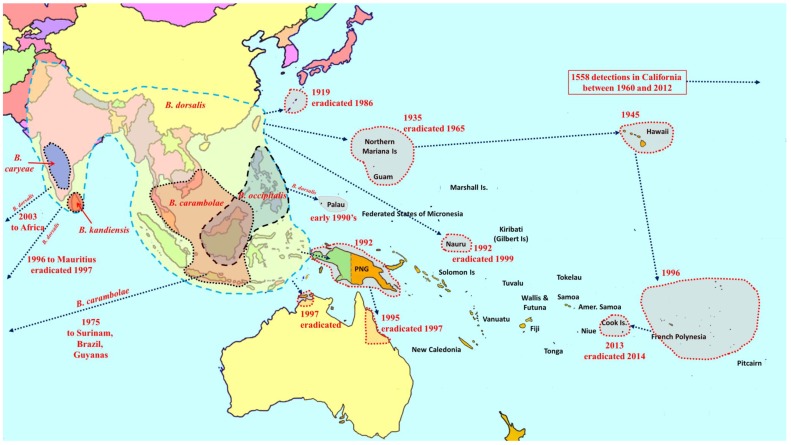
Figure 1
Full legend
Distribution and invasion history of species in the Oriental fruit fly (Bactrocera dorsalis) complex.
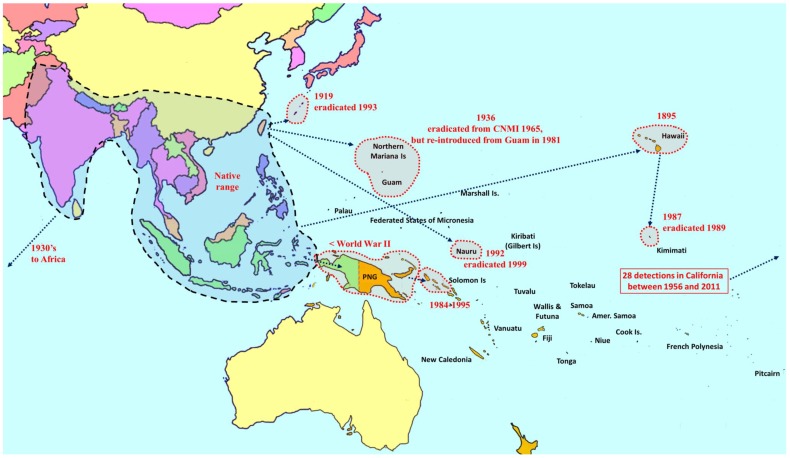
Figure 2
Full legend
Distribution and invasion history of melon fly (Bactrocera cucurbitae).
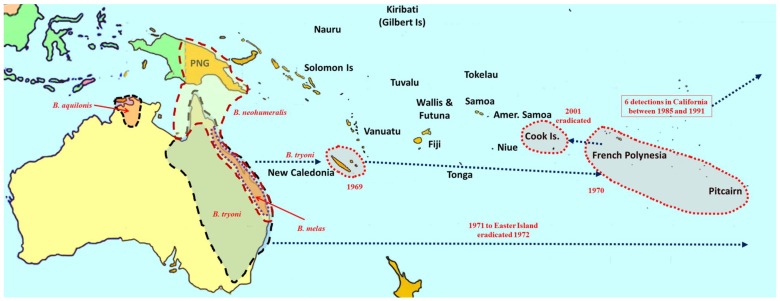
Figure 3
Full legend
Distribution and invasion history of species in the Queensland fruit fly (Bactrocera tryoni) complex.
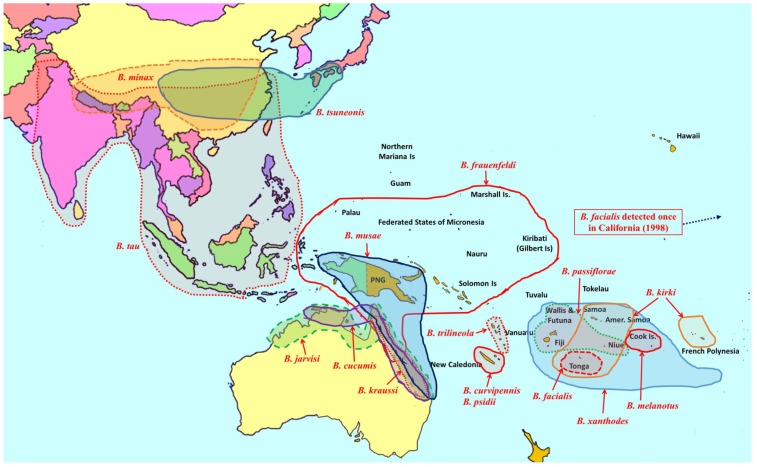
Figure 4
Full legend
Distribution of Category B pest species in the genus Bactrocera.
References89
- 1.
White I.M., Elson-Harris M.M. Fruit Flies of Economic Significance: Their Identification and Bionomics. 1992.
Not in our library
- 2.
Vargas R.I., Mau R.F.L., Jang E.B., Faust R.M., Wong L., Koul O., Cuperus G. The Hawaii fruit fly areawide pest management programme. Areawide Pest Management: Theory and Implementation. 2008;300-325.
Not in our library
- 3.
Kogan M., Bajwa W.I. Integrated pest management: A global reality? Ann. Soc. Entomol. Brasil. 1999;28:1-25.
Not in our library10.1590/s0301-80591999000100001 (opens in a new tab)
- 4.
Pedigo L.P., Rice M. Entomology and Pest Management. 2008.
Not in our library
- 5.
Dacine Fruit Flies of the Asia-Pacific.
Not in our library
- 6.
Drew R., Tsuruta K., White I. A new species of pest fruit fly (Diptera: Tephritidae: Dacinae) from Sri Lanka and Africa. Afr. Entomol. 2005;13:149-154.
Not in our library
- 7.
Rousse P., Harris E.J., Quilici S. Fopius arisanus, an egg-pupal parasitoid of Tephritidae. Overview. Biocontrol News Inform. 2005;26:59N-69N.
Not in our library
- 8.
Allwood A.J., Chinajariyawong A., Drew R.A.I., Hamacek E.L., Hancock D.L., Hengsawad C., Jipanin J.C., Jirasurat M., Kong Krong C., Kritsaeneepaiboon S., et al. Host plant records for fruit flies (Diptera: Tephritidae) in Southeast Asia. Raffles Bull. Zool. 1999;47:1-92.
Not in our library
- 9.
Allwood A.J., Leblanc L., Tora Vueti E., Bull R. Fruit Fly Control Methods for Pacific Island Countries and Territories.
Not in our library
- 10.
Allwood A.J., Vueti E.T., Leblanc L., Bull R., Veitch C.R., Clout M.N. Eradication of introduced Bactrocera species (Diptera: Tephritidae) in Nauru using male annihilation and protein bait application techniques. Turning the Tide: The Eradication of Invasive Species; Proceedings of the International Conference on Eradication Of Island Invasives. 2002;19-25.
Not in our library
- 11.
Mwatawala M.W., DeMeyer M., Makundi R.H., Maerere A.P. Host range and distribution of fruit-infesting pestiferous fruit flies (Diptera, Tephritidae) in selected areas of Central Tanzania. Bull. Entomol. Res. 2009;99:629-641.
Not in our library10.1017/s0007485309006695 (opens in a new tab)
- 12.
Vargas R.I., Mau R.F.L., Stark J.D., Piñero J.C. Evaluation of methyl eugenol and cue-lure traps with solid lure and insecticide dispensers for monitoring and male annihilation in Hawaii. J. Econ. Entomol. 2010;103:409-415.
Not in our library10.1603/ec09299 (opens in a new tab)
- 13.
Drew R.A.I. The tropical fruit flies (Diptera: Tephritidae: Dacinae) of the Australasian and Oceanian regions. Mem. Queensl. Mus. 1989;26:1-521.
Not in our library
- 14.
Drew R.A.I., Hancock D.L. The Bactrocera dorsalis complex of fruit flies (Diptera: Tephritidae: Dacinae) in Asia. Bull. Entol. Res. 1994;84(Suppl. S2):1-68.
Not in our library10.1017/s0007485300032156 (opens in a new tab)
- 15.
White I.M. Taxonomy of the Dacina (Diptera: Tephritidae) of Africa and the Middle East. 2006.
Not in our library
- 16.
Drew R.A.I., Romig M.C. Tropical Fruit Flies of South-East Asia. 2013.
Not in our library
- 17.
Hancock D.L., Hamacek E.L., Lloyd A.C., Elson-Harris M.M. The Distribution and Host Plants of Fruit Flies (Diptera: Tephritidae) in Australia. 2000;1-75.
Not in our library
- 18.
Leblanc L., Tora Vueti E., Drew R.A.I., Allwood A.J. Host plant records for fruit flies (Diptera: Tephritidae: Dacini) in the Pacific Islands. Proc. Hawaiian Entomol. Soc. 2012;44:11-53.
Not in our library
- 19.
Leblanc L., Vueti E.T., Allwood A.J. Host plant records for fruit flies (Diptera: Tephritidae: Dacini) in the Pacific Islands: 2. Infestation statistics on economic hosts. Proc. Hawaiian Entomol. Soc. 2013;45:83-117.
Not in our library
- 20.
Clarke A.R., Armstrong K.F., Carmichael A.E., Milne J.R., Raghu S., Roderick G.K., Yeates D.K. Invasive phytophagous pests arising through a recent tropical evolutionary radiation: The Bactrocera dorsalis complex of fruit flies. Annu. Rev. Entomol. 2005;50:293-319.
Not in our library10.1146/annurev.ento.50.071803.130428 (opens in a new tab)
- 21.
Schutze M.K., Aketarawong N., Amornsak W., Armstrong K., Augustinos A.A., Barr N., Bo W., Bourtzis K., Boykin L.M., Cáceres C., et al. Synonymization of key pest species within the Bactrocera dorsalis species complex (Diptera: 3 Tephritidae): Taxonomic changes based on 20 years of integrative morphological, molecular, 4 cytogenetic, behavioral, and chemoecological data. Syst. Entomol. 2014.
Not in our library10.1111/syen.12113 (opens in a new tab)
- 22.
Papadopoulos N.T., Plant R.E., Carey J.R. From trickle to flood: The large-scale, cryptic invasion of California by tropical fruit flies. Proc. R. Soc. Series B. 2013;280.
Not in our library10.1098/rspb.2013.1466 (opens in a new tab)
- 23.
Suckling D.M., Kean J.M., Stringer L.D., Caceres-Barrios C., Hendrichs J., Reyes-Flores J. Eradication of tephritid fruit fly pest populations: Outcomes and prospects. Pest Manag. Sci. 2014.
Not in our library10.1002/ps.3905 (opens in a new tab)
- 24.
Clarke A.R., Powell K.S., Weldon C.W., Taylor P.W. The ecology of Bactrocera tryoni (Diptera: Tephritidae): What do we know to assist pest management? Ann. Appl. Biol. 2011;158:26-54.
Not in our library10.1111/j.1744-7348.2010.00448.x (opens in a new tab)
- 25.
Roessler Y., Robinson A.S., Hooper G. Insecticidal bait and cover spray. Fruit Flies, Their Biology, Natural Enemies and Control. 1989;Volume 3A:329-335.
Not in our library
- 26.
Prokopy R.J., Papaj D.R., Hendrichs J., Wong T.T.Y. Behavioral responses of Ceratitis capitata flies to bait spray droplets and natural food. Entomol. Exp. Appl. 1992;64:247-257.
Not in our library10.1111/j.1570-7458.1992.tb01615.x (opens in a new tab)
- 27.
Peck S.L., McQuate G.T. Field tests of environmentally friendly malathion replacements to suppress wild Mediterranean fruit fly (Diptera: Tephritidae) populations. J. Econ. Entomol. 2000;93:280-289.
Not in our library10.1603/0022-0493-93.2.280 (opens in a new tab)
- 28.
Prokopy R.J., Miller N.W., Piñero J.C., Barry J.D., Tran L.C., Oride L., Vargas R.I. Effectiveness of GF-120 fruit fly bait spray applied to border area plants for control of Melon flies (Diptera: Tephritidae). J. Econ. Entomol. 2003;96:1485-1493.
Not in our library10.1093/jee/96.5.1485 (opens in a new tab)
- 29.
Piñero J.C., Mau R.F.L., McQuate G.T., Vargas R.I. Novel bait stations for attract-and-kill of pestiferous fruit flies. Entomol. Exp. Appl. 2009;133:208-216.
Not in our library10.1111/j.1570-7458.2009.00912.x (opens in a new tab)
- 30.
Stark J.D., Vargas R. An Evaluation of alternative insecticides to diazinon for control of Tephritid fruit flies (Diptera: Tephritidae) in Soil. J. Econ. Entomol. 2009;102:139-143.
Not in our library10.1603/029.102.0120 (opens in a new tab)
- 31.
Stark J.D., Vargas R.I., Souder S., Fox A.J., Smith T.R., Mackey B. A Comparison of the Bioinsecticide, Spinosad, the Semi-synthetic Insecticide, Spinetoram and Synthetic Insecticides as Soil Drenches for Control of Tephritid Fruit Flies. Biopestic. Int. 2013;9:120-126.
Not in our library
- 32.
Stark J.D., Vargas R.I., Souder S.K., Fox A.J., Smith T.R., Leblanc L., Mackey B. Simulated field applications of insecticide soil drenches for control of tephritid fruit flies. Biopestic. Int. 2014;10:136-142.
Not in our library
- 33.
Steiner L.F., Mitchell W.C., Harris E.J., Kozuma T.T., Fujimoto M.S. Oriental fruit fly eradication by male annihilation. J. Econ. Entomol. 1965;58:961-964.
Not in our library10.1093/jee/58.5.961 (opens in a new tab)
- 34.
Koyama J., Tadashi T., Kenji T. Eradication of the oriental fruit fly (Diptera: Tephritidae) from Okinawa Islands by male annihilation method. J. Econ. Entomol. 1984;77:468-472.
Not in our library
- 35.
Vargas R.I., Stark J.D., Kido M.H., Ketter H.M., Whitehand L.C. Methyl eugenol and cue-lure traps for suppression of male oriental fruit flies and melon flies (Diptera: Tephritidae) in Hawaii: Effects of lure mixtures and weathering. J. Econ. Entomol. 2000;93:81-87.
Not in our library10.1603/0022-0493-93.1.81 (opens in a new tab)
- 36.
Vargas R.I., Leblanc L., Piñero J.C., Hoffman K.M., Shelly T., Epsky N., Jang E.B., Reyes-Flores J., Vargas R. Male annihilation, past, present, and future. Trapping Tephritid Fruit Flies. Lures, Area-Wide Programs, and Trade Implications. 2014;493-511.
Not in our library
- 37.
Steiner L.F., Hart W.G., Harris E.J., Cunningham R.T., Ohinata K., Kamakahi D.C. Eradication of the oriental fruit fly from the Mariana Islands by the methods of male annihilation and sterile insect release. J. Econ. Entomol. 1970;63:131-135.
Not in our library10.1093/jee/63.1.131 (opens in a new tab)
- 38.
Koyama J. Eradication of the melon fly, Bactrocera cucurbitae by the sterile insect technique in Japan. Proceedings of IAEA Training Course on the Use of Sterile Insect and Related Techniques for the Area-Wide Management of Insect Pests.
Not in our library
- 39.
McInnis D., Leblanc L., Mau R. Melon fly (Diptera: Tephritidae) genetic sexing: All-male sterile fly releases in Hawaii. Proc. Hawaiian Entomol. Soc. 2007;39:105-110.
Not in our library
- 40.
Vargas R.I., Leblanc L., Putoa R., Eitam A. Impact of introduction of Bactrocera dorsalis (Diptera: Tephritidae) and classical biological control releases of Fopius arisanus (Hymenoptera: Braconidae) on economically important fruit flies in French Polynesia. J. Econ. Entomol. 2007;100:670-679.
Not in our library10.1093/jee/100.3.670 (opens in a new tab)
- 41.
- 42.
Allwood A.J., Allwood A.J., Drew R.A.I. Control strategies for fruit flies (Diptera: Tephritidae) in the South Pacific. Management of Fruit Flies in the Pacific. A Regional Symposium, Nadi, Fiji 28–31 October 1996. 1997;171-178.
Not in our library
- 43.
Klungness L.M., Jang E.B., Mau R.F.L., Vargas R.I., Sugano J.S., Fujitani E. New sanitation techniques for controlling tephritid fruit flies (Diptera: Tephritidae) in Hawaii. J. Appl. Sci. Environ. Mgt. 2005;9:4-14.
Not in our library
- 44.
Steiner L.F., Rohwer G.G., Ayers E.L., Christenson L.D. The role of attractants in the recent Mediterranean fruit fly eradication program in Florida. J. Econ. Entomol. 1961;54:30-35.
Not in our library10.1093/jee/54.1.30 (opens in a new tab)
- 45.
Steiner L.F. Methyl eugenol as an attractant for oriental fruit fly. J. Econ. Entomol. 1952;45:241-248.
Not in our library10.1093/jee/45.2.241 (opens in a new tab)
- 46.
Vargas R.I., Miller N.W., Prokopy R.J. Attraction and feeding responses of Mediterranean fruit fly and a natural enemy to protein baits laced with two novel toxins, Phloxine B and Spinosad. Entomol. Exp. Appl. 2002;102:273-282.
Not in our library10.1046/j.1570-7458.2002.00948.x (opens in a new tab)
- 47.
Canale A., Benelli G., Conti B., Lenzi G., Flamini G., Francini A., Cioni P.L. Ingestion toxicity of three Lamiaceae essential oils incorporated in protein baits against the olive fruit fly, Bactrocera oleae (Rossi) (Diptera Tephritidae). Nat. Prod. Res. 2013;27:2091-2099.
Not in our library10.1080/14786419.2013.784871 (opens in a new tab)
- 48.
Stark J.D., Vargas R.I., Miller N.W. Toxicity of spinosad in protein bait to three economically important tephritid fruit fly species (Diptera: Tephritidae) and their parasitoids Hymenoptera: Braconidae). J. Econ. Entomol. 2004;97:911-915.
Not in our library10.1093/jee/97.3.911 (opens in a new tab)
- 49.
Moreno D.S., Mangan R.L., Heitz J.R., Downum K.R. Responses of the Mexican fruit fly (Diptera: Tephritidae) to twohydrolyzed proteins and incorporation of phloxine B to kill adults. Light Activated Pest Control. 1995;257-279.
Not in our library
- 50.
DowElanco. Spinosad Technical Guide. 1994.
Not in our library
- 51.
Nishida T., Bess H.A., Ota A. Comparative effectiveness of malathion and malathion-yeast hydrolysate bait sprays for control of the melon fly. J. Econ. Entomol. 1957;50:680-684.
Not in our library10.1093/jee/50.5.680 (opens in a new tab)
- 52.
Piñero J.C., Mau R.F.L., Vargas R.I. Managing oriental fruit fly (Diptera: Tephritidae) with spinosad-based protein bait sprays and sanitation in papaya orchards in Hawaii. J. Econ. Entomol. 2009;102:1123-1132.
Not in our library10.1603/029.102.0334 (opens in a new tab)
- 53.
Ekesi S., Dimbi S., Maniania N.K., Ekesi S., Maniania N.K. The role of entomopathogenic fungi in the integrated management of tephritid fruit flies (Diptera: Tephritidae) with emphasis on species occurring in Africa. Use of Entomopathogenic Fungi in Biological Pest Management. 2007;239-274.
Not in our library
- 54.
Steiner L.F., Lee R.K.S. Large area tests of a male-annihilation method for oriental fruit fly control. J. Econ. Entomol. 1955;48:311-317.
Not in our library10.1093/jee/48.3.311 (opens in a new tab)
- 55.
Bateman M.A., Insungza V., Arreta P. The eradication of Queensland fruit fly from Easter Island. FAO Plant Prot. Bull. 1973;21:114.
Not in our library
- 56.
Vargas R.I., Stark J.D., Hertlein M., Mafra-Neto A., Coler R., Piñero J.C. Evaluation of SPLAT with spinosad and methyl eugenol or cue-lure for “attract-and-kill” of oriental and melon fruit flies (Diptera: Tephritidae) in Hawaii. J. Econ. Entomol. 2008;101:750-768.
Not in our library10.1093/jee/101.3.750 (opens in a new tab)
- 57.
Vargas R.I., Piñero J.C., Mau R.F.L., Stark J.D., Hertlein M., Mafra-Neto A., Coler R., Getchell A. Attraction and mortality of oriental fruit flies (Diptera: Tephritidae) to SPLAT-MAT-methyl eugenol with spinosad. Entomol. Exp. Appl. 2009;131:286-293.
Not in our library10.1111/j.1570-7458.2009.00853.x (opens in a new tab)
- 58.
Cunningham R.T., Suda D.Y. Male annihilation of the oriental fruit fly, Dacus dorsalis Hendel (Diptera: Tephritidae): A new thickener and extender for methyl eugenol formulations. J. Econ. Entomol. 1985;75:503-504.
Not in our library10.1093/jee/78.2.503 (opens in a new tab)
- 59.
Vargas R.I., Souder S.K., Hoffman K., Mercogliano J., Smith T.R., Hammond J.H., Davis B.J., Brodie M., Dripps J.E. Attraction and mortality of Bactrocera dorsalis to STATICTM Spinosad ME weathered under operational conditions in California and Florida: A reduced-risk male annihilation treatment. J. Econ. Entomol. 2014;107:1362-1369.
Not in our library10.1603/ec14121 (opens in a new tab)
- 60.
Vargas R.I., Souder S.K., Borges R., Mafra-Neto A., Mackey B., Chou M.Y., Spafford H. Effectiveness of a sprayable male annihilation treatment with a biopesticide against fruit flies (Dipera: Tephritidae) attacking tropical fruits. Biopest. Int. 2014;10:1-10.
Not in our library
- 61.
Knipling E.F. Possibilities of insect control or eradication through the use of sexually sterile males. J. Econ. Entomol. 1955;48:59-62.
Not in our library10.1093/jee/48.4.459 (opens in a new tab)
- 62.
Baumhover A.H., Graham A.J., Bitter B.A., Hopkins D.E., New W.D., Dudley F.H., Bushland R.C. Screwworm control through release of sterilized flies. J. Econ. Entomol. 1955;48:462-466.
Not in our library10.1093/jee/48.4.462 (opens in a new tab)
- 63.
Knipling E.F. The Basic Principles of Insect Population Suppression and Management. 1979;1-659.
Not in our library
- 64.
Benelli G., Daane K.M., Canale A., Niu C.-Y., Messing R.H., Vargas R.I. Sexual communication and related behaviours in Tephritidae: Current knowledge and potential applications for Integrated Pest Management. J. Pest Sci. 2014;87:385-405.
Not in our library10.1007/s10340-014-0577-3 (opens in a new tab)
- 65.
Benelli G. Aggression in Tephritidae flies: Where, when, why? Future directions for research in integrated pest management. Insects. 2015;6:38-53.
Not in our library10.3390/insects6010038 (opens in a new tab)
- 66.
Steiner L.F., Harris E.J., Mitchell W.C., Fujimoto M.S., Christenson L.D. Melon fly eradication by overflooding with sterile flies. J. Econ. Entomol. 1965;58:519-521.
Not in our library10.1093/jee/58.3.519 (opens in a new tab)
- 67.
Andreawartha H.G., Monro J., Richardson N.L. The use of sterile males to control populations of Queensland fruit fly, Dacus tryoni (Frogg.) (Diptera: Tephritidae). II. Filed experiments in New South Wales. Aust. J. Zool. 1967;15:461-473.
Not in our library10.1071/zo9670461 (opens in a new tab)
- 68.
Harris E.J., Cunningham R.T., Tanaka N., Ohinata K., Schroeder W.J. Development of the sterile-insect technique on the Island of Lanai, Hawaii for suppression of the Mediterranean fruit fly. Proc. Hawaii. Entomol. Soc. 1986;26:77-88.
Not in our library
- 69.
Cunningham R.T., Routhier W., Harris E.J., Cunningham G., Johnson L., Edwards W., Rosander R., Vettel W.G. Eradication of medfly by sterile-male release: A case study. Citograph. 1980;65:63-69.
Not in our library
- 70.
McInnis D.O., Tam S., Lim R., Komatsu J., Albrecht C. Development of a pupal-color based genetic sexing strain of the melon fly, Bactrocera cucurbitae (Diptera: Tephritidae). Ann. Entomol. Soc. Am. 2004;97:1026-1033.
Not in our library10.1603/0013-8746(2004)097[1026:doapcg]2.0.co;2 (opens in a new tab)
- 71.
Harris E.J., Bautista R.C., Vargas R.I., Jang E.B., Eitam A., Leblanc L. Suppression of melon fly (Diptera: Tephritidae) populations with releases of Fopius arisanus and Psyttalia fletcheri (Hymenoptera: Braconidae) in North Shore Oahu, HI, USA. Biocontrol. 2010;55:593-599.
Not in our library10.1007/s10526-010-9282-1 (opens in a new tab)
- 72.
Vargas R.I., Stark J.D., Uchida G., Purcell M. Opiine parasitoids (Hymenoptera, Braconidae) of oriental fruit-fly (Diptera, Tephritidae) on Kauai Island, Hawaii: Islandwide relative abundance and parasitism rates in wild and orchard guava habitats. Environ. Entomol. 1993;22:246-253.
Not in our library10.1093/ee/22.1.246 (opens in a new tab)
- 73.
Ekesi S., Billah M.K. A Field Guide to the Management of Economically Important Tephritid Fruit Flies in Africa. 2007.
Not in our library
- 74.
Liquido N.J. Fruit on the ground as a reservoir of resident melon fly (Diptera: Tephritidae) population in Papaya orchards. Environ. Entomol. 1991;20:620-625.
Not in our library10.1093/ee/20.2.620 (opens in a new tab)
- 75.
Liquido N.J. Reduction of Oriental fruit fly (Diptera: Tephritidae) populations in papaya orchards by field sanitation. J. Agric. Entomol. 1993;10:163-170.
Not in our library
- 76.
Sarker D., Rahman M.M., Barman J.C. Efficacy of different bagging materials for the control of mango fruit fly. Bangladesh J. Agric. Res. 2009;34:165-168.
Not in our library10.3329/bjar.v34i1.5766 (opens in a new tab)
- 77.
Jang E.B., Klungness L.M., McQuate G. Extension of the use of Augmentoria for Sanitation in a cropping system susceptible to the alien terphritid fruit flies (Diptera: Tephritidae) in Hawaii. J. Appl. Sci. Environ. Manag. 2007;11:239-248.
Not in our library
- 78.
Deguine J.P., Atiama-Nurbel T., Quilici S. Net choice is key to the augmentorium technique of fruit fly sequestration and parasitoid release. Crop Prot. 2011;30:198-202.
Not in our library10.1016/j.cropro.2010.10.007 (opens in a new tab)
- 79.
Verghese A., Tandon P.L., Stonehouse J.M. Economic evaluation of the integrated management of the oriental fruit fly Bactrocera dorsalis (Diptera: Tephritidae) in mango in India. Crop Prot. 2004;23:61-63.
Not in our library10.1016/s0261-2194(03)00087-5 (opens in a new tab)
- 80.
Mau R.F.L., Vargas R.I., Jang E.B., Wong L. Hawaii Area-Wide Fruit Fly Integrated Pest Management Program: A Model System. 2009.
Not in our library
- 81.
Verghese A., Sreedevi K., Nagaraju D.K. Pre and post-harvest IPM for the mango fruit fly, Bactrocera dorsalis (Hendel). Proceedings of the 7th International Symposium on Fruit Flies of Economic Importance. 179-182.
Not in our library
- 82.
Singh M., Gupta D., Gupta P.R. Population suppression of fruit flies (Bactrocera spp.) in mango (Mangifera indica) orchards. Ielendian J. Agric. Sci. 2013;83:1064-1068.
Not in our library
- 83.
Gogi M.D., Arif M.J., Arshad M., Khan M.A., Bashir M.H., Zia K., Abdin Z.U. Impact of sowing Times, Plant-to-Plant Distances, Sowing Methods and Sanitation on Infestation of Melon Fruit Fly (Bactrocera cucurbitae) and Yield Components of Bitter Gourd (Momordica charantia). Int. J. Agric. Biol. 2014;16:521-528.
Not in our library
- 84.
Collier T.R., van Steenwyk R.A. Prospects for integrated control of olive fruit fly are promising in California. Calif. Agric. 2003;57:28-31.
Not in our library10.3733/ca.v057n01p28 (opens in a new tab)
- 85.
Yokoyama V.Y. Olive fruit fly (Diptera: Tephritidae) in California: Invasion, distribution, and management implications. J. Pest Manag.
Not in our library
- 86.
Johnson M.W., Zalom F.G., van Steenwyk R., Vossen P., Devarenne A.K., Daane K.M., Krueger B., Connell J.H., Yokoyama V., Bisabri B., et al. Olive Fruit Fly Management Guidelines for 2006. UC Plant Prot. Q. 2006;16:1-9.
Not in our library
- 87.
Yokoyama V.Y. Olive fruit fly adult response to attract-and-kill traps in greenhouse cage tests with weathered bait spray and in a commercial table olive orchard. J. Asia-Pac. Entomol. 2014;17:717-721.
Not in our library10.1016/j.aspen.2014.07.004 (opens in a new tab)
- 88.
Yokoyama V.Y. Response of olive fruit fly, Bactrocera oleae, to an attract and kill trap in greenhouse cage tests. J. Insect Sci. 2014;14:1-5.
Not in our library10.1093/jisesa/ieu112 (opens in a new tab)
- 89.
Mangan R.L., Shelly T., Epsky N., Jang E.B., Reyes-Flores J., Vargas R. Priorities in formulation and activity of adulticidal insecticide bait sprays for fruit flies. Trapping Tephritid Fruit Flies. Lures, Area-Wide Programs, and Trade Implications. 2014;423-456.
Not in our library
Cited by papers we hold1
Reads
Read by people on this page
None yet.
Checked or read by AI through naulon
None yet.
A person counts once a day per paper. We keep no cookie and no address: a reader is a hash that changes every day. Any month under five reads shows no number.
Are you an author?
Is this your paper?
Claim it to add your note and be paid when agents cite it. Free.