Functional Dental Pulp Regeneration: Basic Research and Clinical Translation
Zhuo Xie, Zongshan Shen, Peimeng Zhan and 5 more
International Journal of Molecular Sciences · 2021 · Review · CC BY
doi:10.3390/ijms22168991 (opens in a new tab)
We email you when a new notice or a question about this paper appears.
Abstract
Pulpal and periapical diseases account for a large proportion of dental visits, the current treatments for which are root canal therapy (RCT) and pulp revascularisation. Despite the clinical signs of full recovery and histological reconstruction, true regeneration of pulp tissues is still far from being achieved. The goal of regenerative endodontics is to promote normal pulp function recovery in inflamed or necrotic teeth that would result in true regeneration of the pulpodentinal complex. Recently, rapid progress has been made related to tissue engineering-mediated pulp regeneration, which combines stem cells, biomaterials, and growth factors. Since the successful isolation and characterisation of dental pulp stem cells (DPSCs) and other applicable dental mesenchymal stem cells, basic research and preclinical exploration of stem cell-mediated functional pulp regeneration via cell transplantation and cell homing have received considerably more attention. Some of this effort has translated into clinical therapeutic applications, bringing a ground-breaking revolution and a new perspective to the endodontic field. In this article, we retrospectively examined the current treatment status and clinical goals of pulpal and periapical diseases and scrutinized biological studies of functional pulp regeneration with a focus on DPSCs, biomaterials, and growth factors. Then, we reviewed preclinical experiments based on various animal models and research strategies. Finally, we summarised the current challenges encountered in preclinical or clinical regenerative applications and suggested promising solutions to address these challenges to guide tissue engineering-mediated clinical translation in the future.
Figures4
From PubMed Central, U.S. National Library of Medicine.
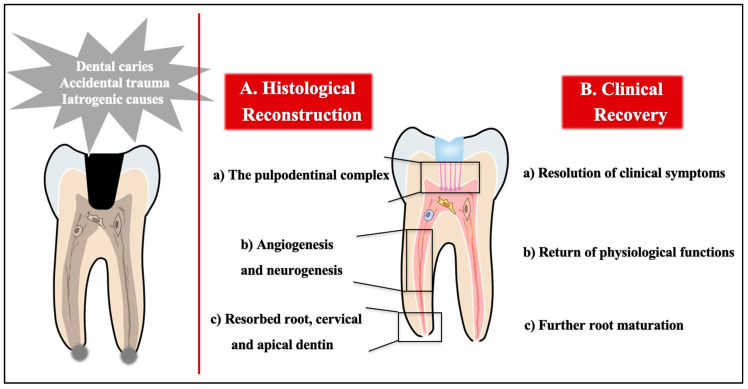
Figure 1
Full legend
Histological and clinical goals of pulp regeneration. Dental pulp may be damaged by dental caries, accidental trauma, or iatrogenic causes. The success of pulp regeneration should be defined by (A) histological and (B) clinical measures. Reconstruction of the pulpodentinal complex through angiogenesis and neurogenesis could yield histologically successful regeneration following cervical and apical dentin formation. Clinical success includes elimination of clinical symptoms such as pain and bone resorption, return of physiological functions, and increased root wall thickness and/or increased root length.
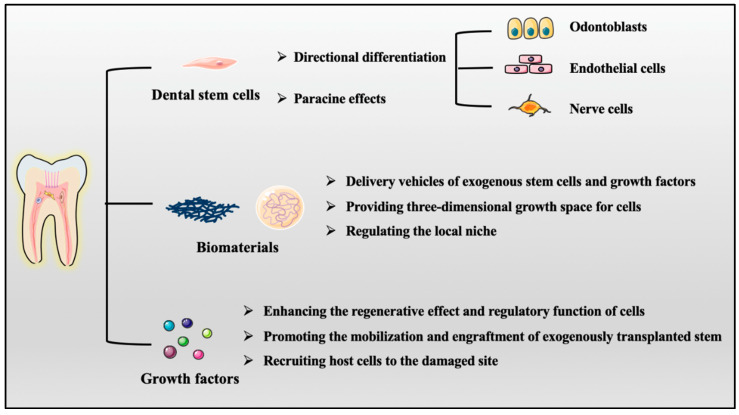
Figure 2
Full legend
Three key elements in pulp regeneration: dental stem cells, biomaterials, and growth factors.
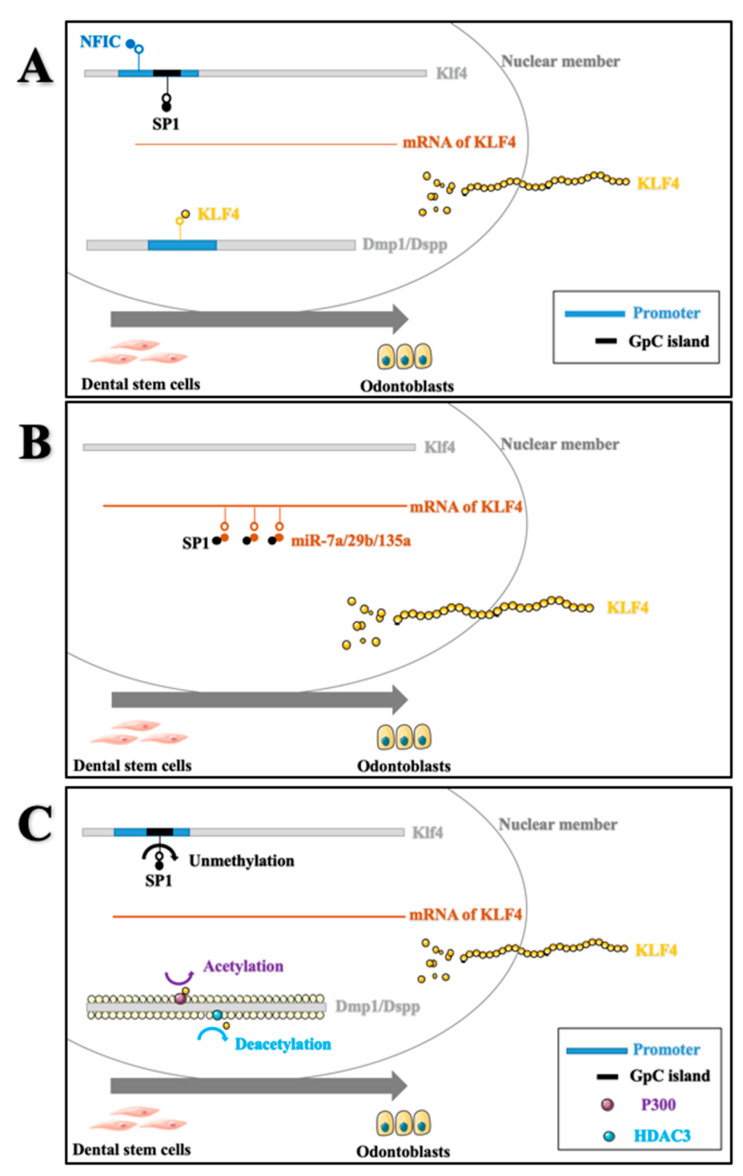
Figure 3
Full legend
Transcriptional (A), posttranscriptional (B), and epigenetic (C) regulation of KLF4 in DPSCs. KLF4 could directly upregulate the expression levels of Dmp1 and Dspp by binding to their promoters; similarly, NFIC and SP1 could regulate KLF4 expression by binding to the promoter region of Klf4. Sp1 was able to function as a ceRNA of Klf4 as well. Demethylation of the SP1/KLF4 binding motif enhanced the efficiency of SP1 binding and transcriptional regulation of KLF4. Additionally, KLF4 could recruit the histone acetylases P300 and HDAC3 to transactivate the expression of Dmp1 and Sp7. Complicated regulatory networks among the Sp1/Klf4/Dmp1, Sp1/Klf4/Dspp, and Sp1/Klf4/Sp7 axes need further investigation.
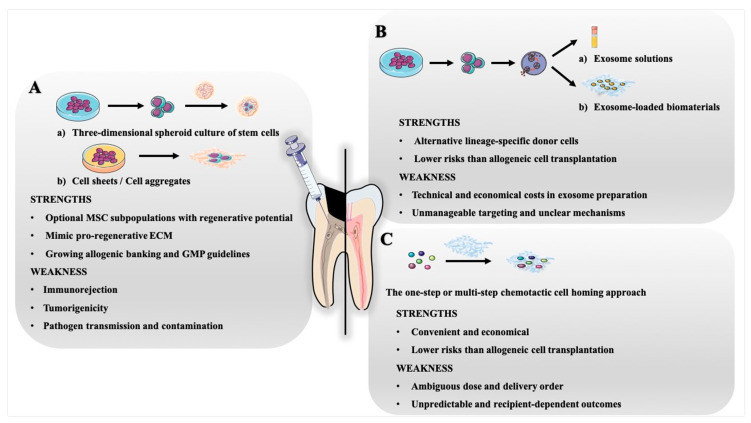
Figure 4
Full legend
Comparison of three optimised strategies for pulp regeneration. (A) Novel culture methods for transplanted dental stem cells, such as three-dimensional spheroid culture systems, cell sheets, and cell aggregates, are beneficial for determining the optimal regenerative subpopulations and mimic pro-regenerative ECM, while some limitations of allogeneic transplantation cannot be avoided. (B) Exosomes used for pulp regeneration could be selected from alternative lineage-specific donor cells; however, high costs in isolation, identification, and administration before application may limit their large-scale production. Further investigations must focus on precise targeting and uptake testing. (C) An exogenous growth factor-mediated cell homing approach would be an operable and economical choice for pulp regeneration, although a wide variation in growth factor types, applied dosages, and delivery orders among recipients may lead to unpredictable outcomes.
References149
- 1.
Jakovljevic A., Nikolic N., Jaćimović J., Pavlovic O., Milicic B., Beljic-Ivanovic K., Miletic M., Andric M., Milasin J. Prevalence of Apical Periodontitis and Conventional Nonsurgical Root Canal Treatment in General Adult Population: An Updated Systematic Review and Meta-analysis of Cross-sectional Studies Published between 2012 and 2020. J. Endod. 2020;46:1371-1386.e8.
Not in our library10.1016/j.joen.2020.07.007 (opens in a new tab)
- 2.
Tibúrcio-Machado C.S., Michelon C., Zanatta F.B., Gomes M.S., Marin J.A., Bier C.A. The global prevalence of apical periodontitis: A systematic review and meta-analysis. Int. Endod. J. 2020;54:712-735.
Not in our library10.1111/iej.13467 (opens in a new tab)
- 3.
Goldberg M., Njeh A., Uzunoglu E. Is Pulp Inflammation a Prerequisite for Pulp Healing and Regeneration? Mediat. Inflamm. 2015;2015:347649.
Not in our library10.1155/2015/347649 (opens in a new tab)
- 4.
Su Y., Wang C., Ye L. Healing Rate and Post-obturation Pain of Single- versus Multiple-visit Endodontic Treatment for Infected Root Canals: A Systematic Review. J. Endod. 2011;37:125-132.
Not in our library10.1016/j.joen.2010.09.005 (opens in a new tab)
- 5.
Duggal M., Tong H.J., Alansary M., Twati W., Day P.F., Nazzal H. Interventions for the endodontic management of non-vital traumatised immature permanent anterior teeth in children and adolescents: A systematic review of the evidence and guidelines of the European Academy of Paediatric Dentistry. Eur. Arch. Paediatr. Dent. 2017;18:139-151.
Not in our library10.1007/s40368-017-0289-5 (opens in a new tab)
- 6.
Murray P., Garcia-Godoy F., Hargreaves K.M. Regenerative Endodontics: A Review of Current Status and a Call for Action. J. Endod. 2007;33:377-390.
Not in our library10.1016/j.joen.2006.09.013 (opens in a new tab)
- 7.
American Association of Endodontists (Aae). Clinical Considerations for a Regenerative Procedure. Revised 2016. 2016.
Not in our library
- 8.
American Association of Endodontists (Aae). Clinical Considerations for a Regenerative Procedure. Revised 2018. 2018.
Not in our library
- 9.
Iwaya S.-I., Ikawa M., Kubota M. Revascularization of an immature permanent tooth with apical periodontitis and sinus tract. Dent. Traumatol. 2001;17:185-187.
Not in our library10.1034/j.1600-9657.2001.017004185.x (opens in a new tab)
- 10.
Wigler R., Kaufman A.Y., Lin S., Steinbock N., Hazan-Molina H., Torneck C.D. Revascularization: A Treatment for Permanent Teeth with Necrotic Pulp and Incomplete Root Development. J. Endod. 2013;39:319-326.
Not in our library10.1016/j.joen.2012.11.014 (opens in a new tab)
- 11.
Altaii M., Richards L., Rossi-Fedele G. Histological assessment of regenerative endodontic treatment in animal studies with different scaffolds: A systematic review. Dent. Traumatol. 2017;33:235-244.
Not in our library10.1111/edt.12338 (opens in a new tab)
- 12.
Cao Y., Song M., Kim E., Shon W., Chugal N., Bogen G., Lin L., Kim R.H., Park N.H., Kang M.K. Pulp-Dentin Regeneration: Current State and Future Prospects. J. Dent. Res. 2015;94:1544-1551.
Not in our library10.1177/0022034515601658 (opens in a new tab)
- 13.
Nakashima M., Iohara K. Regeneration of Dental Pulp by Stem Cells. Adv. Dent. Res. 2011;23:313-319.
Not in our library10.1177/0022034511405323 (opens in a new tab)
- 14.
Moussa D.G., Aparicio C. Present and future of tissue engineering scaffolds for dentin-pulp complex regeneration. J. Tissue Eng. Regen. Med. 2018;13:58-75.
Not in our library10.1002/term.2769 (opens in a new tab)
- 15.
Kim J.Y., Xin X., Moioli E.K., Chung J., Lee C.H., Chen M., Fu S.Y., Koch P.D., Mao J.J. Regeneration of Dental-Pulp-like Tissue by Chemotaxis-Induced Cell Homing. Tissue Eng. Part A. 2010;16:3023-3031.
Not in our library10.1089/ten.tea.2010.0181 (opens in a new tab)
- 16.
- 17.
Meirinhos J., Martins J.N.R., Pereira A.B.D.C.R.J., Baruwa A., Gouveia J., Quaresma S.A., Monroe A., Ginjeira A. Prevalence of apical periodontitis and its association with previous root canal treatment, root canal filling length and type of coronal restoration—A cross-sectional study. Int. Endod. J. 2019;53:573-584.
Not in our library10.1111/iej.13256 (opens in a new tab)
- 18.
Pandey P., Aggarwal H., Tikku A., Singh A., Bains R., Mishra S. Comparative evaluation of sealing ability of gutta percha and resilon as root canal filling materials—A systematic review. J. Oral Biol. Craniofacial Res. 2019;10:220-226.
Not in our library10.1016/j.jobcr.2019.12.004 (opens in a new tab)
- 19.
Bromberg C.R., Alves C.B., Stona D., Spohr A.M., Rodrigues-Junior S.A., Melara R., Burnett L.H. Fracture resistance of endodontically treated molars restored with horizontal fiberglass posts or indirect techniques. J. Am. Dent. Assoc. 2016;147:952-958.
Not in our library10.1016/j.adaj.2016.08.001 (opens in a new tab)
- 20.
Nakashima M., Iohara K., Zayed M. Pulp Regeneration: Current Approaches, Challenges, and Novel Rejuvenating Strategies for an Aging Population. J. Endod. 2020;46:S135-S142.
Not in our library10.1016/j.joen.2020.06.028 (opens in a new tab)
- 21.
Kahler B., Rossi-Fedele G. A Review of Tooth Discoloration after Regenerative Endodontic Therapy. J. Endod. 2016;42:563-569.
Not in our library10.1016/j.joen.2015.12.022 (opens in a new tab)
- 22.
Lin L.M., Huang G.T., Sigurdsson A., Kahler B. Clinical cell-based versus cell-free regenerative endodontics: Clarification of concept and term. Int. Endod. J. 2021;54:887-901.
Not in our library10.1111/iej.13471 (opens in a new tab)
- 23.
Lin J., Zeng Q., Wei X., Zhao W., Cui M., Gu J., Lu J., Yang M., Ling J. Regenerative Endodontics Versus Apexification in Immature Permanent Teeth with Apical Periodontitis: A Prospective Randomized Controlled Study. J. Endod. 2017;43:1821-1827.
Not in our library10.1016/j.joen.2017.06.023 (opens in a new tab)
- 24.
Kahler B., Mistry S., Moule A., Ringsmuth A., Case P., Thomson A., Holcombe T. Revascularization Outcomes: A Prospective Analysis of 16 Consecutive Cases. J. Endod. 2013;40:333-338.
Not in our library10.1016/j.joen.2013.10.032 (opens in a new tab)
- 25.
Panda S., Mishra L., Arbildo-Vega H.I., Lapinska B., Lukomska-Szymanska M., Khijmatgar S., Parolia A., Bucchi C., Del Fabbro M. Effectiveness of Autologous Platelet Concentrates in Management of Young Immature Necrotic Permanent Teeth—A Systematic Review and Meta-Analysis. Cells. 2020;9:2241.
Not in our library10.3390/cells9102241 (opens in a new tab)
- 26.
Kuang R., Zhang Z., Jin X., Hu J., Shi S., Ni L., Ma P.X. Nanofibrous spongy microspheres for the delivery of hypoxia-primed human dental pulp stem cells to regenerate vascularized dental pulp. Acta Biomater. 2016;33:225-234.
Not in our library10.1016/j.actbio.2016.01.032 (opens in a new tab)
- 27.
Kuang R., Zhang Z., Jin X., Hu J., Gupte M.J., Ni L., Ma P.X. Nanofibrous Spongy Microspheres Enhance Odontogenic Differentiation of Human Dental Pulp Stem Cells. Adv. Health Mater. 2015;4:1993-2000.
Not in our library10.1002/adhm.201500308 (opens in a new tab)
- 28.
Murakami M., Horibe H., Iohara K., Hayashi Y., Osako Y., Takei Y., Nakata K., Motoyama N., Kurita K., Nakashima M. The use of granulocyte-colony stimulating factor induced mobilization for isolation of dental pulp stem cells with high regenerative potential. Biomaterials. 2013;34:9036-9047.
Not in our library10.1016/j.biomaterials.2013.08.011 (opens in a new tab)
- 29.
Nakashima M., Iohara K., Ishikawa M., Ito M., Tomokiyo A., Tanaka T., Akamine A. Stimulation of Reparative Dentin Formation by Ex Vivo Gene Therapy Using Dental Pulp Stem Cells Electrotransfected with Growth/differentiation factor 11 (Gdf11). Hum. Gene Ther. 2004.
Not in our library10.1089/hum.2004.15.1045 (opens in a new tab)
- 30.
Yan X., Qin H., Qu C., Tuan R.S., Shi S., Huang G.T.-J. iPS Cells Reprogrammed from Human Mesenchymal-Like Stem/Progenitor Cells of Dental Tissue Origin. Stem Cells Dev. 2010;19:469-480.
Not in our library10.1089/scd.2009.0314 (opens in a new tab)
- 31.
Xuan K., Li B., Guo H., Sun W., Kou X., He X., Zhang Y., Sun J., Liu A., Liao L., et al. Deciduous autologous tooth stem cells regenerate dental pulp after implantation into injured teeth. Sci. Transl. Med. 2018;10:eaaf3227.
Not in our library10.1126/scitranslmed.aaf3227 (opens in a new tab)
- 32.
Hu J., Cao Y., Xie Y., Wang H., Fan Z., Wang J., Zhang C., Wu C.-T., Wang S. Periodontal regeneration in swine after cell injection and cell sheet transplantation of human dental pulp stem cells following good manufacturing practice. Stem Cell Res. Ther. 2016;7:1-11.
Not in our library10.1186/s13287-016-0362-8 (opens in a new tab)
- 33.
Huang C.-C., Narayanan R., Alapati S., Ravindran S. Exosomes as biomimetic tools for stem cell differentiation: Applications in dental pulp tissue regeneration. Biomaterials. 2016;111:103-115.
Not in our library10.1016/j.biomaterials.2016.09.029 (opens in a new tab)
- 34.
He L., Zhou J., Chen M., Lin C.-S., Kim S.G., Zhou Y., Xiang L., Xie M., Bai H., Yao H., et al. Parenchymal and stromal tissue regeneration of tooth organ by pivotal signals reinstated in decellularized matrix. Nat. Mater. 2019;18:627-637.
Not in our library10.1038/s41563-019-0368-6 (opens in a new tab)
- 35.
Postnatal human dental pulp stem cells (DPSCs) in vitro and in vivo · 2000
Not checked - 36.
Miura M., Gronthos S., Zhao M., Lu B., Fisher L.W., Robey P.G., Shi S. Shed: Stem Cells from Human Exfoliated Deciduous Teeth. Proc. Natl. Acad. Sci. USA. 2003;100:5807-5812.
Not in our library10.1073/pnas.0937635100 (opens in a new tab)
- 37.
Seo B.-M., Miura M., Gronthos S., Bartold P., Batouli S., Brahim J., Young M., Robey P., Wang C.Y., Shi S. Investigation of multipotent postnatal stem cells from human periodontal ligament. Lancet. 2004;364:149-155.
Not in our library10.1016/s0140-6736(04)16627-0 (opens in a new tab)
- 38.
Sugimura-Wakayama Y., Katagiri W., Osugi M., Kawai T., Ogata K., Sakaguchi K., Hibi H. Peripheral Nerve Regeneration by Secretomes of Stem Cells from Human Exfoliated Deciduous Teeth. Stem Cells Dev. 2015;24:2687-2699.
Not in our library10.1089/scd.2015.0104 (opens in a new tab)
- 39.
Ratajczak J., Bronckaers A., Dillen Y., Gervois P., Vangansewinkel T., Driesen R.B., Wolfs E., Lambrichts I., Hilkens P. The Neurovascular Properties of Dental Stem Cells and Their Importance in Dental Tissue Engineering. Stem Cells Int. 2016;2016:1-17.
Not in our library10.1155/2016/9762871 (opens in a new tab)
- 40.
Hu L., Zhao B., Gao Z., Xu J., Fan Z., Zhang C., Wang J., Wang S. Regeneration characteristics of different dental derived stem cell sheets. J. Oral Rehabil. 2019;47:66-72.
Not in our library10.1111/joor.12839 (opens in a new tab)
Cited by papers we hold1
Reads
Read by people on this page
None yet.
Checked or read by AI through naulon
None yet.
A person counts once a day per paper. We keep no cookie and no address: a reader is a hash that changes every day. Any month under five reads shows no number.
Are you an author?
Is this your paper?
Claim it to add your note and be paid when agents cite it. Free.