CD44: A Multifunctional Mediator of Cancer Progression
Malak Hassn Mesrati, Saiful Effendi Syafruddin, M. Aiman Mohtar and 1 more
Biomolecules · 2021 · Review · CC BY
doi:10.3390/biom11121850 (opens in a new tab)
We email you when a new notice or a question about this paper appears.
Abstract
CD44, a non-kinase cell surface transmembrane glycoprotein, has been widely implicated as a cancer stem cell (CSC) marker in several cancers. Cells overexpressing CD44 possess several CSC traits, such as self-renewal and epithelial-mesenchymal transition (EMT) capability, as well as a resistance to chemo- and radiotherapy. The CD44 gene regularly undergoes alternative splicing, resulting in the standard (CD44s) and variant (CD44v) isoforms. The interaction of such isoforms with ligands, particularly hyaluronic acid (HA), osteopontin (OPN) and matrix metalloproteinases (MMPs), drive numerous cancer-associated signalling. However, there are contradictory results regarding whether high or low CD44 expression is associated with worsening clinicopathological features, such as a higher tumour histological grade, advanced tumour stage and poorer survival rates. Nonetheless, high CD44 expression significantly contributes to enhanced tumourigenic mechanisms, such as cell proliferation, metastasis, invasion, migration and stemness; hence, CD44 is an important clinical target. This review summarises current research regarding the different CD44 isoform structures and their roles and functions in supporting tumourigenesis and discusses CD44 expression regulation, CD44-signalling pathways and interactions involved in cancer development. The clinical significance and prognostic value of CD44 and the potential of CD44 as a therapeutic target in cancer are also addressed.
Figures7
From PubMed Central, U.S. National Library of Medicine.
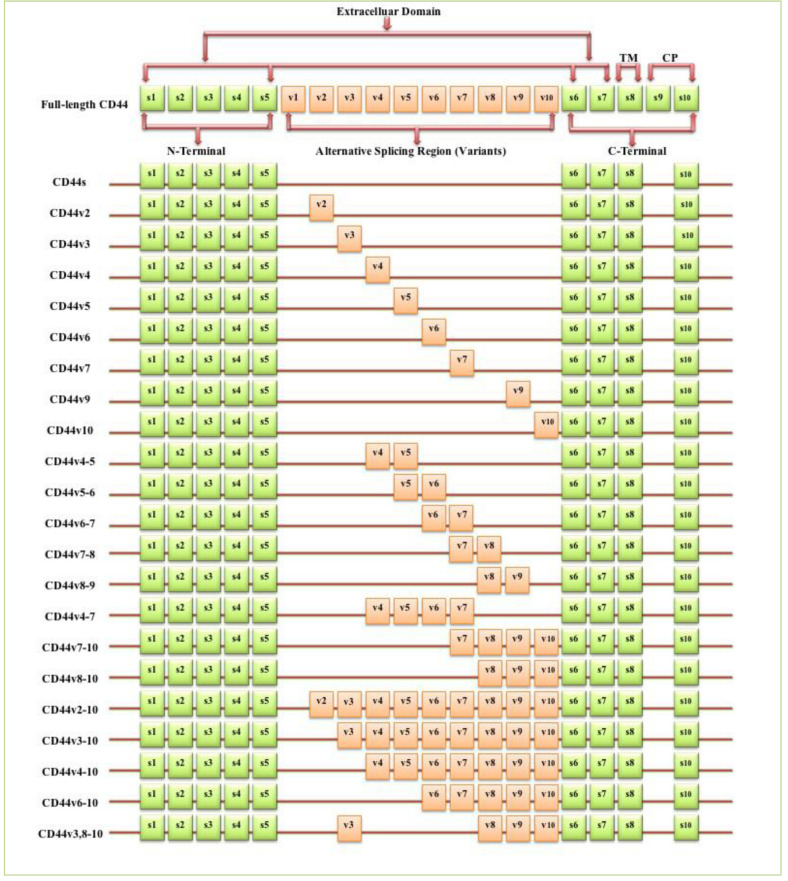
Figure 1
Full legend
Schematic diagram of the mouse CD44 gene and most CD44 isoforms involved in cancer progression. The full-length CD44 gene contains 20 exons in mice and 19 exons in humans, with the constant exons 1–5 and 16–20 encoding the N-terminal and the C-terminal domains. CD44 standard (CD44s) is encoded by these ten constant exons and contains no variant exons, whereas the CD44 variant (CD44v) is produced by the alternative splicing of a variable insertion of nine extra exons in humans or ten extra exons in mice. These extra exons are exons 6-15, typically identified as (v1 to v10) in mice and the exons 7-15 identified as (v2 to v10) in humans and are located between the N-terminal and C-terminal domains. CD44v can contain one or multiple variant exons and exon 19 is spliced out in all CD44 isoforms. Abbreviations: CD44s, CD44 standard; CD44v, CD44 variant; s, standard; v, variant; TM, transmembrane; CP, cytoplasmic. Green boxes refer to the constant/standard exons. Orange boxes refer to the variant exons.
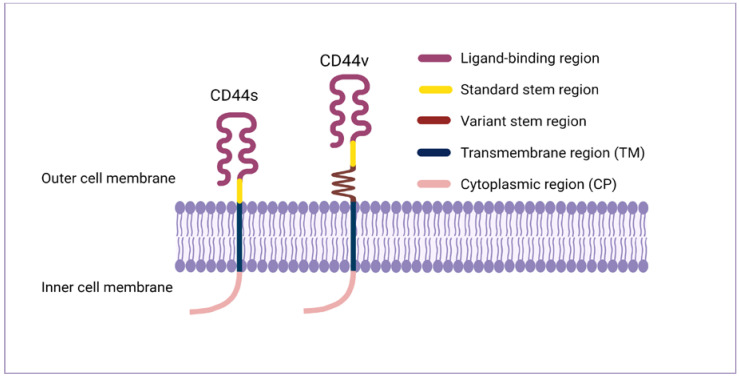
Figure 2
Full legend
CD44 protein structure. The CD44 protein has four primary regions: the extracellular region consists of seven extracellular domains including N-terminal domains (ligand-binding region), the stem region (variable stem region and/or standard stem region) which is the alternative splicing area containing an insertion of one or more variant exons, the transmembrane region (TM), and the C-terminal cytoplasmic (CP) region.
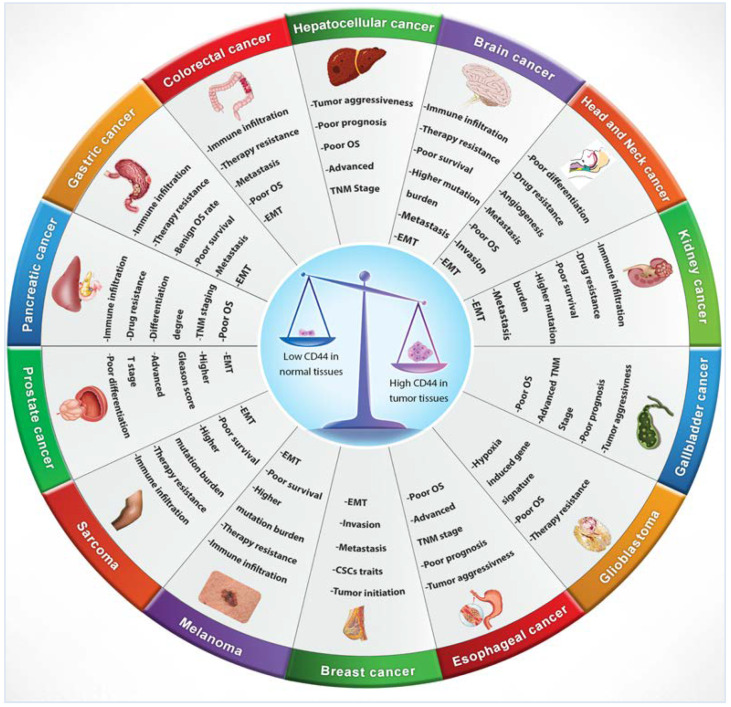
Figure 3
Full legend
CD44 distribution in normal versus cancerous tissues and its correlation with clinical outcomes.
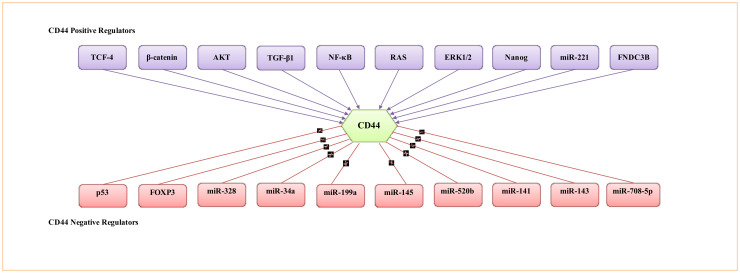
Figure 4
Full legend
Representative transcription factors, protein kinases, cytokines and miRNA involved in the regulation of CD44 activity.
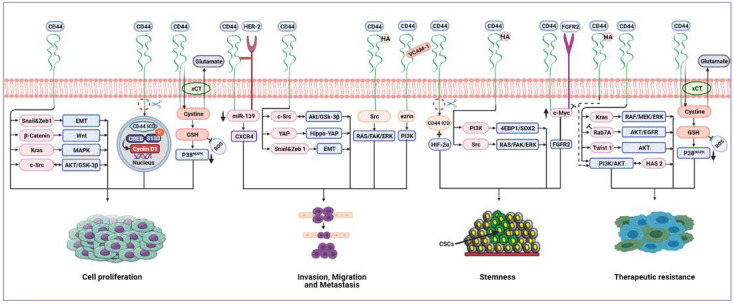
Figure 5
Full legend
Cancer-associated signalling pathways modulated by CD44. CD44 can upregulate EMT biomarkers, Snail1 and Zeb1, promoting proliferation and invasion. CD44 activates KRAS through the MAPK pathway, hence promoting tumour cell proliferation and survival. CD44 mediates invasion and metastasis by binding to HER2, leading to the inhibition of miR-139 and upregulation of CXCR4. There is positive crosstalk between CD44 and FGFR2 to maintain cancer stemness. CD44 regulates tumour cell proliferation, invasion and migration by modulating c-Src via AKT/GSK-3β signalling. CD44/VCAM-1 interaction promotes invasion signalling by the ezrin/PI3K pathway. CD44 binds to HA, resulting in stemness development via the PI3K/4EBP1/SOX2 pathway. Also, the HA/CD44 interaction can drive tumour invasion, metastasis and stemness through Src activating RAS/FAK/ERK pathways. Similarly, HA/CD44 stimulates the PI3K/AKT signalling pathway to increase therapeutic resistance. CD44 can sustain EGFR and AKT signalling by inhibition of Rab7A, leading to therapeutic resistance. CD44 promotes the expression of HAS2 by activating the PI3K/AKT signalling pathway. HAS2 further enhances CD44-mediated PI3K/AKT signalling, thus creating a positive feedback loop that drives tumour cell resistance and survival. CD44 can stabilise the cystine/glutamate antiporter (xCT), leading to increased GSH and decreased ROS levels, which, in turn, results in tumour cell proliferation and therapeutic resistance mediated by suppression of the p38 pathway. CD44 regulates tumour cell proliferation by the Wnt/β-catenin signalling pathway. CD44 can promote invasion and migration through the activation of the Hippo-YAP oncogene signalling pathway. CD44 mediates tumour cells resistance by upregulating Twist1 and AKT signalling. CD44-ICD binds to CREB, enhances S133 phosphorylation and enriches CREB recruitment to the cyclin D1 promoter, thus promoting cyclin D1 activity, resulting in cell proliferation. CD44-ICD is released in a hypoxic environment and binds to HIF-2α leading to induced stemness. Abbreviations: EMT, epithelial–mesenchymal transition; HER2, human epidermal growth factor receptor 2; CXCR4, C-X-C chemokine receptor type 4; FGFR2, fibroblast growth factor receptor 2; EGFR, epidermal growth factor receptor; HAS2, hyaluronan synthase 2; GSH, glutathione; ROS, reactive oxygen species; CD44-ICD, CD44 intracellular domain; CREB, cAMP response element-binding; HIF-2α, hypoxia-inducible factors 2 alpha.
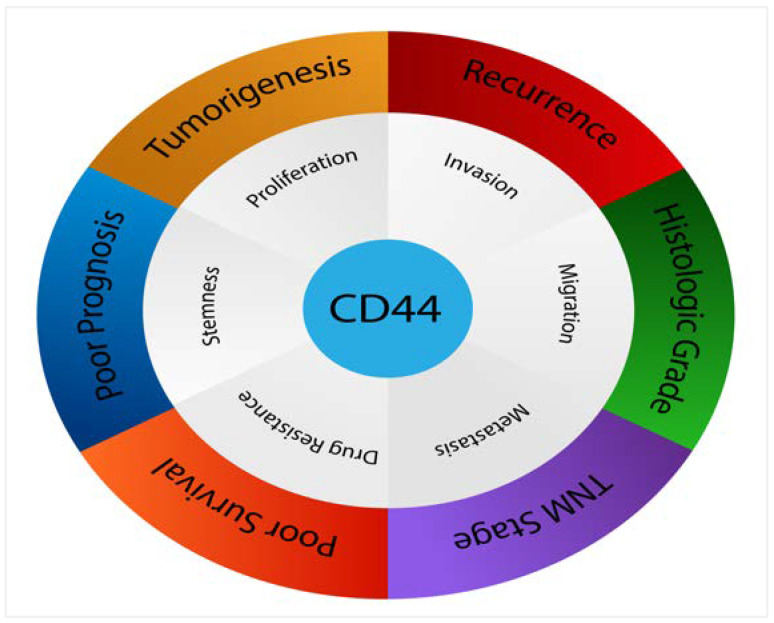
Figure 6
Full legend
CD44 affects numerous pathological processes in cancers.
Show all 7 figures
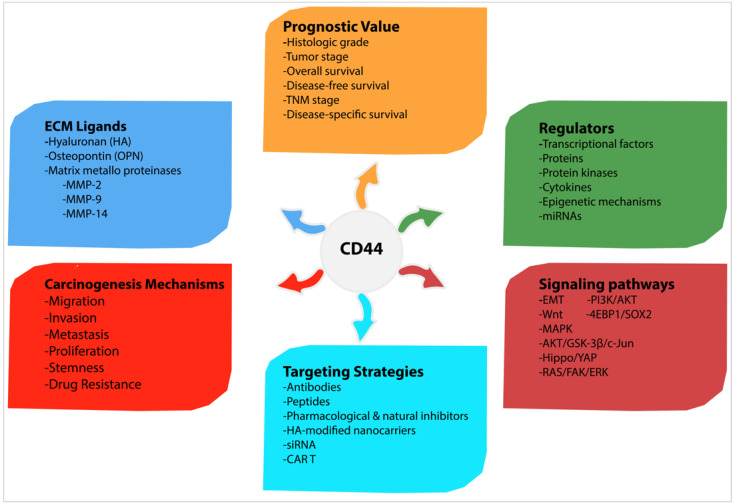
Figure 7
Full legend
Summary of carcinogenic mechanisms and signalling pathways induced by CD44, as well as CD44 regulators, ligands, prognostic value and possible targeting strategies.
References233
- 1.
- 2.
- 3.
Dalchau R., Kirkley J., Fabre J.W. Monoclonal antibody to a human brain-granulocyte-T lymphocyte antigen probably homologous to the W 3/13 antigen of the rat. Eur. J. Immunol. 1980;10:745-749.
Not in our library10.1002/eji.1830101004 (opens in a new tab)
- 4.
Hughes E.N., Mengod G., August J.T. Murine cell surface glycoproteins. Characterization of a major component of 80,000 daltons as a polymorphic differentiation antigen of mesenchymal cells. J. Biol. Chem. 1981;256:7023-7027.
Not in our library10.1016/s0021-9258(19)69093-9 (opens in a new tab)
- 5.
Stamenkovic I., Amiot M., Pesando J.M., Seed B. A lymphocyte molecule implicated in lymph node homing is a member of the cartilage link protein family. Cell. 1989;56:1057-1062.
Not in our library10.1016/0092-8674(89)90638-7 (opens in a new tab)
- 6.
Goodfellow P.N., Banting G., Wiles M.V., Tunnacliffe A., Parkar M., Solomon E., Dalchau R., Fabre J.W. The gene, MIC4, which controls expression of the antigen defined by monoclonal antibody F10.44.2, is on human chromosome 11. Eur. J. Immunol. 1982;12:659-663.
Not in our library10.1002/eji.1830120807 (opens in a new tab)
- 7.
Colombatti A., Hughes E.N., Taylor B.A., August J.T. Gene for a major cell surface glycoprotein of mouse macrophages and other phagocytic cells is on chromosome 2. Proc. Natl. Acad. Sci. USA. 1982;79:1926-1929.
Not in our library10.1073/pnas.79.6.1926 (opens in a new tab)
- 8.
Zeilstra J. CD44 Isoforms in Intestinal Cancer: Identity and Functions. Ph.D. Thesis. 2020.
Not in our library
- 9.
Ouhtit A., Rizeq B., Saleh H.A., Rahman M.M., Zayed H. Novel CD44-downstream signaling pathways mediating breast tumor invasion. Int. J. Biol. Sci. 2018;14:1782-1790.
Not in our library10.7150/ijbs.23586 (opens in a new tab)
- 10.
Loh T.J., Moon H., Cho S., Jang H., Liu Y.C., Tai H., Jung D.W., Williams D.R., Kim H.R., Shin M.G., et al. CD44 alternative splicing and hnRNP A1 expression are associated with the metastasis of breast cancer. Oncol. Rep. 2015;34:1231-1238.
Not in our library10.3892/or.2015.4110 (opens in a new tab)
- 11.
Rall C.J., Rustgi A.K. CD44 isoform expression in primary and metastatic pancreatic adenocarcinoma. Cancer Res. 1995;55:1831-1835.
Not in our library
- 12.
Mishra M.N., Chandavarkar V., Sharma R., Bhargava D. Structure, function and role of CD44 in neoplasia. J. Oral Maxillofac. Pathol. 2019;23:267-272.
Not in our library10.4103/jomfp.jomfp_246_18 (opens in a new tab)
- 13.
Tölg C., Hofmann M., Herrlich P., Ponta H. Splicing choice from ten variant exons establishes CD44 variability. Nucleic Acids Res. 1993;21:1225-1229.
Not in our library10.1093/nar/21.5.1225 (opens in a new tab)
- 14.
Screaton G.R., Bell M.V., Jackson D.G., Cornelis F.B., Gerth U., Bell J.I. Genomic structure of DNA encoding the lymphocyte homing receptor CD44 reveals at least 12 alternatively spliced exons. Proc. Natl. Acad. Sci. USA. 1992;89:12160-12164.
Not in our library10.1073/pnas.89.24.12160 (opens in a new tab)
- 15.
Zeilstra J., Joosten S.P., van Andel H., Tolg C., Berns A., Snoek M., Van De Wetering M., Spaargaren M., Clevers H., Pals S.T. Stem cell CD44v isoforms promote intestinal cancer formation in Apc(min) mice downstream of Wnt signaling. Oncogene. 2014;33:665-670.
Not in our library10.1038/onc.2012.611 (opens in a new tab)
- 16.
Goodison S., Urquidi V., Tarin D. CD44 cell adhesion molecules. Mol. Pathol. 1999;52:189-196.
Not in our library10.1136/mp.52.4.189 (opens in a new tab)
- 17.
Chen K.L., Li D., Lu T.X., Chang S.W. Structural Characterization of the CD44 Stem Region for Standard and Cancer-Associated Isoforms. Int. J. Mol. Sci. 2020;21:336.
Not in our library10.3390/ijms21010336 (opens in a new tab)
- 18.
- 19.
Liu X., Taftaf R., Kawaguchi M., Chang Y.F., Chen W., Entenberg D., Zhang Y., Gerratana L., Huang S., Patel D.B., et al. Homophilic CD44 Interactions Mediate Tumor Cell Aggregation and Polyclonal Metastasis in Patient-Derived Breast Cancer Models. Cancer Discov. 2019;9:96-113.
Not in our library10.1158/2159-8290.cd-18-0065 (opens in a new tab)
- 20.
Wolf K.J., Shukla P., Springer K., Lee S., Coombes J.D., Choy C.J., Kenny S.J., Xu K., Kumar S. A mode of cell adhesion and migration facilitated by CD44-dependent microtentacles. Proc. Natl. Acad. Sci. USA. 2020;117:11432-11443.
Not in our library10.1073/pnas.1914294117 (opens in a new tab)
- 21.
Hassn Mesrati M., Behrooz A.B., Abuhamad A.Y., Syahir A. Understanding Glioblastoma Biomarkers: Knocking a Mountain with a Hammer. Cells. 2020;9:1236.
Not in our library10.3390/cells9051236 (opens in a new tab)
- 22.
Ludwig N., Szczepanski M.J., Gluszko A., Szafarowski T., Azambuja J.H., Dolg L., Gellrich N.-C., Kampmann A., Whiteside T.L., Zimmerer R.M. CD44(+) tumor cells promote early angiogenesis in head and neck squamous cell carcinoma. Cancer Lett. 2019;467:85-95.
Not in our library10.1016/j.canlet.2019.10.010 (opens in a new tab)
- 23.
Gzil A., Zarębska I., Bursiewicz W., Antosik P., Grzanka D., Szylberg Ł. Markers of pancreatic cancer stem cells and their clinical and therapeutic implications. Mol. Biol. Rep. 2019;46:6629-6645.
Not in our library10.1007/s11033-019-05058-1 (opens in a new tab)
- 24.
Durko L., Wlodarski W., Stasikowska-Kanicka O., Wagrowska-Danilewicz M., Danilewicz M., Hogendorf P., Strzelczyk J., Malecka-Panas E. Expression and Clinical Significance of Cancer Stem Cell Markers CD24, CD44, and CD133 in Pancreatic Ductal Adenocarcinoma and Chronic Pancreatitis. Dis. Markers. 2017;2017:3276806.
Not in our library10.1155/2017/3276806 (opens in a new tab)
- 25.
Li W., Qian L., Lin J., Huang G., Hao N., Wei X., Wang W., Liang J. CD44 regulates prostate cancer proliferation, invasion and migration via PDK1 and PFKFB4. Oncotarget. 2017;8:65143-65151.
Not in our library10.18632/oncotarget.17821 (opens in a new tab)
- 26.
Wang Z., Tang Y., Xie L., Huang A., Xue C., Gu Z., Wang K., Zong S. The Prognostic and Clinical Value of CD44 in Colorectal Cancer: A Meta-Analysis. Front. Oncol. 2019;9:309.
Not in our library10.3389/fonc.2019.00309 (opens in a new tab)
- 27.
Holah N.S., Aiad H.A., Asaad N.Y., Elkhouly E.A., Lasheen A.G. Evaluation of the role of CD44 as a cancer stem cell marker in colorectal carcinoma: Immunohistochemical study. Menoufia Med. J. 2017;30:174-183.
Not in our library10.7860/jcdr/2017/22671.9291 (opens in a new tab)
- 28.
Zhang H., Brown R.L., Wei Y., Zhao P., Liu S., Liu X., Deng Y., Hu X., Zhang J., Gao X.D., et al. CD44 splice isoform switching determines breast cancer stem cell state. Genes Dev. 2019;33:166-179.
Not in our library10.1101/gad.319889.118 (opens in a new tab)
- 29.
Zhao P., Xu Y., Wei Y., Qiu Q., Chew T.L., Kang Y., Cheng C. The CD44s splice isoform is a central mediator for invadopodia activity. J. Cell Sci. 2016;129:1355-1365.
Not in our library10.1242/jcs.171959 (opens in a new tab)
- 30.
Brown R.L., Reinke L.M., Damerow M.S., Perez D., Chodosh L.A., Yang J., Cheng C. CD44 splice isoform switching in human and mouse epithelium is essential for epithelial-mesenchymal transition and breast cancer progression. J. Clin. Investig. 2011;121:1064-1074.
Not in our library10.1172/jci44540 (opens in a new tab)
- 31.
Mima K., Okabe H., Ishimoto T., Hayashi H., Nakagawa S., Kuroki H., Watanabe M., Beppu T., Tamada M., Nagano O., et al. CD44s regulates the TGF-β-mediated mesenchymal phenotype and is associated with poor prognosis in patients with hepatocellular carcinoma. Cancer Res. 2012;72:3414-3423.
Not in our library10.1158/0008-5472.can-12-0299 (opens in a new tab)
- 32.
Miwa T., Nagata T., Kojima H., Sekine S., Okumura T. Isoform switch of CD44 induces different chemotactic and tumorigenic ability in gallbladder cancer. Int. J. Oncol. 2017;51:771-780.
Not in our library10.3892/ijo.2017.4063 (opens in a new tab)
- 33.
Chen Q., Gu M., Cai Z.k., Zhao H., Sun S.C., Liu C., Zhan M., Chen Y.B., Wang Z. TGF-β1 promotes epithelial-to-mesenchymal transition and stemness of prostate cancer cells by inducing PCBP1 degradation and alternative splicing of CD44. Cell. Mol. Life Sci. 2021;78:949-962.
Not in our library10.1007/s00018-020-03544-5 (opens in a new tab)
- 34.
Zhao S., Chen C., Chang K., Karnad A., Jagirdar J., Kumar A.P., Freeman J.W. CD44 Expression Level and Isoform Contributes to Pancreatic Cancer Cell Plasticity, Invasiveness, and Response to Therapy. Clin. Cancer Res. 2016;22:5592-5604.
Not in our library10.1158/1078-0432.ccr-15-3115 (opens in a new tab)
- 35.
Tsubouchi K., Minami K., Hayashi N., Yokoyama Y., Mori S., Yamamoto H., Koizumi M. The CD44 standard isoform contributes to radioresistance of pancreatic cancer cells. J. Radiat. Res. 2017;58:816-826.
Not in our library10.1093/jrr/rrx033 (opens in a new tab)
- 36.
Ozawa M., Ichikawa Y., Zheng Y.W., Oshima T., Miyata H., Nakazawa K., Guan H.B., Shiozawa M., Akaike M., Watanabe K., et al. Prognostic significance of CD44 variant 2 upregulation in colorectal cancer. Br. J. Cancer. 2014;111:365-374.
Not in our library10.1038/bjc.2014.253 (opens in a new tab)
- 37.
Gotoda T., Matsumura Y., Kondo H., Saitoh D., Shimada Y., Kosuge T., Kanai Y., Kakizoe T. Expression of CD44 variants and its association with survival in pancreatic cancer. Jpn. J. Cancer Res. 1998;89:1033-1040.
Not in our library10.1111/j.1349-7006.1998.tb00493.x (opens in a new tab)
- 38.
Todoroki K., Ogasawara S., Akiba J., Nakayama M., Naito Y., Seki N., Kusukawa J., Yano H. CD44v3+/CD24- cells possess cancer stem cell-like properties in human oral squamous cell carcinoma. Int. J. Oncol. 2016;48:99-109.
Not in our library10.3892/ijo.2015.3261 (opens in a new tab)
- 39.
Holm F., Hellqvist E., Mason C.N., Ali S.A., Delos-Santos N., Barrett C.L., Chun H.J., Minden M.D., Moore R.A., Marra M.A., et al. Reversion to an embryonic alternative splicing program enhances leukemia stem cell self-renewal. Proc. Natl. Acad. Sci. USA. 2015;112:15444-15449.
Not in our library10.1073/pnas.1506943112 (opens in a new tab)
- 40.
Bánky B., Rásó-Barnett L., Barbai T., Tímár J., Becságh P., Rásó E. Characteristics of CD44 alternative splice pattern in the course of human colorectal adenocarcinoma progression. Mol. Cancer. 2012;11:83.
Not in our library10.1186/1476-4598-11-83 (opens in a new tab)
- 41.
Spiegelberg D., Kuku G., Selvaraju R., Nestor M. Characterization of CD44 variant expression in head and neck squamous cell carcinomas. Tumour Biol. 2014;35:2053-2062.
Not in our library10.1007/s13277-013-1272-3 (opens in a new tab)
- 42.
Endo K., Terada T. Protein expression of CD44 (standard and variant isoforms) in hepatocellular carcinoma: Relationships with tumor grade, clinicopathologic parameters, p53 expression, and patient survival. J. Hepatol. 2000;32:78-84.
Not in our library10.1016/s0168-8278(00)80192-0 (opens in a new tab)
- 43.
Okuyama K., Fukushima H., Naruse T., Yanamoto S., Tsuchihashi H., Umeda M. CD44 Variant 6 Expression and Tumor Budding in the Medullary Invasion Front of Mandibular Gingival Squamous Cell Carcinoma Are Predictive Factors for Cervical Lymph Node Metastasis. Pathol. Oncol. Res. 2019;25:603-609.
Not in our library10.1007/s12253-018-0529-y (opens in a new tab)
- 44.
Ni J., Cozzi P.J., Hao J.L., Beretov J., Chang L., Duan W., Shigdar S., Delprado W.J., Graham P.H., Bucci J., et al. CD44 variant 6 is associated with prostate cancer metastasis and chemo-/radioresistance. Prostate. 2014;74:602-617.
Not in our library10.1002/pros.22775 (opens in a new tab)
- 45.
Yanamoto S., Yamada S., Takahashi H., Naruse T., Matsushita Y., Ikeda H., Shiraishi T., Seki S., Fujita S., Ikeda T., et al. Expression of the cancer stem cell markers CD44v6 and ABCG2 in tongue cancer: Effect of neoadjuvant chemotherapy on local recurrence. Int. J. Oncol. 2014;44:1153-1162.
Not in our library10.3892/ijo.2014.2289 (opens in a new tab)
- 46.
Masaki T., Goto A., Sugiyama M., Matsuoka H., Abe N., Sakamoto A., Atomi Y. Possible contribution of CD44 variant 6 and nuclear beta-catenin expression to the formation of budding tumor cells in patients with T1 colorectal carcinoma. Cancer. 2001;92:2539-2546.
Not in our library10.1002/1097-0142(20011115)92:10<2539::aid-cncr1605>3.0.co;2-i (opens in a new tab)
- 47.
Li Z., Chen K., Jiang P., Zhang X., Li X., Li Z. CD44v/CD44s expression patterns are associated with the survival of pancreatic carcinoma patients. Diagn. Pathol. 2014;9:79.
Not in our library10.1186/1746-1596-9-79 (opens in a new tab)
- 48.
Kainz C., Kohlberger P., Tempfer C., Sliutz G., Gitsch G., Reinthaller A., Breitenecker G. Prognostic value of CD44 splice variants in human stage III cervical cancer. Eur. J. Cancer. 1995;31:1706-1709.
Not in our library10.1016/0959-8049(95)00353-k (opens in a new tab)
- 49.
Yakushijin Y., Steckel J., Kharbanda S., Hasserjian R., Neuberg D., Jiang W., Anderson I., Shipp M.A. A directly spliced exon 10-containing CD44 variant promotes the metastasis and homotypic aggregation of aggressive non-Hodgkin’s lymphoma. Blood. 1998;91:4282-4291.
Not in our library10.1182/blood.v91.11.4282 (opens in a new tab)
- 50.
Li D.M., Li S.S., Zhang Y.H., Zhang H.J., Gao D.L., Wang Y.X. Expression of human chorionic gonadotropin, CD44v6 and CD44v4/5 in esophageal squamous cell carcinoma. World J. Gastroenterol. 2005;11:7401-7404.
Not in our library10.3748/wjg.v11.i47.7401 (opens in a new tab)
- 51.
Lourenço B.N., Springer N.L., Ferreira D., Oliveira C., Granja P.L., Fischbach C. CD44v6 increases gastric cancer malignant phenotype by modulating adipose stromal cell-mediated ECM remodeling. Integr. Biol. 2018;10:145-158.
Not in our library10.1039/c7ib00179g (opens in a new tab)
- 52.
CD44v9 Induces Stem Cell-Like Phenotypes in Human Cholangiocarcinoma · 2020
Not checked - 53.
Kobayashi K., Matsumoto H., Matsuyama H., Fujii N., Inoue R., Yamamoto Y., Nagao K. Clinical significance of CD44 variant 9 expression as a prognostic indicator in bladder cancer. Oncol. Rep. 2016;36:2852-2860.
Not in our library10.3892/or.2016.5061 (opens in a new tab)
- 54.
Li N., Tsuji M., Kanda K., Murakami Y., Kanayama H., Kagawa S. Analysis of CD44 isoform v10 expression and its prognostic value in renal cell carcinoma. BJU Int. 2000;85:514-518.
Not in our library10.1046/j.1464-410x.2000.00483.x (opens in a new tab)
- 55.
Iida N., Bourguignon L.Y. Coexpression of CD44 variant (v10/ex14) and CD44S in human mammary epithelial cells promotes tumorigenesis. J. Cell. Physiol. 1997;171:152-160.
Not in our library10.1002/(sici)1097-4652(199705)171:2<152::aid-jcp5>3.0.co;2-n (opens in a new tab)
- 56.
Iida J., Clancy R., Dorchak J., Somiari R.I., Somiari S., Cutler M.L., Mural R.J., Shriver C.D. DNA aptamers against exon v10 of CD44 inhibit breast cancer cell migration. PLoS ONE. 2014;9:e88712.
Not in our library10.1371/journal.pone.0088712 (opens in a new tab)
- 57.
Tran T.A., Kallakury B.V., Sheehan C.E., Ross J.S. Expression of CD44 standard form and variant isoforms in non-small cell lung carcinomas. Hum. Pathol. 1997;28:809-814.
Not in our library10.1016/s0046-8177(97)90154-4 (opens in a new tab)
- 58.
Zhao P., Damerow M.S., Stern P., Liu A.H., Sweet-Cordero A., Siziopikou K., Neilson J.R., Sharp P.A., Cheng C. CD44 promotes Kras-dependent lung adenocarcinoma. Oncogene. 2013;32:5186-5190.
Not in our library10.1038/onc.2012.542 (opens in a new tab)
- 59.
Dall P., Hekele A., Ikenberg H., Göppinger A., Bauknecht T., Pfleiderer A., Moll J., Hofmann M., Ponta H., Herrlich P. Increasing incidence of CD44v7/8 epitope expression during uterine cervical carcinogenesis. Int. J. Cancer. 1996;69:79-85.
Not in our library10.1002/(sici)1097-0215(19960422)69:2<79::aid-ijc2>3.0.co;2-s (opens in a new tab)
- 60.
Omara-Opyene A.L., Qiu J., Shah G.V., Iczkowski K.A. Prostate cancer invasion is influenced more by expression of a CD44 isoform including variant 9 than by Muc18. Lab. Investig. 2004;84:894-907.
Not in our library10.1038/labinvest.3700112 (opens in a new tab)
- 61.
Hiraga T., Nakamura H. Comparable roles of CD44v8-10 and CD44s in the development of bone metastases in a mouse model. Oncol. Lett. 2016;12:2962-2969.
Not in our library10.3892/ol.2016.4985 (opens in a new tab)
- 62.
Lau W.M., Teng E., Chong H.S., Lopez K.A., Tay A.Y., Salto-Tellez M., Shabbir A., So J.B., Chan S.L. CD44v8-10 is a cancer-specific marker for gastric cancer stem cells. Cancer Res. 2014;74:2630-2641.
Not in our library10.1158/0008-5472.can-13-2309 (opens in a new tab)
- 63.
Yae T., Tsuchihashi K., Ishimoto T., Motohara T., Yoshikawa M., Yoshida G.J., Wada T., Masuko T., Mogushi K., Tanaka H., et al. Alternative splicing of CD44 mRNA by ESRP1 enhances lung colonization of metastatic cancer cell. Nat. Commun. 2012;3:883.
Not in our library10.1038/ncomms1892 (opens in a new tab)
- 64.
- 65.
Kagami T., Yamade M., Suzuki T., Uotani T., Tani S., Hamaya Y., Iwaizumi M., Osawa S., Sugimoto K., Baba S., et al. High expression level of CD44v8-10 in cancer stem-like cells is associated with poor prognosis in esophageal squamous cell carcinoma patients treated with chemoradiotherapy. Oncotarget. 2018;9:34876-34888.
Not in our library10.18632/oncotarget.26172 (opens in a new tab)
- 66.
Hagiwara M., Kikuchi E., Tanaka N., Kosaka T., Mikami S., Saya H., Oya M. Variant isoforms of CD44 involves acquisition of chemoresistance to cisplatin and has potential as a novel indicator for identifying a cisplatin-resistant population in urothelial cancer. BMC Cancer. 2018;18:113.
Not in our library10.1186/s12885-018-3988-3 (opens in a new tab)
- 67.
- 68.
Bourguignon L.Y., Zhu H., Shao L., Zhu D., Chen Y.W. Rho-kinase (ROK) promotes CD44v (3,8-10)-ankyrin interaction and tumor cell migration in metastatic breast cancer cells. Cell Motil. Cytoskelet. 1999;43:269-287.
Not in our library10.1002/(sici)1097-0169(1999)43:4<269::aid-cm1>3.0.co;2-5 (opens in a new tab)
- 69.
Fujita N., Yaegashi N., Ide Y., Sato S., Nakamura M., Ishiwata I., Yajima A. Expression of CD44 in normal human versus tumor endometrial tissues: Possible implication of reduced expression of CD44 in lymph-vascular space involvement of cancer cells. Cancer Res. 1994;54:3922-3928.
Not in our library
- 70.
Ruiz P., Schwärzler C., Günthert U. CD44 isoforms during differentiation and development. BioEssays. 1995;17:17-24.
Not in our library10.1002/bies.950170106 (opens in a new tab)
- 71.
Yu Q., Stamenkovic I. Localization of matrix metalloproteinase 9 to the cell surface provides a mechanism for CD44-mediated tumor invasion. Genes Dev. 1999;13:35-48.
Not in our library10.1101/gad.13.1.35 (opens in a new tab)
- 72.
He Y., Xue C., Yu Y., Chen J., Chen X., Ren F., Ren Z., Cui G., Sun R. CD44 is overexpressed and correlated with tumor progression in gallbladder cancer. Cancer Manag. Res. 2018;10:3857-3865.
Not in our library10.2147/cmar.s175681 (opens in a new tab)
- 73.
Nishino M., Ozaki M., Hegab A.E., Hamamoto J., Kagawa S., Arai D., Yasuda H., Naoki K., Soejima K., Saya H., et al. Variant CD44 expression is enriching for a cell population with cancer stem cell-like characteristics in human lung adenocarcinoma. J. Cancer. 2017;8:1774-1785.
Not in our library10.7150/jca.19732 (opens in a new tab)
- 74.
Xia P., Xu X.Y. Prognostic significance of CD44 in human colon cancer and gastric cancer: Evidence from bioinformatic analyses. Oncotarget. 2016;7:45538-45546.
Not in our library10.18632/oncotarget.9998 (opens in a new tab)
- 75.
Li X.P., Zhang X.W., Zheng L.Z., Guo W.J. Expression of CD44 in pancreatic cancer and its significance. Int. J. Clin. Exp. Pathol. 2015;8:6724-6731.
Not in our library
- 76.
Mishra A., Sriram H., Chandarana P., Tanavde V., Kumar R.V., Gopinath A., Govindarajan R., Ramaswamy S., Sadasivam S. Decreased expression of cell adhesion genes in cancer stem-like cells isolated from primary oral squamous cell carcinomas. Tumour Biol. 2018;40:1010428318780859.
Not in our library10.1177/1010428318780859 (opens in a new tab)
- 77.
Carneiro I., Quintela-Vieira F., Lobo J., Moreira-Barbosa C., Menezes F.D., Martins A.T., Oliveira J., Silva R., Jerónimo C., Henrique R. Expression of EMT-Related Genes CAMK2N1 and WNT5A is increased in Locally Invasive and Metastatic Prostate Cancer. J. Cancer. 2019;10:5915-5925.
Not in our library10.7150/jca.34564 (opens in a new tab)
- 78.
Dzobo K., Senthebane D.A., Ganz C., Thomford N.E. The significance of Cancer stem cell markers’ gene expression and Relevance for Survival Outcomes. OMICS J. Integr. Biol. 2020.
Not in our library10.1089/omi.2020.0185 (opens in a new tab)
- 79.
CD44 expression in oro-pharyngeal carcinoma tissues and cell lines. · 2012
Not checked - 80.
Pietras A., Katz A.M., Ekström E.J., Wee B., Halliday J.J., Pitter K.L., Werbeck J.L., Amankulor N.M., Huse J.T., Holland E.C. Osteopontin-CD44 signaling in the glioma perivascular niche enhances cancer stem cell phenotypes and promotes aggressive tumor growth. Cell Stem Cell. 2014;14:357-369.
Not in our library10.1016/j.stem.2014.01.005 (opens in a new tab)
- 81.
Wang F., Zheng Z., Guan J., Qi D., Zhou S., Shen X., Wang F., Wenkert D., Kirmani B., Solouki T., et al. Identification of a panel of genes as a prognostic biomarker for glioblastoma. EBioMedicine. 2018;37:68-77.
Not in our library10.1016/j.ebiom.2018.10.024 (opens in a new tab)
- 82.
Liu M.Y., Su H., Huang H.L., Chen J.Q. Cancer stem-like cells with increased expression of NY-ESO-1 initiate breast cancer metastasis. Oncol. Lett. 2019;18:3664-3672.
Not in our library10.3892/ol.2019.10699 (opens in a new tab)
- 83.
Dzobo K., Sinkala M. The Cancer Stem Cell Marker CD44 Play Key Roles in Immune Suppression/Evasion, Drug Resistance, Epithelial-Mesenchymal Transition, and Metastasis in Several Human Cancers. OMICS J. Integr. Biol. 2021;2021:2021010490.
Not in our library10.1089/omi.2021.0025 (opens in a new tab)
- 84.
Tanabe K.K., Ellis L.M., Saya H. Expression of CD44R1 adhesion molecule in colon carcinomas and metastases. Lancet. 1993;341:725-726.
Not in our library10.1016/0140-6736(93)90490-8 (opens in a new tab)
- 85.
Prochazka L., Tesarik R., Turanek J. Regulation of alternative splicing of CD44 in cancer. Cell. Signal. 2014;26:2234-2239.
Not in our library10.1016/j.cellsig.2014.07.011 (opens in a new tab)
- 86.
Wielenga V.J., Smits R., Korinek V., Smit L., Kielman M., Fodde R., Clevers H., Pals S.T. Expression of CD44 in Apc and Tcf mutant mice implies regulation by the WNT pathway. Am. J. Pathol. 1999;154:515-523.
Not in our library10.1016/s0002-9440(10)65297-2 (opens in a new tab)
- 87.
Van de Wetering M., Sancho E., Verweij C., de Lau W., Oving I., Hurlstone A., van der Horn K., Batlle E., Coudreuse D., Haramis A.P., et al. The beta-catenin/TCF-4 complex imposes a crypt progenitor phenotype on colorectal cancer cells. Cell. 2002;111:241-250.
Not in our library10.1016/s0092-8674(02)01014-0 (opens in a new tab)
- 88.
- 89.
Wang L., Yang H., Abel E.V., Ney G.M., Palmbos P.L., Bednar F., Zhang Y., Leflein J., Waghray M., Owens S., et al. ATDC induces an invasive switch in KRAS-induced pancreatic tumorigenesis. Genes Dev. 2015;29:171-183.
Not in our library10.1101/gad.253591.114 (opens in a new tab)
- 90.
Godar S., Ince T.A., Bell G.W., Feldser D., Donaher J.L., Bergh J., Liu A., Miu K., Watnick R.S., Reinhardt F., et al. Growth-inhibitory and tumor- suppressive functions of p53 depend on its repression of CD44 expression. Cell. 2008;134:62-73.
Not in our library10.1016/j.cell.2008.06.006 (opens in a new tab)
- 91.
Zhang C., Xu Y., Hao Q., Wang S., Li H., Li J., Gao Y., Li M., Li W., Xue X., et al. FOXP3 suppresses breast cancer metastasis through downregulation of CD44. Int. J. Cancer. 2015;137:1279-1290.
Not in our library10.1002/ijc.29482 (opens in a new tab)
- 92.
- 93.
Cheng C., Yaffe M.B., Sharp P.A. A positive feedback loop couples Ras activation and CD44 alternative splicing. Genes Dev. 2006;20:1715-1720.
Not in our library10.1101/gad.1430906 (opens in a new tab)
- 94.
Judd N.P., Winkler A.E., Murillo-Sauca O., Brotman J.J., Law J.H., Lewis J.S., Jr Dunn G.P., Bui J.D., Sunwoo J.B., Uppaluri R. ERK1/2 regulation of CD44 modulates oral cancer aggressiveness. Cancer Res. 2012;72:365-374.
Not in our library10.1158/0008-5472.can-11-1831 (opens in a new tab)
- 95.
Huang C., Yoon C., Zhou X.H., Zhou Y.C., Zhou W.W., Liu H., Yang X., Lu J., Lee S.Y., Huang K. ERK1/2-Nanog signaling pathway enhances CD44(+) cancer stem-like cell phenotypes and epithelial-to-mesenchymal transition in head and neck squamous cell carcinomas. Cell Death Dis. 2020;11:266.
Not in our library10.1038/s41419-020-2448-6 (opens in a new tab)
- 96.
Shang Z., Cai Q., Zhang M., Zhu S., Ma Y., Sun L., Jiang N., Tian J., Niu X., Chen J., et al. A switch from CD44⁺ cell to EMT cell drives the metastasis of prostate cancer. Oncotarget. 2015;6:1202-1216.
Not in our library10.18632/oncotarget.2841 (opens in a new tab)
- 97.
Kinugasa H., Whelan K.A., Tanaka K., Natsuizaka M., Long A., Guo A., Chang S., Kagawa S., Srinivasan S., Guha M., et al. Mitochondrial SOD2 regulates epithelial–mesenchymal transition and cell populations defined by differential CD44 expression. Oncogene. 2015;34:5229-5239.
Not in our library10.1038/onc.2014.449 (opens in a new tab)
- 98.
Fernando J., Malfettone A., Cepeda E.B., Vilarrasa-Blasi R., Bertran E., Raimondi G., Fabra À., Alvarez-Barrientos A., Fernández-Salguero P., Fernández-Rodríguez C.M., et al. A mesenchymal-like phenotype and expression of CD44 predict lack of apoptotic response to sorafenib in liver tumor cells. Int. J. Cancer. 2015;136:E161-E172.
Not in our library10.1002/ijc.29097 (opens in a new tab)
- 99.
- 100.
Eberth S., Schneider B., Rosenwald A., Hartmann E.M., Romani J., Zaborski M., Siebert R., Drexler H.G., Quentmeier H. Epigenetic regulation of CD44 in Hodgkin and non-Hodgkin lymphoma. BMC Cancer. 2010;10:517.
Not in our library10.1186/1471-2407-10-517 (opens in a new tab)
- 101.
Yan P., Mühlethaler A., Bourloud K.B., Beck M.N., Gross N. Hypermethylation-mediated regulation of CD44 gene expression in human neuroblastoma. Genes Chromosomes Cancer. 2003;36:129-138.
Not in our library10.1002/gcc.10150 (opens in a new tab)
- 102.
Verkaik N.S., van Steenbrugge G.J., van Weerden W.M., Bussemakers M.J., van der Kwast T.H. Silencing of CD44 expression in prostate cancer by hypermethylation of the CD44 promoter region. Lab. Investig. 2000;80:1291-1298.
Not in our library10.1038/labinvest.3780137 (opens in a new tab)
- 103.
Lou W., Krill D., Dhir R., Becich M.J., Dong J.T., Frierson H.F., Jr Isaacs W.B., Isaacs J.T., Gao A.C. Methylation of the CD44 metastasis suppressor gene in human prostate cancer. Cancer Res. 1999;59:2329-2331.
Not in our library
- 104.
Kagara N., Huynh K.T., Kuo C., Okano H., Sim M.S., Elashoff D., Chong K., Giuliano A.E., Hoon D.S. Epigenetic regulation of cancer stem cell genes in triple-negative breast cancer. Am. J. Pathol. 2012;181:257-267.
Not in our library10.1016/j.ajpath.2012.03.019 (opens in a new tab)
- 105.
Xue H.G., Yang A.H., Sun X.G., Lu Y.Y., Tian Z.B. Expression of microRNA-328 Functions as a Biomarker for Recurrence of Early Gastric Cancer (EGC) After Endoscopic Submucosal Dissection (ESD) by Modulating CD44. Med Sci. Monit. 2016;22:4779-4785.
Not in our library10.12659/msm.896225 (opens in a new tab)
- 106.
Ishimoto T., Sugihara H., Watanabe M., Sawayama H., Iwatsuki M., Baba Y., Okabe H., Hidaka K., Yokoyama N., Miyake K., et al. Macrophage-derived reactive oxygen species suppress miR-328 targeting CD44 in cancer cells and promote redox adaptation. Carcinogenesis. 2014;35:1003-1011.
Not in our library10.1093/carcin/bgt402 (opens in a new tab)
- 107.
Liu C., Kelnar K., Liu B., Chen X., Calhoun-Davis T., Li H., Patrawala L., Yan H., Jeter C., Honorio S., et al. The microRNA miR-34a inhibits prostate cancer stem cells and metastasis by directly repressing CD44. Nat. Med. 2011;17:211-215.
Not in our library10.1038/nm.2284 (opens in a new tab)
- 108.
Cheng W., Liu T., Wan X., Gao Y., Wang H. MicroRNA-199a targets CD44 to suppress the tumorigenicity and multidrug resistance of ovarian cancer-initiating cells. FEBS J. 2012;279:2047-2059.
Not in our library10.1111/j.1742-4658.2012.08589.x (opens in a new tab)
- 109.
Zeng J.F., Ma X.Q., Wang L.P., Wang W. MicroRNA-145 exerts tumor-suppressive and chemo-resistance lowering effects by targeting CD44 in gastric cancer. World J. Gastroenterol. 2017;23:2337-2345.
Not in our library10.3748/wjg.v23.i13.2337 (opens in a new tab)
- 110.
Lu Y.C., Cheng A.J., Lee L.Y., You G.R., Li Y.L., Chen H.Y., Chang J.T. MiR-520b as a novel molecular target for suppressing stemness phenotype of head-neck cancer by inhibiting CD44. Sci. Rep. 2017;7:2042.
Not in our library10.1038/s41598-017-02058-8 (opens in a new tab)
- 111.
- 112.
Yang Z., Chen D., Nie J., Zhou S., Wang J., Tang Q., Yang X. MicroRNA-143 targets CD44 to inhibit breast cancer progression and stem cell-like properties. Mol. Med. Rep. 2016;13:5193-5199.
Not in our library10.3892/mmr.2016.5194 (opens in a new tab)
- 113.
Kim J., Jiang J., Badawi M., Schmittgen T.D. miR-221 regulates CD44 in hepatocellular carcinoma through the PI3K-AKT-mTOR pathway. Biochem. Biophys. Res. Commun. 2017;487:709-715.
Not in our library10.1016/j.bbrc.2017.04.121 (opens in a new tab)
- 114.
Hong Y., Qin H., Li Y., Zhang Y., Zhuang X., Liu L., Lu K., Li L., Deng X., Liu F., et al. FNDC3B circular RNA promotes the migration and invasion of gastric cancer cells via the regulation of E-cadherin and CD44 expression. J. Cell. Physiol. 2019;234:19895-19910.
Not in our library10.1002/jcp.28588 (opens in a new tab)
- 115.
Bao W., Fu H.J., Xie Q.S., Wang L., Zhang R., Guo Z.Y., Zhao J., Meng Y.L., Ren X.L., Wang T., et al. HER2 interacts with CD44 to up-regulate CXCR4 via epigenetic silencing of microRNA-139 in gastric cancer cells. Gastroenterology. 2011;141:2076-2087.e6.
Not in our library10.1053/j.gastro.2011.08.050 (opens in a new tab)
- 116.
Park J., Kim S.Y., Kim H.J., Kim K.M., Choi E.Y., Kang M.S. A reciprocal regulatory circuit between CD44 and FGFR2 via c-myc controls gastric cancer cell growth. Oncotarget. 2016;7:28670-28683.
Not in our library10.18632/oncotarget.8764 (opens in a new tab)
- 117.
Nam K., Oh S., Lee K., Yoo S., Shin I. CD44 regulates cell proliferation, migration, and invasion via modulation of c-Src transcription in human breast cancer cells. Cell. Signal. 2015;27:1882-1894.
Not in our library10.1016/j.cellsig.2015.05.002 (opens in a new tab)
- 118.
Le P.N., Nieto C., Chowdhury F.N., Tyagi A., Lyons T.R., Young C.D., Zhou H., Somerset H.L., Wang X.J., Jimeno A. Cancer cell CD44 mediates macrophage/monocyte-driven regulation of head and neck cancer stem cells. Cancer Res. 2020;80:1079.
Not in our library10.1158/0008-5472.can-20-1079 (opens in a new tab)
- 119.
Karousou E., Misra S., Ghatak S., Dobra K., Götte M., Vigetti D., Passi A., Karamanos N.K., Skandalis S.S. Roles and targeting of the HAS/hyaluronan/CD44 molecular system in cancer. Matrix Biol. 2017;59:3-22.
Not in our library10.1016/j.matbio.2016.10.001 (opens in a new tab)
- 120.
Misra S., Heldin P., Hascall V.C., Karamanos N.K., Skandalis S.S., Markwald R.R., Ghatak S. Hyaluronan-CD44 interactions as potential targets for cancer therapy. FEBS J. 2011;278:1429-1443.
Not in our library10.1111/j.1742-4658.2011.08071.x (opens in a new tab)
- 121.
Orian-Rousseau V., Sleeman J. CD44 is a multidomain signaling platform that integrates extracellular matrix cues with growth factor and cytokine signals. Adv. Cancer Res. 2014;123:231-254.
Not in our library10.1016/b978-0-12-800092-2.00009-5 (opens in a new tab)
- 122.
Orian-Rousseau V. CD44, a therapeutic target for metastasising tumours. Eur. J. Cancer. 2010;46:1271-1277.
Not in our library10.1016/j.ejca.2010.02.024 (opens in a new tab)
- 123.
Ma L., Dong L., Chang P. CD44v6 engages in colorectal cancer progression. Cell Death Dis. 2019;10:30.
Not in our library10.1038/s41419-018-1265-7 (opens in a new tab)
- 124.
Wang W., Zhang H., Liu S., Kim C.K., Xu Y., Hurley L.A., Nishikawa R., Nagane M., Hu B., Stegh A.H., et al. Internalized CD44s splice isoform attenuates EGFR degradation by targeting Rab7A. Proc. Natl. Acad. Sci. USA. 2017;114:8366-8371.
Not in our library10.1073/pnas.1701289114 (opens in a new tab)
- 125.
Liu S., Cheng C. Akt Signaling Is Sustained by a CD44 Splice Isoform-Mediated Positive Feedback Loop. Cancer Res. 2017;77:3791-3801.
Not in our library10.1158/0008-5472.can-16-2545 (opens in a new tab)
- 126.
Thanee M., Loilome W., Techasen A., Sugihara E., Okazaki S., Abe S., Ueda S., Masuko T., Namwat N., Khuntikeo N., et al. CD44 variant-dependent redox status regulation in liver fluke-associated cholangiocarcinoma: A target for cholangiocarcinoma treatment. Cancer Sci. 2016;107:991-1000.
Not in our library10.1111/cas.12967 (opens in a new tab)
- 127.
Chang G., Zhang H., Wang J., Zhang Y., Xu H., Wang C., Zhang H., Ma L., Li Q., Pang T. CD44 targets Wnt/β-catenin pathway to mediate the proliferation of K562 cells. Cancer Cell Int. 2013;13:117.
Not in our library10.1186/1475-2867-13-117 (opens in a new tab)
- 128.
Lai C.J., Lin C.Y., Liao W.Y., Hour T.C., Wang H.D., Chuu C.P. CD44 Promotes Migration and Invasion of Docetaxel-Resistant Prostate Cancer Cells Likely via Induction of Hippo-Yap Signaling. Cells. 2019;8:295.
Not in our library10.3390/cells8040295 (opens in a new tab)
- 129.
Okabe H., Ishimoto T., Mima K., Nakagawa S., Hayashi H., Kuroki H., Imai K., Nitta H., Saito S., Hashimoto D., et al. CD44s signals the acquisition of the mesenchymal phenotype required for anchorage-independent cell survival in hepatocellular carcinoma. Br. J. Cancer. 2014;110:958-966.
Not in our library10.1038/bjc.2013.759 (opens in a new tab)
- 130.
De Falco V., Tamburrino A., Ventre S., Castellone M.D., Malek M., Manié S.N., Santoro M. CD44 proteolysis increases CREB phosphorylation and sustains proliferation of thyroid cancer cells. Cancer Res. 2012;72:1449-1458.
Not in our library10.1158/0008-5472.can-11-3320 (opens in a new tab)
- 131.
Johansson E., Grassi E.S., Pantazopoulou V., Tong B., Lindgren D., Berg T.J., Pietras E.J., Axelson H., Pietras A. CD44 Interacts with HIF-2α to Modulate the Hypoxic Phenotype of Perinecrotic and Perivascular Glioma Cells. Cell Rep. 2017;20:1641-1653.
Not in our library10.1016/j.celrep.2017.07.049 (opens in a new tab)
- 132.
Morath I., Hartmann T.N., Orian-Rousseau V. CD44: More than a mere stem cell marker. Int. J. Biochem. Cell Biol. 2016;81 Pt A:166-173.
Not in our library10.1016/j.biocel.2016.09.009 (opens in a new tab)
- 133.
Toole B.P. Hyaluronan-CD44 Interactions in Cancer: Paradoxes and Possibilities. Clin. Cancer Res. 2009;15:7462-7468.
Not in our library10.1158/1078-0432.ccr-09-0479 (opens in a new tab)
- 134.
Bourguignon L., Earle C., Shiina M. Activation of Matrix Hyaluronan-Mediated CD44 Signaling, Epigenetic Regulation and Chemoresistance in Head and Neck Cancer Stem Cells. Int. J. Mol. Sci. 2017;18:1849.
Not in our library10.3390/ijms18091849 (opens in a new tab)
- 135.
- 136.
- 137.
Ahrens T., Assmann V., Fieber C., Termeer C., Herrlich P., Hofmann M., Simon J.C. CD44 is the principal mediator of hyaluronic-acid-induced melanoma cell proliferation. J. Investig. Dermatol. 2001;116:93-101.
Not in our library10.1046/j.1523-1747.2001.00236.x (opens in a new tab)
- 138.
Wu R.L., Sedlmeier G., Kyjacova L., Schmaus A., Philipp J., Thiele W., Garvalov B.K., Sleeman J.P. Hyaluronic acid-CD44 interactions promote BMP4/7-dependent Id1/3 expression in melanoma cells. Sci. Rep. 2018;8:14913.
Not in our library10.1038/s41598-018-33337-7 (opens in a new tab)
- 139.
Hanke-Roos M., Fuchs K., Maleschlijski S., Sleeman J., Orian-Rousseau V., Rosenhahn A. CD44 mediates the catch-bond activated rolling of HEPG2Iso epithelial cancer cells on hyaluronan. Cell Adhes. Migr. 2017;11:476-487.
Not in our library10.1080/19336918.2016.1260809 (opens in a new tab)
- 140.
Pęcak A., Skalniak Ł., Pels K., Książek M., Madej M., Krzemień D., Malicki S., Władyka B., Dubin A., Holak T.A., et al. Anti-CD44 DNA Aptamers Selectively Target Cancer Cells. Nucleic Acid Ther. 2020;30:289-298.
Not in our library10.1089/nat.2019.0833 (opens in a new tab)
- 141.
Skandalis S.S., Karalis T.T., Chatzopoulos A., Karamanos N.K. Hyaluronan-CD44 axis orchestrates cancer stem cell functions. Cell. Signal. 2019;63:109377.
Not in our library10.1016/j.cellsig.2019.109377 (opens in a new tab)
- 142.
Kreger S.T., Voytik-Harbin S.L. Hyaluronan concentration within a 3D collagen matrix modulates matrix viscoelasticity, but not fibroblast response. Matrix Biol. 2009;28:336-346.
Not in our library10.1016/j.matbio.2009.05.001 (opens in a new tab)
- 143.
- 144.
Sapudom J., Müller C.D., Nguyen K.T., Martin S., Anderegg U., Pompe T. Matrix Remodeling and Hyaluronan Production by Myofibroblasts and Cancer-Associated Fibroblasts in 3D Collagen Matrices. Gels. 2020;6:33.
Not in our library10.3390/gels6040033 (opens in a new tab)
- 145.
Takasugi M., Firsanov D., Tombline G., Ning H., Ablaeva J., Seluanov A., Gorbunova V. Naked mole-rat very-high-molecular-mass hyaluronan exhibits superior cytoprotective properties. Nat. Commun. 2020;11:2376.
Not in our library10.1038/s41467-020-16050-w (opens in a new tab)
- 146.
Bonnans C., Chou J., Werb Z. Remodelling the extracellular matrix in development and disease. Nat. Reviews. Mol. Cell Biol. 2014;15:786-801.
Not in our library10.1038/nrm3904 (opens in a new tab)
- 147.
Amorim S., Pashkuleva I., Reis C.A., Reis R.L., Pires R.A. Tunable layer-by-layer films containing hyaluronic acid and their interactions with CD44. J. Mater. Chem. B. 2020;8:3880-3885.
Not in our library10.1039/d0tb00407c (opens in a new tab)
- 148.
Wolny P.M., Banerji S., Gounou C., Brisson A.R., Day A.J., Jackson D.G., Richter R.P. Analysis of CD44-hyaluronan interactions in an artificial membrane system: Insights into the distinct binding properties of high and low molecular weight hyaluronan. J. Biol. Chem. 2010;285:30170-30180.
Not in our library10.1074/jbc.m110.137562 (opens in a new tab)
- 149.
Sapudom J., Ullm F., Martin S., Kalbitzer L., Naab J., Möller S., Schnabelrauch M., Anderegg U., Schmidt S., Pompe T. Molecular weight specific impact of soluble and immobilized hyaluronan on CD44 expressing melanoma cells in 3D collagen matrices. Acta Biomater. 2017;50:259-270.
Not in our library10.1016/j.actbio.2016.12.026 (opens in a new tab)
- 150.
Carvalho A.M., Soares da Costa D., Paulo P.M.R., Reis R.L., Pashkuleva I. Co-localization and crosstalk between CD44 and RHAMM depend on hyaluronan presentation. Acta Biomater. 2020;8:19.
Not in our library10.1016/j.actbio.2020.10.024 (opens in a new tab)
- 151.
Mirzaei A., Mohammadi S., Ghaffari S.H., Yaghmaie M., Vaezi M., Alimoghaddam K., Ghavamzadeh A. Osteopontin b and c Splice isoforms in Leukemias and Solid Tumors: Angiogenesis Alongside Chemoresistance. Asian Pac. J. Cancer Prev. 2018;19:615-623.
Not in our library10.22034/apjcp.2018.19.3.615 (opens in a new tab)
- 152.
Butler W.T. The nature and significance of osteopontin. Connect. Tissue Res. 1989;23:123-136.
Not in our library10.3109/03008208909002412 (opens in a new tab)
- 153.
Ahmed M., Sottnik J.L., Dancik G.M., Sahu D., Hansel D.E., Theodorescu D., Schwartz M.A. An Osteopontin/CD44 axis in RhoGDI2-mediated metastasis suppression. Cancer Cell. 2016;30:432-443.
Not in our library10.1016/j.ccell.2016.08.002 (opens in a new tab)
- 154.
Yang G.H., Fan J., Xu Y., Qiu S.J., Yang X.R., Shi G.M., Wu B., Dai Z., Liu Y.K., Tang Z.Y., et al. Osteopontin combined with CD44, a novel prognostic biomarker for patients with hepatocellular carcinoma undergoing curative resection. Oncologist. 2008;13:1155-1165.
Not in our library10.1634/theoncologist.2008-0081 (opens in a new tab)
- 155.
Shirasaki T., Honda M., Yamashita T., Nio K., Shimakami T., Shimizu R., Nakasyo S., Murai K., Shirasaki N., Okada H., et al. The osteopontin-CD44 axis in hepatic cancer stem cells regulates IFN signaling and HCV replication. Sci. Rep. 2018;8:13143.
Not in our library10.1038/s41598-018-31421-6 (opens in a new tab)
- 156.
Kolb A., Kleeff J., Guweidhi A., Esposito I., Giese N.A., Adwan H., Giese T., Büchler M.W., Berger M.R., Friess H. Osteopontin influences the invasiveness of pancreatic cancer cells and is increased in neoplastic and inflammatory conditions. Cancer Biol. Ther. 2005;4:740-746.
Not in our library10.4161/cbt.4.7.1821 (opens in a new tab)
- 157.
Shi J., Zhou Z., Di W., Li N. Correlation of CD44v6 expression with ovarian cancer progression and recurrence. BMC Cancer. 2013;13:182.
Not in our library10.1186/1471-2407-13-182 (opens in a new tab)
- 158.
Khan S.A., Cook A.C., Kappil M., Günthert U., Chambers A.F., Tuck A.B., Denhardt D.T. Enhanced cell surface CD44 variant (v6, v9) expression by osteopontin in breast cancer epithelial cells facilitates tumor cell migration: Novel post-transcriptional, post-translational regulation. Clin. Exp. Metastasis. 2005;22:663-673.
Not in our library10.1007/s10585-006-9007-0 (opens in a new tab)
- 159.
Wohlleben G., Hauff K., Gasser M., Waaga-Gasser A.M., Grimmig T., Flentje M., Polat B. Hypoxia induces differential expression patterns of osteopontin and CD44 in colorectal carcinoma. Oncol. Rep. 2018;39:442-448.
Not in our library10.3892/or.2017.6068 (opens in a new tab)
- 160.
Klement J.D., Paschall A.V., Redd P.S., Ibrahim M.L., Lu C., Yang D., Celis E., Abrams S.I., Ozato K., Liu K. An osteopontin/CD44 immune checkpoint controls CD8+ T cell activation and tumor immune evasion. J. Clin. Investig. 2018;128:5549-5560.
Not in our library10.1172/jci123360 (opens in a new tab)
- 161.
Sun S.J., Wu C.C., Sheu G.T., Chang H.Y., Chen M.Y., Lin Y.Y., Chuang C.Y., Hsu S.L., Chang J.T. Integrin β3 and CD44 levels determine the effects of the OPN-a splicing variant on lung cancer cell growth. Oncotarget. 2016;7:55572-55584.
Not in our library10.18632/oncotarget.10865 (opens in a new tab)
- 162.
Qiu Y., Hu Y., Zhang Z.Y., Ye L., Xu F.H., Schneider M.E., Ma X.L., Du Y.X., Zuo X.B., Zhou F.S., et al. Genetic association of osteopontin (OPN) and its receptor CD44 genes with susceptibility to Chinese gastric cancer patients. J. Cancer Res. Clin. Oncol. 2014;140:2143-2156.
Not in our library10.1007/s00432-014-1761-9 (opens in a new tab)
- 163.
Kajita M., Itoh Y., Chiba T., Mori H., Okada A., Kinoh H., Seiki M. Membrane-type 1 matrix metalloproteinase cleaves CD44 and promotes cell migration. J. Cell Biol. 2001;153:893-904.
Not in our library10.1083/jcb.153.5.893 (opens in a new tab)
- 164.
Cho S.H., Park Y.S., Kim H.J., Kim C.H., Lim S.W., Huh J.W., Lee J.H., Kim H.R. CD44 enhances the epithelial-mesenchymal transition in association with colon cancer invasion. Int. J. Oncol. 2012;41:211-218.
Not in our library10.3892/ijo.2012.1453 (opens in a new tab)
- 165.
Vos M.C., Hollemans E., Ezendam N., Feijen H., Boll D., Pijlman B., van der Putten H., Klinkhamer P., van Kuppevelt T.H., van der Wurff A.A., et al. MMP-14 and CD44 in Epithelial-to-Mesenchymal Transition (EMT) in ovarian cancer. J. Ovarian Res. 2016;9:53.
Not in our library10.1186/s13048-016-0262-7 (opens in a new tab)
- 166.
- 167.
Montgomery N., Hill A., McFarlane S., Neisen J., O’Grady A., Conlon S., Jirstrom K., Kay E.W., Waugh D.J. CD44 enhances invasion of basal-like breast cancer cells by upregulating serine protease and collagen-degrading enzymatic expression and activity. Breast Cancer Res. 2012;14:R84.
Not in our library10.1186/bcr3199 (opens in a new tab)
- 168.
Langers A.M., Verspaget H.W., Hawinkels L.J., Kubben F.J., van Duijn W., van der Reijden J.J., Hardwick J.C., Hommes D.W., Sier C.F. MMP-2 and MMP-9 in normal mucosa are independently associated with outcome of colorectal cancer patients. Br. J. Cancer. 2012;106:1495-1498.
Not in our library10.1038/bjc.2012.80 (opens in a new tab)
- 169.
Zhou W., Yu X., Sun S., Zhang X., Yang W., Zhang J., Zhang X., Jiang Z. Increased expression of MMP-2 and MMP-9 indicates poor prognosis in glioma recurrence. Biomed. Pharmacother. 2019;118:109369.
Not in our library10.1016/j.biopha.2019.109369 (opens in a new tab)
- 170.
Levicar N., Nuttall R.K., Lah T.T. Acta Neurochir. 2003;145:825.
Not in our library10.1007/s00701-003-0097-z (opens in a new tab)
- 171.
Chetty C., Vanamala S.K., Gondi C.S., Dinh D.H., Gujrati M., Rao J.S. MMP-9 induces CD44 cleavage and CD44 mediated cell migration in glioblastoma xenograft cells. Cell. Signal. 2012;24:549-559.
Not in our library10.1016/j.cellsig.2011.10.008 (opens in a new tab)
- 172.
Hu B., Ma Y., Yang Y., Zhang L., Han H., Chen J. CD44 promotes cell proliferation in non-small cell lung cancer. Oncol. Lett. 2018;15:5627-5633.
Not in our library10.3892/ol.2018.8051 (opens in a new tab)
- 173.
Zhang L., Li N., Yan H.C., Jiang H., Fang X.J. Expression of Novel CD44st and MMP2 in NSCLC Tissues and Their Clinical Significance. Oncol. Res. Treat. 2017;40:192-196.
Not in our library10.1159/000456669 (opens in a new tab)
- 174.
Bagnoli F., Oliveira V.M., Silva M.A., Taromaru G.C., Rinaldi J.F., Aoki T. The interaction between aromatase, metalloproteinase 2,9 and CD44 in breast cancer. Rev. Da Assoc. Med. Bras. 2010;56:472-477.
Not in our library10.1590/s0104-42302010000400023 (opens in a new tab)
- 175.
Wang K., Li P., Liu Y., Zhao D., Xu J., Yu K., Yan Q., Guo S., Wang Z., Fan L. Expression of RSK4, CD44 and MMP-9 is upregulated and positively correlated in metastatic ccRCC. Diagn. Pathol. 2020;15:28.
Not in our library10.1186/s13000-020-00948-6 (opens in a new tab)
- 176.
Hiraga T., Ito S., Nakamura H. Cancer stem-like cell marker CD44 promotes bone metastases by enhancing tumorigenicity, cell motility, and hyaluronan production. Cancer Res. 2013;73:4112-4122.
Not in our library10.1158/0008-5472.can-12-3801 (opens in a new tab)
- 177.
Senbanjo L.T., AlJohani H., Majumdar S., Chellaiah M.A. Characterization of CD44 intracellular domain interaction with RUNX2 in PC3 human prostate cancer cells. Cell Commun. Signal. 2019;17:80.
Not in our library10.1186/s12964-019-0395-6 (opens in a new tab)
- 178.
Binmadi N., Elsissi A., Elsissi N. Expression of cell adhesion molecule CD44 in mucoepidermoid carcinoma and its association with the tumor behavior. Head Face Med. 2016;12:8.
Not in our library10.1186/s13005-016-0102-4 (opens in a new tab)
- 179.
Fok T.C., Lapointe H., Tuck A.B., Chambers A.F., Jackson-Boeters L., Daley T.D., Darling M.R. Expression and localization of osteopontin, homing cell adhesion molecule/CD44, and integrin αvβ3 in pleomorphic adenoma, polymorphous low-grade adenocarcinoma, and adenoid cystic carcinoma. Oral Surg. Oral Med. Oral Pathol. Oral Radiol. 2013;116:743-751.
Not in our library10.1016/j.oooo.2013.09.004 (opens in a new tab)
- 180.
Xu H., Wu K., Tian Y., Liu Q., Han N., Yuan X., Zhang L., Wu G.S., Wu K. CD44 correlates with clinicopathological characteristics and is upregulated by EGFR in breast cancer. Int. J. Oncol. 2016;49:1343-1350.
Not in our library10.3892/ijo.2016.3639 (opens in a new tab)
- 181.
Xu H., Tian Y., Yuan X., Liu Y., Wu H., Liu Q., Wu G.S., Wu K. Enrichment of CD44 in basal-type breast cancer correlates with EMT, cancer stem cell gene profile, and prognosis. OncoTargets Ther. 2016;9:431-444.
Not in our library10.2147/ott.s97192 (opens in a new tab)
- 182.
McFarlane S., Coulter J.A., Tibbits P., O’Grady A., McFarlane C., Montgomery N., Hill A., McCarthy H.O., Young L.S., Kay E.W., et al. CD44 increases the efficiency of distant metastasis of breast cancer. Oncotarget. 2015;6:11465-11476.
Not in our library10.18632/oncotarget.3410 (opens in a new tab)
- 183.
Louhichi T., Ziadi S., Saad H., Dhiab M.B., Mestiri S., Trimeche M. Clinicopathological significance of cancer stem cell markers CD44 and ALDH1 expression in breast cancer. Breast Cancer. 2018;25:698-705.
Not in our library10.1007/s12282-018-0875-3 (opens in a new tab)
- 184.
Jang M.H., Kang H.J., Jang K.S., Paik S.S., Kim W.S. Clinicopathological analysis of CD44 and CD24 expression in invasive breast cancer. Oncol. Lett. 2016;12:2728-2733.
Not in our library10.3892/ol.2016.4987 (opens in a new tab)
- 185.
Roosta Y., Sanaat Z., Nikanfar A.R., Dolatkhah R., Fakhrjou A. Predictive Value of CD44 for Prognosis in Patients with Breast Cancer. Asian Pac. J. Cancer Prev. 2020;21:2561-2567.
Not in our library10.31557/apjcp.2020.21.9.2561 (opens in a new tab)
- 186.
Wang Z., Wang Q., Wang Q., Wang Y., Chen J. Prognostic Significance of CD24 and CD44 in Breast Cancer: A Meta-Analysis. Int. J. Biol. Markers. 2017;32:75-82.
Not in our library10.5301/jbm.5000224 (opens in a new tab)
- 187.
Dong Q., Li Q., Wang M., Hu J., Dai J., Niu L., Yuan G., Pan Y. Elevated CD44 expression predicts poor prognosis in patients with low-grade glioma. Oncol. Lett. 2019;18:3698-3704.
Not in our library10.3892/ol.2019.10728 (opens in a new tab)
- 188.
Lee Y.M., Kim J.M., Lee H.J., Seong I.O., Kim K.H. Immunohistochemical expression of CD44, matrix metalloproteinase2 and matrix metalloproteinase9 in renal cell carcinomas. Urol. Oncol. 2019;37:742-748.
Not in our library10.1016/j.urolonc.2019.04.017 (opens in a new tab)
- 189.
Zanjani L.S., Madjd Z., Abolhasani M., Rasti A., Fodstad O., Andersson Y., Asgari M. Increased expression of CD44 is associated with more aggressive behavior in clear cell renal cell carcinoma. Biomark. Med. 2018;12:45-61.
Not in our library10.2217/bmm-2017-0142 (opens in a new tab)
- 190.
Wattanawongdon W., Simawaranon Bartpho T., Tongtawee T. Expression of CD44 and MDM2 in cholangiocarcinoma is correlated with poor clinicopathologic characteristics. Int. J. Clin. Exp. Pathol. 2019;12:3961-3967.
Not in our library
- 191.
Kim J.Y., Bae B.N., Kim K.S., Shin E., Park K. Osteopontin, CD44, and NFkappaB expression in gastric adenocarcinoma. Cancer Res. Treat. 2009;41:29-35.
Not in our library10.4143/crt.2009.41.1.29 (opens in a new tab)
- 192.
Fanelli M.F., Chinen L.T., Begnami M.D., Costa W.L., Jr Fregnami J.H., Soares F.A., Montagnini A.L. The influence of transforming growth factor-α, cyclooxygenase-2, matrix metalloproteinase (MMP)-7, MMP-9 and CXCR4 proteins involved in epithelial-mesenchymal transition on overall survival of patients with gastric cancer. Histopathology. 2012;61:153-161.
Not in our library10.1111/j.1365-2559.2011.04139.x (opens in a new tab)
- 193.
Fang M., Wu J., Lai X., Ai H., Tao Y., Zhu B., Huang L. CD44 and CD44v6 are Correlated with Gastric Cancer Progression and Poor Patient Prognosis: Evidence from 42 Studies. Cell. Physiol. Biochem. 2016;40:567-578.
Not in our library10.1159/000452570 (opens in a new tab)
- 194.
Conić I., Stojnev S., Dimitrijević A., Jankovič-Veličković L., Djordjević B., Djordjević I., Pejčić I., Vrbić S. Clinical significant of CD44 expression in serous ovarian cancer. Acta Med. Median. 2020;59:26-33.
Not in our library10.5633/amm.2020.0404 (opens in a new tab)
- 195.
Zhou J., Du Y., Lu Y., Luan B., Xu C., Yu Y., Zhao H. CD44 Expression Predicts Prognosis of Ovarian Cancer Patients Through Promoting Epithelial-Mesenchymal Transition (EMT) by Regulating Snail, ZEB1, and Caveolin-1. Front. Oncol. 2019;9:802.
Not in our library10.3389/fonc.2019.00802 (opens in a new tab)
- 196.
Lin J., Ding D. The prognostic role of the cancer stem cell marker CD44 in ovarian cancer: A meta-analysis. Cancer Cell Int. 2017;17:8.
Not in our library10.1186/s12935-016-0376-4 (opens in a new tab)
- 197.
Calvete J., Larrinaga G., Errarte P., Martín A.M., Dotor A., Esquinas C., Nunes-Xavier C.E., Pulido R., López J.I., Angulo J.C. The coexpression of fibroblast activation protein (FAP) and basal-type markers (CK 5/6 and CD44) predicts prognosis in high-grade invasive urothelial carcinoma of the bladder. Hum. Pathol. 2019;91:61-68.
Not in our library10.1016/j.humpath.2019.07.002 (opens in a new tab)
- 198.
Sun Z., Li D., Wu H., Hou B. Tumour stem cell markers CD133 and CD44 are useful prognostic factors after surgical resection of pancreatic neuroendocrine tumours. Oncol. Lett. 2020;20:341.
Not in our library10.3892/ol.2020.12204 (opens in a new tab)
- 199.
Mohamed S.Y., Kaf R.M., Ahmed M.M., Elwan A., Ashour H.R., Ibrahim A. The Prognostic Value of Cancer Stem Cell Markers (Notch1, ALDH1, and CD44) in Primary Colorectal Carcinoma. J. Gastrointest. Cancer. 2019;50:824-837.
Not in our library10.1007/s12029-018-0156-6 (opens in a new tab)
- 200.
- 201.
Kaza S., Kantheti L.P., Poosarla C., Gontu S.R., Kattappagari K.K., Baddam V.R. A study on the expression of CD44 adhesion molecule in oral squamous cell carcinoma and its correlation with tumor histological grading. J. Orofac. Sci. 2018;10:42-49.
Not in our library
- 202.
Krump M., Ehrmann J. Differences in CD44s expression in HNSCC tumours of different areas within the oral cavity. Biomed. Pap. 2013;157:280-283.
Not in our library10.5507/bp.2012.107 (opens in a new tab)
- 203.
Boxberg M., Götz C., Haidari S., Dorfner C., Jesinghaus M., Drecoll E., Boskov M., Wolff K.D., Weichert W., Haller B., et al. Immunohistochemical expression of CD44 in oral squamous cell carcinoma in relation to histomorphological parameters and clinicopathological factors. Histopathology. 2018;73:559-572.
Not in our library10.1111/his.13496 (opens in a new tab)
- 204.
Morand G.B., Ikenberg K., Vital D.G., Cardona I., Moch H., Stoeckli S.J., Huber G.F. Preoperative assessment of CD44-mediated depth of invasion as predictor of occult metastases in early oral squamous cell carcinoma. Head Neck. 2019;41:950-958.
Not in our library10.1002/hed.25532 (opens in a new tab)
- 205.
Lee J.R., Roh J.L., Lee S.M., Park Y., Cho K.J., Choi S.H., Nam S.Y., Kim S.Y. Overexpression of cysteine-glutamate transporter and CD44 for prediction of recurrence and survival in patients with oral cavity squamous cell carcinoma. Head Neck. 2018;40:2340-2346.
Not in our library10.1002/hed.25331 (opens in a new tab)
- 206.
Arabi L., Badiee A., Mosaffa F., Jaafari M.R. Targeting CD44 expressing cancer cells with anti-CD44 monoclonal antibody improves cellular uptake and antitumor efficacy of liposomal doxorubicin. J. Control. Release. 2015;220 Pt A:275-286.
Not in our library10.1016/j.jconrel.2015.10.044 (opens in a new tab)
- 207.
Zhang S., Wu C.C., Fecteau J.F., Cui B., Chen L., Zhang L., Wu R., Rassenti L., Lao F., Weigand S., et al. Targeting chronic lymphocytic leukemia cells with a humanized monoclonal antibody specific for CD44. Proc. Natl. Acad. Sci. USA. 2013;110:6127-6132.
Not in our library10.1073/pnas.1221841110 (opens in a new tab)
- 208.
Maisel D., Birzele F., Voss E., Nopora A., Bader S., Friess T., Goller B., Laifenfeld D., Weigand S., Runza V. Targeting Tumor Cells with Anti-CD44 Antibody Triggers Macrophage-Mediated Immune Modulatory Effects in a Cancer Xenograft Model. PLoS ONE. 2016;11:e0159716.
Not in our library10.1371/journal.pone.0159716 (opens in a new tab)
- 209.
Chen X., Nagai Y., Zhu Z., Ruan H., Peehl D.M., Greene M.I., Zhang H. A spliced form of CD44 expresses the unique glycan that is recognized by the prostate cancer specific antibody F77. Oncotarget. 2017;9:3631-3640.
Not in our library10.18632/oncotarget.23341 (opens in a new tab)
- 210.
Qian H., Xia L., Ling P., Waxman S., Jing Y. CD44 ligation with A3D8 antibody induces apoptosis in acute myeloid leukemia cells through binding to CD44s and clustering lipid rafts. Cancer Biol. Ther. 2012;13:1276-1283.
Not in our library10.4161/cbt.21784 (opens in a new tab)
- 211.
Khayrani A.C., Mahmud H., Oo A., Zahra M.H., Oze M., Du J., Alam M.J., Afify S.M., Quora H., Shigehiro T., et al. Targeting Ovarian Cancer Cells Overexpressing CD44 with Immunoliposomes Encapsulating Glycosylated Paclitaxel. Int. J. Mol. Sci. 2019;20:1042.
Not in our library10.3390/ijms20051042 (opens in a new tab)
- 212.
Park H.Y., Lee K.J., Lee S.J., Yoon M.Y. Screening of peptides bound to breast cancer stem cell specific surface marker CD44 by phage display. Mol. Biotechnol. 2012;51:212-220.
Not in our library10.1007/s12033-011-9458-7 (opens in a new tab)
- 213.
Cho J.H., Lee S.C., Ha N.R., Lee S.J., Yoon M.Y. A novel peptide-based recognition probe for the sensitive detection of CD44 on breast cancer stem cells. Mol. Cell. Probes. 2015;29:492-499.
Not in our library10.1016/j.mcp.2015.05.014 (opens in a new tab)
- 214.
Taghipour-Sabzevar V., Sharifi T., Bagheri-Khoulenjani S., Goodarzi V., Kooshki H., Halabian R., Moghaddam M.M. Targeted delivery of a short antimicrobial peptide against CD44-overexpressing tumor cells using hyaluronic acid-coated chitosan nanoparticles: An in vitro study. J. Nanoparticle Res. 2020;22:99.
Not in our library10.1007/s11051-020-04838-2 (opens in a new tab)
- 215.
Muntimadugu E., Kumar R., Saladi S., Rafeeqi T.A., Khan W. CD44 targeted chemotherapy for co-eradication of breast cancer stem cells and cancer cells using polymeric nanoparticles of salinomycin and paclitaxel. Colloids Surfaces. B Biointerfaces. 2016;143:532-546.
Not in our library10.1016/j.colsurfb.2016.03.075 (opens in a new tab)
- 216.
Shitara K., Doi T., Nagano O., Imamura C.K., Ozeki T., Ishii Y., Tsuchihashi K., Takahashi S., Nakajima T.E., Hironaka S., et al. Dose-escalation study for the targeting of CD44v+ cancer stem cells by sulfasalazine in patients with advanced gastric cancer (EPOC1205). Gastric Cancer. 2017;20:341-349.
Not in our library10.1007/s10120-016-0610-8 (opens in a new tab)
- 217.
Kim S., Kil W.H., Lee J., Oh S.J., Han J., Jeon M., Jung T., Lee S.K., Bae S.Y., Lee H.C., et al. Zerumbone suppresses EGF-induced CD44 expression through the inhibition of STAT3 in breast cancer cells. Oncol. Rep. 2014;32:2666-2672.
Not in our library10.3892/or.2014.3514 (opens in a new tab)
- 218.
Chung S.S., Vadgama J.V. Curcumin and epigallocatechin gallate inhibit the cancer stem cell phenotype via down-regulation of STAT3-NFκB signaling. Anticancer. Res. 2015;35:39-46.
Not in our library
- 219.
Patel S., Waghela B., Shah K., Vaidya F., Mirza S., Patel S., Pathak C., Rawal R. Publisher Correction: Silibinin, A Natural Blend In Polytherapy Formulation For Targeting Cd44v6 Expressing Colon Cancer Stem Cells. Sci. Rep. 2018;8:17992.
Not in our library10.1038/s41598-018-36920-0 (opens in a new tab)
- 220.
Chen D., Li D., Xu X.B., Qiu S., Luo S., Qiu E., Rong Z., Zhang J., Zheng D. Galangin inhibits epithelial-mesenchymal transition and angiogenesis by downregulating CD44 in glioma. J. Cancer. 2019;10:4499-4508.
Not in our library10.7150/jca.31487 (opens in a new tab)
- 221.
Erdogan S., Doganlar O., Doganlar Z.B., Serttas R., Turkekul K., Dibirdik I., Bilir A. The flavonoid apigenin reduces prostate cancer CD44(+) stem cell survival and migration through PI3K/Akt/NF-κB signaling. Life Sci. 2016;162:77-86.
Not in our library10.1016/j.lfs.2016.08.019 (opens in a new tab)
- 222.
Eliaz R.E., Szoka F.C. Liposome-encapsulated doxorubicin targeted to CD44: A strategy to kill CD44-overexpressing tumor cells. Cancer Res. 2001;61:2592-2601.
Not in our library
- 223.
Spadea A., Rios de la Rosa J.M., Tirella A., Ashford M.B., Williams K.J., Stratford I.J., Tirelli N., Mehibel M. Evaluating the Efficiency of Hyaluronic Acid for Tumor Targeting via CD44. Mol. Pharm. 2019;16:2481-2493.
Not in our library10.1021/acs.molpharmaceut.9b00083 (opens in a new tab)
- 224.
Yang Z., Luo H., Cao Z., Chen Y., Gao J., Li Y., Jiang Q., Xu R., Liu J. Dual-targeting hybrid nanoparticles for the delivery of SN38 to Her2 and CD44 overexpressed human gastric cancer. Nanoscale. 2016;8:11543-11558.
Not in our library10.1039/c6nr01749e (opens in a new tab)
- 225.
Diao L., Shen A., Yang Y., Tao J., Hu Y. CD44-targeted hyaluronic acid–curcumin reverses chemotherapeutics resistance by inhibiting P-gp and anti-apoptotic pathways. RSC Adv. 2019;9:40873-40882.
Not in our library10.1039/c9ra08202f (opens in a new tab)
- 226.
Yin J., Zhang H., Wu X., Zhang Y., Li J., Shen J., Zhao Y., Xiao Z., Lu L., Huang C., et al. CD44 inhibition attenuates EGFR signaling and enhances cisplatin sensitivity in human EGFR wild-type non-small-cell lung cancer cells. Int. J. Mol. Med. 2020;45:1783-1792.
Not in our library10.3892/ijmm.2020.4562 (opens in a new tab)
- 227.
- 228.
Tirella A., Kloc-Muniak K., Good L., Ridden J., Ashford M., Puri S., Tirelli N. CD44 targeted delivery of siRNA by using HA-decorated nanotechnologies for KRAS silencing in cancer treatment. Int. J. Pharm. 2019;561:114-123.
Not in our library10.1016/j.ijpharm.2019.02.032 (opens in a new tab)
- 229.
- 230.
Porcellini S., Asperti C., Corna S., Cicoria E., Valtolina V., Stornaiuolo A., Valentinis B., Bordignon C., Traversari C. CAR T Cells Redirected to CD44v6 Control Tumor Growth in Lung and Ovary Adenocarcinoma Bearing Mice. Front. Immunol. 2020;11:99.
Not in our library10.3389/fimmu.2020.00099 (opens in a new tab)
- 231.
Wang H., Ye X., Ju Y., Cai Z., Wang X., Du P., Zhang M., Li Y., Cai J. Minicircle DNA-Mediated CAR T Cells Targeting CD44 Suppressed Hepatocellular Carcinoma Both in vitro and in vivo. OncoTargets Ther. 2020;13:3703-3716.
Not in our library10.2147/ott.s247836 (opens in a new tab)
- 232.
Porter C.E., Rosewell Shaw A., Jung Y., Yip T., Castro P.D., Sandulache V.C., Sikora A., Gottschalk S., Ittman M.M., Brenner M.K., et al. Oncolytic Adenovirus Armed with BiTE, Cytokine, and Checkpoint Inhibitor Enables CAR T Cells to Control the Growth of Heterogeneous Tumors. Mol. Ther. 2020;28:1251-1262.
Not in our library10.1016/j.ymthe.2020.02.016 (opens in a new tab)
- 233.
Alhabbab R.Y. Targeting Cancer Stem Cells by Genetically Engineered Chimeric Antigen Receptor T Cells. Front. Genet. 2020;11:312.
Not in our library10.3389/fgene.2020.00312 (opens in a new tab)
Cited by papers we hold4
Reads
Read by people on this page
None yet.
Checked or read by AI through naulon
None yet.
A person counts once a day per paper. We keep no cookie and no address: a reader is a hash that changes every day. Any month under five reads shows no number.
Are you an author?
Is this your paper?
Claim it to add your note and be paid when agents cite it. Free.