Corrected on Sep 19, 2013.
Source: the publisher, via Crossref · checked Oct 18, 2026 · Read the notice (opens in a new tab)
The Genomic Signature of Crop-Wild Introgression in Maize
Matthew B. Hufford, Pesach Lubinksy, Tanja Pyhäjärvi and 3 more
PLoS Genetics · 2013
doi:10.1371/journal.pgen.1003477 (opens in a new tab)
We email you when a new notice or a question about this paper appears.
Abstract
The evolutionary significance of hybridization and subsequent introgression has long been appreciated, but evaluation of the genome-wide effects of these phenomena has only recently become possible. Crop-wild study systems represent ideal opportunities to examine evolution through hybridization. For example, maize and the conspecific wild teosinte Zea mays ssp. mexicana (hereafter, mexicana) are known to hybridize in the fields of highland Mexico. Despite widespread evidence of gene flow, maize and mexicana maintain distinct morphologies and have done so in sympatry for thousands of years. Neither the genomic extent nor the evolutionary importance of introgression between these taxa is understood. In this study we assessed patterns of genome-wide introgression based on 39,029 single nucleotide polymorphisms genotyped in 189 individuals from nine sympatric maize-mexicana populations and reference allopatric populations. While portions of the maize and mexicana genomes appeared resistant to introgression (notably near known cross-incompatibility and domestication loci), we detected widespread evidence for introgression in both directions of gene flow. Through further characterization of these genomic regions and preliminary growth chamber experiments, we found evidence suggestive of the incorporation of adaptive mexicana alleles into maize during its expansion to the highlands of central Mexico. In contrast, very little evidence was found for adaptive introgression from maize to mexicana. The methods we have applied here can be replicated widely, and such analyses have the potential to greatly inform our understanding of evolution through introgressive hybridization. Crop species, due to their exceptional genomic resources and frequent histories of spread into sympatry with relatives, should be particularly influential in these studies.
No text here
Its licence does not allow us to show the full text. Read it at PubMed Central:
Read at PubMed Central (opens in a new tab)Figures5
From PubMed Central, U.S. National Library of Medicine.
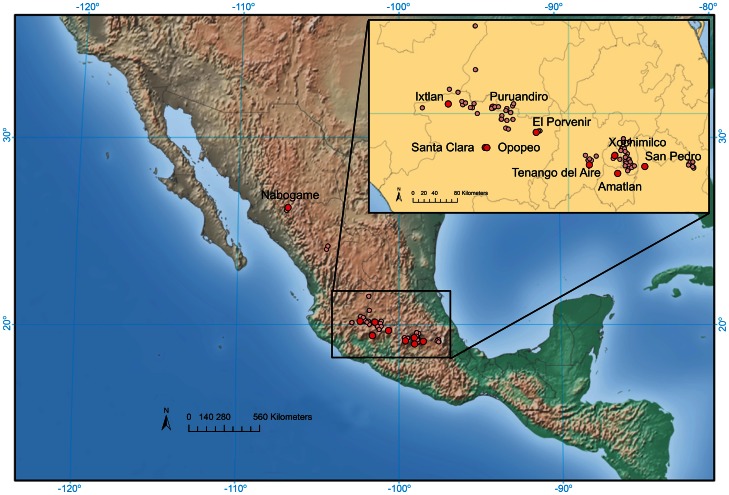
Figure 1
Full legend
Map of collection sites. Light red dots indicate known mexicana populations and larger, dark red dots indicate populations included in the current study.
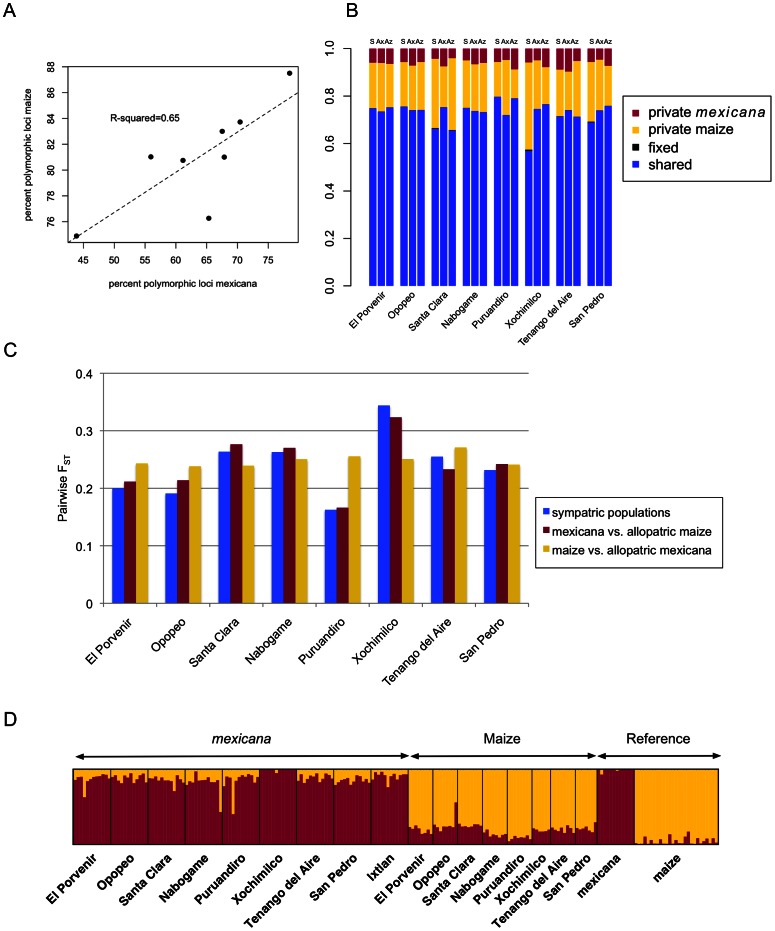
Figure 2
Full legend
Population-level polymorphism and differentiation. (A) Correlation of percent polymorphic loci in sympatric populations of mexicana and maize. (B) Proportion of shared and privately segregating polymorphisms in mexicana and maize and fixed differences between taxa. Letters above bars indicate sympatric maize/mexicana comparisons (S), maize from a given population versus allopatric mexicana (Ax) and mexicana from a given population versus allopatric maize (Az). (C) Pairwise differentiation (FST) in sympatric and allopatric comparisons of mexicana and maize. (D) Bar plot of assignment proportions from STRUCTURE analysis at K = 2 for mexicana (maroon) and maize (gold) individuals. The Ixtlan maize population was excluded from this figure and the STRUCTURE analysis.
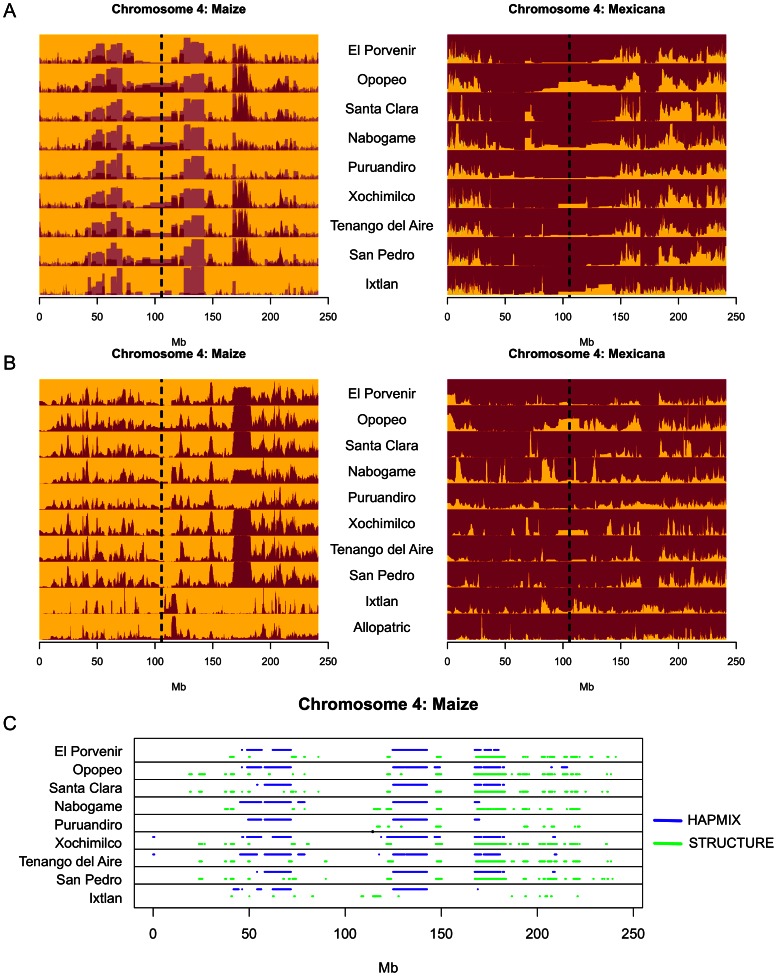
Figure 3
Full legend
Detection of introgression across chromosome 4. (A) Stacked bar plots of the HAPMIX introgression scan across sympatric populations. Population labels are indicated between plots for maize (gold) and mexicana (maroon). Lighter colors indicate introgression initially detected in each population and darker colors show these values after subtracting introgression proportions from jackknife samples of the allopatric reference populations that may be due to false positives. A dotted black line indicates the position of the centromere. (B) Stacked bar plots of the STRUCTURE introgression scan across sympatric populations. The mexicana group is indicated by maroon and the maize group is indicated by gold. The y-axis for each population in (A) and (B) indicates the average admixture proportion across individuals. (C) Genomic regions in maize populations showing greater than 50% membership in mexicana.
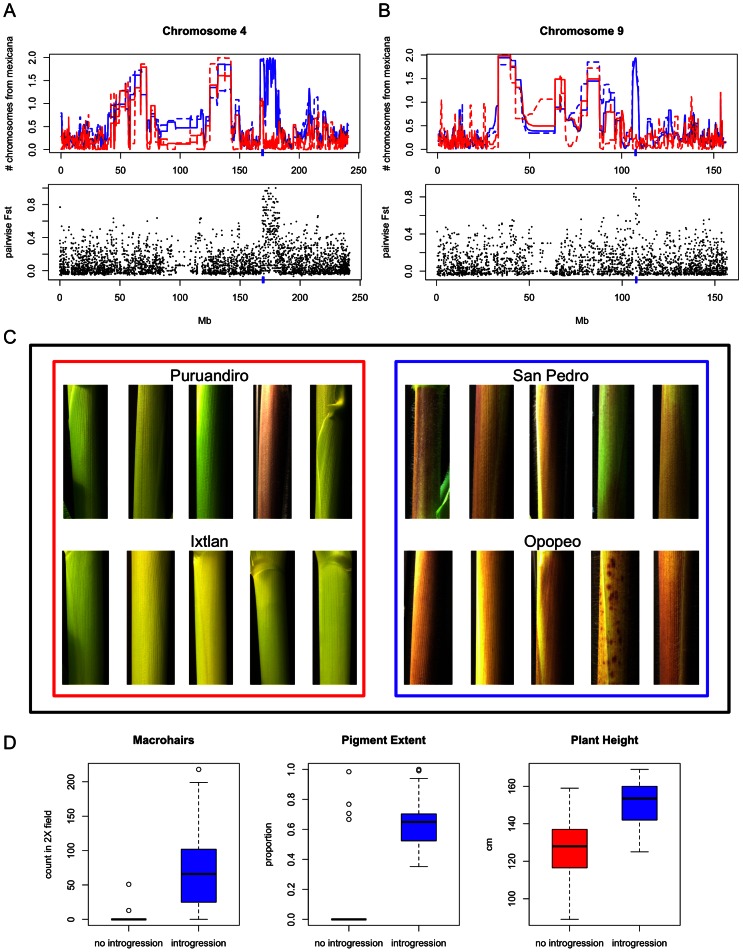
Figure 4
Full legend
Growth chamber experiment. (A) Region of mexicana-to-maize introgression on chromosome 4 (indicated by blue hash on x-axis) shared across seven populations. Above: patterns of introgression seen in San Pedro (blue solid line) and Opopeo (blue dashed line) versus Puruandiro (red solid line) and Ixtlan (red dashed line). Below: pairwise FST of San Pedro/Opopeo (with introgression) versus Puruandiro/Ixtlan (without introgression). (B) Region of mexicana-to-maize introgression on chromosome 9 (indicated by blue hash on x-axis) shared across seven populations. Populations and comparisons are as in Figure 4A. (C) Five leaf sheaths from each of four maize populations grown under highland conditions. (D) Distribution of maize trait values (macrohairs, pigment extent and plant height at 50 days) from growth chamber experiment emulating highland conditions in populations with and without introgression.
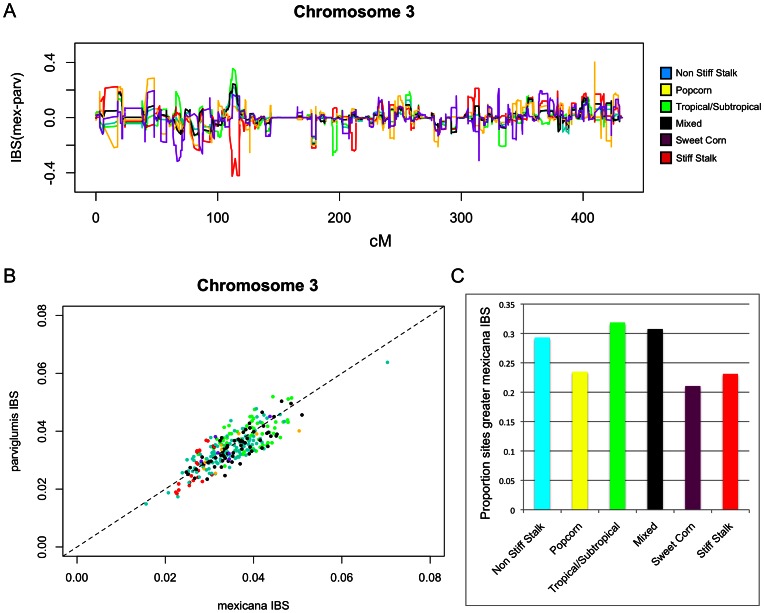
Figure 5
Full legend
Contribution of mexicana germplasm to a global maize diversity panel. (A) The difference between the average IBS proportion with mexicana individuals and the average IBS proportion with parviglumis individuals calculated across six groups of modern maize lines identified by Flint-Garcia et al. [81] in the maize association population. Positive values indicate greater IBS with mexicana. (B) Average IBS across chromosome 3 in each line in the maize association population compared to both mexicana and parviglumis. The one-to-one line is indicated by the dashed line. Colors are as in Figure 5A. (C) The proportion of sites across the genome showing greater IBS with mexicana than with parviglumis for each of the six maize association population groups.
References99
- 1.
Stebbins GL (1959 ) The role of hybridization in evolution. P Am Philos Soc 103: 231–251.
Not in our library
- 2.
Anderson E (1948 ) Hybridization of the habitat. Evolution 2: 1–9.
Not in our library
- 3.
Anderson E, Stebbins GL (1954 ) Hybridization as an evolutionary stimulus. Evolution 8: 378–388.
Not in our library
- 4.
Arnold ML (2004 ) Transfer and origin of adaptations through natural hybridization: Were Anderson and Stebbins right? Plant Cell 16: 562–570.
Not in our library10.1105/tpc.histpersp (opens in a new tab)
- 5.
Arnold ML, Martin NH (2010 ) Hybrid fitness across time and habitats. Trends Ecol Evol 25: 530–536.
Not in our library10.1016/j.tree.2010.06.005 (opens in a new tab)
- 6.
Arnold ML (2004 ) Natural hybridization and the evolution of domesticated, pest and disease organisms. Mol Ecol 13: 997–1007.
Not in our library10.1111/j.1365-294x.2004.02145.x (opens in a new tab)
- 7.
Ellstrand NC, Heredia SM, Leak-Garcia JA, Heraty JM, Burger JC, et al (2010 ) Crops gone wild: evolution of weeds and invasives from domesticated ancestors. Evol Appl 3: 494–504.
Not in our library10.1111/j.1752-4571.2010.00140.x (opens in a new tab)
- 8.
Grant BR, Grant PR (1996 ) High survival of Darwin's finch hybrids: Effects of beak morphology and diets. Ecology 77: 500–509.
Not in our library
- 9.
Grant PR, Grant BR (2010 ) Conspecific versus heterospecific gene exchange between populations of Darwin's finches. Philos T Roy Soc B 365: 1065–1076.
Not in our library10.1098/rstb.2009.0283 (opens in a new tab)
- 10.
Whitney KD, Randell RA, Rieseberg LH (2006 ) Adaptive introgression of herbivore resistance traits in the weedy sunflower Helianthus annuus. Am Nat 167: 794–807.
Not in our library10.1086/504606 (opens in a new tab)
- 11.
Whitney KD, Randell RA, Rieseberg LH (2010 ) Adaptive introgression of abiotic tolerance traits in the sunflower Helianthus annuus. New Phytol 187: 230–239.
Not in our library10.1111/j.1469-8137.2010.03234.x (opens in a new tab)
- 12.
Heiser CB (1951 ) Hybridization in the annual sunflowers - Helianthus-annuusXH-debilis var-cucumerifolius. Evolution 5: 42–51.
Not in our library
- 13.
Kim SC, Rieseberg LH (1999 ) Genetic architecture of species differences in annual sunflowers: Implications for adaptive trait introgression. Genetics 153: 965–977.
Not in our library10.1093/genetics/153.2.965 (opens in a new tab)
- 14.
Kim M, Cui M-L, Cubas P, Gillies A, Lee K, et al (2008 ) Regulatory genes control a key morphological and ecological trait transferred between species. Science 322: 1116–1119.
Not in our library10.1126/science.1164371 (opens in a new tab)
- 15.
Dasmahapatra KK, Walters JR, Briscoe AD, Davey JW, Whibley A, et al (2012 ) Butterfly genome reveals promiscuous exchange of mimicry adaptations among species. Nature 487: 94–98.
Not in our library10.1038/nature11041 (opens in a new tab)
- 16.
- 17.
Durand EY, Patterson N, Reich D, Slatkin M (2011 ) Testing for ancient admixture between closely related populations. Mol Biol Evol 28: 2239–2252.
Not in our library10.1093/molbev/msr048 (opens in a new tab)
- 18.
Green RE, Krause J, Briggs AW, Maricic T, Stenzel U, et al (2010 ) A draft sequence of the Neandertal genome. Science 328: 710–722.
Not in our library10.1126/science.1188021 (opens in a new tab)
- 19.
- 20.
- 21.
Reich D, Green RE, Kircher M, Krause J, Patterson N, et al (2010 ) Genetic history of an archaic hominin group from Denisova Cave in Siberia. Nature 468: 1053–1060.
Not in our library10.1038/nature09710 (opens in a new tab)
- 22.
Sun Y, Corcoran P, Menkis A, Whittle CA, Andersson SGE, et al (2012 ) Large-scale introgression shapes the evolution of the mating-type chromosomes of the filamentous ascomycete Neurospora tetrasperma. PLoS Genet 8: e1002820 doi:10.1371/journal.pgen.1002820.
Not in our library10.1371/journal.pgen.1002820 (opens in a new tab)
- 23.
Arnaud JF, Viard F, Delescluse M, Cuguen J (2003 ) Evidence for gene flow via seed dispersal from crop to wild relatives in Beta vulgaris (Chenopodiaceae): consequences for the release of genetically modified crop species with weedy lineages. P Roy Soc Lond B Bio 270: 1565–1571.
Not in our library10.1098/rspb.2003.2407 (opens in a new tab)
- 24.
Ellstrand NC (2003) Dangerous Liaisons? When Cultivated Plants Mate with Their Wild Relatives. Baltimore, Maryland: The Johns Hopkins University Press. 244 p.
Not in our library
- 25.
Gutierrez A, Cantamutto M, Poverene M (2011 ) Persistence of sunflower crop traits and fitness in Helianthus petiolaris populations. Plant Biol 13: 821–830.
Not in our library10.1111/j.1438-8677.2010.00433.x (opens in a new tab)
- 26.
Morrell PL, Williams-Coplin TD, Lattu AL, Bowers JE, Chandler JM, et al (2005 ) Crop-to-weed introgression has impacted allelic composition of johnsongrass populations with and without recent exposure to cultivated sorghum. Mol Ecol 14: 2143–2154.
Not in our library10.1111/j.1365-294x.2005.02579.x (opens in a new tab)
- 27.
Xia HB, Wang W, Xia H, Zhao W, Lu BR (2011 ) Conspecific crop-weed introgression influences evolution of weedy rice (Oryza sativa f. spontanea) across a geographical range. PLoS ONE 6: e16189 doi:10.1371/journal.pone.0016189.
Not in our library10.1371/journal.pone.0016189 (opens in a new tab)
- 28.
Fujino K, Wu J, Sekiguchi H, Ito T, Izawa T, et al (2010 ) Multiple introgression events surrounding the Hd1 flowering-time gene in cultivated rice, Oryza sativa L. Mol Genet Genomics 284: 137–146.
Not in our library10.1007/s00438-010-0555-2 (opens in a new tab)
- 29.
McNally KL, Childs KL, Bohnert R, Davidson RM, Zhao K, et al (2009 ) Genomewide SNP variation reveals relationships among landraces and modern varieties of rice. P Natl Acad Sci USA 106: 12273–12278.
Not in our library10.1073/pnas.0900992106 (opens in a new tab)
- 30.
- 31.
- 32.
Luo MC, Yang ZL, You FM, Kawahara T, Waines JG, et al (2007 ) The structure of wild and domesticated emmer wheat populations, gene flow between them, and the site of emmer domestication. Theor Appl Genet 114: 947–959.
Not in our library10.1007/s00122-006-0474-0 (opens in a new tab)
- 33.
Myles S, Boyko AR, Owens CL, Brown PJ, Grassi F, et al (2011 ) Genetic structure and domestication history of the grape. P Natl Acad Sci USA 108: 3530–3535.
Not in our library10.1073/pnas.1009363108 (opens in a new tab)
- 34.
Matsuoka Y, Vigouroux Y, Goodman MM, Sanchez GJ, Buckler E, et al (2002 ) A single domestication for maize shown by multilocus microsatellite genotyping. P Natl Acad Sci USA 99: 6080–6084.
Not in our library10.1073/pnas.052125199 (opens in a new tab)
- 35.
Piperno DR, Ranere AJ, Holst I, Iriarte J, Dickau R (2009 ) Starch grain and phytolith evidence for early ninth millennium BP maize from the Central Balsas River Valley, Mexico. P Natl Acad Sci USA 106: 5019–5024.
Not in our library10.1073/pnas.0812525106 (opens in a new tab)
- 36.
van Heerwaarden J, Doebley J, Briggs WH, Glaubitz JC, Goodman MM, et al (2011 ) Genetic signals of origin, spread, and introgression in a large sample of maize landraces. P Natl Acad Sci USA 108: 1088–1092.
Not in our library10.1073/pnas.1013011108 (opens in a new tab)
- 37.
Vigouroux Y, Glaubitz JC, Matsuoka Y, Goodman MM, Jesus SG, et al (2008 ) Population structure and genetic diversity of New World maize races assessed by DNA microsatellites. Am J Bot 95: 1240–1253.
Not in our library10.3732/ajb.0800097 (opens in a new tab)
- 38.
Hufford MB, Martinez-Meyer E, Gaut BS, Eguiarte LE, Tenaillon MI (2012 ) Past and present distributions of wild and domesticated Zea mays: a chance to revisit maize history. PLoS ONE 7: e47659 doi:10.1371/journal.pone.0047659.
Not in our library10.1371/journal.pone.0047659 (opens in a new tab)
- 39.
Ross-Ibarra J, Tenaillon M, Gaut BS (2009 ) Historical divergence and gene flow in the genus Zea. Genetics 181: 1397–1409.
Not in our library10.1534/genetics.108.097238 (opens in a new tab)
- 40.
Wilkes HG (1967) Teosinte: The Closest Relative of Maize. Cambridge, Massachusetts: The Bussey Institute of Harvard University. 159 p.
Not in our library
Cited by papers we hold9
Ecogeography of teosinte. · 2018
Not checked
Reads
Read by people on this page
None yet.
Checked or read by AI through naulon
None yet.
A person counts once a day per paper. We keep no cookie and no address: a reader is a hash that changes every day. Any month under five reads shows no number.
Are you an author?
Is this your paper?
Claim it to add your note and be paid when agents cite it. Free.