The Context-Dependence of Mutations: A Linkage of Formalisms
Frank J. Poelwijk, Vinod Krishna, Rama Ranganathan
PLOS Computational Biology · 2016 · CC BY
doi:10.1371/journal.pcbi.1004771 (opens in a new tab)
We email you when a new notice or a question about this paper appears.
Abstract
OverviewDefining the extent of epistasis-the nonindependence of the effects of mutations-is essential for understanding the relationship of genotype, phenotype, and fitness in biological systems.The applications cover many areas of biological research, including biochemistry, genomics, protein and systems engineering, medicine, and evolutionary biology.However, the quantitative definitions of epistasis vary among fields, and its analysis beyond just pairwise effects remains problematic in general.Here, we bring together a number of previous results that show that different definitions of epistasis are versions of a single mathematical formalismthe weighted Walsh-Hadamard transform.We demonstrate that one of the definitions, the background-averaged epistasis, may be the most informative for describing the epistatic structure of a biological system.Key issues are the choice of effective ensembles for averaging and to practically contend with the vast combinatorial complexity of mutations.In this regard, we discuss strategies for optimally learning the epistatic structure of biological systems.
No text here
Its licence does not allow us to show the full text. Read it at PubMed Central:
Read at PubMed Central (opens in a new tab)Figures3
From PubMed Central, U.S. National Library of Medicine.
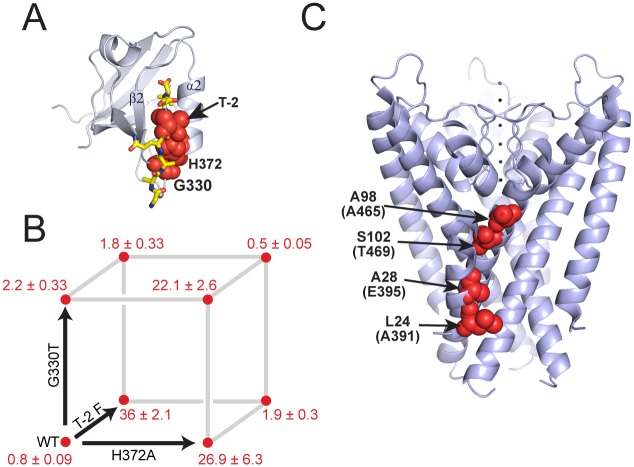
Fig 2
Full legend
Examples of epistasis in a PDZ domain (A) and a K+ ion channel (B). (A) PDZ domains are small, mixed αβ proteins that bind target peptide ligand (in yellow stick bonds) in a groove formed between the β2 and α2 elements (PSD95pdz3 shown, Protein Data Bank (PDB) accession 1BE9). The study discussed in the main text and in Table 1 is focused on the epistatic interactions between three amino acid positions—two in the PDZ domain (H372 and G330) and one in the ligand (T-2) (red spheres). (B) a thermodynamic cube representing the energetics of mutations at the three positions; values are equilibrium dissociation constants (Kd) for the target ligand (CRIPT [58]) in μM for all eight possible combination of mutations; errors represent standard deviation. (C) structure of the homotetrameric KcsA K+ ion channel (PDB accession 1K4C), showing the four positions selected for mutation in Sadovsky and Yifrach (in red spheres, shown only for one subunit for clarity) [60]. Note that the experiments were carried out in the Shaker K+ ion channel, and the positions in Shaker numbering are given in parentheses. The positions form a network that roughly links the intracellular activation gate and the selectivity filter.
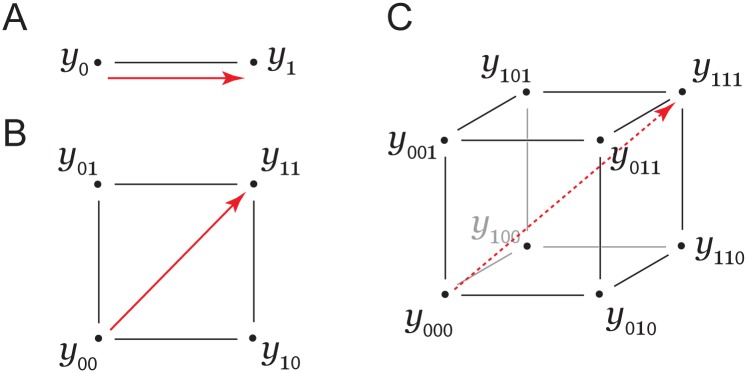
Fig 1
Full legend
Definitions of genotype, phenotype, and effects of mutations. Representation of (A) single mutant, (B) double mutant, and (C) triple mutant experiments. Phenotypes are denoted by yg, where g is the underlying genotype. g = {gN,…,g1} with gi ∈{0,1}; “0” or “1” indicates the state of the mutable site (e.g., amino acid position). The effect of a single, double, and triple mutation is given by the red arrows. Pairwise (or second-order) epistasis is defined as the differential effect of a mutation depending on the background in which it occurs; for example, in (B) it is the degree to which the effect of one mutation (e.g., y10−y00) deviates in the background of the second mutation (y11−y01). Thus, the expression for second-order epistasis is (y11−y10)−(y01−y00). The third order and higher cases are considered in the main text.
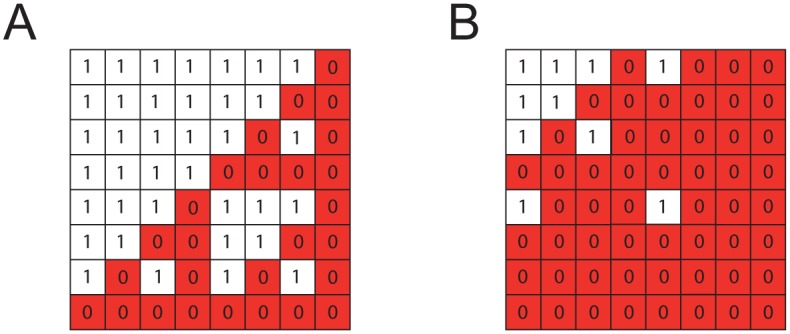
Fig 3
Full legend
Examples of matrices Zp introduced to calculate the partial background-averaged epistasis for n = 3. (A) Z2 for when data for mutants up to second-order is available and (B) Z1 for when only first-order mutants are available. Both matrices are self-similar, which allows their generation for arbitrary order, and are related to the logic Sierpinski triangle. For example, Z2 = 1−AΣ, where A is the anti-diagonal identity matrix and Σ is the Sierpinski matrix (i.e., multigrade AND in Boolean logic) for three inputs.
References91
- 1.
Wells JA (1990 ) Additivity of mutational effects in proteins. Biochemistry 29:8509
Not in our library10.1021/bi00489a001 (opens in a new tab)
- 2.
Phillips PC (2008 ) Epistasis–the essential role of gene interactions in the structure and evolution of genetic systems. Nat Rev Genet 9:855
Not in our library10.1038/nrg2452 (opens in a new tab)
- 3.
Costanzo M, Baryshnikova A, Myers CL, Andrews B, Boone C (2011 ) Charting the genetic interaction map of a cell. Curr Opin Biotechnol 22:66
Not in our library10.1016/j.copbio.2010.11.001 (opens in a new tab)
- 4.
Lehner B (2011 ) Molecular mechanisms of epistasis within and between genes. Trends Genet 27:323
Not in our library10.1016/j.tig.2011.05.007 (opens in a new tab)
- 5.
Dowell RD, Ryan O, Jansen A, Cheung D, Agarwala S, et al (2010 ) Genotype to phenotype: a complex problem. Science 328:469
Not in our library10.1126/science.1189015 (opens in a new tab)
- 6.Corrected
- 7.
- 8.
Bateson W (1908 ) Facts limiting the theory of heredity. Science 26:647.
Not in our library10.1126/science.26.672.649 (opens in a new tab)
- 9.
Fisher RA (1918 ) The correlation between relatives on the supposition of Mendelian inheritance. Trans R Soc Edinb 52:399.
Not in our library
- 10.
Horovitz A (1987 ) Non-additivity in protein-protein interactions. J Mol Biol 196:733
Not in our library10.1016/0022-2836(87)90045-3 (opens in a new tab)
- 11.
Cordes MH, Davidson AR, Sauer RT (1996 ) Sequence space, folding and protein design. Curr Opin Struct Biol 6:3
Not in our library10.1016/s0959-440x(96)80088-1 (opens in a new tab)
- 12.
Horovitz A, Bochkareva ES, Yifrach O, Girshovich AS (1994 ) Prediction of an inter-residue interaction in the chaperonin GroEL from multiple sequence alignment is confirmed by double-mutant-cycle analysis. J Mol Biol 238:133
Not in our library10.1006/jmbi.1994.1275 (opens in a new tab)
- 13.
Dill KA (1997 ) Additivity principles in biochemistry. J Biol Chem 272:701
Not in our library10.1074/jbc.272.2.701 (opens in a new tab)
- 14.
Jain RK, Ranganathan R (2004 ) Local complexity of amino acid interactions in a protein core. Proc Natl Acad Sci USA 101:111
Not in our library10.1073/pnas.2534352100 (opens in a new tab)
- 15.
Lander ES, Schork NJ (1994 ) Genetic dissection of complex traits. Science 265:2037
Not in our library10.1126/science.8091226 (opens in a new tab)
- 16.
Pettersson M, Besnier F, Siegel PB, Carlborg O (2011 ) Replication and explorations of high-order epistasis using a large advanced intercross line pedigree. PLoS Genet 7:e1002180
Not in our library10.1371/journal.pgen.1002180 (opens in a new tab)
- 17.
Kouyos RD, Leventhal GE, Hinkley T, Haddad M, Whitcomb JM, et al (2012 ) Exploring the complexity of the HIV-1 fitness landscape. PLoS Genet 8:e1002551
Not in our library10.1371/journal.pgen.1002551 (opens in a new tab)
- 18.
Brem RB, Kruglyak L (2005 ) The landscape of genetic complexity across 5,700 gene expression traits in yeast. Proc Natl Acad Sci USA 102:1572
Not in our library10.1073/pnas.0408709102 (opens in a new tab)
- 19.
Ehrenreich IM, Torabi N, Jia Y, Kent J, Martis S, et al (2010 ) Dissection of genetically complex traits with extremely large pools of yeast segregants. Nature 464:1039
Not in our library10.1038/nature08923 (opens in a new tab)
- 20.
Burch CL, Chao L (2004 ) Epistasis and its relationship to canalization in the RNA virus phi 6. Genetics 167:559
Not in our library10.1534/genetics.103.021196 (opens in a new tab)
- 21.
Weinreich DM, Watson RA, Chao L (2005 ) Perspective: Sign epistasis and genetic constraint on evolutionary trajectories. Evolution 59:1165
Not in our library
- 22.
Poelwijk FJ, Kiviet DJ, Weinreich DM, Tans SJ (2007 ) Empirical fitness landscapes reveal accessible evolutionary paths. Nature 445:383
Not in our library10.1038/nature05451 (opens in a new tab)
- 23.
Poelwijk FJ, Tănase-Nicola S, Kiviet DJ, Tans SJ (2011 ) Reciprocal sign epistasis is a necessary condition for multi-peaked fitness landscapes. J Theor Biol 272:141
Not in our library10.1016/j.jtbi.2010.12.015 (opens in a new tab)
- 24.
Lozovsky ER, Chookajorn T, Brown KM, Imwong M, Shaw PJ, et al (2009 ) Stepwise acquisition of pyrimethamine resistance in the malaria parasite. Proc Natl Acad Sci USA 106:12025
Not in our library10.1073/pnas.0905922106 (opens in a new tab)
- 25.
Maharjan RP, Ferenci T (2013 ) Epistatic interactions determine the mutational pathways and coexistence of lineages in clonal Escherichia coli populations. Evolution 67:2762
Not in our library10.1111/evo.12137 (opens in a new tab)
- 26.
Draghi JA, Plotkin JB (2013 ) Selection biases the prevalence and type of epistasis along adaptive trajectories. Evolution 67:3120
Not in our library10.1111/evo.12192 (opens in a new tab)
- 27.
VanderSluis B, Bellay J, Musso G, Costanzo M, Papp B, et al (2010 ) Genetic interactions reveal the evolutionary trajectories of duplicate genes. Mol Syst Biol 6:429
Not in our library10.1038/msb.2010.82 (opens in a new tab)
- 28.
Natarajan C, Inoguchi N, Weber RE, Fago A, Moriyama H, et al (2013 ) Epistasis among adaptive mutations in deer mouse hemoglobin. Science 340:1324
Not in our library10.1126/science.1236862 (opens in a new tab)
- 29.
- 30.
Ashworth A, Lord C, Reis-Filho J (2011 ) Genetic interactions in cancer progression and treatment. Cell 145:30
Not in our library10.1016/j.cell.2011.03.020 (opens in a new tab)
- 31.
Chakravarti A, Clark AG, Mootha VK (2013 ) Distilling pathophysiology from complex disease genetics. Cell 155:21
Not in our library10.1016/j.cell.2013.09.001 (opens in a new tab)
- 32.
Leiserson MDM, Eldridge JV, Ramachandran S, Raphael BJ (2013 ) Network analysis of GWAS data. Curr Opin Genet Dev 23:602
Not in our library10.1016/j.gde.2013.09.003 (opens in a new tab)
- 33.
Hinkley T, Martins J, Chappey C, Haddad M, Stawiski E, et al (2011 ) A systems analysis of mutational effects in HIV-1 protease and reverse transcriptase. Nat Genet 43:487
Not in our library10.1038/ng.795 (opens in a new tab)
- 34.
Combarros O, Cortina-Borja M, Smith AD, Lehmann DJ (2009 ) Epistasis in sporadic Alzheimer’s disease. Neurobiol Aging 30:1333
Not in our library10.1016/j.neurobiolaging.2007.11.027 (opens in a new tab)
- 35.
Fitzgerald JB, Schoeberl B, Nielsen UB, Sorger PK (2006 ) Systems biology and combination therapy in the quest for clinical efficacy. Nat Chem Biol 2:458
Not in our library10.1038/nchembio817 (opens in a new tab)
- 36.
Fu W, O’Connor TD, Akey JM (2013 ) Genetic architecture of quantitative traits and complex diseases. Curr Opin Genet Dev 23:678
Not in our library10.1016/j.gde.2013.10.008 (opens in a new tab)
- 37.
Wang X, Fu AQ, McNerney ME, White KP (2014 ) Widespread genetic epistasis among cancer genes. Nature Comm 5:4828
Not in our library10.1038/ncomms5828 (opens in a new tab)
- 38.
Chen J, Stites WE (2001 ) Higher-order packing interactions in triple and quadruple mutants of staphylococcal nuclease. Biochemistry 40:14012
Not in our library10.1021/bi011269d (opens in a new tab)
- 39.
Frisch C, Schreiber G, Johnson CM, Fersht AR (1997 ) Thermodynamics of the interaction of barnase and barstar: changes in free energy versus changes in enthalpy on mutation. J Mol Biol 267:696
Not in our library10.1006/jmbi.1997.0892 (opens in a new tab)
- 40.
Jiang C, Hwang YT, Wang G, Randell JCW, Coen DM, et al (2007 ) Herpes simplex virus mutants with multiple substitutions affecting DNA binding of UL42 are impaired for viral replication and DNA synthesis. J Virol 81:12077
Not in our library10.1128/jvi.01133-07 (opens in a new tab)
Cited by papers we hold10
Predictable Phenotypes of Antibiotic Resistance Mutations · 2018
Not checked
Reads
Read by people on this page
None yet.
Checked or read by AI through naulon
None yet.
A person counts once a day per paper. We keep no cookie and no address: a reader is a hash that changes every day. Any month under five reads shows no number.
Are you an author?
Is this your paper?
Claim it to add your note and be paid when agents cite it. Free.