Congenital neutropenia: diagnosis, molecular bases and patient management
Jean Donadieu, Odile Fenneteau, Blandine Beaupain and 2 more
Orphanet Journal of Rare Diseases · 2011 · Review
doi:10.1186/1750-1172-6-26 (opens in a new tab)
We email you when a new notice or a question about this paper appears.
Abstract
The term congenital neutropenia encompasses a family of neutropenic disorders, both permanent and intermittent, severe (<0.5 G/l) or mild (between 0.5-1.5 G/l), which may also affect other organ systems such as the pancreas, central nervous system, heart, muscle and skin. Neutropenia can lead to life-threatening pyogenic infections, acute gingivostomatitis and chronic parodontal disease, and each successive infection may leave permanent sequelae. The risk of infection is roughly inversely proportional to the circulating polymorphonuclear neutrophil count and is particularly high at counts below 0.2 G/l. When neutropenia is detected, an attempt should be made to establish the etiology, distinguishing between acquired forms (the most frequent, including post viral neutropenia and auto immune neutropenia) and congenital forms that may either be isolated or part of a complex genetic disease. Except for ethnic neutropenia, which is a frequent but mild congenital form, probably with polygenic inheritance, all other forms of congenital neutropenia are extremely rare and have monogenic inheritance, which may be X-linked or autosomal, recessive or dominant. About half the forms of congenital neutropenia with no extra-hematopoetic manifestations and normal adaptive immunity are due to neutrophil elastase (ELANE) mutations. Some patients have severe permanent neutropenia and frequent infections early in life, while others have mild intermittent neutropenia. Congenital neutropenia may also be associated with a wide range of organ dysfunctions, as for example in Shwachman-Diamond syndrome (associated with pancreatic insufficiency) and glycogen storage disease type Ib (associated with a glycogen storage syndrome). So far, the molecular bases of 12 neutropenic disorders have been identified. Treatment of severe chronic neutropenia should focus on prevention of infections. It includes antimicrobial prophylaxis, generally with trimethoprim-sulfamethoxazole, and also granulocyte-colony-stimulating factor (G-CSF). G-CSF has considerably improved these patients' outlook. It is usually well tolerated, but potential adverse effects include thrombocytopenia, glomerulonephritis, vasculitis and osteoporosis. Long-term treatment with G-CSF, especially at high doses, augments the spontaneous risk of leukemia in patients with congenital neutropenia.
Abstract licence: CC BY
Figures2
From PubMed Central, U.S. National Library of Medicine. Licence: CC BY.
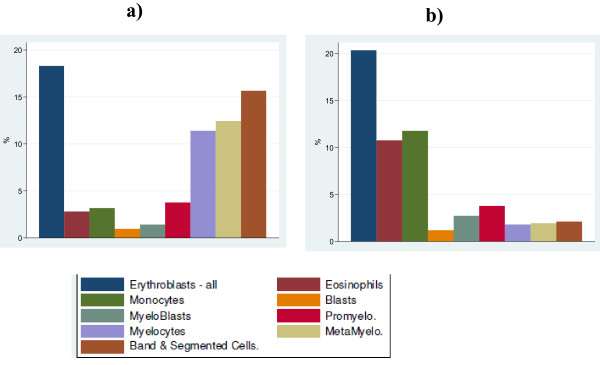
Figure 1
Full legend
Bone marrow smear differential count including % of the different granulocyte precursors. a) normal bone marrow - a regular pyramid. b) patients with severe congenital neutropenia and ELANE mutation: bone marrow myeloid arrest at promyelocyte stage with eosinophilia
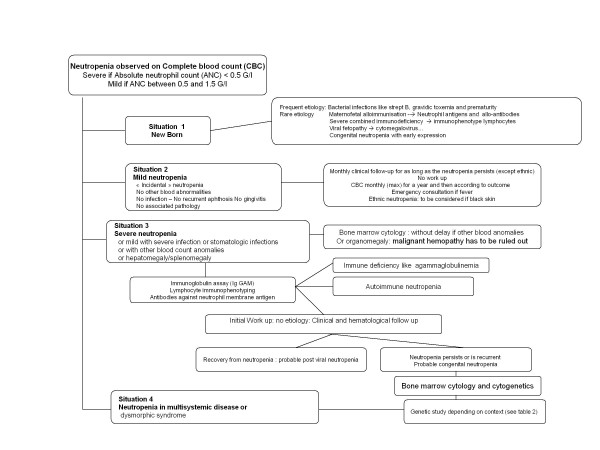
Figure 2
Full legend
Neutropenia: diagnostic tree.
References238
238 more references, whose wording the paper’s licence keeps private.
Cited by papers we hold4
Neutrophil Evolution and Their Diseases in Humans · 2017
Not checked
Reads
Read by people on this page
None yet.
Checked or read by AI through naulon
None yet.
A person counts once a day per paper. We keep no cookie and no address: a reader is a hash that changes every day. Any month under five reads shows no number.
Are you an author?
Is this your paper?
Claim it to add your note and be paid when agents cite it. Free.