Trough concentration of voriconazole and its relationship with efficacy and safety: a systematic review and meta-analysis
Haiying Jin, Tiansheng Wang, Bonnie A. Falcione and 5 more
Journal of Antimicrobial Chemotherapy · 2016 · Meta-analysis
doi:10.1093/jac/dkw045 (opens in a new tab)
We email you when a new notice or a question about this paper appears.
Abstract
OBJECTIVES: The optimum trough concentration of voriconazole for clinical response and safety is controversial. The objective of this review was to determine the optimum trough concentration of voriconazole and evaluate its relationship with efficacy and safety. METHODS: MEDLINE, EMBASE, ClinicalTrials.gov, the Cochrane Library and three Chinese literature databases were searched. Observational studies that compared clinical outcomes below and above the trough concentration cut-off value were included. We set the trough concentration cut-off value for efficacy as 0.5, 1.0, 1.5, 2.0 and 3.0 mg/L and for safety as 3.0, 4.0, 5.0, 5.5 and 6.0 mg/L. The efficacy outcomes were invasive fungal infection-related mortality, all-cause mortality, rate of successful treatment and rate of prophylaxis failure. The safety outcomes included incidents of hepatotoxicity, neurotoxicity and visual disorders. RESULTS: A total of 21 studies involving 1158 patients were included. Compared with voriconazole trough concentrations of >0.5 mg/L, levels of 3.0, >4.0, >5.5 and >6.0 mg/L. The incidence of neurotoxicity was significantly increased with trough concentrations >4.0 and >5.5 mg/L. CONCLUSIONS: A voriconazole level of 0.5 mg/L should be considered the lower threshold associated with efficacy. A trough concentration >3.0 mg/L is associated with increased hepatotoxicity, particularly for the Asian population, and >4.0 mg/L is associated with increased neurotoxicity.
Full text
From PubMed Central, U.S. National Library of Medicine, as current on Oct 22, 2026. Paragraph numbers are ours, so an answer can point at one.
Introduction
Deep mycoses are serious infections associated with a high mortality. In 77% of patients with invasive fungal infection (IFI), their IFI were significantly related to their death. Voriconazole is a second-generation triazole antifungal agent with a broad spectrum of activity, which is often recommended as primary therapy for IFI– and as antifungal prophylaxis in immunocompromised patients. To improve treatment outcomes of voriconazole, therapeutic drug monitoring (TDM) is suggested in major guidelines from the IDSA, the American Thoracic Society and ESCMID.– Voriconazole trough concentrations are good measures of drug exposure, but the aforementioned guidelines do not explicitly recommend an optimum trough concentration.
To our knowledge, no randomized trials have evaluated the target trough concentration of voriconazole in deep mycoses. However, numerous observational studies have recommended lowest voriconazole concentration cut-off values, including 0.25, 1, 1.2, 1.5, 1.7, 2 and 2.2 mg/L. A guideline authored by two Japanese societies and published in 2013 recommended a voriconazole target trough concentration of 1–2 mg/L for efficacy and a trough concentration >4–5 mg/L as a critical concentration for potentially attributable elevated liver function tests, which was primarily based on a meta-analysis of observational studies by Hamada et al. In 2014 the British Society for Medical Mycology recommended a trough concentration >1 mg/L or a trough/MIC ratio of 2–5 as a target for efficacy and a trough concentration of <4–6 mg/L for safety, which was based on a large observational study by Troke, smaller observational studies,,,,– and the previous meta-analysis.
However, the evidence supporting the voriconazole target and critical trough concentrations described in these two guidelines has important limitations. For example, Troke et al. used simulation data derived from a Monte Carlo model rather than actual patient data. Furthermore, the previous meta-analysis has drawbacks such as a lack of inclusion of eligible studies (searched only PubMed from its inception until April 2009), a lack of standardization for outcome definitions among included studies, including a study that evaluated voriconazole random concentration rather than trough concentration, and inadequate subgroup analysis to explore the heterogeneity. Therefore, it is necessary to perform an updated meta-analysis to provide recommendations for the optimum voriconazole trough concentration. The objective of this study was to evaluate the relationship between the reported voriconazole trough concentration, and efficacy and safety of voriconazole in patients with, or at risk for, deep mycoses.
Methods
We followed the methods specified in the Cochrane Handbook for Systematic Reviews and the Meta-analysis of Observational Studies in Epidemiology guidelines.
Data sources
Eligible trials were identified through electronic and manual searches. Electronic searches were performed in MEDLINE, EMBASE, Cochrane Library, ClinicalTrials.gov and three Chinese literature databases (CNKI, WanFang, CBM) from their inception until March 2015. The search was limited to English or Chinese articles. We used the keyword ‘voriconazole’ to search these databases. Manual searches included scanning of reference lists in relevant papers.
Study selection
Initial screening was conducted by a group of clinical pharmacists. Two reviewers (H. J., K. C.) independently assessed titles, abstracts and citations in greater detail. Studies were included if: (i) observational study; (ii) voriconazole was used for treatment or prophylaxis; (iii) TDM was performed; (iv) trough concentrations at steady state were reported for included patients; (v) rate of treatment success, rate of prophylaxis failure, mortality or incidence of voriconazole-related adverse events (hepatotoxicity, neurotoxicity, visual disorder) at both below and above the cut-off value of the trough concentration were reported for included patients, or sufficient data to estimate these was provided; (vi) sample size was ≥10 patients; and (vii) full text of the publication was available. Full text of potentially relevant articles was retrieved and assessed by the same reviewers using the criteria above. Disagreements were resolved through discussion.
Our exclusion criteria included: (i) data came from simulated patients or pharmacokinetic models rather than from real patients; (ii) concentrations were not troughs; or (iii) concentrations were not measured at steady state.
Outcome measures
The efficacy outcomes included were: IFI-related death; all-cause mortality; treatment success; and prophylaxis failure. Given the known variation in the definitions of treatment success in the literature, we used the criteria from the majority of included studies to minimize heterogeneity (complete and partial response). Definitions of outcomes are provided in Table S1 (available as Supplementary data at JAC Online). Prophylaxis failure was evaluated by the incidence of IFIs; a high risk ratio (RR) meant a high prophylaxis failure rate. The safety outcomes were hepatotoxicity, neurotoxicity and visual disorders. The pooled analysis for treatment success included only treatment studies, for prophylaxis failure only prophylaxis studies and analysis of side effects included all studies.
Cut-off value establishment
According to previous studies,,,– the MIC90 (MIC at which 90% of isolates were inhibited) of voriconazole for most yeasts and moulds is between 0.5 and 1 mg/L,– and patients with voriconazole trough concentrations >2 mg/L were associated with good clinical response. Some studies have shown that the most likely target concentration for efficacy is >1 mg/L, and one study recommended 1.5 mg/L as the target concentration. Thus we established the stepwise cut-off values for efficacy between 0.5 and 3.0 mg/L (0.5, 1.0, 1.5, 2.0 and 3.0 mg/L).
A target voriconazole trough concentration <4–6 mg/L was suggested by the British Society for Medical Mycology to minimize drug-related toxicity. Previous studies,, have evaluated 5.5 mg/L as a cut-off concentration for toxicity. Thus, we set the stepwise cut-off values for voriconazole safety between 3.0 and 6.0 mg/L (3.0, 4.0, 5.0, 5.5, 6.0 mg/L).
Data extraction
Two authors extracted data independently (H. J. and K. C.) and disagreements were resolved by discussion or by a third investigator (T. W.). From each study, we extracted study characteristics, participants' baseline characteristics, methods for measuring voriconazole trough concentration, type of trough concentration (initial, mean or maximum), cut-off value of voriconazole trough concentration and pre-specified study outcomes of efficacy and safety.
As our outcomes were all dichotomous, we used the number of events (numerator) and sample size (denominator) to perform the meta-analysis. For each study, we considered patient groups treated with voriconazole at a concentration below the pre-defined cut-off value as the intervention group, and patient groups treated with voriconazole at a concentration above the pre-defined cut-off value as the control. When individual patient data were available, we used all of our pre-defined cut-off values to divide patients into two groups in the same way and extracted the number of events.
For efficacy, when the trough concentration was measured multiple times for each patient, we used the mean value of multiple measurements for that patient; median value was used only when the mean was not available. For safety, we extracted the highest trough concentration for each patient; if it was not available, we used the reported trough concentration for that patient in the article. If there were multiple data for the same outcome in an article, only outcome data with the longest follow-up were extracted. According to a previous method, if concentration values were below the detection limit for a certain value, we set the concentration as half of this value (e.g. individual data provided by Kim et al. showed trough concentrations <0.5 mg/L in some cases, so we defined these trough concentrations as 0.25 mg/L). When necessary, we contacted the study's corresponding author for clarification, or requested additional data.
Quality assessment
The Newcastle–Ottawa Scale was applied to evaluate the quality of the included studies. This scale uses a star system (maximum of nine stars) to evaluate the methodological quality of each study.
Data analysis
Meta-analysis and assessment of publication bias was performed using RevMan 5.1 (Cochran IMS) and Stata version 12.0 (StataCorp LP). To assess variations between studies in addition to sampling error within studies, the random-effects model was selected. The Mantel–Haenszel method was used to calculate the RR and 95% CI for each study. The Cochran Q χ2 test and I2 statistic were used to assess heterogeneity among studies. I2 values of over 25%, 50% and 75% represent low, moderate and considerable heterogeneity, respectively. P < 0.05 was considered statistically significant.
To explore the heterogeneity among different studies, subgroup analysis was performed when more than two studies were included in the analysis of each cut-off level. For the efficacy outcome, studies were stratified by: (i) studies exclusively including patients with proven or probable IFI compared with studies including patients with possible IFI or the category of IFI was not clearly reported; (ii) studies reporting single drug therapy compared with studies including patients on combo therapy (at least some patients on combo therapy) (since voriconazole monotherapy was recommended by the IDSA, the American Thoracic Society and ESCMID,– if a study did not report whether voriconazole was used in combination with other antifungal agents, we considered it as a monotherapy study, as long as the site of infection for the study did not include the CNS); and (iii) studies for adults compared with studies for children.
For the safety outcome, studies were stratified by (i) studies for adults compared with studies for children, and (ii) study location in Asian countries compared with study location in non-Asian countries. Previous study for genotyping of CYP2C19 showed that about 12%–23% of the Asian population could be poor metabolizers of voriconazole, which may influence the incidence of adverse effects. However, as we only evaluated concentration at steady state, CYP2C19 polymorphism would not influence our assessment; therefore, it was not considered in our subgroup analysis.
Sensitivity analysis was performed to examine whether a single study had a substantial influence on the main results. We excluded each study and evaluated its effect on the summary estimates and heterogeneity of the main analysis. We further evaluated the rate of treatment success for voriconazole monotherapy. For studies that included patients on concomitant antifungals, we extracted data from patients on monotherapy only when individual patient data were available, and excluded the study otherwise. The results for sensitivity analysis were reported if the conclusions differed. If more than 10 studies were included in the analysis of each cut-off level, publication bias was evaluated using Begg's test and Egger's weighted regression statistics.
Literature searches and study inclusion
The study selection process for inclusion is shown in Figure 1. The electronic searches identified 17 452 articles. After initial screening, 49 full-text, potentially relevant, articles were selected, 28 studies were excluded (the reasons for excluding are shown in Table S2) and 21 articles involving 1158 patients were included for meta-analysis.–,,,,–,– We obtained additional data from three authors.,,
Study descriptions
A summary of descriptions of included studies is reported in Table 1. Of these 21 studies, 9 were conducted in Asia,,,,,,,– 4 included only patients diagnosed with proven or probable IFI,,, and 6 included patients with concomitant use of other antifungals.,,,,, Five studies used voriconazole for prophylaxis,,,, and 16 used voriconazole for treatment.–,,,,–,,–,, Two studies were conducted in children, one used voriconazole for treatment and the other for prophylaxis. Five studies used serum samples,,,,, 13 used plasma samples and the remainder did not report whether serum or plasma sample was used.,, All the included studies measured voriconazole concentrations by HPLC except the study by Lee et al., which used tandem MS.
Evaluation of efficacy
A summary of outcomes for each study is shown in Table 2. Summaries of meta-analysis and subgroup analysis for efficacy are shown in Tables 3–5, forest plots are shown in Figure 2 and Figures S1–19, raw data are shown in Tables S3–S6.
There was a significant difference only at the cut-off level of 0.5 mg/L (RR = 0.46, 95% CI 0.29–0.74) (Figure 2 and Table 3). Subgroup analysis showed that rate of treatment success significantly decreased at a cut-off level of <0.5 mg/L in the following subgroups: patients with proven or probable IFI (RR = 0.37, 95% CI 0.19–0.72), monotherapy (RR = 0.46, 95% CI 0.25–0.82) and adults (RR = 0.46, 95% CI 0.26–0.82) (Table 4). There were no significant differences at other cut-off levels.
The results from the sensitivity analysis including studies on concomitant antifungals, but with individual patient data on voriconazole monotherapy, showed voriconazole trough concentrations of <0.5 mg/L with a significantly lower rate of treatment success (RR = 0.49, 95% CI 0.29–0.81) (Figure 3), which further confirmed the result of subgroup analysis. There were no significant differences at other cut-off levels (Table 5 and Figures S20–23).
Although two studies contributed data for IFI-related mortality, one study evaluated IFI prophylaxis, the other evaluated IFI treatment, thus we were unable to pool data. For all-cause mortality, our meta-analysis based on two studies showed that the rate of death significantly decreased at a cut-off level of <3.0 mg/L (RR = 0.44, 95% CI 0.22–0.91). There were no significant differences at other cut-off levels (Table 3, Figure 4 and Figures S24–27). For prophylaxis failure, the meta-analysis showed that the occurrence of IFI for voriconazole trough concentrations below the cut-off value were not significantly different from those above the same value for each evaluated cut-off level (Table 3 and Figures S28–32).
Sensitivity analysis on each study's effect on the summary estimates showed that exclusion of the study by Kim et al. resulted in a significantly increased rate of treatment success at trough concentrations >1.5 mg/L (Table S7).
Evaluation of safety
Summary of primary and subgroup analysis for safety are shown in Tables 6 and 7; forest plots are shown in Figures 5 and 6 and Figures S33–55; raw data are shown in Tables S8–S10. For hepatotoxicity, the definitions varied across the 12 studies (Table 2). Our meta-analysis demonstrated a significantly lower incidence with trough concentration below cut-off levels of 3.0, 4.0, 5.5 and 6 mg/L compared with controls (Table 6 and Figure 5). Subgroup analysis showed that there were significant differences in the Asian study locations at all cut-off levels and for the adult population at cut-off levels of 3.0, 4.0, 5.5 and 6 mg/L. There was no significant difference in non-Asian study locations or paediatric populations at all cut-off levels (Table 7).
For neurotoxicity, the meta-analysis demonstrated a significant increase at voriconazole trough cut-off values >4.0 mg/L (RR = 0.20, 95% CI 0.05–0.74) and >5.5 mg/L (RR = 0.37, 95% CI 0.21–0.65) (Table 6 and Figure 6). Owing to the scant data, subgroup analysis was performed only at a cut-off level of 5.5 mg/L, which showed the incidence of neurotoxicity was significantly increased in the non-Asian study locations (RR = 0.36, 95% CI 0.17–0.75).
For visual disorders, there were no significant differences in incidence between the interventional and control groups at all cut-off levels (Table 6).
Sensitivity analysis on each study's effect on the summary estimates showed that exclusion of studies by Wang et al., Okuda et al. or Ueda et al., resulted in an insignificant difference at a cut-off level of 3.0 mg/L. Exclusion of studies by Ueda et al. or Brüggemann et al. resulted in a significant increased incidence of hepatotoxicity at trough concentration >5.0 mg/L. Additionally, exclusion of the study by Koselke et al. resulted in a significant increased incidence of neurotoxicity at trough concentration >5.5 mg/L (Table S11).
Publication bias and sensitivity analysis
Owing to the limited number of studies, we only evaluated publication bias at the trough concentration cut-off level of 1 mg/L for treatment success (10 studies). The results of Begg's test (P = 0.929) and Egger's test (P = 0.539) showed a low likelihood of publication bias.
Assessment of quality of included studies
Using the nine-point scoring system, most studies scored between 7 and 8. Assessment of study-specific quality scores from the Newcastle–Ottawa Scale system is summarized in Table S12.
Efficacy
Major guidelines support and recommend TDM for voriconazole,– although exact threshold levels remain inconclusive. We determined in this meta-analysis that a trough concentration of 0.5 mg/L is associated with efficacy, which differs from the 1.0–2.0 mg/L threshold recommended in some publications., Our findings are similar to the results in an FDA analysis of 280 patients, which suggested a trend to higher success rates in patients with mean voriconazole levels >0.5 mg/L. Our subgroup analysis for patients with proven or probable IFI, patients on monotherapy and a sensitivity analysis based on individual patient data further validated the 0.5 mg/L trough concentration for efficacy (Table 4). First, ‘possible IFI’ is less reliable than a proven or probable IFI diagnosis and has limited value in clinical trials because it does not require mycological evidence, and host factors and clinical features are not sufficiently specific, resulting in the inclusion of non-IFI patients. Besides, five studies included persistently febrile neutropenic patients,,,, and used voriconazole as empirical therapy. This may explain why voriconazole did not show significant improvement in treatment success rates. Secondly, antifungal combination therapy with micafungin, caspofungin or amphotericin B may confound the assessment of an exposure–response relationship of voriconazole, which might explain why the combo therapy subgroup did not show significance at the 0.5 mg/L cut-off level.
This 0.5 mg/L cut-off value is in conflict with the results of a study in 825 patients, which suggested a trough/MIC (MIC90 for the majority of fungal pathogens is 0.5–1 mg/L) ratio of 2–5 as a TDM target based on Monte Carlo simulation. Notably, in clinical practice, fungal voriconazole MIC data are usually not available, which limits the utility of this metric. Furthermore, the conclusion of this study was based on simulated data rather than real patients' data. Thus, we believe our result has greater validity.
Sensitivity analysis showed that the rate of treatment success significantly decreased at a cut-off level of <1.5 mg/L when excluding the study by Kim et al., hence future studies are needed to test our conclusion of the 0.5 mg/L lower limit further.
A number of factors contribute to the death of patients with IFI, such as progress of underlying disease, concomitant infection and severe adverse effects. Although our result showed significantly decreased all-cause mortality at a cut-off level of <3.0 mg/L, the sample size was small (only two studies contributed data) and the confounding factors could not be removed. Thus, the significance of our result for all-cause mortality is likely unreliable.
Safety
It seems reasonable that the most severe adverse event, hepatotoxicity, should be the focus since other events occur less frequently or have limited lasting sequelae. Our meta-analysis indicated a concentration of >3.0 mg/L is associated with an increased risk of hepatotoxicity, which is considerably lower than described in previous studies., Subgroup analysis found the incidence of hepatotoxicity in the studies conducted in Asia were different than non-Asian studies, suggesting the possibility that the concentration–hepatotoxicity relationship follows a different profile among different races. Sensitivity analysis showed the incidence of hepatotoxicity became insignificant at a cut-off of 3.0 mg/L when removing the studies by Okuda et al., Wang et al. or Ueda et al. Notably, these three studies were all conducted in a predominantly Asian population. Therefore, a lowered upper limit of the target concentration should be considered for Asian patients compared with the upper limit for non-Asian patients. Voriconazole does exhibit high inter- and intra-patient variability in the pharmacokinetic profile following oral and intravenous doses., Because of the variability, a reasonable recommendation for treatment would be to obtain a trough concentration once steady state is achieved, with target concentrations between 0.5 and 3.0 mg/L. Clearly, adequately powered, prospective, multicentre research is needed to answer these important questions.
Strengths and limitations
Our study has several strengths. First, this meta-analysis allowed comparison of commonly used cut-off levels for efficacy and safety in a single analysis for individual cut-off levels. Second, we used explicit, pre-defined efficacy and safety outcomes to minimize heterogeneity of outcomes across different studies. Finally, we obtained additional and individual data from the study authors to perform more detailed analyses (e.g. extracting individual data for patients on monotherapy).
We acknowledge the following limitations to our work. First, due to the paucity of available data, a detailed analysis according to pathological condition (e.g. whether resistant to voriconazole or not) or infection location was not performed. In addition, we were unable to perform subgroup analysis for different patient populations and some results remain inconclusive. Besides, rare, serious adverse events such as renal failure and cardiotoxicity were not evaluated. Second, the use of observational studies in a meta-analysis is prone to biases and confounding factors that are inherent in the original studies. Third, differences in assay methods across studies may lead to differences in precision of the voriconazole result and differences in the timing of clinical outcome assessment may lead to lack of reliability in the results across studies.
Conclusions
This meta-analysis demonstrated that 0.5 mg/L is the lower limit of the target voriconazole trough concentration during treatment. Trough concentrations of >3.0 mg/L are associated with an increased risk of moderate–severe hepatotoxicity, particularly for the Asian population. Trough concentrations >4.0 mg/L were associated with an increased risk of neurotoxicity.
Funding
This study was carried out as part of our routine work.
Transparency declarations
B. A. F. was a co-investigator on a project for which the principal investigator received research support from HOSPIRA. All other authors: none to declare.
Author contributions
H. J. performed searches, screened search results, screened retrieved papers against inclusion criteria, extracted data from papers, wrote to authors of papers for additional information, provided additional data from papers, managed data for the review, did analysis and interpretation of data and drafted the manuscript. T. W. designed and coordinated the review, did interpretation of data, prepared the manuscript and provided general advice on the review. B. A. F. provided a clinical perspective, contributed to data interpretation and revised the manuscript. K. M. O. provided a clinical perspective, contributed to data interpretation and revised the manuscript. K. C. conducted searching, extracted data and appraised the quality of papers. H. T. provided a methodological perspective on meta-analysis. J. H. provided a clinical perspective and revised the manuscript. S. Z. conceived and coordinated the review. All authors read and approved the final version of the manuscript.
Supplementary data
Tables S1–S12 and Figures S1–S55 are available as Supplementary data at JAC Online (http://jac.oxfordjournals.org/).
Figures6
From PubMed Central, U.S. National Library of Medicine.
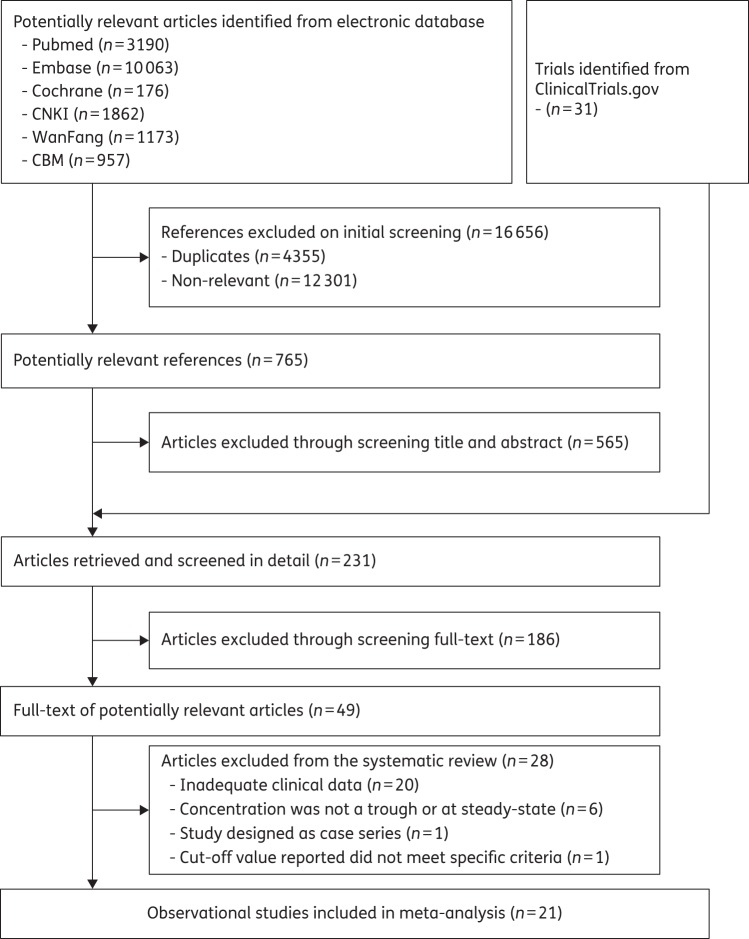
Figure 1.
Full legend
Flow chart of study selection.
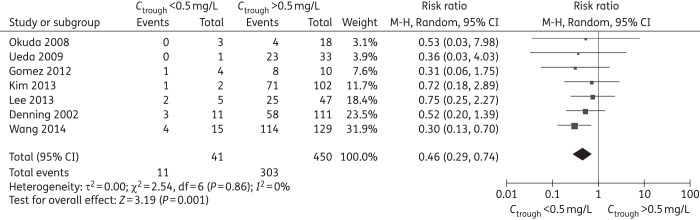
Figure 2.
Full legend
Meta-analysis for successful treatment rate (trough concentration of <0.5 mg/L comparison with >0.5 mg/L, RR <1 favours Ctrough >0.5 mg/L).
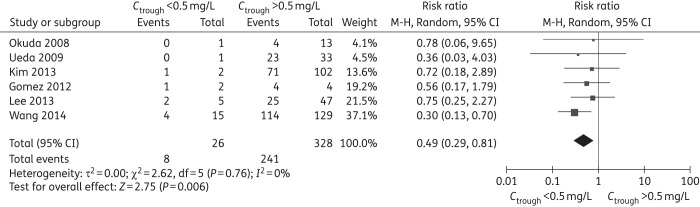
Figure 3.
Full legend
Sensitivity analysis that included only patients on monotherapy for treatment success rate (trough concentration of <0.5 mg/L comparison with >0.5 mg/L, RR <1 favours Ctrough >0.5 mg/L).
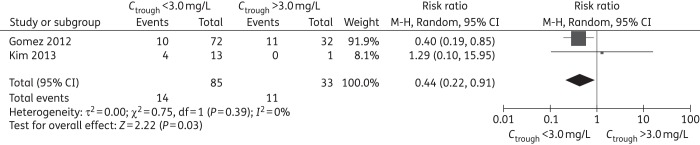
Figure 4.
Full legend
Meta-analysis for all-cause mortality (trough concentration of <3.0 mg/L comparison with >3.0 mg/L, RR <1 favours Ctrough <3.0 mg/L).
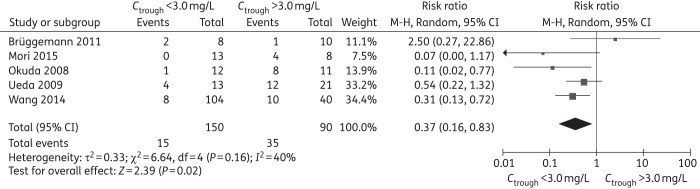
Figure 5.
Full legend
Meta-analysis for incidence of hepatotoxicity (trough concentration of <3.0 mg/L comparison with >3.0 mg/L, RR <1 favours Ctrough <3.0 mg/L).
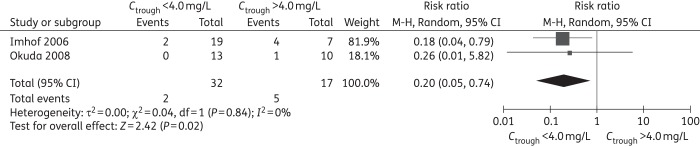
Figure 6.
Full legend
Meta-analysis for incidence of neurotoxicity (trough concentration of <4.0 mg/L comparison with >4.0 mg/L, RR <1 favours Ctrough <4.0 mg/L).
References52
52 more references, whose wording the paper’s licence keeps private.
Cited by papers we hold1
Reads
Read by people on this page
None yet.
Checked or read by AI through naulon
None yet.
A person counts once a day per paper. We keep no cookie and no address: a reader is a hash that changes every day. Any month under five reads shows no number.
Are you an author?
Is this your paper?
Claim it to add your note and be paid when agents cite it. Free.