No noticeNo retraction, correction or concern found when last checked on Oct 27, 2026.
Odd viscosity in chiral active fluids
Debarghya Banerjee, Anton Souslov, Alexander G. Abanov and 1 more
Nature Communications · 2017 · CC BY
doi:10.1038/s41467-017-01378-7 (opens in a new tab)
We email you when a new notice or a question about this paper appears.
Abstract
We study the hydrodynamics of fluids composed of self-spinning objects such as chiral grains or colloidal particles subject to torques. These chiral active fluids break both parity and time-reversal symmetries in their non-equilibrium steady states. As a result, the constitutive relations of chiral active media display a dissipationless linear-response coefficient called odd (or equivalently, Hall) viscosity. This odd viscosity does not lead to energy dissipation, but gives rise to a flow perpendicular to applied pressure. We show how odd viscosity arises from non-linear equations of hydrodynamics with rotational degrees of freedom, once linearized around a non-equilibrium steady state characterized by large spinning speeds. Next, we explore odd viscosity in compressible fluids and suggest how our findings can be tested in the context of shock propagation experiments. Finally, we show how odd viscosity in weakly compressible chiral active fluids can lead to density and pressure excess within vortex cores.
Abstract licence: CC BY-NC-ND
No text here
Its licence does not allow us to show the full text. Read it at PubMed Central:
Read at PubMed Central (opens in a new tab)Figures4
From PubMed Central, U.S. National Library of Medicine. Licence: CC BY-NC-ND.
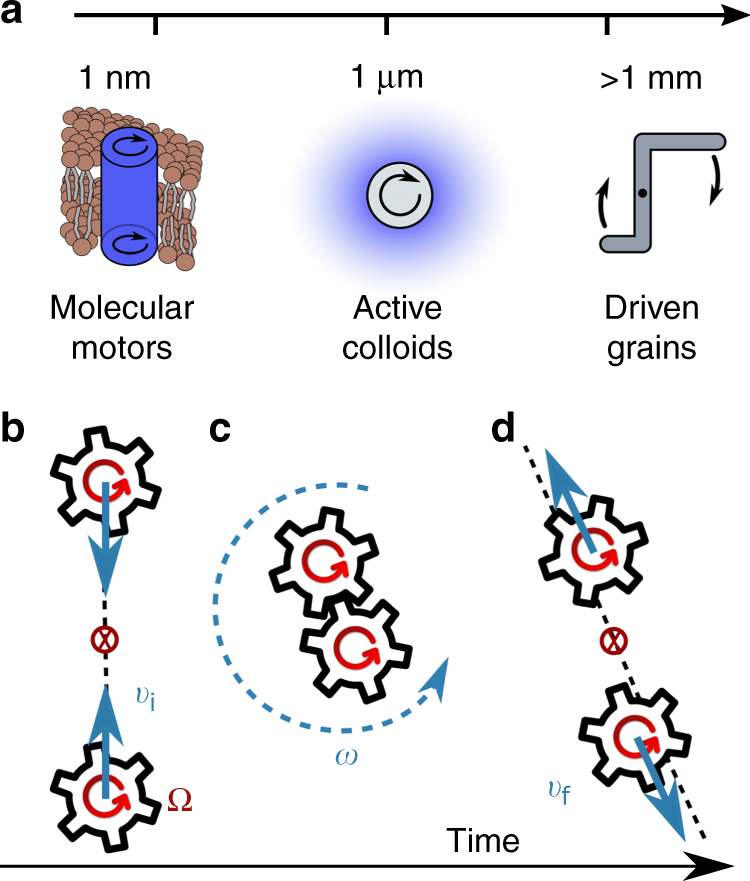
Fig. 1
Full legend
Chiral active fluids with odd viscosity. a Chiral active fluids in a variety of contexts: biological1–6, colloidal8–10, and granular11. b–d Schematic of the collision processes in a chiral active gas. b Head-on collision between self-spinning gears that initially move with speed v i and rotate with frequency Ω. Their center of mass is represented as a red crossed circle. c While in contact, the frictional gears convert intrinsic angular momentum into orbital angular momentum, which leads to rotation around their center of mass with frequency ω (shown as a dashed circular arrow). We assume that this process occurs on a time scale that is fast compared to the time between collisions. As a result, the spinning frequency is rapidly reset to the initial Ω0 favored by the balance of internal active torque and dissipation. d After the collision, the self-spinning gears move away from each other with velocity v f. However, the particles do not necessarily move with final velocities that parallel the vector distance between them, i.e., orbital angular momentum is generated in the collision
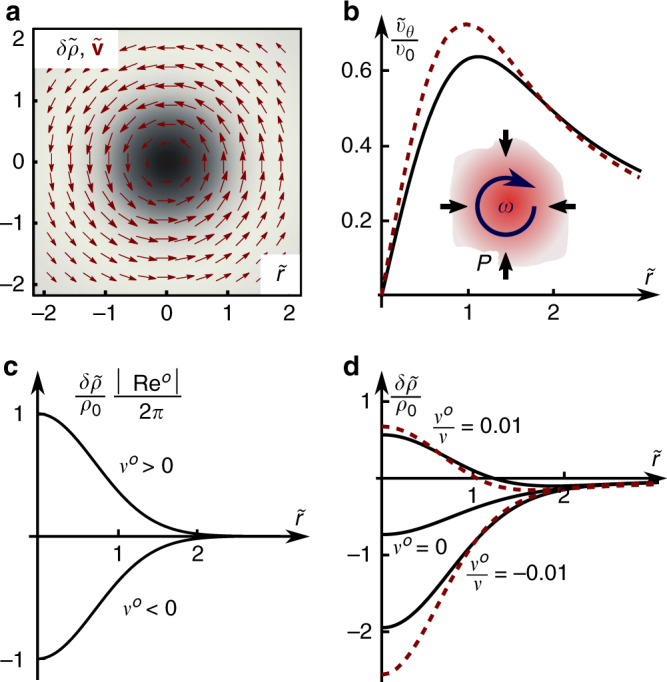
Fig. 2
Full legend
Odd viscosity in weakly compressible active fluids can lead to a build-up of particles inside a vortex. The Lamb–Oseen vortex flow (a: red arrow, b: Rescaled azimuthal component \documentclass[12pt]{minimal} \usepackage{amsmath} \usepackage{wasysym} \usepackage{amsfonts} \usepackage{amssymb} \usepackage{amsbsy} \usepackage{mathrsfs} \usepackage{upgreek} \setlength{\oddsidemargin}{-69pt} \begin{document}$${\tilde v_\theta } \equiv {v_\theta }{r_{\rm{s}}}\pi {\rm{/}}{r_0}$$\end{document}ṽθ≡vθrsπ∕r0, \documentclass[12pt]{minimal} \usepackage{amsmath} \usepackage{wasysym} \usepackage{amsfonts} \usepackage{amssymb} \usepackage{amsbsy} \usepackage{mathrsfs} \usepackage{upgreek} \setlength{\oddsidemargin}{-69pt} \begin{document}$${r_{\rm{s}}} \equiv {r_0}\sqrt {1 + t{\rm{/}}{t_0}} $$\end{document}rs≡r01+t∕t0, r 0 is a length scale that we chose via the initial vortex profile, and \documentclass[12pt]{minimal} \usepackage{amsmath} \usepackage{wasysym} \usepackage{amsfonts} \usepackage{amssymb} \usepackage{amsbsy} \usepackage{mathrsfs} \usepackage{upgreek} \setlength{\oddsidemargin}{-69pt} \begin{document}$$\tilde r \equiv r{\rm{/}}{r_{\rm{s}}}$$\end{document}r~≡r∕rs) is unperturbed by the presence of odd viscosity ν o (b: black, solid), but does change due to antisymmetric stress (b: red, dashed). (b inset: schematic illustration of the fact that a fluid with odd viscosity couples vorticity and pressure, i.e., the phenomenon illustrated quantitatively in parts a–d.) Odd viscosity does change the density profile (grayscale map of a; c, d). We plot time-rescaled solutions for odd-viscosity vortices of particle density \documentclass[12pt]{minimal} \usepackage{amsmath} \usepackage{wasysym} \usepackage{amsfonts} \usepackage{amssymb} \usepackage{amsbsy} \usepackage{mathrsfs} \usepackage{upgreek} \setlength{\oddsidemargin}{-69pt} \begin{document}$$\delta \tilde \rho {\rm{/}}{\rho _0} \equiv (\rho - {\rho _0})\frac{{{\pi ^2}(1 + t{\rm{/}}{t_0})}}{{{\rho _0}{\rm{M}}{{\rm{a}}^2}}}$$\end{document}δρ~∕ρ0≡(ρ-ρ0)π2(1+t∕t0)ρ0Ma2, as a function of \documentclass[12pt]{minimal} \usepackage{amsmath} \usepackage{wasysym} \usepackage{amsfonts} \usepackage{amssymb} \usepackage{amsbsy} \usepackage{mathrsfs} \usepackage{upgreek} \setlength{\oddsidemargin}{-69pt} \begin{document}$$\tilde r$$\end{document}r~. c Deep in the limit Reo much less than 1, the inertial contribution to the density profile inside a Lamb–Oseen vortex can be neglected and the profile depends on the odd viscosity only. Plotted is the rescaled form of the density profile, also written in Eq. (7). The sign of the relative density at the vortex center depends on the relative sign of fluid vorticity and odd viscosity. d When the effects of inertia are non-negligible, they modify the density profile: inertia always favors a smaller density at the vortex core. Plotted in black are the exact solutions for Reynolds number \documentclass[12pt]{minimal} \usepackage{amsmath} \usepackage{wasysym} \usepackage{amsfonts} \usepackage{amssymb} \usepackage{amsbsy} \usepackage{mathrsfs} \usepackage{upgreek} \setlength{\oddsidemargin}{-69pt} \begin{document}$$\frac{{{v_0}{r_0}}}{\nu } = 0.05$$\end{document}v0r0ν=0.05 and the viscosity ratio \documentclass[12pt]{minimal} \usepackage{amsmath} \usepackage{wasysym} \usepackage{amsfonts} \usepackage{amssymb} \usepackage{amsbsy} \usepackage{mathrsfs} \usepackage{upgreek} \setlength{\oddsidemargin}{-69pt} \begin{document}$$\frac{{{\nu ^o}}}{\nu } = \{ - 0.01,0,0.01\} $$\end{document}νoν={-0.01,0,0.01} (see Methods for details). For \documentclass[12pt]{minimal} \usepackage{amsmath} \usepackage{wasysym} \usepackage{amsfonts} \usepackage{amssymb} \usepackage{amsbsy} \usepackage{mathrsfs} \usepackage{upgreek} \setlength{\oddsidemargin}{-69pt} \begin{document}$$\frac{{{\nu ^o}}}{\nu } = 0.01$$\end{document}νoν=0.01, excess density builds up at the vortex core and can dominate over the usual density depletion in a purely inertial vortex (for which \documentclass[12pt]{minimal} \usepackage{amsmath} \usepackage{wasysym} \usepackage{amsfonts} \usepackage{amssymb} \usepackage{amsbsy} \usepackage{mathrsfs} \usepackage{upgreek} \setlength{\oddsidemargin}{-69pt} \begin{document}$${\textstyle{{{\nu ^o}} \over \nu }} = 0$$\end{document}νoν=0). Plotted as red dashed lines are the numerical solutions for the density profile near the vortex center in the presence of a moderately small antisymmetric stress. In these solutions, the density profile is modified, but the conclusion about the possible presence of a density peak at the vortex center does not change
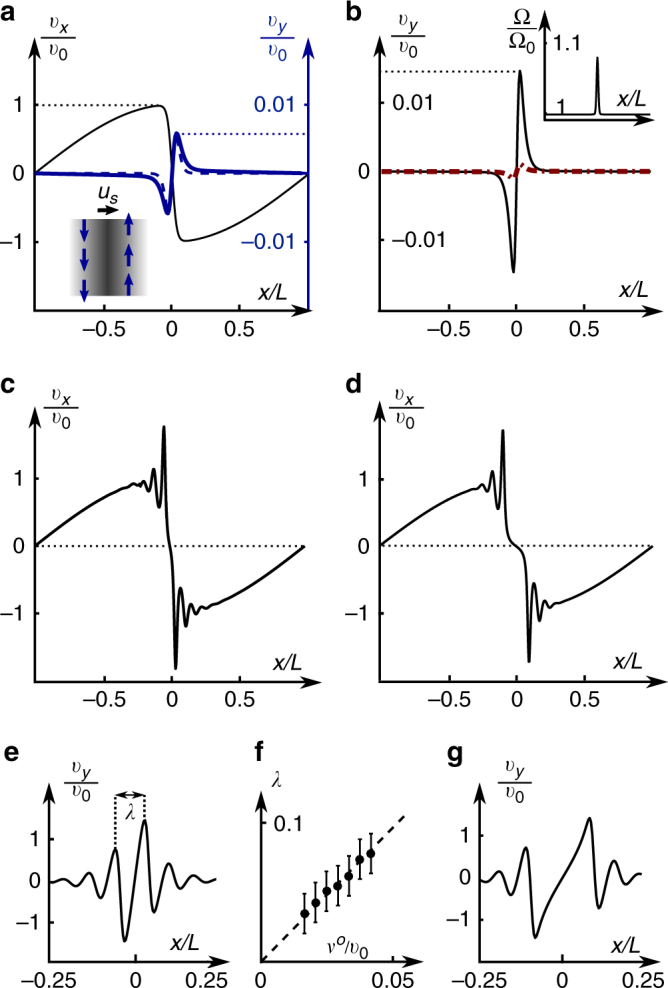
Fig. 3
Full legend
Shocks in chiral active fluids. a Inset: schematic of transverse flow v y (blue arrows) in a compression shock. Main panel: longitudinal [black, thin] and transverse [blue: analytic (dashed), numeric (solid, thick)] flow profiles for small viscosity ratio ν o/ν = −0.02 in a stationary shock which results from symmetric external forcing \documentclass[12pt]{minimal} \usepackage{amsmath} \usepackage{wasysym} \usepackage{amsfonts} \usepackage{amssymb} \usepackage{amsbsy} \usepackage{mathrsfs} \usepackage{upgreek} \setlength{\oddsidemargin}{-69pt} \begin{document}$${\bf{f}}({\rm{x}}) = - \hat x\frac{{{f_0}\pi }}{4}{\kern 1pt} {\rm{sin}}{\kern 1pt} \pi x{\rm{/}}L$$\end{document}f(x)=-x^f0π4sinπx∕L. The characteristic velocity scale is \documentclass[12pt]{minimal} \usepackage{amsmath} \usepackage{wasysym} \usepackage{amsfonts} \usepackage{amssymb} \usepackage{amsbsy} \usepackage{mathrsfs} \usepackage{upgreek} \setlength{\oddsidemargin}{-69pt} \begin{document}$${v_0} \equiv \sqrt {{f_0}L{\rm{/}}{\rho _0}} $$\end{document}v0≡f0L∕ρ0; transverse flow v y scales as \documentclass[12pt]{minimal} \usepackage{amsmath} \usepackage{wasysym} \usepackage{amsfonts} \usepackage{amssymb} \usepackage{amsbsy} \usepackage{mathrsfs} \usepackage{upgreek} \setlength{\oddsidemargin}{-69pt} \begin{document}$${v_0}\frac{{{\nu ^o}}}{\nu }$$\end{document}v0νoν. b Even in the presence of antisymmetric stress, the effects of odd viscosity can dominate if the variation in Ω is small: \documentclass[12pt]{minimal} \usepackage{amsmath} \usepackage{wasysym} \usepackage{amsfonts} \usepackage{amssymb} \usepackage{amsbsy} \usepackage{mathrsfs} \usepackage{upgreek} \setlength{\oddsidemargin}{-69pt} \begin{document}$$\left| {\Omega - {\Omega _0}} \right|{\rm{/}}{\Omega _0} \lesssim 10\% $$\end{document}Ω-Ω0∕Ω0≲10% (inset: Ω/Ω0). The sharper peak (black, solid) includes the combined effect of antisymmetric stress and odd viscosity. Neglecting odd viscosity, we find only a small transverse flow due to antisymmetric stress (red, dashed). c–g The longitudinal (c, d) and transverse (e, g) flow for ν o/ν = −10. Shocks develop oscillations with wavelength \documentclass[12pt]{minimal} \usepackage{amsmath} \usepackage{wasysym} \usepackage{amsfonts} \usepackage{amssymb} \usepackage{amsbsy} \usepackage{mathrsfs} \usepackage{upgreek} \setlength{\oddsidemargin}{-69pt} \begin{document}$$\lambda \sim \left| {{\nu ^o}} \right|{\rm{/}}{v_0}$$\end{document}λ~νo∕v0: f numerical verification of this scaling law. In c, e and f, the antisymmetric stress is zero, whereas in d and g its value is as in b. See Supplementary Movie 1 for the numerical simulations that show the dynamics of relaxation to this steady state
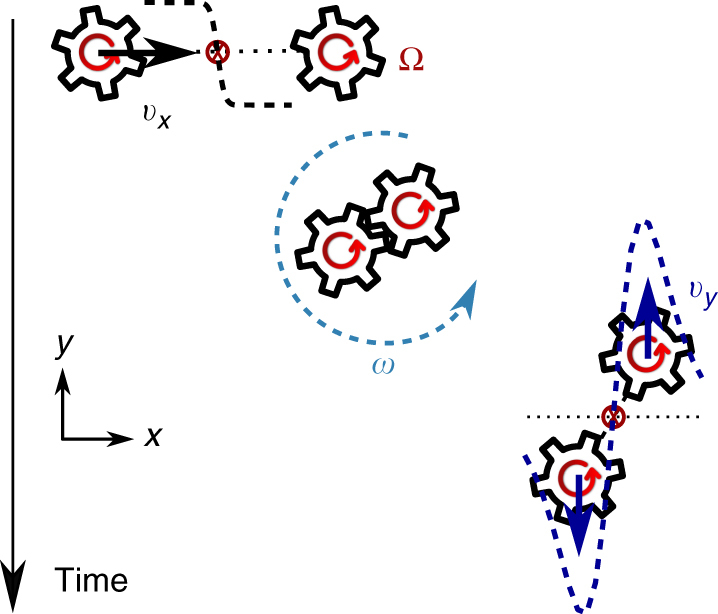
Fig. 4
Full legend
An intuitive picture for the shock profile. With the shock propagating at speed v x, the left particle collides into the right one. During the collision, intrinsic rotation Ω is converted into the orbital rotation ω within the shock. After the collision, transverse flow has a profile with amplitude \documentclass[12pt]{minimal} \usepackage{amsmath} \usepackage{wasysym} \usepackage{amsfonts} \usepackage{amssymb} \usepackage{amsbsy} \usepackage{mathrsfs} \usepackage{upgreek} \setlength{\oddsidemargin}{-69pt} \begin{document}$${v_y} \sim a\Omega $$\end{document}vy~aΩ, where a is the particle size. This picture agrees well with the hydrodynamic description of the shape of transverse flow and the scaling of v y
References41
- 1.
Sumino Y, et al. Large-scale vortex lattice emerging from collectively moving microtubules. Nature. 2012;483:448-452.
Not in our library10.1038/nature10874 (opens in a new tab)
- 2.
Tabe Y, Yokoyama H. Coherent collective precession of molecular rotors with chiral propellers. Nat. Mater. 2003;2:806-809.
Not in our library10.1038/nmat1017 (opens in a new tab)
- 3.
Oswald P, Poy G. Lehmann rotation of cholesteric droplets: role of the sample thickness and of the concentration of chiral molecules. Phys. Rev. E. 2015;91:032502.
Not in our library10.1103/physreve.91.032502 (opens in a new tab)
- 4.
Drescher K, et al. Dancing volvox: hydrodynamic bound states of swimming algae. Phys. Rev. Lett. 2009;102:168101.
Not in our library10.1103/physrevlett.102.168101 (opens in a new tab)
- 5.
Petroff AP, Wu X-L, Libchaber A. Fast-moving bacteria self-organize into active two-dimensional crystals of rotating cells. Phys. Rev. Lett. 2015;114:158102.
Not in our library10.1103/physrevlett.114.158102 (opens in a new tab)
- 6.
Riedel I, Kruse K, Howard J. A self-organized vortex array of hydrodynamically entrained sperm cells. Science. 2005;309:300.
Not in our library10.1126/science.1110329 (opens in a new tab)
- 7.
Denk J, Huber L, Reithmann E, Frey E. Active curved polymers form vortex patterns on membranes. Phys. Rev. Lett. 2016;116:178301.
Not in our library10.1103/physrevlett.116.178301 (opens in a new tab)
- 8.
Snezhko A. Complex collective dynamics of active torque-driven colloids at interfaces. Curr. Opin. Colloid Interface Sci. 2016;21:65-75.
Not in our library10.1016/j.cocis.2015.11.010 (opens in a new tab)
- 9.
- 10.
Lemaire E, Lobry L, Pannacci N, Peters F. Viscosity of an electro-rheological suspension with internal rotations. J. Rheol. 2008;52:769.
Not in our library10.1122/1.2903546 (opens in a new tab)
- 11.
Tsai J-C, Ye F, Rodriguez J, Gollub JP, Lubensky TC. A chiral granular gas. Phys. Rev. Lett. 2005;94:214301.
Not in our library10.1103/physrevlett.94.214301 (opens in a new tab)
- 12.
Stern A. Anyons and the quantum Hall effect—a pedagogical review. Ann. Phys. 2008;323:204-249.
Not in our library10.1016/j.aop.2007.10.008 (opens in a new tab)
- 13.
Hasan MZ, Kane CL. Colloquium: topological insulators. Rev. Mod. Phys. 2010;82:3045-3067.
Not in our library10.1103/revmodphys.82.3045 (opens in a new tab)
- 14.
Souslov, A., van Zuiden, B. C., Bartolo, D., & Vitelli, V. Topological sound in active-liquid metamaterials. Nat. Phys. advance online publication, 17 July 2017 (https://doi.org/10.1038/nphys4193).
Not in our library
- 15.
Landau, L. & Lifshitz, E. Fluid Mechanics. v. 6 (Pergamon, New York, 2013).
Not in our library
- 16.
Lenz P, Joanny J-F, Jülicher F, Prost J. Membranes with rotating motors. Phys. Rev. Lett. 2003;91:108104.
Not in our library10.1103/physrevlett.91.108104 (opens in a new tab)
- 17.
Uchida N, Golestanian R. Synchronization and collective dynamics in a carpet of microfluidic rotors. Phys. Rev. Lett. 2010;104:178103.
Not in our library10.1103/physrevlett.104.178103 (opens in a new tab)
- 18.
Yeo K, Lushi E, Vlahovska PM. Collective dynamics in a binary mixture of hydrodynamically coupled microrotors. Phys. Rev. Lett. 2015;114:188301.
Not in our library10.1103/physrevlett.114.188301 (opens in a new tab)
- 19.
Spellings M, et al. Shape control and compartmentalization in active colloidal cells. Proc. Natl Acad. Sci. USA. 2015;112:E4642-E4650.
Not in our library10.1073/pnas.1513361112 (opens in a new tab)
- 20.
Nguyen NHP, Klotsa D, Engel M, Glotzer SC. Emergent collective phenomena in a mixture of hard shapes through active rotation. Phys. Rev. Lett. 2014;112:075701.
Not in our library10.1103/physrevlett.112.075701 (opens in a new tab)
- 21.
van Zuiden BC, Paulose J, Irvine WTM, Bartolo D, Vitelli V. Spatiotemporal order and emergent edge currents in active spinner materials. Proc. Natl Acad. Sci. USA. 2016;113:12919-12924.
Not in our library10.1073/pnas.1609572113 (opens in a new tab)
- 22.
Dahler J, Scriven L. Angular momentum of continua. Nature. 1961;192:36-37.
Not in our library10.1038/192036a0 (opens in a new tab)
- 23.
Condiff DW, Dahler JS. Fluid mechanical aspects of antisymmetric stress. Phys. Fluids. 1964;7:842-854.
Not in our library10.1063/1.1711295 (opens in a new tab)
- 24.
Bonthuis DJ, Horinek D, Bocquet L, Netz RR. Electrohydraulic power conversion in planar nanochannels. Phys. Rev. Lett. 2009;103:144503.
Not in our library10.1103/physrevlett.103.144503 (opens in a new tab)
- 25.
Fürthauer S, Strempel M, Grill SW, Jülicher F. Active chiral fluids. Eur. Phys. J. E. 2012;35:89.
Not in our library10.1140/epje/i2012-12089-6 (opens in a new tab)
- 26.
Avron JE, Seiler R, Zograf PG. Viscosity of quantum hall fluids. Phys. Rev. Lett. 1995;75:697-700.
Not in our library10.1103/physrevlett.75.697 (opens in a new tab)
- 27.
Avron JE. Odd viscosity. J. Stat. Phys. 1998;92:543-557.
Not in our library10.1023/a:1023084404080 (opens in a new tab)
- 28.
Read N. Non-abelian adiabatic statistics and hall viscosity in quantum hall states and px + ipy paired superfluids. Phys. Rev. B. 2009;79:045308.
Not in our library10.1103/physrevb.79.045308 (opens in a new tab)
- 29.
Wiegmann P, Abanov AG. Anomalous hydrodynamics of two-dimensional vortex fluids. Phys. Rev. Lett. 2014;113:034501.
Not in our library10.1103/physrevlett.113.034501 (opens in a new tab)
- 30.
Lapa MF, Hughes TL. Swimming at low reynolds number in fluids with odd, or hall, viscosity. Phys. Rev. E. 2014;89:043019.
Not in our library10.1103/physreve.89.043019 (opens in a new tab)
- 31.
Ganeshan S, Abanov T. Odd viscosity in two-dimensional incompressible fluids. Phys. Rev. Fluids. 2017;2:094101.
Not in our library10.1103/physrevfluids.2.094101 (opens in a new tab)
- 32.
Moroz S, Hoyos C, Radzihovsky L. Galilean invariance at quantum hall edge. Phys. Rev. B. 2015;91:195409.
Not in our library10.1103/physrevb.91.195409 (opens in a new tab)
- 33.
Marchetti MC, et al. Hydrodynamics of soft active matter. Rev. Mod. Phys. 2013;85:1143-1189.
Not in our library10.1103/revmodphys.85.1143 (opens in a new tab)
- 34.
Solon AP, et al. Pressure is not a state function for generic active fluids. Nat. Phys. 2015;11:673-678.
Not in our library10.1038/nphys3377 (opens in a new tab)
- 35.
Lingam M, Morrison PJ. The action principle for generalized fluid motion including gyroviscosity. Phys. Lett. A. 2014;378:3526-3532.
Not in our library10.1016/j.physleta.2014.10.013 (opens in a new tab)
- 36.
Zakharov VE, Kuznetsov EA. Hamiltonian formalism for nonlinear waves. Phys. Usp. 1997;40:1087.
Not in our library10.1070/pu1997v040n11abeh000304 (opens in a new tab)
- 37.
Saarloos WV, Bedeaux D, Mazur P. Hydrodynamics for an ideal fluid: Hamiltonian formalism and Liouville-equation. Physica. A. 1981;107:109.
Not in our library10.1016/0378-4371(81)90026-1 (opens in a new tab)
- 38.
Wensink HH, Kantsler V, Goldstein RE, Dunkel J. Controlling active self-assembly through broken particle-shape symmetry. Phys. Rev. E. 2014;89:010302.
Not in our library10.1103/physreve.89.010302 (opens in a new tab)
- 39.
Whitham, G. B. Linear and Nonlinear Waves, vol. 42 (John Wiley & Sons, New York, 2011).
Not in our library
- 40.
Kulkarni M, Abanov AG. Hydrodynamics of cold atomic gases in the limit of weak nonlinearity, dispersion, and dissipation. Phys. Rev. A. 2012;86:033614.
Not in our library10.1103/physreva.86.033614 (opens in a new tab)
Cited by papers we hold3
Hydrodynamic effective field theories with discrete rotational symmetry · 2022
Not checkedOdd surface waves in two-dimensional incompressible fluids · 2018
Not checked
Reads
Read by people on this page
None yet.
Checked or read by AI through naulon
None yet.
A person counts once a day per paper. We keep no cookie and no address: a reader is a hash that changes every day. Any month under five reads shows no number.
Are you an author?
Is this your paper?
Claim it to add your note and be paid when agents cite it. Free.