Anxiety and depression in Alzheimer’s disease: a systematic review of pathogenetic mechanisms and relation to cognitive decline
Rossana Botto, Nicoletta Callai, Aurora Cermelli and 2 more
Neurological Sciences · 2022 · Systematic review · CC BY
doi:10.1007/s10072-022-06068-x (opens in a new tab)
We email you when a new notice or a question about this paper appears.
Abstract
Objectives. To explore the pathogenetic hypothesis provided to explain the comorbidity of anxious and depressive symptomatology and AD and to assess the association between anxious and depressive symptoms and the AD-related cognitive impairment.
Methods. In October 2020 and March 2021, PsycINFO, Embase, Ovid, and CINAHL were searched for peer-reviewed original articles investigating anxiety and/or depression in AD.
Results. A total of 14,760 studies were identified and 34 papers on AD patients were included in the review. Suggested biological causes of depression and anxiety in AD include higher strychnine-sensitive glycine receptor (GlyRS) functioning and selective reduction of N-methyl-d-aspartate (NMDA) receptor NR2A density, cortical and limbic atrophy, lower resting cortical metabolism, lower CSF Aβ42 and higher t-tau and p-tau levels, and neuritic plaques. At the same time, dysthymia arises in the early stages of AD as an emotional reaction to the progressive cognitive decline and can cause it; anxiety can appear as an initial compensating behaviour; and depression might be related to AD awareness and loss of functional abilities. Affective symptoms and the expression of the depressive symptoms tend to reduce as AD progresses.
Conclusion. The neurodegeneration of areas and circuits dealing with emotions can elicit anxiety and depression in AD. In the early stages of the disease, anxiety and depression could arise as a psychological reaction to AD and due to coping difficulties. In late AD stages, the cognitive impairment reduces the emotional responses and their expression. Anxiety and depression are more intense in early-onset AD, due to the major impact of AD on the individual.
Supplementary Information. The online version contains supplementary material available at 10.1007/s10072-022-06068-x.
Abstract licence: CC BY
Full text
From PubMed Central, U.S. National Library of Medicine, as current on Oct 21, 2026. Paragraph numbers are ours, so an answer can point at one.
Introduction
Alzheimer’s disease (AD) is a primary neurodegenerative dementia and one of the leading causes of disability in older people. AD is clinically characterized by a progressive, global cognitive impairment that affects a person’s ability to perform everyday activities and is associated with brain changes that involve the extracellular accumulation of beta-amyloid plaques outside neurons and intraneuronal deposition of tau tangles inside neurons.
Although the core symptoms of AD are memory impairment and deficits in other cognitive domains, neuropsychiatric symptoms such as anxiety and depression are commonly observed during the clinical course of the illness. In AD, the prevalence of anxiety ranges from 9.4% (preclinical phase) to 39% (from mild to severe decline) and the prevalence of depression in mild-to-moderate AD varies from 14.8% to 40%. Anxiety is generally characterized by excessive worry, tenseness, irritability, wandering, and decreased engagement in once pleasurable activities. Anxious symptoms seem to be associated with more severe impairments in activities of daily living and worse behavioural concerns, and anxiety could be considered a psychological response to AD diagnosis. Typical depressive symptoms in AD are insomnia, social withdrawal, reduced purpose-oriented behaviour, loss of interest in once-enjoyable activities and hobbies, guilt, hopelessness, and sadness. Anxiety and depression often overlap, especially in patients with mild AD.
Nevertheless, despite this evidence, due to progressive cognitive deterioration and to diagnostic and methodological difficulties in assessing anxiety and depression in AD patients, it is not easy to evaluate their role with respect to the progression of the disease.
Anxiety and depression in AD have been largely studied. Nevertheless, the pathogenetic explanations of the relationship of anxiety and depression with AD are still not so clear. On the one hand, a history of anxiety and depressive disorders, as well as their presence at the first stages of AD, represents a risk factor for the development of dementia. On the other hand, it is well-known that neuropsychiatric symptoms and AD share some common biological bases. Moreover, to our knowledge, to date, no studies proposed summary explanations of the various reasons why anxiety and depression can appear in comorbidity with AD and during its progression.
It is known that anxiety and depression can manifest during AD, and there are always causes explaining psychological symptoms. Thus, why AD patients can suffer from anxiety and depression? Which are the causes for the occurrence of these symptoms in patients with AD?
Research on the theme is heterogeneous relatively to the aims and the methodology of the studies. Most of the published studies on this theme had different aims but presented suggestions that answer to this clinical question in comment to their evidence. Moreover, singly consulted, they offer partial explanations to this clinical phenomenon that, instead, is complex. Furthermore, other reviews on anxiety and depression in AD did not specifically deal with the pathogenetic hypothesis on their comorbidity and suggest the analysis of the basic mechanisms explaining the prevalence of anxiety and depression in AD.
Therefore, according to these considerations, it could be useful to analyse deeper and resume literature evidence on this topic, combining different data and providing a bio-psycho-social frame to explain why AD patients can suffer from anxiety and depression. Hence, this systematic review had the aim to collect the evidence published to date that answer the above-presented clinical question. This question can be declined into two sub-hypotheses: anxiety and depression in AD could be due to pathogenetic mechanisms and there could be a relationship between them and cognitive decline. Thus, the purposes of this systematic review were to explore the pathogenetic hypothesis provided to explain the comorbidity of anxious and depressive symptomatology and AD and to assess the association between anxious and depressive symptoms and the AD-related cognitive impairment.
Methods
The systematic review (PROSPERO registration n. CRD42019126592) was conducted according to the recommendations of the Preferred Reporting Items for Systematic Reviews and Meta-Analyses (PRISMA) criteria. The study was approved by “Comitato Etico Interaziendale A.O.U. San Giovanni Battista di Torino A.O. C.T.O./Maria Adelaide di Torino”: protocol number 0034410, procedure number CS2/1179, date of approval: 29/03/19.
Search strategy
The literature search was performed in October 2020 on PsycINFO, Embase, MEDLINE, and CINAHL databases. Then, a search update followed in March 2021 on the same databases. The search was conducted by L.C., a librarian expert in data extraction from databases, using keywords including the following terms (MeSH and free words): (“Alzheimer’s disease” [MeSH] OR (Alzheimer disease) OR (Alzheimer) OR Dementia [MeSH]) AND (“Anxiety” [MeSH] OR (Anxiety Disorder) OR (anx) OR “Depression” [MeSH] OR (Depressive Disorders) OR (Stress, Psychological)). See online resource “SM 1” for the details of the search strategy.
Study eligibility criteria
Only full-text original articles published in English language on peer-reviewed journals were included in the search. In detail, studies with longitudinal, prospective, cross-sectional, multicentre, evaluative, or comparative designs, and not assessing interventions were analysed. Furthermore, studies had to be on patients with a diagnosis of AD. Diagnosis of AD had to be done using approved diagnostic criteria, i.e., those of DSM-III-R, DSM-IV, DSM-IV-TR, NIA-AA, NINCDS-ADRDA, ICD-10, CERAD, and Braak stage. No age-filters were used. Finally, they had to investigate symptoms of anxiety and/or depression; then, they had to propose pathogenetic hypothesis on anxiety and depression in AD and/or to investigate the association between anxiety and/or depression and cognitive impairment.
The exclusion criteria were (1) literature reviews; (2) systematic reviews; (3) meta-analysis; (4) case reports or case series studies; (5) clinical trials; (6) studies not including patients with AD (i.e., studies including patients with frontotemporal dementia, vascular dementia, Parkinson disease, mixed dementia, post-traumatic dementia, Huntington disease, dementia with Lewy bodies, and HIV-associated dementia); (7) studies not evaluating anxiety or depression; (8) studies evaluating anxiety or depression but not proposing pathogenetic hypothesis on anxiety and depression in AD or not investigating the association between anxiety and/or depression and cognitive impairment; (9) studies not published and not peer-reviewed; and (10) health policies and guidelines.
Studies of grey literature (theses, abstracts, books, dissertations) were not included in the search considering the high number of peer-reviewed articles published on the topic.
No limitations were established on publication data of the studies. No limitations were established on methods of anxiety and depression assessment on condition of these criteria: studies had to assess anxiety and/or depression using validated scales or structured interviews.
Data collection and analysis
Two researchers (NC and AC) identified the potential studies of interest, screening titles, and abstracts. All the studies that did not meet all the inclusion criteria or that complied with almost one exclusion criterion were excluded.
Then, the remaining studies were screened reading their full text, and the selected articles were revised to verify whether they fulfilled the inclusion criteria. If there was any disagreement in the study selection, a third investigator (RB) read the article and NC, AC, and RB decided together for the inclusion of the article in the review or not.
All the studies selected for the review were revised considering the country, objectives, design, sampling and sample size, outcome measures, and results.
Any direct contact with authors was necessary with the following exception: for Panegyres et al.’s study, information was missing for the tools used to assess anxiety and depression. So, the people responsible for the C-Path Online Data Repository used by authors were contacted and they provided the missing information.
Risk of bias
We assessed the quality of the included articles using the Newcastle–Ottawa Quality Assessment Scale (NOS), a standardized instrument used to critically review nonrandomized studies with its design and content. Two independent investigators (A.C. and N.C.) analysed each article. Scores ranged from 0 to 9 points, with higher scores indicating higher study quality. We considered NOS scores of 0–3, 4–6, and ≥ 7 to indicate low, medium, and high quality, respectively.
Results
The identified potentially relevant studies, resulting from the searches on the abovementioned databases, were 14,760. Of these, 4700 were on PsycINFO, 1351 on Embase, 4738 on Ovid, and 3971 on CINAHL. After comparison of the databases, 3888 duplicates were removed.
Screening titles and abstracts, 10,798 studies were identified as not meeting the inclusion criteria or fulfilling almost one exclusion criterion and were excluded.
Then, the full texts of the 74 articles considered relevant for the inclusion in the review were analysed. Of those, 40 were excluded because they did not meet the inclusion criteria, or they meet almost one exclusion criterion.
Finally, 34 papers were included in the systematic review after the end of the screening process.
The selection procedure is represented through a flow diagram in the online resource “SM 2.”
Country
Fifteen studies were conducted in the USA, 2 in Germany, 2 in the Netherlands (Banning et al. conducted their study both in the USA and in Netherlands), 1 in Singapore, 2 in Japan, 1 in Sweden, 2 in Argentina, 3 in England, 1 in Australia, 2 in France, 1 in Italy, 1 in China, and 1 in Norway.
Objectives
Of the 34 studies, 17 explored the pathogenetic hypothesis that explains the comorbidity of AD, anxiety, and/or depression. Among these, 4 evaluated the association between anxiety, depression, and AD biomarkers; 8 evaluated whether anxious and depressive symptomatology in AD arise after the diagnosis of AD or as a reaction to perceived cognitive decline. Ten studies investigated whether anxiety and/or depression can influence the cognitive functions, 3 evaluated the prevalence of depressive and anxiety symptoms, 2 assessed the trajectories of depression, 1 examined if depression is a risk factor for the onset of AD, and 1 study explored clinical differences between early-onset AD and late-onset AD patients.
Study design
Of the 34 studies, 12 were longitudinal studies, 9 were cross-sectional studies, 1 was a comparative study, 1 was a multicentric study, 5 were prospective studies, 2 were retrospective studies, 1 was a cohort observational study, 2 were prospective longitudinal studies, and 1 was a retrospective longitudinal study.
Sample
The samples consisted of 12,512 elderly patients with diagnosis of AD or with probable AD in total. All the screened studies included both genders, predominantly women (56.4%). Patients’ mean age was 73.82 ± 6.8 years (range = 57.7–86.2). Relevant variability among studies was observed in the number of participants. Sample sizes ranged from 20 to 3747 AD patients.
The AD duration varies between studies: in 14 studies, patients suffered from AD from less than 6 years, and in 5 studies, patients suffered from AD from at least 7 years. The authors of the remaining studies did not provide precise data on AD duration.
At the time of the assessment, most patients were in a mild-to-moderate AD stage. Only in 4 studies, participants were patients with severe AD.
In addition to AD, patients also showed a comorbidity of depression and/or anxiety. Of all the samples, 18 consisted of subjects with AD and depression; 5 consisted of subjects with AD and anxiety; and 5 included subjects with a comorbidity of AD, and depressive and anxious symptoms. In the other samples, during the study, patients with AD developed depression or anxiety.
About the samples of the included studies, only 2 of them were from psychiatric settings and only 1 was from primary care. Most samples were from dementia specialty clinics. Among them, 15 were from outpatient settings, 4 were inpatient settings, 2 nursing home settings, and 3 in-home settings. The other remaining studies, instead, did not provide further information on the sample.
Outcomes assessment
For AD diagnosis, 26 studies used criteria established by the NINCDS-ADRDA and 1 study also used NIA-AA criteria. Two studies, instead, used ICD-10 diagnostic criteria, while the Diagnostic and Statistical Manual of Mental Disorders third edition revised (DSM III-R) and the fourth edition (DSM IV) have been used in 6 studies, respectively, for AD diagnosis and for dementia diagnosis. In one study, AD diagnosis was neuropathologically confirmed in post-mortem using the Consortium to Establish a Registry for AD (CERAD) criteria.
Few studies also performed the staging of the severity of AD neuropathology, using the Braak staging scheme. For the assessment of the cognitive impairment, the Mini Mental State Examination (MMSE) was used in almost all the studies.
Most studies evaluated anxiety and depression using the Neuropsychiatric Inventory (NPI), the DSM III-R/DSM IV criteria, the Hamilton Depression Rating Scale (HDRS), and the Hamilton Anxiety Rating Scale (HARS).
Risk of bias assessment
The risk of bias assessment of the included studies showed high-quality design in most of our studies (25 out of 34), while the rest appeared with a medium risk of bias (9 out of 34). A closer analysis revealed that most of the research did not clarify the duration of the follow-up or how many patients concluded it; some articles lost “stars” within the “comparability category”; finally, several studies did not specify in detail the history of the investigated disease. The table in the online resource “SM 3” shows the results of the risk of bias assessment, specifying how many “stars” we evaluated in each included study.
Pathogenetic hypothesis for anxiety, depression, and AD comorbidity
Depression and anxiety occur throughout the AD course both due to brain damage and psychosocial factors.
Higher anxiety levels seemed to be associated with higher strychnine-sensitive glycine receptor (GlyRS) functioning and selective reduction of N-methyl-d-aspartate (NMDA) receptor NR2A density. Anxiety in AD could be explained by the atrophy in the right precuneus and inferior parietal lobule and hyperperfusion of the bilateral anterior cingulate cortex. Higher anxiety was associated with lower resting metabolism in the bilateral entorhinal cortex, anterior parahippocampal gyrus, left anterior superior temporal gyrus, and insula.
Depression was associated with AD pathology, i.e., lower CSF Aβ42 and higher t-tau and p-tau levels, to atrophy of the insula, the inferior frontal lobe, and the limbic neural networks, and to changes in the temporal and parietal regions, including supramarginal, superior and inferior temporal and fusiform gyri, right posterior cingulate and precuneus, locus coeruleus, and basal nucleus of Meynert. Depression can be determined by decreased cortical metabolism, neuritic plaques, and neuronal damage in the temporal cortex that lead to disinhibition of the HPA-axis. On the other hand, the association between depression, HPA hyperactivity, and cardiovascular disease can determine AD progression. AD development seems to stop the continuity of the depressive state due to impaired memory and executive control. Affective symptoms and the expression of the depressive symptoms tend to reduce as AD progresses. Dysthymia was primarily in the early stages of AD, as an emotional reaction to the progressive cognitive decline, while major depression may be related to biological factors and is a symptom of the neurodegenerative AD processes.
Banning et al. explained anxiety in AD as an initial compensating behaviour, while depression could be more related to AD awareness or to the psychological reaction to AD, and to relational and biological factors. Depression can also be reactive to AD-related loss of functional ability.
Anxiety and depression were higher in patients with early-onset AD compared to patients with late-onset AD due to the following factors present in early-onset AD patients: greater changes in lifestyles, roles, and responsibility; poor social adjustment; cognitive impairment; dementia severity; and more rapid progression. Van Vliet evidenced that in late-onset AD, depression was more persistent and was the most prevalent symptom, probably due to contextual factors, i.e., death of a loved one or physical disability (see Fig. 1).
Association between anxiety, depression, and cognitive impairment
Cognitive impairment seemed to mediate the association between the presence of anxiety, lower CSF levels of Ab42, and higher levels of CSF t-tau and p-tau. Lower inhibition performance on Stroop test was associated with subsequent higher risk of anxiety and depression, due to the involving of anterior cingulate cortex. Association of depressive symptoms and cognitive impairment seems to be independent of cortical plaques and tangles.
Depressive symptoms in AD were associated with a greater severity of cognitive impairment and additional cognitive impairment, i.e., frontal planning impairments, disappear or improve with remission of depression.
Depression did not increase as mild cognitive impairment developed. It could be an early reaction to perceived cognitive decline.
Depression can cause cognitive impairment, but it seems to have no impact on cognitive functions during the early and advanced stages of AD.
Cognitive impairment was associated with a small reduction in mood symptoms and a modest increase in somatic symptoms: the AD progression determines the degradation of the ability to experience or express emotion (see Fig. 2).
A summary of the 34 studies included in the systematic review is reported in Table 1.
Discussion
The review aims to provide a bio-psycho-social frame to explain why AD patients can suffer from anxiety and depression, considering the phenomenon in its complexity. Thus, multiple pieces of punctual evidence have been combined to resume and conceptualize the literature state of the art on reasons underlying the comorbidity between anxiety, depression, and AD. For this reason, the results of the studies analysed in this review are heterogeneous because they consider not only biological, but also psychosocial aspects and they deal with AD in all its different phases relative to its progression. They evidence that both anxiety and depression could be due to brain damage on the one hand and psychosocial factors on the other.
The neurodegeneration of neural areas and circuits dealing with emotions can determine hyperactivation and disinhibition of the HPA axis that can elicit the anxious and depressive symptoms. In this regard, it has been hypothesized that hyper perfusion and atrophy of cerebral areas—i.e., anterior cingulate cortex, precuneus and parietal lobule—but also receptor alterations—i.e., NMDA receptor—could be linked to depressive symptoms. This condition of chronic distress, in turn, can lead to neurodegeneration and contribute to AD progression. Then, during the late AD stages, the high rate of brain damage could stop the depressive condition due to the impairment of memory and the executive functions, and the intensity and expression of the affective symptoms are reduced. This phenomenon could be present because a more severe cognitive decline is frequently associated with loss of insight in AD. Stronger negative emotions require a good cerebral function: if the cognitive impairment is too serious, patients will not be able to produce this type of emotional response.
On the other hand, the early stages of AD seem to be characterized by dysthymia, as an emotional reaction to the cognitive decline, and anxiety, as an initial compensating behaviour. During the initial phases of AD, depressive symptoms can manifest due to AD awareness, the impairment of the socio-relational functioning, and the loss of functional abilities. Thus, in this phase, anxiety and depression could arise due to difficulties in the adaptation to the disease and represent the psychological response to the loss of self-sufficiency and independence. Instead, major depression could be more related to biological factors, such as neurotransmitters and endocrine alterations or cortical apoptosis.
Literature evidence also differences in anxiety and depression between early-onset and late-onset AD. They seem to be more intense in early-onset AD due to more changes in lifestyles and life roles, to more responsibilities to cope with and to poorer social adjustment to the disease. Moreover, early-onset AD is often characterized by more rapid progression, dementia severity, and cognitive impairment and this can promote the psychological symptoms. The late-onset AD can occur in the elders in comorbidity with other concerns, such as physical disability or bereavements. Thus, in late-onset AD, depressive symptoms are the most prevalent and seem to be more persistent.
The results of the studies show an association between anxiety, depression, and cognitive decline. Anxious and depressive symptoms can manifest as an initial psychological reaction to the cognitive impairment. Furthermore, on its turn, depression can impact on the cognitive functioning, causing an increase of the cognitive deficits: i.e., during the remission of the depressive symptoms, the capacities of planning mediated by the frontal circuits improve. This role of influence of depression on cognition has been observed only in the intermediate AD phases.
Finally, higher cognitive impairment is associated with higher somatic symptoms of anxiety and depression and lower affective symptoms. This could be due to reduced metacognitive possibilities to experience and express emotions.
The methodology of the symptoms’ assessment could have moderated the abovementioned findings.
Assessment tools more specifically dedicated to the analysis of anxiety and depression in AD can estimate symptoms differently than those provided by more generic criteria, such as the DSM or the ICD. In this regard, Vilalta-Franch and colleagues hypothesized that the degree of rigidity of the included criteria could influence the diagnosis. Furthermore, they observed that the use of the Neuropsychiatric Inventory (NPI) can be biased by the fact that caregivers usually overestimate patients’ depressive symptoms due to their own distress.
The minority of studies performed longitudinal research designs, so further research with longitudinal observations is needed to better explore the variation of anxiety and depression along the AD course. Moreover, few studies assessed the AD severity, despite it emerging as a factor playing a role with respect to the considered psychological symptomatology. Another limitation of the studies is that they have used different AD diagnostic criteria, such as NINCDS-ADRDA, NIA-AA, DSM, and ICD. Furthermore, NINCDS-ADRDA, although it is the most used and more valid than the other diagnostic criteria, is less accurate than the currently used NIA-AA criteria. Large criteria for source search have been preferred to more stringent ones to collect and mix more evidence. At the same time, they reduced quality and homogeneity of evidence. In fact, NOS scores indicated that the quality of the included studies is not high, and studies were heterogeneous in aims, types of assessment, sampling, participants, AD duration, and neuropsychological assessment, that in most cases were not adequate. In this regard, also time impacted on method heterogeneity between older studies and the more recent ones, because the assessment criteria have changed and improved over time. Implementing more circumscribed reviews could preserve research quality and favour a more specific, detailed, and reliable comprehension of the described clinical phenomena. Moreover, most studies assessed anxiety and depression when AD was mild or moderate and not severe: this is understandable considering the serious cognitive decline that characterizes the AD advanced phases and hinders the psychological assessment, but, at the same time, it limits the exploration of anxiety and depression in patients with severe AD. Finally, AD is often present in comorbidity with dementias due to other causes, such as the vascular one. So, it would be useful to study anxiety and depression also in clinical condition of multiple dementias.
Conclusion
The neurodegeneration of areas and circuits dealing with emotions can elicit the anxious and depressive symptoms that, in their turn, can lead to neurodegeneration. In the early AD stages, anxiety and depression could arise as a psychological reaction to the disease and due to difficulties in the adaptation to AD. During the late AD stages, the serious cognitive impairment reduces the emotional responses and their expression. Finally, anxiety and depression are more intense in early-onset AD, due to the major impact of AD on the individual.
Further research, especially with longitudinal design, considering all the AD stages, performing adequate neuropsychological assessment, and investigating psycho-social factors are needed to better clarify the comorbidity between depression, anxiety, and AD.
Below is the link to the electronic supplementary material.
Figures2
From PubMed Central, U.S. National Library of Medicine. Licence: CC BY.
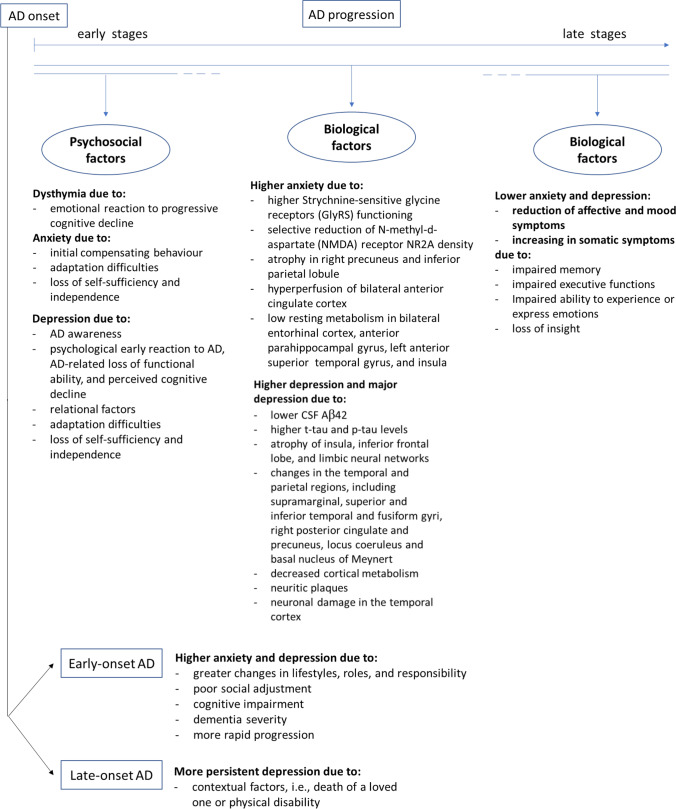
Fig. 1
Full legend
Causal factors for anxiety and depression in AD
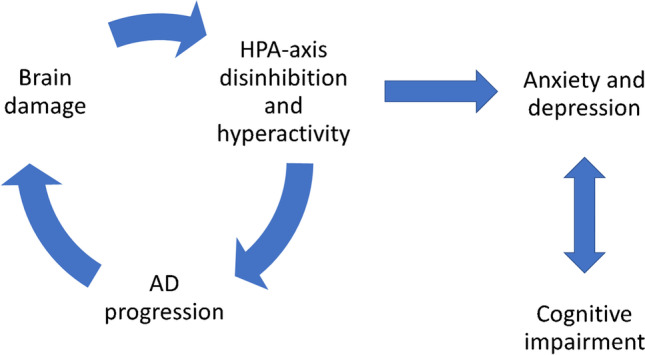
Fig. 2
Full legend
Relationships between anxiety, depression, AD, and cognitive impairment
References69
- 1.
Winblad B, Amouyel P, Andrieu S, Ballard C, Brayne C, Brodaty H. Defeating Alzheimer’s disease and other dementias: a priority for European science and society. Lancet Neurol. 2016;15(5):455-532.
Not in our library10.1016/s1474-4422(16)00062-4 (opens in a new tab)
- 2.
Alzheimer’s Association. Alzheimer’s Association Report (2016) Alzheimer’s disease facts and figures. Alzheimer’s & Dementia 459-509. 10.1016/j.jalz.2016.03.001
Not in our library10.1016/j.jalz.2016.03.001 (opens in a new tab)
- 3.
Dubois B, Feldman HH, Jacova C, Hampel H, Molinuevo JL, Blennow K, et al. Advancing research diagnostic criteria for Alzheimer’s disease: the IWG-2 criteria. Lancet Neurol. 2014;13(6):614-629.
Not in our library10.1016/s1474-4422(14)70090-0 (opens in a new tab)
- 4.
Suárez-González A, Crutch SJ, Franco-Macías E, Gil-Néciga E. Neuropsychiatric symptoms in posterior cortical atrophy and Alzheimer disease. J Geriatr Psychiatry Neurol. 2016;29(2):65-71.
Not in our library10.1177/0891988715606229 (opens in a new tab)
- 5.
Connors MH, Seeher KM, Crawford J, Ames D, Woodward M, Brodaty H. The stability of neuropsychiatric subsyndromes in Alzheimer’s disease. Alzheimers Dement. 2018;14(7):880-888.
Not in our library10.1016/j.jalz.2018.02.006 (opens in a new tab)
- 6.
Becker E Orellana Rios Lahmann C Rücker G Bauer J & Boeker M (2018) Anxiety as a risk factor of Alzheimer’s disease and vascular dementia. The British Journal of Psychiatry 1-7. 10.1192/bjp.2018.173
Not in our library10.1192/bjp.2018.173 (opens in a new tab)
- 7.
Zhao QF, Tan L, Wang HF, Jiang T, Tan MS, Tan L, et al. The prevalence of neuropsychiatric symptoms in Alzheimer’s disease: systematic review and meta-analysis. J Affect Disord. 2016;190:264-271.
Not in our library10.1016/j.jad.2015.09.069 (opens in a new tab)
- 8.
Asmer MS Kirkham J Newton H Ismail Z Elbayoumi H Leung RH et al (2018) Meta-analysis of the prevalence of major depressive disorder among older adults with dementia. J Clin Psychiartry 70 (5). 10.4088/JCP.17r11772
Not in our library10.4088/jcp.17r11772 (opens in a new tab)
- 9.
Chen P, Guarino PD, Dysken MW, Pallaki M, Asthana S, Llorente MD, Sano M. Neuropsychiatric symptoms and caregiver burden in individuals with Alzheimer’s disease: the TEAM-AD VA cooperative study. J Geriatr Psychiatry Neurol. 2018;31(4):177-185.
Not in our library10.1177/0891988718783897 (opens in a new tab)
- 10.
Yong TK YoungSoon Y & Min-Seong K. Anxiety in dementia (2017) Dement Neurocogn Disord 16(2):33–39. 10.12779/dnd.2017.16.2.33
Not in our library10.12779/dnd.2017.16.2.33 (opens in a new tab)
- 11.
Breitve MH, Hynninen MJ, Brønnick K, Chwiszczuk LJ, Auestad BJ, Aarsland D, et al. A longitudinal study of anxiety and cognitive decline in dementia with Lewy bodies and Alzheimer’s disease. Alzheimers Res Ther. 2016;8:3.
Not in our library10.1186/s13195-016-0171-4 (opens in a new tab)
- 12.
Mormont E, Jamart J, Jacques D. Symptoms of depression and anxiety after the disclosure of the diagnosis of Alzheimer disease. J Geriatr Psychiatry Neurol. 2014;27(4):231-236.
Not in our library10.1177/0891988714532021 (opens in a new tab)
- 13.
Nobis L, Husain M. Apathy in Alzheimer’s disease. Curr Opin Behav Sci. 2018;22:7-13.
Not in our library10.1016/j.cobeha.2017.12.007 (opens in a new tab)
- 14.
Hynninen MJ, Breitve MH, Rongve A, Aarsland D, Nordhus IH. The frequency and correlates of anxiety in patients with first-time diagnosed mild dementia. Int Psychogeriatr. 2012;24:1771-1778.
Not in our library10.1017/s1041610212001020 (opens in a new tab)
- 15.
Almeida OP, Hankey GJ, Yeap BB, Golledge J, Flicker L. Depression as a modifiable factor to decrease the risk of dementia. Transl Psychiatry. 2017;7:e1117.
Not in our library10.1038/tp.2017.90 (opens in a new tab)
- 16.
Gallagher D, Kiss A, Lanctot K, Herrmann N. Am J Geriatr Psychiatry. 2018;26(8):819-827.
Not in our library10.1016/j.jagp.2018.05.002 (opens in a new tab)
- 17.
Kuring JK, Mathias JL, Ward L. Prevalence of depression, anxiety and PTSD in people with dementia: a systematic review and meta-analysis. Neuropsychol rev. 2018;28(4):393-416.
Not in our library10.1007/s11065-018-9396-2 (opens in a new tab)
- 18.
Verdaguer ES, Stafford J, Tuijt R, Orgeta V. Minor and subthreshold depressive disorders in Alzheimer’s disease: a systematic review and meta-analysis of prevalence studies. J Affect Disord. 2020;263:728-734.
Not in our library10.1016/j.jad.2019.11.053 (opens in a new tab)
- 19.
- 20.
Panegyres PK, Chen HY, Coalition against Major Diseases (CAMD). Early-onset Alzheimer’s disease: a global cross-sectional analysis. Eur J Neurol. 2014;21(9):1149-e65.
Not in our library10.1111/ene.12453 (opens in a new tab)
- 21.
Wells GA Shea B O’Connell D et al. The Newcastle-Ottawa Scale (NOS) for assessing the quality of nonrandomised studies in meta-analyses - 2008. Available from URL: http://www.ohri.ca/programs/clinical_epidemiology/oxford.asp (accessed January 2019)
Not in our library
- 22.
Zweig RM, Ross CA, Hedreen JC, Sreele C, Cardillo JE, Whitehouse PJ, Folstein MF, Price DL. The neuropathology of aminergic nuclei in Alzheimer’s disease. Ann Neurol. 1988;24:233-242.
Not in our library10.1002/ana.410240210 (opens in a new tab)
- 23.
Lopez OL, Boller F, Becker JT, Miller M, Reynolds CF. Alzheimer’s disease and depression: neuropsychological impairment and progression of the illness. Am J Psychiatry. 1990;147(7):855-860.
Not in our library10.1176/ajp.147.7.855 (opens in a new tab)
- 24.
Pearlson GD, Ross CA, Lohr D, Rovner BW, Chase GA, Folstein MF. Association between family history of affective disorder and the depressive syndrome of Alzheimer’s disease. Am J Psychiatry. 1990;147:4.
Not in our library10.1176/ajp.147.2.248-a (opens in a new tab)
- 25.
Wilson RS, Schneider JA, Bienias JL, Arnold SE, Evans DA, Bennett DA. Depressive symptoms, clinical AD, and cortical plaques and tangles in older persons. Neurology. 2003;61:1102-1107.
Not in our library10.1212/01.wnl.0000092914.04345.97 (opens in a new tab)
- 26.
Zubenko GS, Zubenko WN, McPherson S, Spoor E, Marin DB, Farlow MR, et al. A collaborative study of the emergence and clinical features of the major depressive syndrome of Alzheimer’s disease. Am J Psychiatry. 2003;160(5):857-866.
Not in our library10.1176/appi.ajp.160.5.857 (opens in a new tab)
- 27.
Gilley DW, Wilson RS, Bienias JL, Bennett DA, Evans DA. Predictors of depressive symptoms in persons with Alzheimer’s disease. J Gerontol B Psychol Sci Soc Sci. 2004;59(2):P75-83.
Not in our library10.1093/geronb/59.2.p75 (opens in a new tab)
- 28.
Cannon-Spoor HE, Levy JA, Zubenko GS, Zubenko WW, Cohen RM, Mirza N, et al. Effects of previous major depressive illness on cognition in Alzheimer disease patients. Am J Geriatr Psychiatr Off J Am Assoc Geriatr Psychiatr. 2005;13(4):312-318.
Not in our library10.1176/appi.ajgp.13.4.312 (opens in a new tab)
- 29.
Holtzer R, Scarmeas N, Wegesin DJ, Albert M, Brandt J, Dubois B, et al. Depressive symptoms in Alzheimer’s disease: natural course and temporal relation to function and cognitive status. J Am Geriatr Soc. 2005;53(12):2083-2089.
Not in our library10.1111/j.1532-5415.2005.00535.x (opens in a new tab)
- 30.
Hashimoto H, Monserratt L, Nguyen P, Feil D, Harwood D, Mandelkern MA, et al. Anxiety and regional cortical glucose metabolism in patients with Alzheimer’s disease. J Neuropsychiatry Clin Neurosci. 2006;18:521-528.
Not in our library10.1176/jnp.2006.18.4.521 (opens in a new tab)
- 31.
Wilson RS, Arnold SE, Beck TL, Bienias JL, Bennett DA. Change in depressive symptoms during the prodromal phase of Alzheimer disease. Arch Gen Psychiatry. 2008;65:439-446.
Not in our library10.1001/archpsyc.65.4.439 (opens in a new tab)
- 32.
Wilson RS, Hoganson GM, Rajan KB, Barnes LL, De Leon CM, Evans DA. Temporal course of depressive symptoms during the development of Alzheimer disease. Neurology. 2010;75(1):21-26.
Not in our library10.1212/wnl.0b013e3181e620c5 (opens in a new tab)
- 33.
Zahodne LB, Devanand DP, Stern Y. Coupled cognitive and functional change in Alzheimer’s disease and the influence of depressive symptoms. Journal of Alzheimer’s Disease. 2013;34(4):851-860.
Not in our library10.3233/jad-121921 (opens in a new tab)
- 34.
Kaiser NC, Liang LJ, Melrose RJ, Wilkins SS, Sultzer DL, Mendez MF. Differences in anxiety among patients with early- versus late-onset Alzheimer’s disease. J Neuropsychiatry Clin Neurosci. 2014;26(1):73-80.
Not in our library10.1176/appi.neuropsych.12100240 (opens in a new tab)
- 35.
Banning LC, Ramakers IH, Köhler S, Bron EE, Verhey FR, de Deyn PP, Parelsnoer Institute Neurodegenerative Diseases study group. The association between biomarkers and neuropsychiatric symptoms across the Alzheimer’s disease spectrum. Am J Geriatr Psychiatry. 2020;28(7):735-744.
Not in our library10.1016/j.jagp.2020.01.012 (opens in a new tab)
- 36.
Banning LC, Ramakers IH, Rosenberg PB, Lyketsos CG, Leoutsakos JMS, Initiative ADN. Alzheimer’s disease biomarkers as predictors of trajectories of depression and apathy in cognitively normal individuals, mild cognitive impairment, and Alzheimer’s disease dementia. Int J Geriatr Psychiatry. 2021;36(1):224-234.
Not in our library10.1002/gps.5418 (opens in a new tab)
- 37.
Haupt M, Kurz A, Greifenhagen A. Depression in Alzheimer’s disease: phenomenological features and association with severity and progression of cognitive and functional impairment. Int J Geriatr Psychiatry. 1995;10(6):469-476.
Not in our library10.1002/gps.930100606 (opens in a new tab)
- 38.
Heun R, Kockler M, Ptok U. Depression in Alzheimer’s disease: is there a temporal relationship between the onset of depression and the onset of dementia? Eur Psychiatr J Assoc Eur Psychiatr. 2002;17(5):254-258.
Not in our library10.1016/s0924-9338(02)00678-8 (opens in a new tab)
- 39.
Meynen G, van Stralen H, Smit JH, Kamphorst W, Swaab DF, Hoogendijk WJG. Relation between neuritic plaques and depressive state in Alzheimer’s disease. Acta Neuropsychiatrica. 2010;22(1):14-20.
Not in our library10.1111/j.1601-5215.2009.00423.x (opens in a new tab)
- 40.
van Vliet D, de Vugt ME, Aalten P, et al. Prevalence of neuropsychiatric symptoms in young-onset compared to late-onset Alzheimer’s disease—part 1: findings of the two-year longitudinal NeedYD-study. Dement Geriatr Cogn Disord. 2012;34(5–6):319-327.
Not in our library10.1159/000342824 (opens in a new tab)
- 41.
Tsang SWY, Vinters HV, Cummings JL, Wong PT, Chen CP, Lai MK. Alterations in NMDA receptor subunit densities and ligand binding to glycine recognition sites are associated with chronic anxiety in Alzheimer’s disease. Neurobiol Aging. 2008;29(10):1524-1532.
Not in our library10.1016/j.neurobiolaging.2007.03.014 (opens in a new tab)
- 42.
Tagai K, Nagata T, Shinagawa S, Nemoto K, Inamura K, Tsuno N, Nakayama K. Correlation between both morphologic and functional changes and anxiety in Alzheimer’s disease. Dement Geriatr Cogn Disord. 2014;38(3–4):153-160.
Not in our library10.1159/000358822 (opens in a new tab)
- 43.
Tanaka H, Hashimoto M, Fukuhara R, et al. Relationship between dementia severity and behavioural and psychological symptoms in early-onset Alzheimer’s disease. Psychogeriatrics. 2015;15(4):242-247.
Not in our library10.1111/psyg.12108 (opens in a new tab)
- 44.
Lebedeva A, Westman E, Lebedev AV, Li X, Winblad B, Simmons A, et al. Structural brain changes associated with depressive symptoms in the elderly with Alzheimer’s disease. J Neurol Neurosurg Psychiatry. 2014;85:930-935.
Not in our library10.1136/jnnp-2013-307110 (opens in a new tab)
- 45.
Migliorelli R, Teson A, Sabe L, Petracchi M, Leiguarda R, Starkstein SE. Prevalence and correlates of dysthymia and major depression among patients with Alzheimer’s disease. Am J Psychiatry. 1995;152(1):37-44.
Not in our library10.1176/ajp.152.1.37 (opens in a new tab)
- 46.
Chemerinski E, Petracca G, Manes F, Leiguarda R, Starkstein SE. Prevalence and correlates of anxiety in Alzheimer’s disease. Depress Anxiety. 1998;7(4):166-170.
Not in our library10.1002/(sici)1520-6394(1998)7:4<166::aid-da4>3.0.co;2-8 (opens in a new tab)
- 47.
Förstl H, Burns A, Luthert P, Cairns N, Lantos P, Levy R. Clinical and neuropathological correlates of depression in Alzheimer’s disease. Psychol Med. 1992;22:877-884.
Not in our library10.1017/s0033291700038459 (opens in a new tab)
- 48.
Milwain EJ, Nagy Z. Depressive symptoms increase the likelihood of cognitive impairment in elderly people with subclinical Alzheimer pathology. Dement Geriatr Cogn Disord. 2005;19(1):46-50.
Not in our library10.1159/000080971 (opens in a new tab)
- 49.
Baillon S, Gasper A, Wilson-Morkeh F, Pritchard M, Jesu A, Velayudhan L. Prevalence and severity of neuropsychiatric symptoms in early- versus late-onset Alzheimer’s disease. Am J Alzheimers dis other dementias. 2019;34(7–8):433-438.
Not in our library10.1177/1533317519841191 (opens in a new tab)
- 50.
Amieva H, Le Goff M, Millet X, Orgogozo JM, Pérès K, Barberger-Gateau P, et al. Prodromal Alzheimer’s disease: successive emergence of the clinical symptoms. Ann Neurol Off J Am Neurol Assoc Child Neurol Soc. 2008;64(5):492-498.
Not in our library10.1002/ana.21509 (opens in a new tab)
- 51.
Rouch I Padovan C Boublay N Pongan E Laurent B Trombert-Paviot B et al (2020) Association between executive function and the evolution of behavioral disorders in Alzheimer’s disease. J Am Geriatr Soc 68. 10.1002/gps.5327
Not in our library10.1002/gps.5327 (opens in a new tab)
- 52.
Spalletta G, Caltagirone C, Girardi P, Gianni W, Casini AR, Palmer K. The role of persistent and incident major depression on rate of cognitive deterioration in newly diagnosed Alzheimer’s disease patients. Psychiatry Res. 2012;198(2):263-268.
Not in our library10.1016/j.psychres.2011.11.018 (opens in a new tab)
- 53.
Wu Y Wu X Wei Q Wang K Tian Y & Alzheimer’s Disease Neuroimaging Initiative (2020) Differences in cerebral structure associated with depressive symptoms in the elderly with Alzheimer’s disease. Frontiers in Aging Neuroscience 12, 107. 10.3389/fnagi.2020.00107
Not in our library10.3389/fnagi.2020.00107 (opens in a new tab)
- 54.
Barca ML, Persson K, Eldholm R, et al. Trajectories of depressive symptoms and their relationship to the progression of dementia. J Affect Disord. 2017;222:146-152.
Not in our library10.1016/j.jad.2017.07.008 (opens in a new tab)
- 55.
McKhann G, Drachman D, Folstein M, Katzman R, Price D, Stadlan EM. Clinical diagnosis of Alzheimer’s disease: report of the NINCDS-ADRDA Work Group* under the auspices of Department of Health and Human Services Task Force on Alzheimer’s Disease. Neurology. 1984;34(7):939-939.
Not in our library10.1212/wnl.34.7.939 (opens in a new tab)
- 56.
McKhann GM, Knopman DS, Chertkow H, et al. The diagnosis of dementia due to Alzheimer’s disease: recommendations from the National Institute on Aging-Alzheimer’s Association workgroups on diagnostic guidelines for Alzheimer’s disease. Alzheimer’s Dement. 2011;7:263-269.
Not in our library10.1016/j.jalz.2011.03.005 (opens in a new tab)
- 57.
American Psychiatric Association (1987) Diagnostic and statistical manual of mental disorders, Third Edition. Washington, DC
Not in our library
- 58.
American Psychiatric Association (1994) Diagnostic and statistical manual of mental disorders, Fourth Edition. Washington, DC
Not in our library
- 59.
Mirra SS, Heyman A, McKeel D, Sumi SM, Crain BJ, Brownlee LM, Vogel FS, Hughes JP, van Belle G, Berg L. The Consortium to Establish a Registry for Alzheimer’s Disease (CERAD) Part II Standardization of the neuropathologic assessment of Alzheimer’s disease. Neurology. 1991;41(4):479-86.
Not in our library10.1212/wnl.41.4.479 (opens in a new tab)
- 60.
Braak H, Braak E. Neuropathological stageing of Alzheimer-related changes. Acta Neuropathol Berl. 1991;82:239-259.
Not in our library10.1007/bf00308809 (opens in a new tab)
- 61.
Folstein MF, Folstein SE, McHugh PR. Mini-mental state A practical method for grading the cognitive state of patients for the clinician. J psychiatr res. 1975;12(3):189-98.
Not in our library10.1016/0022-3956(75)90026-6 (opens in a new tab)
- 62.
Cummings JL, Mega M, Gray K, Rosenberg-Thompson S, Carusi DA, Gornbein J. The Neuropsychiatric Inventory: comprehensive assessment of psychopathology in dementia. Neurology. 1994;44:2308-2314.
Not in our library10.1212/wnl.44.12.2308 (opens in a new tab)
- 63.
Hamilton M. A rating scale for depression. J Neurol Neurosurg Psychiatr. 1960;23:56-62.
Not in our library10.1136/jnnp.23.1.56 (opens in a new tab)
- 64.
Hamilton M. The assessment of anxiety states by rating. Br J Med Psychol. 1959;32(1):50-55.
Not in our library10.1111/j.2044-8341.1959.tb00467.x (opens in a new tab)
- 65.
Ott B, Noto R, Fogel B. Apathy and loss of insight in Alzheimer’s disease: a SPECT imaging study. J Neuropsychiatry Clin Neurosci. 1996;8(1):41-46.
Not in our library10.1176/jnp.8.1.41 (opens in a new tab)
- 66.
Starkstein SE, Jorge R, Petracca G, Robinson RG. The construct of generalized anxiety disorder in Alzheimer disease. Am J Geriatr Psychiatry. 2007;15:42-49.
Not in our library10.1097/01.jgp.0000229664.11306.b9 (opens in a new tab)
- 67.
Vilalta-Franch J, Garre-Olmo J, Lopez-Pousa S, Turon-Estrada A, Lozano-Gallego M, Hernandez-Ferrandiz M, et al. Comparison of different clinical diagnostic criteria for depression in Alzheimer disease The American Journal of Geriatric Psychiatry:. Off J Am Assoc Geriatr Psychiatr. 2006;14(7):589-597.
Not in our library10.1097/01.jgp.0000209396.15788.9d (opens in a new tab)
- 68.
Burke WJ, Roccaforte WH, Wengel SP, McArthur-Miller D, Folks DG, Potter JF. Disagreement in the reporting of depressive symptoms between patients with dementia of the Alzheimer type and their collateral sources. Am J Geriatr Psychiatry. 1998;6:308-319.
Not in our library10.1097/00019442-199811000-00006 (opens in a new tab)
- 69.
Lee HB, Lyketsos CG. Depression in Alzheimer’s disease: heterogeneity and related issues. Biol Psychiat. 2003;54:353-362.
Not in our library10.1016/s0006-3223(03)00543-2 (opens in a new tab)
Reads
Read by people on this page
None yet.
Checked or read by AI through naulon
None yet.
A person counts once a day per paper. We keep no cookie and no address: a reader is a hash that changes every day. Any month under five reads shows no number.
Are you an author?
Is this your paper?
Claim it to add your note and be paid when agents cite it. Free.