Prone Positioning in Awake, Nonintubated Patients With COVID-19 Hypoxemic Respiratory Failure
Alison E. Thompson, Benjamin L. Ranard, Ying Wei and 1 more
JAMA Internal Medicine · 2020
doi:10.1001/jamainternmed.2020.3030 (opens in a new tab)
We email you when a new notice or a question about this paper appears.
Abstract
This cohort study investigates whether the prone position is associated with improved oxygenation and decreased risk for intubation in spontaneously breathing patients with severe COVID-19 hypoxemic respiratory failure.
Full text
From PubMed Central, U.S. National Library of Medicine, as current on Oct 24, 2026. Paragraph numbers are ours, so an answer can point at one.
Critically ill patients with coronavirus disease 2019 (COVID-19) severely strained intensive care resources in New York City in April 2020. The prone position improves oxygenation in intubated patients with acute respiratory distress syndrome., We investigated whether the prone position is associated with improved oxygenation and decreased risk for intubation in spontaneously breathing patients with severe COVID-19 hypoxemic respiratory failure.,,
Methods
We screened consecutive patients admitted to the Columbia University step-down unit (intermediate care unit) between April 6 and April 14, 2020 (N = 88). Inclusion criteria were laboratory-confirmed COVID-19 with severe hypoxemic respiratory failure defined as respiratory rate of 30 breaths/min or greater and oxyhemoglobin saturation (Spo2) of 93% or less while receiving supplemental oxygen 6 L/min via nasal cannula and 15 L/min via nonrebreather face mask. A confirmed case of COVID-19 was defined by a positive result on a reverse transcriptase–polymerase chain reaction assay of a specimen collected on a nasopharyngeal swab. Exclusion criteria were altered mental status with inability to turn in bed without assistance (n = 13), extreme respiratory distress requiring immediate intubation (n = 23), or oxygen requirements less than those specified in the inclusion criteria (n = 23). We asked eligible patients (n = 29) to lie on their stomach for as long as tolerated up to 24 hours daily. They could use a pillow placed under the hips/pelvis if desired and rest in the lateral decubitus or supine position followed by repeat prone positioning. Do-not-resuscitate status did not affect the decision to initiate or continue the use of the prone position. The Columbia University institutional review board approved the study and waived the need for informed consent from the participants, as we analyzed deidentified data collected from electronic medical records. The primary outcome was change in Spo2 before and 1 hour after initiation of the prone position. We report the median change in Spo2 with 95% CIs. We used the Wilcoxon test for analysis of change in Spo2. We assessed the mean risk difference in intubation rates for patients with Spo2 of 95% or greater vs Spo2 less than 95% 1 hour after initiation of the prone position. We assessed intubation rates across demographic and other clinical factors with RStudio, version 1.2.5019 (RStudio).
Results
Among 29 eligible patients, 25 had at least 1 awake session of the prone position lasting longer than 1 hour; 4 refused the prone position and were intubated immediately. One hour after initiation of the prone position, Spo2 increased compared with baseline (Figure). The range of improvement in Spo2 was 1% to 34% (median [SE], 7% [1.2%]; 95% CI, 4.6%-9.4%). In all patients, the levels of supplemental oxygen were unchanged during the first hour of the prone position. One hour after initiation of the prone position, 19 patients had Spo2 of 95% or greater; subsequently, 7 (37%) required intubation. Among 6 patients whose Spo2 remained less than 95% 1 hour after initiation of the prone position, 5 (83%) were intubated. The mean difference in the intubation rate among patients with Spo2 of 95% or greater vs Spo2 less than 95% 1 hour after initiation of the prone position was 46% (95% CI, 10%-88%). The Table shows other patient characteristics, none of which were associated with the need for intubation. Among 12 patients who required intubation, 3 died subsequently in the intensive care unit. Among 13 patients who did not require intubation, 9 recovered and were discharged from the hospital, 2 were transferred to the medical ward, and 2 remained in the step-down unit at the time data were censored on May 25, 2020.
Discussion
In this small single-center cohort study, we found that the use of the prone position for awake, spontaneously breathing patients with COVID-19 severe hypoxemic respiratory failure was associated with improved oxygenation. In addition, patients with an Spo2 of 95% or greater after 1 hour of the prone position was associated with a lower rate of intubation. Limitations of our study are the lack of control group and a small sample size. Randomized clinical trials are needed to establish whether improved oxygenation after use of the prone position in awake, nonintubated patients improves survival.
Figures1
From PubMed Central, U.S. National Library of Medicine.
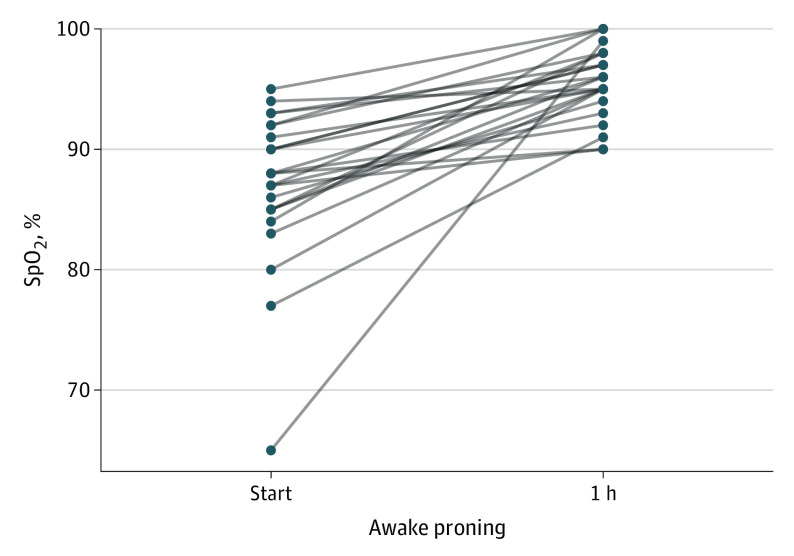
Figure.
Full legend
Oxyhemoglobin Saturation (Spo2) 1 Hour After Initiation of the Prone Position in Awake, Nonintubated Patients With COVID-19 Spo2 before and 1 h after initiation of the prone position in awake, nonintubated patients with COVID-19 severe hypoxemic respiratory failure (n = 25).
References6
- 1.
City of New York COVID-19: data. Accessed April 17, 2020. https://www1.nyc.gov/site/doh/covid/covid-19-data.page
Not in our library
- 2.
Guérin C, Reignier J, Richard JC,; PROSEVA Study Group Prone positioning in severe acute respiratory distress syndrome. N Engl J Med. 2013;368(23):2159-2168
Not in our library10.1056/nejmoa1214103 (opens in a new tab)
- 3.
Gattinoni L, Taccone P, Carlesso E, Marini JJ Prone position in acute respiratory distress syndrome. rationale, indications, and limits. Am J Respir Crit Care Med. 2013;188(11):1286-1293
Not in our library10.1164/rccm.201308-1532ci (opens in a new tab)
- 4.
- 5.
- 6.
Reads
Read by people on this page
None yet.
Checked or read by AI through naulon
None yet.
A person counts once a day per paper. We keep no cookie and no address: a reader is a hash that changes every day. Any month under five reads shows no number.
Are you an author?
Is this your paper?
Claim it to add your note and be paid when agents cite it. Free.